
Question 55 marksAsked 2019Medium
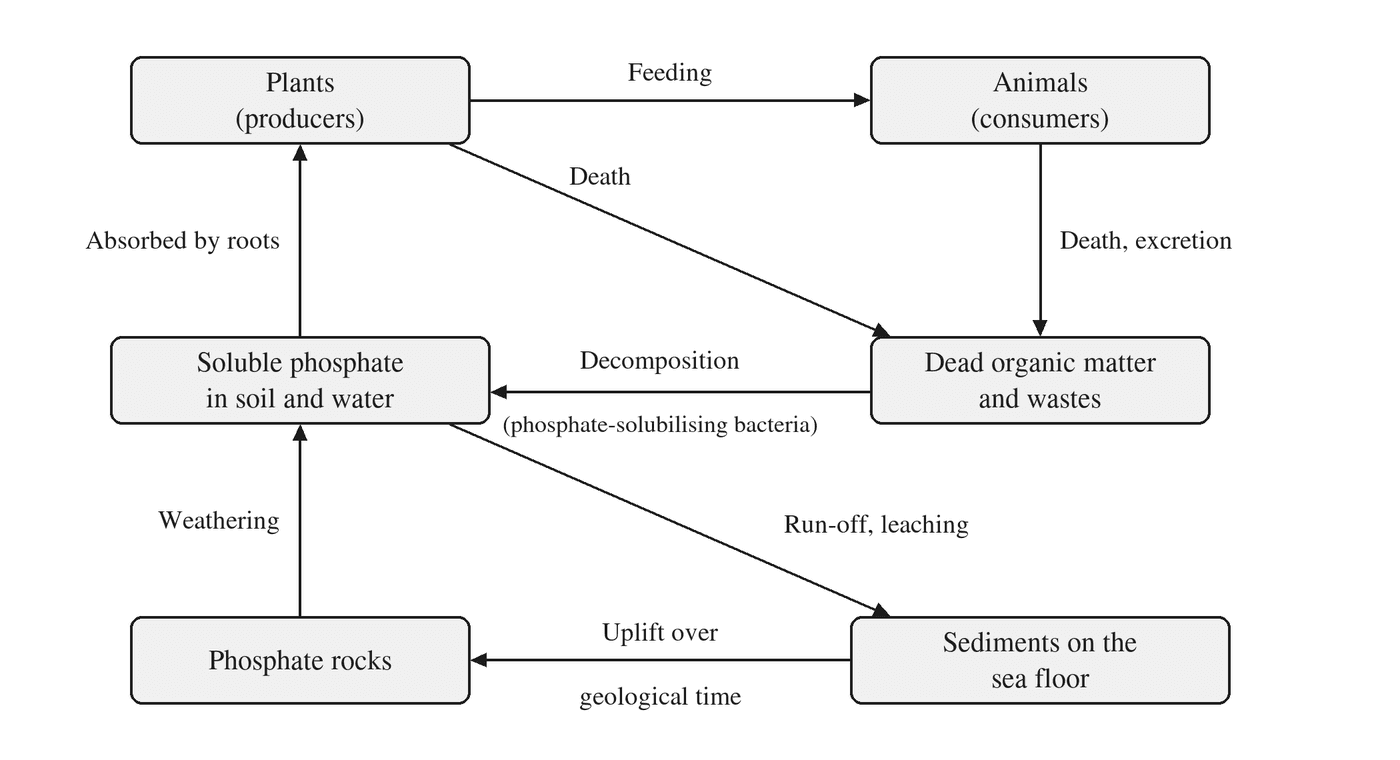
Give a graphic representation of Phosphorus Cycle in Nature
Confirming your payment
Sign up now and get 250 free tokens.
Previous Year Questions · Question 5 of 14
Give a graphic representation of Phosphorus Cycle in Nature
Solution:
Key idea: Phosphorus is a part of DNA, RNA, ATP, cell membranes (phospholipids), bones and teeth. Its natural reservoir is rock, and it has no significant gaseous phase, so it cycles between rocks, soil, water and organisms (a sedimentary cycle).
Step 1 — Draw the cycle.
The graphic below shows the reservoirs as boxes and the processes as labelled arrows.
Step 2 — Weathering of rocks.
Phosphate rocks contain phosphorus as phosphates. When the rocks are weathered, small amounts of these phosphates dissolve into the soil solution and water.
Step 3 — Uptake by producers.
Plants absorb soluble phosphate from the soil through their roots and use it to build their own compounds.
Step 4 — Transfer to consumers.
Herbivores get phosphorus by eating plants, and carnivores by eating herbivores.
Step 5 — Return by decomposition.
The wastes and dead bodies of plants and animals are decomposed by phosphate-solubilising bacteria, which release phosphorus back into the soil as soluble phosphate.
Step 6 — Loss to the sea and uplift.
Some phosphate is carried by run-off and leaching into rivers and the sea, where it settles as sediments. Over geological time these sediments become rock and are lifted up to form new land, where weathering starts the cycle again.
Note: Unlike the carbon cycle, there is no respiratory release of phosphorus into the atmosphere, and the atmospheric input of phosphorus through rain is much smaller than that of carbon.
Therefore, phosphorus cycles from phosphate rocks by weathering into soluble phosphate, into plants and animals, back to the soil by decomposition, and through sea sediments that become rock again over geological time.