
Question 1215 marksMedium
What are biogeochemical cycles? Explain phosphorus cycle and draw a simple diagram of this cycle in a terrestrial ecosystem.
Confirming your payment
Sign up now and get 250 free tokens.
Ecosystem · Question 121 of 123
What are biogeochemical cycles? Explain phosphorus cycle and draw a simple diagram of this cycle in a terrestrial ecosystem.
Solution:
Key idea: Biogeochemical cycles move nutrients between the living world and the non-living environment. The phosphorus cycle is a sedimentary cycle: its reservoir is in rocks, and it has no gaseous phase of significance.
Step 1 — Define biogeochemical cycles.
Biogeochemical cycles are the cyclic movement of nutrient elements between the non-living environment (air, water, rocks and soil) and living organisms. They involve living things (bio-), the earth (geo-) and chemical changes (-chemical), hence the name. They are of two types: gaseous cycles, with the reservoir in the atmosphere or oceans (carbon, nitrogen), and sedimentary cycles, with the reservoir in the earth's crust (phosphorus, sulphur).
Step 2 — State the reservoir and input of phosphorus.
The main reservoir of phosphorus is phosphate rock and natural phosphate deposits. Weathering of these rocks slowly releases soluble phosphate into the soil, and this is the main natural input. Humans add more as phosphate fertiliser.
Step 3 — Explain how phosphorus enters and moves through organisms.
Plants absorb soluble phosphate (mainly orthophosphate) through their roots, helped by mycorrhizal fungi, and build it into their bodies. Animals obtain phosphorus by eating plants or other animals. In organisms phosphorus is part of DNA, RNA, ATP, membrane phospholipids, and bones and teeth.
Step 4 — Explain how phosphorus returns to the soil.
Wastes and dead plants and animals form detritus. Bacteria and fungi decompose it, and phosphate-solubilising bacteria (called phosphatising bacteria in the textbook) release the organic phosphorus as phosphate ions, which return to the soil for reuse.
Step 5 — Explain how phosphorus is lost from the cycle.
Phosphate in bones and teeth decays very slowly. Phosphate that combines with aluminium, iron or calcium becomes insoluble, and phosphate carried by run-off into the sea settles in deep ocean sediments, where it remains locked up until geological uplift exposes the rocks again.
Step 6 — Describe the simple diagram of the phosphorus cycle to be drawn.
The diagram is a loop of labelled boxes joined by arrows: rock minerals → (weathering) → soluble phosphate in soil → (uptake by roots) → producers (plants) → (food) → consumers (animals); producers and consumers → (litter fall, death, wastes) → detritus → (decomposition) → back to soluble phosphate in soil; and a side arrow from soluble phosphate → (run-off) → deep ocean sediments (insoluble phosphates).
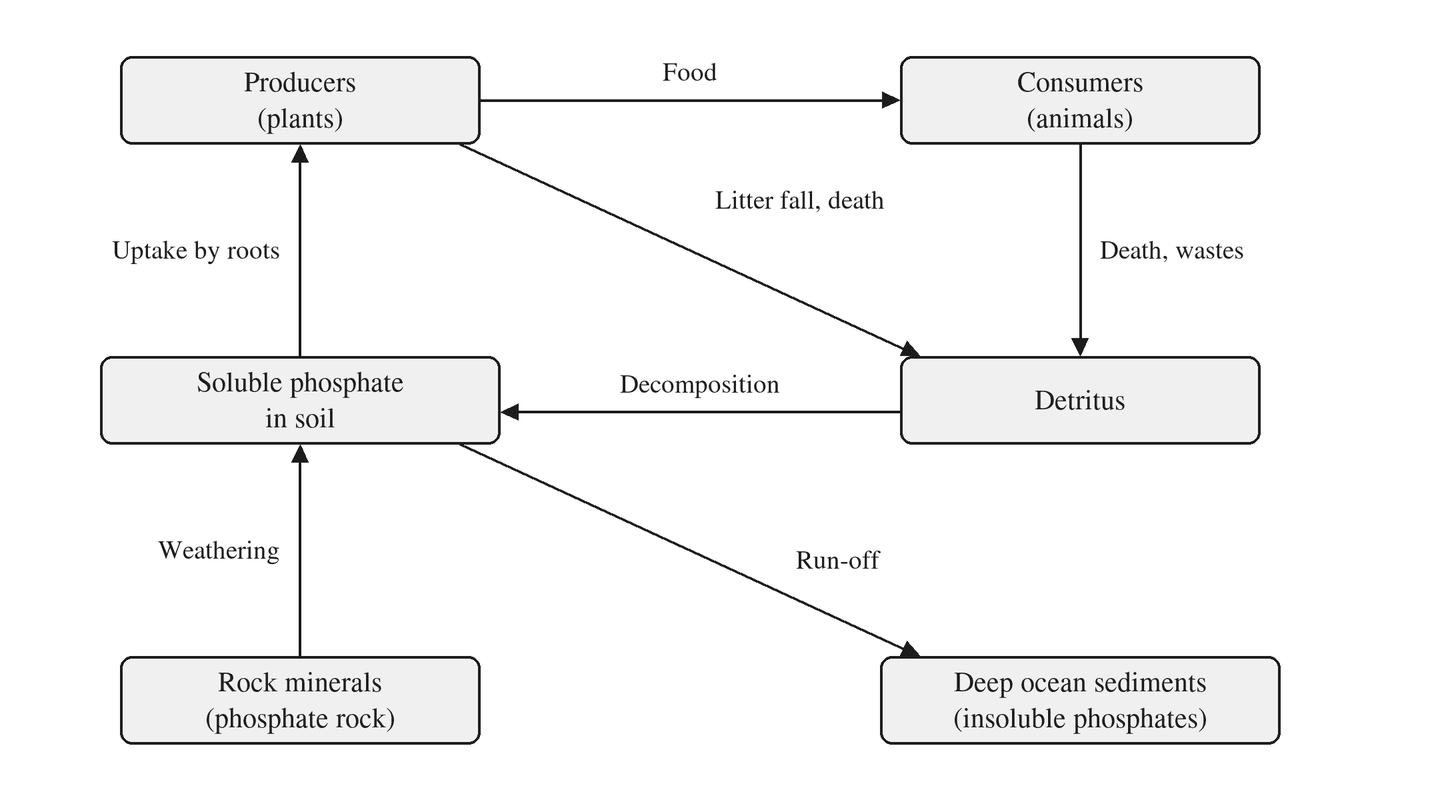
Therefore, biogeochemical cycles are the cyclic movements of nutrients between the non-living environment and living organisms; in the sedimentary phosphorus cycle, weathering of phosphate rocks releases soluble phosphate that plants absorb and pass to animals, decomposers return it from detritus to the soil, and some is lost to deep ocean sediments.