
Opening your dashboard
Class 12 Biology Chapter 18 Ecosystem: Practice Questions
132 questions on Chapter 18, each worked through on its own page with the AI tutor. Class 12 Biology, ICSE 2026-27.
132 questions
1–5 marks · Mixed difficulty
- 11 mark
Question 1
During a field study on a hill slope, students record several abiotic factors. Which pair below consists of edaphic factors only?
- 22 marks
Question 2
In a tropical rainforest, plants are arranged in layers: tall trees at the top, then lower short trees, then shrubs, then herbs and grasses, with the forest floor lowest.
(a) What is this vertical distribution of vegetation called?
(b) Why is such layering not seen in a desert ecosystem?
- 31 mark
Question 3
To compare the standing crop of two grasslands across the year, an ecologist weighs the plant samples only after drying them. Why is dry weight preferred here?
- 42 marks
Question 4
Soil from the same grassland was tested for nitrogen and phosphorus once in the monsoon and again in winter. The two readings differed. A student concluded that one of the tests must have been faulty.
(a) Is the student right? Give a reason.
(b) Apart from the soil, where else in the ecosystem do nutrients such as nitrogen, phosphorus and calcium accumulate?
- 53 marks
Question 5
A lake has a deep open-water region and a shallow region near its edges.
(a) Which autotrophs are the major producers in the deep open water?
(b) Which autotrophs are the major producers in the shallow water near the edges?
(c) Zooplankton in the same lake are called phagotrophs. Why?
- 61 mark
Question 6
The table gives the mean plant biomass and mean net primary productivity (NPP) of four ecosystems.
Ecosystem Mean plant biomass (t/ha) Mean NPP (t/ha/year) Tropical rainforest 440 20 Savanna 40 9 Temperate grassland 20 5 Desert shrub 10 0.7 Which ecosystem produces the most new plant matter per tonne of plant biomass already standing?
- 73 marks
Question 7
(Hypothetical data.) A sugarcane field has a gross primary productivity of 2500 g/m²/year. Its plants use 400 g/m²/year in respiration.
(a) Calculate the net primary productivity (NPP) of the field.
(b) Express this NPP in tons/ha/year and say whether the field is a highly, less or least productive ecosystem. (1 ton = 1000 kg; 1 ha = 10,000 m².)
(c) What percentage of the GPP is used in respiration?
- 81 mark
Question 8
According to estimates made in the 1970s, the annual NPP of the whole biosphere is about 170 billion tons (dry weight), of which the oceans contribute about 55 billion tons. About what percentage of the biosphere's NPP comes from land ecosystems?
- 92 marks
Question 9
Give reasons:
(a) A pasture that is grazed heavily all the time may be highly productive and yet have a low biomass.
(b) Temperate forests have a lower net primary productivity than tropical rainforests.
- 103 marks
Question 10
(Hypothetical data.) A caterpillar eats leaves containing 800 J of food energy. It passes out 400 J in its faeces and uses 240 J in respiration.
(a) How much energy is left for growth (new body biomass)?
(b) Express each of the three portions as a percentage of the food energy eaten.
(c) To which part of the ecosystem does the energy in the faeces pass?
- 111 mark
Question 11
Which detritus would decompose fastest?
- 122 marks
Question 12
A gardener chops dry leaves into small bits before adding them to a compost pit and finds they rot faster than whole leaves.
(a) Which natural step of decomposition is the gardener copying, and which animals normally carry it out?
(b) Why does this step speed up decomposition?
- 131 mark
Question 13
In a field, nitrogen released from decaying detritus is taken up into the bodies of soil bacteria and stays there until those bacteria die. What is this process called, and how does it help the ecosystem?
- 143 marks
Question 14
(Hypothetical data.) Two identical mesh bags of the same leaf litter were buried at the same temperature, one in moist, well-aerated soil (Bag P) and one in waterlogged soil with no oxygen (Bag Q). After three months the results were:
Bag Loss in dry mass P 60% Q 15% (a) Explain why Bag Q lost much less mass.
(b) Name the process by which percolating water would remove sugars from both bags even if no microbes were active.
(c) Into what final products is most of the lost mass converted?
- 152 marks
Question 15
A student writes: "Earthworms are the main decomposers because they break down organic matter into inorganic substances." Correct the statement by explaining the separate roles of earthworms and of bacteria and fungi in decomposition.
- 161 mark
Question 16
When a deer eats grass, only part of the chemical energy of the grass becomes deer tissue. Which statement explains this?
- 174 marks
Question 17
(Hypothetical data.) In one season, 1,000,000 kJ/m² of solar radiation falls on a crop. The crop's gross primary productivity is 2% of this incident radiation, and its respiration uses 0.5% of the incident radiation.
(a) How much of the incident energy is photosynthetically active radiation (PAR)?
(b) Calculate the GPP.
(c) Calculate the NPP.
(d) Express the NPP as a percentage of the PAR.
- 181 mark
Question 18
A carnivore assimilates 200 kJ of energy from its prey. Using the average respiration cost of carnivores, how much of this energy is left after respiration?
- 192 marks
Question 19
In a generalised energy flow model, state whether each of the following is energy not assimilated (NA) or energy not utilised (NU), and name the group of organisms that finally receives it.
(a) The energy in the dung of a rabbit.
(b) The energy in grass leaves that no animal eats, which later die and fall.
- 203 marks
Question 20
Give reasons:
(a) Energy flow in an ecosystem is called unidirectional and non-cyclic.
(b) The respiration cost rises sharply along successive higher trophic levels, so very little energy reaches a top carnivore.
(c) The deep sea hydrothermal ecosystem is an exception to the statement that the sun is the source of energy for every ecosystem.
- 211 mark
Question 21
In the food chain grass → grasshopper → frog → snake → eagle, the snake is
- 224 marks
Question 22
In a grassland, grass is eaten by grasshoppers and rats. Frogs eat grasshoppers. Snakes eat frogs and rats. Eagles eat snakes and rats.
(a) List every food chain that runs from grass to the eagle.
(b) At which trophic levels does the eagle feed in this web?
(c) If all the snakes were removed, which food chain to the eagle would remain?
(d) Name the primary consumers in this web.
- 231 mark
Question 23
In which ecosystem does a much larger fraction of energy flow through the detritus food chain than through the grazing food chain?
- 243 marks
Question 24
A village has grain containing 10,000 kJ of energy. It can either be eaten by the villagers directly, or be fed to goats whose meat the villagers then eat.
(a) Using the 10% law of energy transfer, how much of this energy reaches the villagers by each route?
(b) Which route can feed more people, and how many times more energy does it give?
(c) State the general principle shown.
- 253 marks
Question 25
Trace how energy locked in fallen leaves on a forest floor can reach a small carnivore, naming the type of organism at each step. Then state how this links the detritus food chain with the grazing food chain.
- 261 mark
Question 26
Values for the producers, primary consumers and secondary consumers (in that order) of four ecosystems were recorded, but the headings saying what was measured were lost. Which set of values cannot be the data of a pyramid of energy?
- 272 marks
Question 27
A student counts the organisms on one large banyan tree: the tree, thousands of leaf-eating insects and a few dozen birds that eat the insects. She concludes: "The herbivores on this tree hold more energy than the tree itself, because there are many more of them."
(a) What feature of a pyramid of numbers misled her?
(b) Which pyramid should she draw to compare the energy at each level, and what shape will it have?
- 283 marks
Question 28
(Hypothetical data.) The energy present at each trophic level of a grassland is given below.
Trophic level Energy (kJ/m²/year) Producers (grass) 15,000 Primary consumers 1,800 Secondary consumers 200 Tertiary consumers 25 (a) Draw and label the pyramid of energy for this grassland.
(b) Which tier forms the base and which forms the apex?
(c) Why is each tier narrower than the one below it?
- 291 mark
Question 29
A student draws a pyramid of numbers, a pyramid of biomass and a pyramid of energy for a tree-dominated forest, and the same three pyramids for a sea in which phytoplanktons are the producers. In how many of these six pyramids can the base tier be smaller than the tier just above it?
- 301 mark
Question 30
A dairy scientist measures the energy in the fodder a cow eats and the energy in the dung it passes out. From these two values alone she can directly calculate the cow's
- 312 marks
Question 31
A tall teak tree and a grass growing in the same area have the same gross primary productivity (GPP). Which of the two is expected to have the higher net production efficiency? Give a reason.
- 323 marks
Question 32
(Hypothetical data.) The energy in biomass production of three trophic levels of a lake is: phytoplanktons 9,000 kJ/m²/year, zooplanktons 1,080 kJ/m²/year and small fishes 120 kJ/m²/year.
(a) Calculate the ecological (trophic level) efficiency of the zooplanktons.
(b) Calculate the ecological efficiency of the small fishes.
(c) At which of the two transfers is energy used more efficiently?
- 331 mark
Question 33
(Hypothetical data.) In one year a crop field receives 4,000,000 kJ/m² of incident solar radiation. Its GPP is 40,000 kJ/m² and its NPP is 28,000 kJ/m². Which pair of values is correct?
- 341 mark
Question 34
A forest is burnt down, but its soil is left in place. Why are herbs, weeds and grasses, rather than lichens, the first to appear here?
- 352 marks
Question 35
(a) After a forest was cleared, a few exotic weeds were introduced into the area. How may this affect the succession that follows?
(b) A grassland is overgrazed by cattle year after year. How is this related to succession?
- 363 marks
Question 36
During a field visit, students note the following in three ponds that are at different stages of hydrarch succession.
Pond X: water about 3 ft deep; plants partly emerged, with roots at the bottom and aerial leaves above the water, such as reed grass and arrowhead.
Pond Y: water about 9 ft deep; rooted plants with floating leaves such as water lilies.
Pond Z: water only about 3 inches deep over marshy soil, with thick shallow vegetation.
(a) Name the seral stage seen in each pond.
(b) Arrange the three ponds in the order in which these stages occur.
(c) Why does the water become shallower from one stage to the next?
- 371 mark
Question 37
Plot P is at an early seral stage with herbs and shrubs; plot Q nearby is a climax forest of large trees. Which observation is expected in plot Q compared with plot P?
- 383 marks
Question 38
Lichens were the first organisms to cover a bare rock. Some years later, mosses cover most of the rock and lichens have become few.
(a) Give two reasons why the number of lichens decreased.
(b) What did the lichens leave behind that helped the next group of plants?
- 391 mark
Question 39
A temperate forest and a tropical rainforest (such as that of the Andaman group of islands) are both climax communities. Which statement about their dominant species is correct?
- 403 marks
Question 40
(Hypothetical data.) In one year, the plants of a forest take up 120 kg of nitrogen per hectare from the soil. Of this, 70 kg/ha returns to the soil as litter fall and 25 kg/ha as dead roots.
(a) How much nitrogen is retained by the plants?
(b) In what form is this retained nitrogen held?
(c) What is the effect of retention on the ecosystem's nutrient content?
- 411 mark
Question 41
A fresh leaf is analysed for its elements. About what share of its mass is formed by carbon, nitrogen, oxygen and hydrogen, the major nutrient elements cycled between living and non-living components?
- 423 marks
Question 42
(Hypothetical data.) Calcium budgets of two forest watersheds are given below.
Watershed Input (kg/ha/year) Output (kg/ha/year) A (undisturbed) 10 9 B (trees felled) 10 55 (a) Which watershed is stable? Give a reason from the data.
(b) What happens to watershed B if this continues?
(c) Name the type of nutrient output by which watershed B mainly loses its calcium, and the route.
- 431 mark
Question 43
Carbon locked as carbonates in rocks of the earth's crust is not available to organisms. Which process returns this carbon to the atmosphere as CO₂?
- 443 marks
Question 44
A farmer adds phosphate fertiliser to a field with strongly acidic soil, but the crop still shows a shortage of phosphorus.
(a) Why is the availability of phosphorus low in such a soil?
(b) What happens to phosphate that forms compounds with metals such as aluminium, iron or calcium?
(c) In which form does phosphorus mainly occur in the soil solution from which roots absorb it?
- 451 mark
Question 45
In which soil would the loss of nitrogen as free nitrogen gas by Pseudomonas be the greatest?
- 462 marks
Question 46
Coal was formed from plants that lived millions of years ago.
(a) How did the carbon in coal first enter living organisms, and how did it end up in coal?
(b) Name the process by which the carbon in coal returns to the atmosphere, and the form in which it returns.
- 473 marks
Question 47
State whether each event below is an input of nutrients into a forest, an output from it, or part of its internal cycling, and name the specific type or process.
(a) Dust carried by wind settles on the forest floor.
(b) Fallen leaves decompose and return their nutrients to the soil.
(c) Logs are cut and taken out of the forest for sale.
- 481 mark
Question 48
Heavy insecticide spraying around an orchard kills most of the bees, wasps, butterflies and moths. Which ecological service to the orchard is lost most directly?
- 492 marks
Question 49
Fruit-eating animals carry seeds far away from the parent tree. Give two reasons why this seed dispersal is called an important ecological service.
- 504 marks
Question 50
A town council plans to clear a forest for a factory, arguing that the forest "earns nothing in cash".
(a) List three services the forest provides free of cost.
(b) What did the ecologist Robert Costanza's 1997 estimate show about the value of ecological services?
- 511 mark
Question 51
Which of the following is an abiotic component of the ecosystem?
- 521 mark
Question 52
Of the incoming solar energy which percentage is reflected back into space?
- 531 mark
Question 53
Total energy stored by green plants is called
- 541 mark
Question 54
Which of the following process helps in nutrient conservation?
- 551 mark
Question 55
What fraction of assimilated energy is used in respiration by the herbivore?
- 561 mark
Question 56
Which of the following is not a part of detritus?
- 571 mark
Question 57
Detritus food chain begins with
- 581 mark
Question 58
The decomposition process does not involve
- 591 mark
Question 59
Percentage energy (of total incident radiation) captured by photosynthetic process is
- 601 mark
Question 60
A food chain always starts with
- 611 mark
Question 61
Which of the following can explain the energy stored in a food chain?
- 621 mark
Question 62
What fraction of assimilated energy is used in respiration by the carnivore?
- 631 mark
Question 63
What fraction of herbivore energy is available to the next trophic level of carnivores?
- 641 mark
Question 64
Which pyramid is always upright, can never be inverted?
- 651 mark
Question 65
Which one of the following has the sedimentary nutrient cycle?
- 661 mark
Question 66
Which of the following is a free living nitrogen fixing bacteria present in soil?
- 671 mark
Question 67
Azospirillum is an example of
- 681 mark
Question 68
Ammonifying bacteria convert
- 691 mark
Question 69
Denitrifying bacteria convert
- 701 mark
Question 70
Atmospheric nitrogen can be fixed by
- 711 mark
Question 71
Main reservoir of phosphorus is
- 721 mark
Question 72
Absorption of phosphorus by higher plants is promoted by the presence of
- 731 mark
Question 73
Which of the following are pioneer organisms of primary succession on a xerarch?
- 741 mark
Question 74
The terminal stage of succession is represented by
- 751 mark
Question 75
In a succession in hydrarch, the reed-swamp stage comes after
- 761 mark
Question 76
The succession occurring in water bodies is called
- 771 mark
Question 77
The pyramid of ________ is always upright.
- 781 mark
Question 78
Inverted pyramid is generally found in ________.
- 791 mark
Question 79
In oceans, the productivity is generally limited by ________.
- 801 mark
Question 80
Humus serves as a reservoir of ________.
- 811 mark
Question 81
Dead plant parts and animal remains are called ________.
- 821 mark
Question 82
In deep aquatic ecosystems, floating plants called ________ are the major autotrophs.
- 831 mark
Question 83
The nutrients present in the soil at any given time is referred as its ________.
- 841 mark
Question 84
Only about ________ % of PAR is utilised for photosynthesis.
- 851 mark
Question 85
Nitrosomonas converts ________ to ________.
- 861 mark
Question 86
Nitrates are converted to free molecular nitrogen by ________ a denitrifying bacteria.
- 871 mark
Question 87
Both abiotic and biotic factors form the structural components of an ecosystem.
- 881 mark
Question 88
Zooplanktons and free-swimming organisms are the decomposers in a pond.
- 891 mark
Question 89
Net primary productivity is equal to gross primary productivity plus the energy spent on respiration.
- 901 mark
Question 90
Decomposition involves fragmentation, leaching and catabolism.
- 911 mark
Question 91
Humification is a slow process and is followed by mineralisation.
- 921 mark
Question 92
In an ecosystem energy flows in a single direction only from consumers to producers.
- 931 mark
Question 93
In a food chain only 10% of energy is transferred to the next trophic level.
- 941 mark
Question 94
In a tree-dominated ecosystem, the pyramid of numbers could be an inverted pyramid.
- 951 mark
Question 95
In a primary succession, lichens are the pioneer organisms that invade a bare rock.
- 961 mark
Question 96
Carbon present as carbonates in producers and consumers, acts as a reservoir of carbon in nature.
- 975 marks
Question 97
Match the following:
Column A Column B 1. Xerarch succession (a) Reed-swamp stage 2. Hydrarch succession (b) Bacteria and fungi 3. Primary consumers (c) Herbivores 4. Secondary consumers (d) Carnivores 5. Detritus feeders (e) Lichens as pioneer organisms - 981 mark
Question 98
A term for man-made ecosystems.
- 991 mark
Question 99
Animals that feed on herbivores.
- 1001 mark
Question 100
The net stored energy in green plants after meeting the cost of respiration.
- 1011 mark
Question 101
Detritus feeding invertebrates like earthworms.
- 1021 mark
Question 102
Pyramid that represents the 'standing crop' of organisms at each trophic level at a particular time.
- 1031 mark
Question 103
Conversion of nitrates back to free molecular nitrogen.
- 1041 mark
Question 104
A process that leads to accumulation of humus.
- 1051 mark
Question 105
Another term for above ground detritus.
- 1061 mark
Question 106
Nutrient cycle whose reservoir exists in the earth's crust.
- 1071 mark
Question 107
Ecological succession that occurs on a previously unoccupied site like a volcano.
- 1081 mark
Question 108
Assertion (A): Despite occupying about 70% of the earth's surface, oceans are a low productivity ecosystem.
Reason (R): In aquatic ecosystems, productivity is limited by light that decreases with increasing water depth.
- 1091 mark
Question 109
Assertion (A): A network of food chains, existing together in an ecosystem is a form of food web.
Reason (R): An animal like tiger, a carnivore, cannot be a part of food web.
- 1101 mark
Question 110
Assertion (A): Pyramid of energy may be upright or inverted.
Reason (R): Only 20% of energy goes to next trophic level.
- 1111 mark
Question 111
Assertion (A): In a marine aquatic ecosystem, at any given time, the biomass of phytoplanktons (producers) is lower than the biomass of zooplanktons (primary consumers).
Reason (R): Phytoplanktons are consumed almost as rapidly as they are formed and thus have shorter life spans.
- 1121 mark
Question 112
Assertion (A): A lake can undergo ecological succession and become a forest over a period of time.
Reason (R): A bare rock can become a forest through ecological succession.
- 1131 mark
Question 113
Assertion (A): Secondary succession always involves a predictable species sequence and ends up with the same climax community as existed prior to the disturbance.
Reason (R): A pond can never be considered as a self-sustained ecosystem, as it lacks the structural and functional components of an ecosystem.
- 1141 mark
Question 114
Assertion (A): The recycling of carbon is essentially a self-regulating feedback system in nature.
Reason (R): In the atmosphere the reservoir pool of carbon consists of free CO₂.
- 1151 mark
Question 115
Assertion (A): Gross primary productivity (GP) refers to the total energy stored by the green plants.
Reason (R): GP includes the energy a plant would spend on respiration.
- 1161 mark
Question 116
Assertion (A): The total number of species in an ecotone is more than those present in an adjoining area.
Reason (R): Ecotone is a sharp transition zone between two or more diverse communities.
- 1171 mark
Question 117
Assertion (A): Mosses and lichens are said to form the pioneer community in xerarch succession.
Reason (R): It is because during the course of succession these species get established later.
- 1185 marks
Question 118
Fill in the blanks.
(a) Plants are called as ________ because they fix carbon dioxide.
(b) In an ecosystem dominated by trees, the pyramid (of numbers) is ________ type.
(c) In aquatic ecosystems, the limiting factor for the productivity is ________.
(d) Common detritivores in our ecosystem are ________.
(e) The major reservoir of carbon on earth is ________.
- 1191 mark
Question 119
Which one of the following has the largest population in a food chain?
- 1201 mark
Question 120
The second trophic level in a lake is
- 1211 mark
Question 121
Secondary producers are
- 1221 mark
Question 122
What is the percentage of photosynthetically active radiation (PAR), in the incident solar radiation?
- 1233 marks
Question 123
Describe the components of an ecosystem.
- 1243 marks
Question 124
Write important features of a sedimentary cycle in an ecosystem.
- 1252 marks
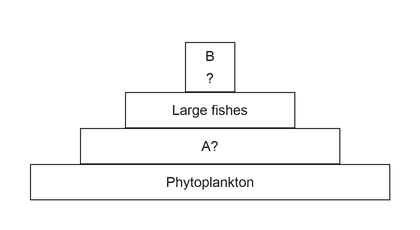
Question 125
Write the probable primary consumer and top consumer of the following ecological pyramid.
- 1262 marks
Question 126
Which stage is common between hydrarch and xerarch succession?
- 1273 marks
Question 127
Why food chain in the environment operative in the form of food web?
- 1282 marks
Question 128
Complete the steps of decomposition process by using a suitable terminology in a and b.

- 1292 marks
Question 129
Why are all the pyramids upright in most of the ecosystems?
- 1303 marks
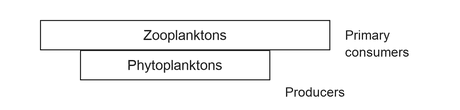
Question 130
In the pyramid of biomass drawn name the following.
(i) One which is supported.
(ii) One which supports.
(iii) In which ecosystem is such a pyramid found.
- 1311 mark
Question 131
What do detritus food chains begin with?
- 1321 mark
Question 132
What type of ecological pyramid would be obtained from the following data?
Secondary consumer: 120 gm
Primary consumer: 60 gm
Primary producer: 10 gm