
Opening your dashboard
Class 11 Physics Chapter 7: Friction Solutions
48 textbook questions with step-by-step answers, free to read, for ISC 2026-27.
Get talked through Ch 7, not just shown the answer
Reading a finished solution is not the same as being able to do it. The AI tutor takes one question at a time and works it with you, in your own words, until you can.
- Ask it out loud, in your own words
- It gives you the next step, not the answer
- Stuck on part (ii)? Start there
48 questions with solutions
1–5 marks · Mixed difficulty
The first 43 solutions are on this page. This chapter is a long one, so the rest open on their own page to keep this one quick to load.
- 11 mark
Question 1
The frictional force between two surfaces is independent of
Solve with AIAnswer
(A) nature of the surface
(B) size of the body
- Correct
(C) area of contact
(D) mass of the body
Answer: (C) Area of contact
Concept: The laws of friction: the limiting friction is proportional to the normal reaction (), it depends on the nature of the surfaces in contact (through ), and it does not depend on the apparent area of contact.
Step 1 — Recall what friction depends on. The force of friction depends on how hard the surfaces are pressed together () and on what they are made of ().
Step 2 — Pick the quantity it does not depend on. A brick lying on its broad face or on its narrow face presses on the floor with the same normal reaction, and the force needed to slide it is the same. So friction is independent of the area of contact.
- (A) This is wrong because the nature of the surfaces fixes the coefficient ; wood on ice and rubber on concrete give very different friction.
- (B) This is wrong because a bigger body of the same material is heavier, so it presses harder on the surface and the friction is larger. If only the shape changes while the weight stays the same, what changes is the area of contact, which is option (C).
- (D) This is wrong because on a horizontal surface the normal reaction equals the weight , so friction grows with the mass of the body.
Therefore, the frictional force is independent of the area of contact, option (C).
- 21 mark
Question 2
Frictional forces are considered to act in a direction
Solve with AIAnswer
(A) perpendicular to surfaces in contact
- Correct
(B) parallel to surfaces in contact
(C) parallel to normal reaction
(D) inclined 45° to normal reaction
Answer: (B) Parallel to surfaces in contact
Concept: The contact force between two surfaces has two parts: the normal reaction, perpendicular to the surfaces, and the force of friction, along the surfaces (tangential), opposing the relative motion or the tendency of it.
Step 1 — Recall the direction of friction. Friction opposes the sliding of one surface over the other. Sliding takes place along the surfaces, so friction acts along them.
Step 2 — Choose the option. Friction is therefore parallel to the surfaces in contact.
- (A) This is the direction of the normal reaction, not of friction.
- (C) This is the same as (A): the normal reaction is perpendicular to the surfaces, and friction is at right angles to it.
- (D) This is wrong because friction is always at to the normal reaction; it is the resultant of friction and the normal reaction that makes an angle with the normal (the angle of friction, which depends on and is not fixed at ).
Therefore, frictional forces act parallel to the surfaces in contact, option (B).
- 31 mark
Question 3
To avoid slipping while walking on ice, one should take smaller steps because of the
Solve with AIAnswer
(A) friction of ice is large
(B) larger normal reaction
- Correct
(C) friction of ice is small
(D) smaller normal reaction
Answer: (C) Friction of ice is small
Concept: While walking, the foot pushes on the ground both downward and backward. The foot does not slip as long as the backward (horizontal) push is less than the limiting friction .
Step 1 — Note the property of ice. The coefficient of friction between a shoe and ice is very small, so the limiting friction is small.
Step 2 — See what a small step does. With a short step the leg is nearly vertical when the foot lands and pushes, so the push of the foot is nearly straight down. Its backward part is then small and stays below the small limiting friction, so the foot does not slip.
Step 3 — Choose the option. Small steps are needed because the friction of ice is small.
- (A) This is wrong because ice is slippery: its friction is small, not large. If it were large, long steps would be safe.
- (B) This is wrong because the normal reaction while walking is set mainly by the person's weight; short steps do not make it larger. What they reduce is the backward push that friction has to balance.
- (D) This is wrong because a smaller normal reaction would lower the limiting friction and make slipping more likely, and short steps do not reduce it anyway.
Note: the book's hint speaks of producing a larger reaction; in fact short steps keep the push of the foot close to vertical, so the sideways force that friction must supply stays small.
Therefore, one takes smaller steps on ice because the friction of ice is small, option (C).
- 41 mark
Question 4
Two masses and of and respectively are connected with a string passing over a frictionless pulley fixed at the corner of a table as shown in the given figure. The co-efficient of friction of with the table is . The minimum mass of that may be placed on to prevent it from moving is equal to
 Solve with AI
Answer
- Correct
(A) 15 kg
(B) 10 kg
(C) 5 kg
(D) 0 kg
Answer: (A) 15 kg
Concept: A body stays at rest as long as the force trying to move it does not exceed the limiting friction , where is the normal reaction.
Step 1 — Find the pull on A. The block hangs at rest, so the tension in the string equals its weight, (in newtons, with in ). This tension pulls towards the pulley.
Step 2 — Find the limiting friction on A. With a mass of on top, and together press on the table with , so the limiting friction is .
Step 3 — Write the condition for no motion. For the least mass of , the limiting friction just equals the pull:
- (B) This is wrong because with on the limiting friction is , less than the pull , so moves.
- (C) This is wrong because with the limiting friction is , still less than .
- (D) This is wrong because with nothing on the limiting friction is only , and is pulled along.
Therefore, the minimum mass of C is 15 kg, option (A).
- 51 mark
Question 5
Consider a car moving along a straight horizontal road with a speed of . If the coefficient of static friction between the tyres and the road is , the shortest distance in which the car can be stopped is [take ]
Solve with AIAnswer
(A) 30 m
- Correct
(B) 40 m
(C) 72 m
(D) 20 m
Answer: (B) 40 m
Concept: When a car brakes without skidding, the road stops it through static friction. The largest retarding force is the limiting friction , so the largest deceleration is . The stopping distance then follows from the equation of motion .
Step 1 — Convert the speed to SI units. One km/h is :
Step 2 — Find the greatest deceleration. The greatest friction force is , so dividing by the mass gives:
Step 3 — Find the stopping distance. The final speed is zero, so the equation gives:
- (A) This is wrong because stopping in would need a deceleration of about , and so a coefficient of friction of about 0.67, more than this road can give.
- (C) This is wrong because is the speed in km/h, not a distance; stopping in would correspond to .
- (D) This is wrong because stopping in would need a deceleration of and so a coefficient of friction of 1; it also repeats the speed in m/s as a distance.
Note: the stem prints the unit of as ; an acceleration is measured in , as used above.
Therefore, the shortest stopping distance is 40 m, option (B).
- 61 mark
Question 6
A body of mass is sliding from an inclined plane of inclination . What is the frictional force experienced if ?
Solve with AIAnswer
(A) N
- Correct
(B) N
(C) N
(D) N
Answer: (B) N
Concept: On an incline of angle , the normal reaction balances . While the body slides, the kinetic friction is times the normal reaction, , acting along the plane against the motion.
Step 1 — Draw the forces. The weight is resolved into along the plane and into it; the plane pushes back with , and friction acts up the plane:

Step 2 — Put in the numbers. The options are built with , and we use :
- (A) This is wrong because it gives about ; the factor is not or any other quantity of this problem.
- (C) This is wrong because it leaves out the factor : it uses in place of and so is twice the correct value (about ).
- (D) This is wrong because it gives about ; is not a component of the weight on a plane.
Note: with the friction is about . Also, since is larger than , a body sliding down this plane slows down and stops; once at rest, the friction needed to hold it is only . The value above is the friction while it slides.
Therefore, the frictional force on the sliding body is N (about 1.47 N), option (B).
- 71 mark
Question 7
A block is initially at rest. A force is required to set the block in motion. After the motion a force of is applied to keep the block moving with constant speed. The coefficient of static friction is
Solve with AIAnswer
(A) 0.6
(B) 0.52
(C) 0.44
- Correct
(D) 0.38
Answer: (D) 0.38
Concept: The force just needed to set a body in motion equals the limiting static friction, . On a horizontal surface with a horizontal force, , so .
Step 1 — Identify the limiting friction. We take the block to lie on a horizontal surface and the forces to be horizontal. The force just starts the motion, so the limiting static friction is . (The needed for steady motion is the kinetic friction; it gives , not .)
Step 2 — Find the normal reaction. The normal reaction equals the weight:
Step 3 — Find the coefficient of static friction. We divide the limiting friction by the normal reaction:
With the value is , which also rounds to .
- (A) This is wrong because would need a starting force of , not .
- (B) This is wrong because would need a starting force of about .
- (C) This is wrong because would need a starting force of about .
Note: the book prints the last option as 0.35, but the data give 0.383 with and 0.375 with , so neither value of gives 0.35; the option is shown here with the correct value 0.38. The kinetic coefficient is .
Therefore, the coefficient of static friction is about 0.38, option (D).
- 81 mark
Question 8
A block of mass is placed on another block of mass and the block rests on a smooth horizontal table. For sliding the block on , a horizontal force of is required to be applied on it. The maximum horizontal force that can be applied on so that both and B move together and the acceleration produced by this force is
 Solve with AI
Answer
(A) 25 N,
- Correct
(B) 27 N,
(C) 30 N,
(D) cannot be calculated from the given data
Answer: (B) 27 N,
Concept: When a force is applied to the lower block, the upper block is carried along only by the friction between the blocks. This friction can be at most the limiting value, so it sets the greatest common acceleration.
Step 1 — Find the limiting friction between A and B. A force of is needed to make slide on (with held still), so the limiting friction between the blocks is .
Step 2 — Find the greatest acceleration of A. When acts on , the only horizontal force on is the friction from , which is at most :
Step 3 — Find the greatest force on B. The table is smooth, so the force alone accelerates both blocks together (total mass ):
A larger force would need more than of friction on , so would slip on .
- (A) This is wrong because on gives only about , not ; the pair of values does not even fit .
- (C) This is wrong because on gives about , not , and it is more than the at which starts to slip.
- (D) This is wrong because the limiting friction and the two masses are given, and they fix both answers.
Note: this follows the intended reading that the is needed with held fixed. If were free on the smooth table, on would mean a limiting friction of only about ; the largest force on B would then be , with an acceleration of about , and this pair is not among the options.
Therefore, the maximum force on B is 27 N and the common acceleration is 3 m/s², option (B).
- 91 mark
Question 9
A block slides with a velocity of on a rough horizontal surface. It comes to rest after covering a distance of . If is , then the coefficient of dynamic friction between the block and surface is
Solve with AIAnswer
(A) 1
(B) 10
(C) 2
- Correct
(D) 0.1
Answer: (D) 0.1
Concept: On a rough horizontal surface the only horizontal force on a sliding block is kinetic friction , so its retardation is .
Step 1 — Find the retardation. The block comes to rest from a speed of in a distance of , so setting the final speed to zero in gives:
Step 2 — Find the coefficient of friction. Since :
- (A) This is wrong because is the retardation in , before dividing by .
- (B) This is wrong because is the speed in m/s (or the value of ), not a ratio of forces; such a large would stop the block in .
- (C) This is wrong because is , which leaves out both the factor 2 in and the division by .
Therefore, the coefficient of dynamic friction is 0.1, option (D).
- 101 mark
Question 10
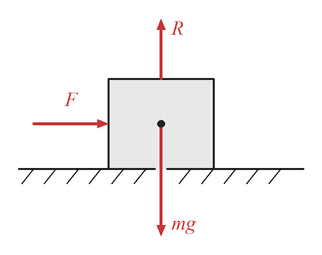
A block of mass is placed on the floor. The coefficient of static friction is . A force of is applied on the block as shown in the given figure. The force of friction between the block and the floor is ()
 Solve with AI
Answer
(A) 1.5 N
(B) 0.5 N
- Correct
(C) 2.5 N
(D) None of the above
Answer: (C) 2.5 N
Concept: Static friction is a self-adjusting force. It takes whatever value is needed to keep the body at rest, up to the limiting value . Only when the applied force exceeds does the body move.
Step 1 — Find the limiting friction. The floor is horizontal and is horizontal, so :
Step 2 — Decide whether the block moves. The applied force is less than , so the block stays at rest.
Step 3 — Find the actual friction. The block stays at rest, so the net horizontal force on it is zero, and friction balances exactly. The friction is therefore , opposite to .
- (A) This is wrong because a friction of would leave a net force of , and the block would accelerate, yet it stays at rest.
- (B) This is wrong for the same reason: cannot balance the force.
- (D) This is wrong because option (C) gives the correct value. The limiting value is only the most that friction can supply; it acts in full only when the body is about to slide.
Therefore, the force of friction is 2.5 N, option (C).
- 111 mark
Question 11
A block of mass , lying on a rough horizontal plane, is acted upon by a horizontal force and another force inclined at an angle to the vertical. The block will remain in equilibrium if the coefficient of friction between it and the surface is
Solve with AIAnswer
- Correct
(A)
(B)
(C)
(D)
Answer: (A)
Concept: A body on a rough surface stays at rest as long as the total force along the surface does not exceed the limiting friction . Just at the limit, .
Step 1 — Fix the directions. We take as pushing on the block downward, at angle to the vertical, with its horizontal part in the same direction as (the reading the options are built on):
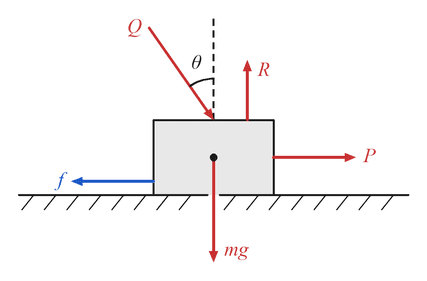
Step 2 — Resolve Q. The vertical part of is (downward) and its horizontal part is (along ).
Step 3 — Find the normal reaction. Vertically, balances the weight and the downward part of :
Step 4 — Find the force along the surface. The horizontal forces trying to move the block add:
Step 5 — Apply the condition at the limit. Friction must be able to balance , so at the limit:
The block stays in equilibrium for this value of or any larger one.
- (B) This is wrong because it resolves instead of ; is horizontal and has no component to resolve, while is the inclined force.
- (C) This is wrong because it swaps sine and cosine, which would be correct only if were measured from the horizontal.
- (D) This is wrong because it subtracts from a component of and reduces the normal reaction; neither step fits a downward push at to the vertical.
Therefore, the required coefficient of friction is , option (A).
- 121 mark
Question 12
What is (i) dry friction and (ii) fluid friction?
Solve with AIWritten solution
Solution:
Concept: Friction is named after the kind of bodies in contact: solids rubbing on solids, or a body moving through (or on) a liquid or a gas.
Step 1 — Part (i), dry friction. The force of friction between the surfaces of two solids in contact, with no lubricant between them, is called dry friction.
Step 2 — Part (ii), fluid friction. The force of friction between a liquid (or a gas) and a body moving through it, or between layers of a fluid, is called fluid friction; air resistance is an example.
Therefore, (i) dry friction acts between two solid surfaces, and (ii) fluid friction acts between a fluid (liquid or gas) and a body moving through it.
- 131 mark
Question 13
It is easier to roll than to pull a barrel along a road. Explain.
Solve with AIWritten solution
Solution:
Concept: Rolling friction is much smaller than sliding friction between the same surfaces.
Step 1 — Compare the two cases. When the barrel is pulled, it slides over the road and sliding friction acts. When it is rolled, only rolling friction acts.
Step 2 — Conclude. Since rolling friction is much smaller, a smaller force is needed to roll the barrel.
Therefore, it is easier to roll a barrel than to pull it because rolling friction is much less than sliding friction.
- 141 mark
Question 14
“Friction is a self-adjusting force.” Why?
Solve with AIWritten solution
Solution:
Concept: Static friction is not fixed: it takes whatever value is needed to stop sliding, up to the limiting value .
Step 1 — Follow an increasing push. If a small force pushes a heavy box at rest, friction equals that small force; if the push is increased, friction increases by the same amount, so the box stays at rest.
Step 2 — Note the limit. This adjustment continues only until friction reaches the limiting value; a larger push then makes the box move.
Therefore, friction is called self-adjusting because static friction always becomes equal and opposite to the applied force, up to the limiting friction, so that there is no relative motion.
- 151 mark
Question 15
Explain how lubricants help in reducing friction?
Solve with AIWritten solution
Solution:
Concept: Dry friction between solids is much larger than fluid friction inside a thin layer of liquid.
Step 1 — See what a lubricant does. Oil or grease forms a thin, uniform layer between the two surfaces, fills their irregularities and keeps the surfaces from touching directly, so they cannot interlock.
Step 2 — Find the effect. The surfaces now slide over the layer of lubricant, so the large dry friction is replaced by the much smaller fluid friction.
Therefore, lubricants reduce friction by forming a thin layer between the surfaces that keeps them apart, so that only the small fluid friction of the lubricant acts.
- 161 mark
Question 16
“The dynamic friction is a little less than the limiting friction”. Why?
Solve with AIWritten solution
Solution:
Concept: Friction comes from the interlocking of surface irregularities and the bonding of the two surfaces at their points of contact.
Step 1 — A body at rest. When the body is at rest, the irregularities settle into each other and the contact points have time to bond, so a large force (the limiting friction) is needed to start sliding.
Step 2 — A body in motion. Once the body slides, the irregularities have no time to settle fully into each other and the contact points have little time to bond, so the force needed to keep it sliding is a little smaller.
Therefore, dynamic friction is a little less than limiting friction because, during motion, the interlocking and bonding of the surfaces are less complete than when the body is at rest.
- 171 mark
Question 17
“A parachute descends slowly.” Why?
Solve with AIWritten solution
Solution:
Concept: Air resistance is a kind of fluid friction; it grows with the speed of the body and with its area facing the air.
Step 1 — Note the parachute's shape. An open parachute has a very large area facing the air as it falls.
Step 2 — Find the effect. The air resistance on it is therefore large, and it soon balances the weight of the parachute and the person at a small speed, after which they fall at that small, steady speed.
Therefore, a parachute descends slowly because its large surface area produces a large air resistance (fluid friction), which balances the weight at a low speed.
- 181 mark
Question 18
Name one factor on which the coefficient of friction depends.
Solve with AIWritten solution
Solution:
Concept: The coefficient of friction does not depend on the normal force or on the area of contact.
Step 1 — Name the factor. It depends on the nature of the two surfaces in contact: what they are made of and how smooth or rough they are (their state of polish), and whether they are dry or lubricated.
Therefore, the coefficient of friction depends on the nature of the surfaces in contact.
- 191 mark
Question 19
“Carts with rubber tyres are better than those with iron tyres”. Why?
Solve with AIWritten solution
Solution:
Concept: A cart wheel on a road meets rolling friction (resistance to rolling); the wheel also needs grip (static friction) to brake and turn without skidding.
Step 1 — Resistance to rolling. On an uneven road a hard iron tyre must climb over every stone and bump, and the cart is jerked at each one, which wastes energy. A rubber tyre gives a little and rides over small irregularities, so the cart rolls more easily and smoothly.
Step 2 — Grip and comfort. Rubber grips the road better than iron, so the cart is less likely to skid, and it absorbs shocks and makes less noise.
Note: the book's hint says that the coefficient of friction between rubber and road is less than between iron and road; the sliding friction of rubber on a road is in fact larger (that is its grip), and what is smaller on an uneven road is the resistance to rolling.
Therefore, carts with rubber tyres are better because on ordinary roads they roll with less resistance and fewer jolts, and they also grip the road better.
- 201 mark
Question 20
Is friction, a conservative or non-conservative force?
Solve with AIWritten solution
Solution:
Concept: A force is conservative if the work it does over any closed path is zero; otherwise it is non-conservative.
Step 1 — Follow a closed path. If a block is pushed forward and then back to its starting point, friction opposes the motion both ways, so it does negative work on the way out and negative work on the way back.
Step 2 — Conclude. The total work done by friction over the closed path is negative, not zero; the energy appears as heat.
Note: the book's hint says that the net work done during the forward and backward motion is zero; it is in fact not zero (it is negative in both directions), and that is exactly why friction is non-conservative.
Therefore, friction is a non-conservative force, because the work it does over a closed path is not zero.
- 212 marks
Question 21
Explain the origin of friction.
Solve with AIWritten solution
Solution:
Concept: Even surfaces that look smooth have many tiny hills and hollows. When two surfaces are placed together, they actually touch only at the tops of these hills.
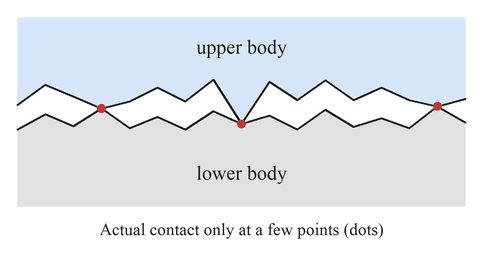
Step 1 — Interlocking (old view). The hills and hollows of the two surfaces fit into each other. To slide one surface over the other, these irregularities must be lifted over or broken, and the force needed for this shows up as friction.
Step 2 — Molecular attraction (modern view). At the few points of real contact the pressure is very large, and the molecules of the two surfaces come close enough to attract each other strongly; the surfaces are almost welded together at these points. To slide one surface over the other, these bonds must be broken, and this needs a force.
Therefore, friction arises from the interlocking of surface irregularities and, mainly, from the force of attraction between the molecules of the two surfaces at their points of actual contact.
- 222 marks
Question 22
“The friction between two surfaces increases when the surfaces are made smoother and smoother.” Why?
Solve with AIWritten solution
Solution:
Concept: Friction is caused mainly by the attraction between the molecules of the two surfaces at the points where they actually touch, so it grows with the actual area of contact.
Step 1 — Ordinary surfaces. Rough surfaces touch only at a few high points, so the actual area of contact is small.
Step 2 — Very smooth surfaces. When the surfaces are made smoother and smoother (beyond ordinary polishing), they fit more and more closely, and the actual area of contact becomes much larger.
Step 3 — Find the effect. Over this larger area the molecular attraction between the surfaces is larger, so a larger force is needed to slide one over the other.
Therefore, beyond a certain point, making surfaces smoother increases friction because the actual area of contact, and hence the molecular attraction between the surfaces, increases.
- 232 marks
Question 23
What is static friction? Why is it called so?
Solve with AIWritten solution
Solution:
Concept: When a force tries to move a body over a surface, friction opposes it even before any motion begins.
Step 1 — Define static friction. The opposing force that acts between two surfaces in contact when one tends to move over the other but does not actually move is called static friction. It is equal and opposite to the applied force and keeps the body at rest.
Step 2 — Explain the name. It acts while the body remains static (at rest) even though an external force is applied, so it is called static friction.
Therefore, static friction is the friction that balances an applied force and keeps a body at rest; it is called static because it acts while the body is static.
- 242 marks
Question 24
What is limiting friction?
Solve with AIWritten solution
Solution:
Concept: Static friction grows with the applied force, but only up to a certain maximum value.
Step 1 — Follow an increasing applied force. As the applied force increases, static friction increases equally, and the body stays at rest. The graph shows this as the straight part OA:

Step 2 — Define limiting friction. At A the body is just about to slide. The maximum value of static friction, reached just before the body starts sliding over the other surface, is called limiting friction (). After that, the smaller kinetic friction acts.
Therefore, limiting friction is the maximum value of static friction, which acts when a body is just about to start sliding over another.
- 252 marks
Question 25
State the laws of static friction.
Solve with AIWritten solution
Solution:
Concept: The laws of static friction describe the limiting friction between two surfaces.
Step 1 — State the laws. The laws are:
- The limiting friction depends on the nature of the surfaces in contact and on their state of polish.
- It acts along (tangential to) the surfaces in contact, opposite to the direction in which the body tends to move.
- It is directly proportional to the normal reaction, .
- It does not depend on the apparent area of contact, as long as the normal reaction is the same.
Therefore, the limiting friction depends on the nature of the surfaces, acts along them opposite to the tendency of motion, is proportional to the normal reaction and is independent of the area of contact.
- 262 marks
Question 26
Define the coefficient of static friction and kinetic friction.
Solve with AIWritten solution
Solution:
Concept: Both limiting friction and kinetic friction are proportional to the normal reaction ; the constant of proportionality is the coefficient of friction.
Step 1 — Coefficient of static friction. The limiting friction satisfies . The coefficient of static friction is the ratio of the limiting friction to the normal reaction:
Step 2 — Coefficient of kinetic friction. When the body slides, the kinetic friction satisfies . The coefficient of kinetic friction is the ratio of the kinetic friction to the normal reaction:
Both are ratios of two forces, so they have no units, and for the same pair of surfaces .
Therefore, is the ratio of limiting friction to normal reaction and is the ratio of kinetic friction to normal reaction.
- 272 marks
Question 27
What is the angle of friction?
Solve with AIWritten solution
Solution:
Concept: The surface exerts two forces on a body resting on it: the normal reaction and the force of friction. Their resultant is the total reaction of the surface.
Step 1 — Draw the forces at the limit. When the body is just about to slide, friction has its limiting value . The resultant of and then makes an angle with the normal reaction:
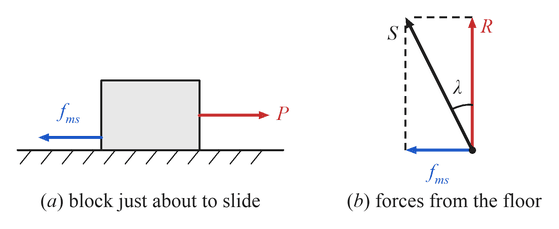
Step 2 — Define the angle. The angle of friction is the angle between the normal reaction and the resultant of the limiting friction and the normal reaction. From the right-angled triangle of forces:
Therefore, the angle of friction is the angle that the resultant of the limiting friction and the normal reaction makes with the normal reaction, and .
- 282 marks
Question 28
Define angle of repose. Is this angle equal to the angle of friction?
Solve with AIWritten solution
Solution:
Concept: On an inclined plane of angle , the weight has a part down the plane and a part into it; the plane pushes back with .
Step 1 — Define the angle of repose. The angle of repose is the angle of the inclined plane with the horizontal at which a body placed on it just begins to slide down.
Step 2 — Find its tangent. At this angle the part of the weight down the plane just equals the limiting friction:
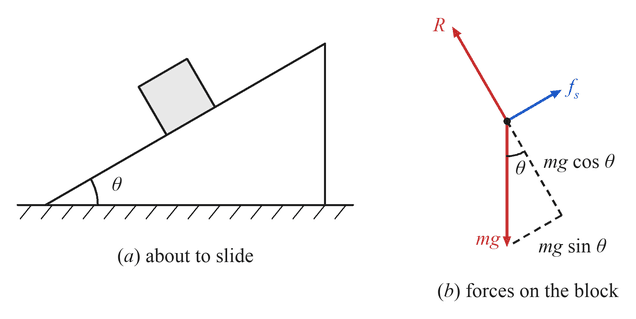
Step 3 — Compare with the angle of friction. The angle of friction also satisfies . Since both angles are acute and have the same tangent, they are equal.
Therefore, the angle of repose is the angle of an incline at which a body on it just begins to slide, and yes, it is equal to the angle of friction, since the tangent of each is .
- 292 marks
Question 29
What is rolling friction? How does it arise?
Solve with AIWritten solution
Solution:
Concept: A body that rolls, like a wheel or a ball, meets a resistance to its motion that is much smaller than sliding friction.
Step 1 — Define rolling friction. The force of friction that acts when one body rolls over the surface of another is called rolling friction.
Step 2 — Explain how it arises. Under the weight of the rolling body, both the body and the surface are slightly deformed where they touch: a tyre flattens a little and the road is pressed in. The rolling body must keep climbing out of this small dent, and the deformed material does not spring back fully, so some energy is lost at every turn; this appears as a force opposing the rolling.
Therefore, rolling friction is the friction that opposes a body rolling over a surface, and it arises from the slight flattening of the body and the surface where they touch.
- 302 marks
Question 30
“Friction is a necessary evil”. Why?
Solve with AIWritten solution
Solution:
Concept: Friction always opposes relative motion. This makes many everyday actions possible, but it also wastes energy and wears things out.
Step 1 — Friction as a necessity. Without friction we could not walk (our feet would slip), vehicles could not start or be stopped by brakes, we could not hold a pen or climb a tree, and nails and screws would not stay in place.
Step 2 — Friction as an evil. Friction between moving parts of machines turns useful energy into heat, lowers their efficiency, and wears the parts away.
Therefore, friction is called a necessary evil because life is impossible without it (walking, braking, holding things), yet it wastes energy and causes wear in machines.
- 312 marks
Question 31
Name four different methods of reducing friction.
Solve with AIWritten solution
Solution:
Concept: Friction can be reduced by changing what is in contact, how the surfaces move, or the shape of a body moving through a fluid.
Step 1 — List the methods. Four methods are:
- Lubrication: oil or grease between moving parts.
- Ball bearings (or roller bearings): sliding is replaced by rolling.
- Smoothing (polishing) the surfaces in contact.
- Streamlining: giving vehicles a shape that lets air or water flow smoothly past them.
Therefore, four methods of reducing friction are lubrication, ball bearings, polishing the surfaces, and streamlining.
- 322 marks
Question 32
What are antifriction metals?
Solve with AIWritten solution
Solution:
Concept: In a machine, a rotating shaft rubs against the bearing that supports it. The bearing is lined with a material on which the shaft slides with little friction.
Step 1 — Define antifriction metals. Antifriction metals are metals and alloys that have a low coefficient of friction against a steel shaft, such as babbitt metal (an alloy of tin with small amounts of antimony and copper) and some bronzes.
Step 2 — State their use. The bearings of moving parts are lined with these metals, which reduces friction and the wear of the shaft.
Therefore, antifriction metals are low-friction metals and alloys, such as babbitt metal, used to line the bearings of machines in order to reduce friction.
- 332 marks
Question 33
“A horse has to pull a cart harder during the first few metres of its motion than later on”. Why?
Solve with AIWritten solution
Solution:
Concept: Limiting static friction is greater than kinetic friction. Also, to change the speed of a body a net force is needed ().
Step 1 — Starting. At the start the horse must overcome the limiting static friction, and it must also give the cart an acceleration to bring it up to speed.
Step 2 — Later. Once the cart is moving steadily, only the smaller kinetic (rolling) friction has to be balanced, and no force is needed for acceleration.
Therefore, the horse pulls harder in the first few metres because it must overcome the larger static friction and also accelerate the cart, while later only the smaller kinetic friction acts.
- 342 marks
Question 34
“Resin is rubbed on the violin bow”. Why?
Solve with AIWritten solution
Solution:
Concept: A bowed string vibrates by "stick and slip": the bow grips the string and drags it aside, the string slips back, and the bow grips it again, many times a second.
Step 1 — See what resin does. Resin (rosin) makes the hair of the bow sticky, so the static friction between the bow and the string becomes large.
Step 2 — Explain the vibration. With this large friction, the bow grips the string and pulls it aside until the string's own tension pulls back harder than the limiting friction; the string then slips back and is gripped again. This repeated grip and slip keeps the string vibrating and producing sound. Without resin the bow would simply slide over the string.
Therefore, resin is rubbed on a violin bow to increase the friction between the bow and the string, so that the bow can grip the string and set it vibrating instead of slipping over it.
- 352 marks
Question 35
Derive an expression for the acceleration of a body sliding down a rough inclined plane.
Solve with AIWritten solution
Solution:
Concept: On an inclined plane, resolve the weight along and perpendicular to the plane. Perpendicular to the plane the forces balance; along the plane the net force gives the acceleration. Kinetic friction is , opposite to the motion.
Step 1 — Draw the forces. A body of mass slides down a rough plane inclined at to the horizontal. Its weight has a part down the plane and a part into the plane. The normal reaction acts away from the plane, and kinetic friction acts up the plane:
Step 2 — Balance the forces perpendicular to the plane. There is no motion perpendicular to the plane, so:
Step 3 — Write the friction. The kinetic friction is:
Step 4 — Apply Newton's second law along the plane. The net force down the plane gives the acceleration :
The acceleration does not depend on the mass, and it is less than , the value on a smooth plane.
Therefore, the acceleration of a body sliding down a rough inclined plane is .
- 362 marks
Question 36
Explain why a high pressure tyre roll more easily than a low pressure tyre?
Solve with AIWritten solution
Solution:
Concept: Rolling friction arises from the flattening of the tyre (and the road) where they touch; the more a tyre is deformed at each turn, the more energy is lost and the larger the rolling friction.
Step 1 — Compare the tyres. A tyre pumped to a high pressure is stiff, so it flattens only a little under the load, and its area of contact with the road is small. A soft, low-pressure tyre flattens much more and touches the road over a large area.
Step 2 — Find the effect. The high-pressure tyre is deformed less at each turn, so less energy is lost and its rolling friction is smaller.
Therefore, a high-pressure tyre rolls more easily because it flattens less and has a smaller area of contact, so its rolling friction is smaller.
- 372 marks
Question 37
“The surfaces of the train wheels and railway tracks are made smooth”. Why?
Solve with AIWritten solution
Solution:
Concept: Rolling friction comes from the deformation of the wheel and the surface it rolls on, and from bumps on the surfaces. Hard, smooth surfaces deform very little.
Step 1 — Reduce the resistance to rolling. Smooth, hard steel wheels on smooth steel rails are hardly flattened and meet no bumps, so the rolling friction is very small. The heavy train can then be hauled with a comparatively small force, and wear and noise are reduced.
Step 2 — Keep a good grip. Being smooth, the wheel and the rail also make close, even contact, so the friction between them is still enough for the locomotive to pull and for the brakes to work, helped by the great weight pressing the wheels on the rails.
Therefore, train wheels and tracks are made smooth so that rolling friction (and wear) is very small, while the close contact of the smooth surfaces still gives enough grip for driving and braking.
- 382 marks
Question 38
A body moving on a surface is brought to rest suddenly. What happens to the friction between the two?
Solve with AIWritten solution
Solution:
Concept: Kinetic friction acts only while there is relative motion. Static friction acts only when some force tends to cause relative motion, and then it is just as large as needed.
Step 1 — While it moves. While the body slides, kinetic friction acts on it, opposite to its motion.
Step 2 — Once it is at rest. When the body stops, there is no relative motion, so kinetic friction no longer acts. If no other force tends to move the body (for example on a level surface with nothing pushing it), static friction is not needed either, so the friction becomes zero.
Therefore, the friction disappears when the body comes to rest, because there is no longer any relative motion (or tendency of it) between the surfaces.
- 392 marks
Question 39
“In hilly areas, sand is thrown on tracks covered with snow”. Why?
Solve with AIWritten solution
Solution:
Concept: A vehicle is driven forward, and held on a slope, by the friction between its wheels and the track. Snow and ice make this friction very small.
Step 1 — The problem. On a snow-covered track the friction is so small that the wheels slip and spin, and a train cannot pull itself up the slope.
Step 2 — The remedy. Sand thrown on the track gives a rough layer between the wheels and the track, so friction is increased and the wheels grip.
Therefore, sand is thrown on snow-covered tracks to increase friction, so that the wheels grip and the train is able to move up the slope.
- 402 marks
Question 40
Explain why the shapes of high-speed vehicles are streamlined.
Solve with AIWritten solution
Solution:
Concept: A body moving through air meets fluid friction (air resistance), which grows rapidly with speed and depends on the body's shape.
Step 1 — Effect of the shape. A streamlined shape, rounded at the front and tapering at the back, lets the air flow smoothly past the vehicle with little disturbance.
Step 2 — Find the benefit. This greatly reduces air resistance, which is large at high speed, so less fuel is needed and higher speeds can be reached.
Therefore, high-speed vehicles are streamlined to reduce air resistance (fluid friction), which is large at high speeds.
- 413 marks
Question 41
What is friction? Explain classical view and modern view of friction.
Solve with AIWritten solution
Solution:
Concept: Friction is the force that opposes the relative motion, or the tendency of relative motion, between two surfaces in contact. It acts along the surfaces.
Step 1 — Define friction. When one body slides, or tends to slide, over another, a force acts on each body along the common surface, opposing the relative motion. This force is called friction.
Step 2 — Note what the surfaces look like. Seen under a microscope, even polished surfaces have many hills and hollows, so two surfaces placed together actually touch only at a few high points:
Step 3 — The classical view. In the older (classical) view, friction is due to the interlocking of these irregularities. To make one surface slide over the other, the irregularities must be lifted over each other or broken, and the force needed is the friction. This view explains why rough surfaces show more friction, but it cannot explain why friction increases again when surfaces are polished very smooth.
Step 4 — The modern view. In the modern view, the actual area of contact is very small, so the pressure at the contact points is very large. The surfaces are pressed so close there that the molecules of the two bodies attract each other strongly, and the bodies are almost welded together (cold welding) at these points. To slide one surface over the other, these welds must be broken, and the force needed is the friction. A larger normal force flattens the contact points more and increases the real area of contact in proportion, which explains why friction is proportional to the normal reaction and independent of the apparent area. It also explains why very smooth surfaces show more friction: their real area of contact is larger.
Therefore, friction is the force opposing relative motion between surfaces in contact; the classical view explains it by interlocking of irregularities, and the modern view by molecular attraction (cold welding) at the few points of actual contact.
- 423 marks
Question 42
What is (i) static friction, (ii) limiting friction and (iii) kinetic friction. Explain with an example.
Solve with AIWritten solution
Solution:
Concept: As the force applied to a body at rest on a surface is increased, friction first grows with it, reaches a maximum, and then falls to a slightly smaller steady value once the body slides.
Step 1 — Take an example. Suppose a heavy box rests on the floor and we push it horizontally with a force that we increase slowly. The graph shows how the friction on the box changes:
Step 2 — Part (i), static friction. For a small push the box does not move. The floor exerts a friction force on it that is equal and opposite to the push; as the push grows, this friction grows too (part OA of the graph). The friction that acts while the body is at rest, although a force tends to move it, is called static friction. It is self-adjusting.
Step 3 — Part (ii), limiting friction. At A the box is just about to move. The friction now has its greatest possible value, . This maximum value of static friction, acting when the body is just on the point of sliding, is called limiting friction.
Step 4 — Part (iii), kinetic friction. If the push is increased a little beyond , the box starts to slide, and the friction falls to a slightly smaller, nearly constant value . The friction that acts while one body is sliding over another is called kinetic (dynamic) friction. Because , once the box is moving a smaller push keeps it moving at a steady speed.
Therefore, (i) static friction balances the applied force while the body stays at rest, (ii) limiting friction is the maximum static friction, just before sliding begins, and (iii) kinetic friction is the slightly smaller friction that acts during sliding, as when pushing a heavy box across the floor.
- 433 marks
Question 43
Define (i) coefficient of static friction and (ii) coefficient of kinetic friction. Explain rolling friction.
Solve with AIWritten solution
Solution:
Concept: Limiting friction and kinetic friction are each proportional to the normal reaction ; the constants of proportionality are the two coefficients of friction.
Step 1 — Part (i), coefficient of static friction. Limiting friction satisfies , so . The coefficient of static friction is the ratio of the limiting friction to the normal reaction:
Step 2 — Part (ii), coefficient of kinetic friction. Kinetic friction satisfies , so . The coefficient of kinetic friction is the ratio of the kinetic friction to the normal reaction:
Both coefficients are ratios of forces, so they have no units; they depend on the nature of the surfaces, and for the same pair of surfaces.
Step 3 — Explain rolling friction. When a body such as a wheel or a ball rolls over a surface, the opposing force is called rolling friction. It arises because the rolling body and the surface are slightly deformed where they touch: the wheel flattens a little and the surface is pressed in, so the wheel must keep climbing out of a small dent, and the deformed material does not fully return the energy. Rolling friction is much smaller than sliding friction; this is why wheels, ball bearings and rollers are used. It is smaller for harder surfaces and for wheels of larger radius.
Therefore, is the ratio of limiting friction to the normal reaction, is the ratio of kinetic friction to the normal reaction, and rolling friction is the small resistance to rolling that arises from the deformation of the rolling body and the surface.
- 443 marks
Question 44
Define angle of friction and angle of repose. Show that friction is a non-conservative force.
- 453 marks
Question 45
Explain the different methods of reducing friction.
- 465 marks
Question 46
(a) State two laws of static friction and two laws of kinetic friction.
(b) Explain the use of lubrication and the ball bearings.
- 475 marks
Question 47
Using suitable equations explain the motion of body along a rough inclined plane – both up and down the plane.
- 485 marks
Question 48
(a) Show that it is easier to pull a roller than to push it.
(b) Friction is a necessary evil. Explain this statement with three examples.
What Class 11 Physics Ch 7 covers
The sections of the chapter, in the order the book takes them. Every question above comes from one of these.
- 01Frictional Force and Its Origin
- 02Static and Limiting Friction
- 03Kinetic Friction and Laws of Friction
- 04Coefficient of Friction
- 05Angle of Friction and Angle of Repose
- 06Motion on a Rough Inclined Plane
More ways to study this chapter
The same chapter asked three other ways. Practise it, revise it, and see what the board has set on Ch 7 before.
Class 11 Physics Ch 7 questions students ask
How many questions are there in Class 11 Physics Ch 7?
48 questions. Every one is solved step by step on this page.
Are these Class 11 Physics solutions free?
Yes. Every question and its full working is free to read, with no account needed.
Can I download the Class 11 Physics Ch 7 solutions as a PDF?
There is no PDF to download. Every solution is on this page instead, which means it is searchable, always the current syllabus, and readable on a phone. Use your browser's print option if you want it on paper.