Opening your dashboard
Class 11 Physics Chapter 7 Friction: Competency-Based Questions (CBQ)
44 questions on Chapter 7, each worked through on its own page with the AI tutor. Class 11 Physics, ICSE 2026-27.
44 questions
1–4 marks · Mixed difficulty
- 13 marks
Question 1
Competency: Application
Riya, of mass , wants to slide a carton of books of mass across the tiled floor of her room. She stands on the floor and pushes the carton horizontally. The coefficient of static friction is between her shoes and the floor and between the carton and the floor. Take . (Hypothetical data.)
(a) State the direction of the friction force of the floor on Riya's feet and on the carton while she pushes, and explain each direction.
(b) Show that she can start the carton moving without her feet slipping.
(c) She tries again in socks, for which the coefficient of static friction with the floor is only . Explain what happens, and find the least coefficient of static friction her footwear must give for the carton to be started.
- 21 mark
Question 2
Competency: Analysis & Evaluation
A girl pedals her bicycle along a level road so that it speeds up. The chain drives only the rear wheel; the front wheel turns freely on its axle. Neither tyre slips on the road. Which statement correctly gives the directions of the friction forces of the road on the two tyres?
- 34 marks
Question 3
Competency: Application
A loaded steel cabinet is tall and its base is deep from back to front. Its mass is and its weight acts through its centre. It stands on a level floor, and the coefficient of static friction between its base and the floor is . A worker pushes horizontally on its back face, at a height above the floor, to slide it forward, as shown; is the front bottom edge. Take . (Hypothetical data.)
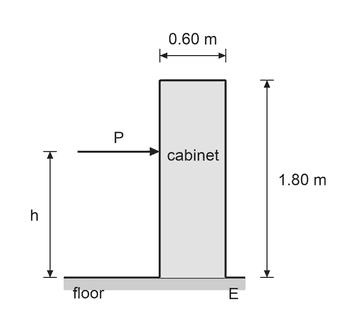
(a) Find the least push that will start the cabinet sliding, if it does not tip over.
(b) The push can also tip the cabinet about . Find the height above which the cabinet tips over before it starts to slide.
(c) Advise the worker where to push, and explain why pushing at shoulder height is dangerous even though the force needed to slide the cabinet does not depend on .
- 41 mark
Question 4
Competency: Analysis & Evaluation
A passenger places a book on the flat, horizontal table of a train coach. The train runs along a straight, level track at a constant , and the book stays at rest on the table.
Assertion (A): The table exerts no friction force on the book.
Reason (R): A body moving with constant velocity has no net force acting on it.
- 51 mark
Question 5
Competency: Analysis & Evaluation
A heavy wooden wardrobe and a light wooden stool stand on the same tiled floor, each on feet made of the same kind of wood. The wardrobe's feet have a much larger total area of contact with the floor than the stool's.
Assertion (A): A larger horizontal push is needed to start the wardrobe sliding than to start the stool sliding.
Reason (R): The limiting friction on a body increases with the area of contact between the body and the floor.
- 64 marks
Question 6
Competency: Application
In a science show, a performer pulls a smooth tablecloth sharply out from under a steel plate. The cloth is pulled along the table top towards its right-hand edge, and the front of the plate starts from that edge, as shown. The cloth slides out from under the plate in . The coefficient of kinetic friction is between the plate and the cloth and between the plate and the bare table. Take . (Hypothetical data.)

(a) In which direction does friction from the cloth act on the plate while the cloth slides beneath it? Find the plate's acceleration.
(b) Find the plate's speed when the cloth leaves it, and how far the plate has moved by then.
(c) The plate then slides on the bare table. Find how much farther it slides, and decide whether it stays on the table.
(d) Explain why the trick works better when the cloth is pulled out faster.
- 71 mark
Question 7
Competency: Analysis & Evaluation
A crate lies on the flat floor of a pickup truck. The truck starts from rest with a large acceleration, and the crate slides backward along the floor relative to the truck, although relative to the road it moves forward.
Assertion (A): The kinetic friction on the crate acts opposite to its velocity relative to the road.
Reason (R): Kinetic friction opposes the relative motion of the two surfaces in contact.
- 81 mark
Question 8
Competency: Analysis & Evaluation
A student drags a heavy wooden block across a wooden bench using a long rubber band. She moves her end of the band at a slow, steady speed. Instead of sliding smoothly, the block moves in jerks: it stays still while the band stretches, then suddenly slides forward and stops again, over and over. Which property of friction best explains this jerky motion?
- 93 marks
Question 9
Competency: Analysis & Evaluation
In a laboratory experiment, a wooden block of mass lies on a horizontal board. A string tied to it runs horizontally over a smooth pulley to a scale pan. Slotted masses are added on top of the block, and for each load small weights are added to the pan until the block just begins to slide. The total weight of the pan and its contents at that moment is recorded. Take . (Hypothetical data.)
Total mass on the board (block + slotted masses) (a) Find the normal reaction for each load, plot against , and state what the graph shows about the relation between the limiting friction and the normal reaction.
(b) Find the coefficient of static friction from the graph.
(c) Predict the value of when the total mass on the board is , and explain why the best-fit line should pass through the origin.
- 103 marks
Question 10
Competency: Application
A shopkeeper must send a sealed tin trunk by courier, but he has no weighing machine, only a spring balance that reads up to . On the shop's level floor he pulls the trunk horizontally with the balance at a slow, steady speed, and the balance reads . He then puts a bag of rice on the trunk and repeats the pull; the balance now reads . Take . (Hypothetical data.)
(a) Find the coefficient of kinetic friction between the trunk and the floor.
(b) Find the mass of the trunk.
(c) The coefficient of static friction between the trunk and the floor is . Can he use the balance to start the trunk moving from rest, (i) with the rice on it, (ii) without the rice?
- 111 mark
Question 11
Competency: Analysis & Evaluation
A mechanic puts a few drops of oil on the steel slides of a lathe.
Assertion (A): A thin film of oil between two steel surfaces can lower the coefficient of friction between them from roughly to roughly .
Reason (R): The coefficient of friction is the ratio of the limiting friction to the normal reaction.
- 123 marks
Question 12
Competency: Application
Wheat is stored in a steel hopper whose sloping walls make an angle with the horizontal, as shown. When the outlet at the bottom is opened, grain lying against the walls must slide down to it by itself. For wheat on the clean steel, the coefficient of static friction is . Treat a grain on a wall as a small block on an inclined plane. (Hypothetical data.)
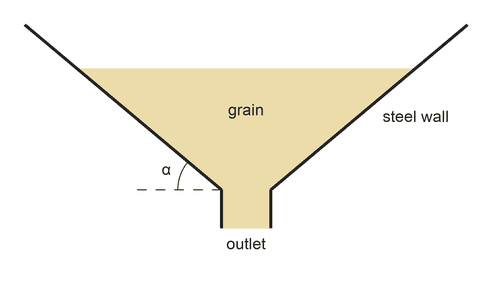
(a) Find the least wall angle for which grain slides down the walls by itself, and name this angle.
(b) After some years the walls are rusty and rough, and the coefficient of static friction rises to . Would grain still slide down walls built at ? Find the new least angle.
(c) The designer actually builds the walls at . Show that grain still flows when the walls are rusty, and give one reason for building steeper than the least angle.
- 131 mark
Question 13
Competency: Analysis & Evaluation
A climber in rubber-soled shoes stands still on a smooth, sloping rock slab without using her hands. The coefficient of static friction between her soles and the rock is . (Hypothetical data.) On the steepest slab on which she can stand without slipping, the total contact force of the rock on her feet (the resultant of the normal reaction and the friction)
- 144 marks
Question 14
Competency: Application
A school is buying a straight playground slide long, set at an angle to the horizontal, as shown. For children's clothes on its polished steel surface, the coefficients of friction are and . The designer wants (i) a child who sits at the top to start sliding by itself, and (ii) a child who starts from rest at the top to reach the bottom at no more than . Treat a child as a small block, and take . (Hypothetical data.)

(a) Find the least angle that meets requirement (i).
(b) For , find the child's acceleration and speed at the bottom. Does this slide meet both requirements?
(c) Find the greatest angle that meets requirement (ii), and state the range of angles that meet both requirements.
- 151 mark
Question 15
Competency: Analysis & Evaluation
Two wooden blocks of masses and , with undersides of the same wood, are released together from rest on the same rough plank, tilted at . This is steeper than their angle of repose, so both slide down.
Assertion (A): The block slides down with a larger acceleration than the block.
Reason (R): Both the component of the weight down the slope and the kinetic friction on a block are proportional to its mass.
- 161 mark
Question 16
Competency: Analysis & Evaluation
A wooden block is placed at rest on a board whose angle to the horizontal can be set anywhere from to , and it is released. For the block on the board, and . Take . (Hypothetical data.) Which description of how the block's acceleration down the board changes with is correct?
- 174 marks
Question 17
Competency: Application
Archaeology students test how a stone block could have been moved along a firm track of wooden planks. Dragged directly over the track, the coefficient of kinetic friction is . When the block rides on wooden logs that roll on the track, the coefficient of rolling friction is only , as shown. Each worker can pull steadily with . Take . (Hypothetical data.)
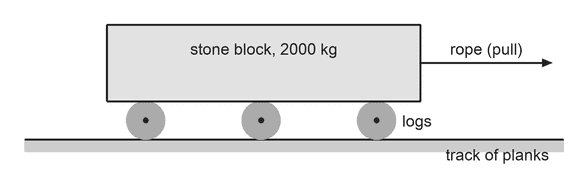
(a) How many workers are needed to move the block at a steady speed (i) by dragging it, (ii) on the logs?
(b) The logs roll without slipping on the track and under the block. When the block moves forward , how far does each log move forward?
(c) The block is long. A log is put under its front end. How far must the block move before that log comes out at the back? Explain why workers have to keep carrying logs from the back to the front.
- 181 mark
Question 18
Competency: Analysis & Evaluation
Bicycles made for riding on loose sand and snow ("fat bikes") have very wide tyres run at low pressure.
Assertion (A): On loose sand, a fat bike is easier to pedal than an ordinary bicycle with narrow, hard tyres.
Reason (R): On soft ground, rolling friction comes mainly from the rut that the wheel presses into the ground, and a wide tyre spreads the load and sinks in less.
- 191 mark
Question 19
Competency: Application
On a long downhill highway, a runaway-truck ramp is built: an escape lane that slopes upward at and is covered with deep, loose gravel. A truck whose brakes have failed enters it at and stops with no braking. The gravel resists the rolling wheels with a rolling friction equal to times the normal reaction. Ignore air resistance and take . (Hypothetical data.) About how long must the lane be for the truck to stop in it?
- 203 marks
Question 20
Competency: Application
In a car's clutch, a friction disc is clamped between the engine's flywheel and a pressure plate by springs that push with a total force of , as shown. The disc grips on both its faces, and the friction on each face can be taken to act at an effective radius of from the axis. The coefficient of static friction between the disc's linings and the steel faces is . (Hypothetical data.)

(a) Find the largest torque the clutch can pass from the engine to the gearbox without slipping.
(b) The engine gives a torque of up to . Will the clutch slip?
(c) Oil from a leaking seal reaches the linings and lowers the coefficient of static friction to . Find the new largest torque, say what happens when the driver accelerates hard, and explain why friction is useful here.
- 211 mark
Question 21
Competency: Analysis & Evaluation
Before swinging on the bars, gymnasts rub white chalk (magnesium carbonate) powder on their hands.
Assertion (A): Chalk rubbed on a gymnast's sweaty hands increases the friction between the hands and the bar.
Reason (R): A gymnast needs friction between the hands and the bar in order to hold on while swinging.
- 221 mark
Question 22
Competency: Analysis & Evaluation
Before a game of carrom, a player tests the board. A striker flicked across the bare board stops after sliding . She sprinkles a little fine powder on the board, and the striker, flicked at the same speed, now stops after sliding . (Hypothetical data.) What has happened to the coefficient of kinetic friction between the striker and the board?
- 234 marks
Question 23
Competency: Analysis & Evaluation
A step-ladder has two identical legs, each long and of mass , hinged together at the top . It stands on a level floor, with no tie or spreader between the legs, and each leg makes with the floor, as shown. A painter of mass stands on a small platform at the very top, so that his weight acts at . Treat each leg as a uniform rod, take the floor as equally rough under both feet and , and take . (Hypothetical data.)
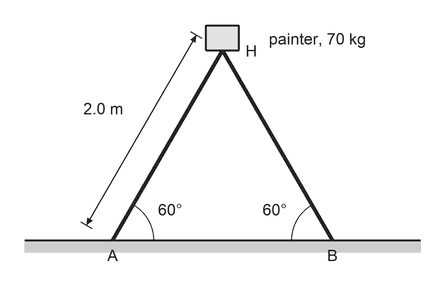
(a) Find the normal reaction of the floor on each leg.
(b) By taking moments about for one leg, find the friction force needed at its foot, and state its direction.
(c) The coefficient of static friction at the floor is . Will the step-ladder stand? Find the least angle with the floor at which it can stand, and explain how a spreader bar between the legs helps.
- 241 mark
Question 24
Competency: Analysis & Evaluation
A uniform ladder stands on a polished floor and leans against a smooth vertical wall. It would slip, so a worker ties a horizontal rope from a point just above its foot to the wall, as shown, and the ladder then stays in place.
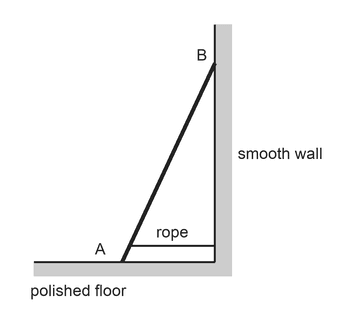
Assertion (A): The rope can keep the ladder from slipping even if the floor is almost frictionless.
Reason (R): The rope increases the normal reaction of the floor on the ladder, and so increases the limiting friction at its foot.
- 251 mark
Question 25
Competency: Analysis & Evaluation
A uniform ladder rests with its foot on rough ground and its top against a smooth vertical wall, as shown; is its mid-point.
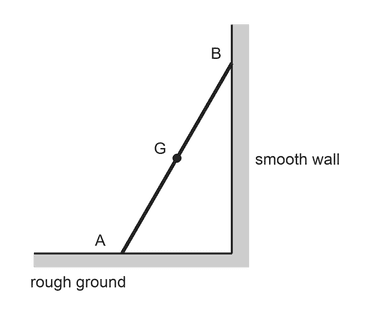
The ladder is at rest. Only three forces act on it: its weight, the push of the wall at , and the total force of the ground at (normal reaction and friction together). The line of action of the total force of the ground at passes through
- 264 marks
Question 26
(Hypothetical data.) A librarian lifts a row of 10 identical books, each of mass , off a shelf by pressing the two end books between her flat palms with equal horizontal forces , as shown. The row stays straight and horizontal, with the faces of the books vertical. The coefficient of static friction is between a palm and a book, and between two books. Take .
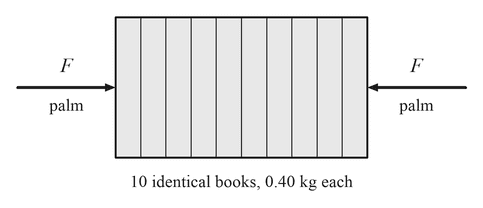
(a) Find the friction force that each palm must supply.
(b) Find the friction force needed between an end book and the book next to it.
(c) Find the least value of with which she can lift the row without any book slipping, and say where slipping would begin if were smaller.
- 274 marks
Question 27
(Hypothetical data.) A block rests on a horizontal table. From time , a horizontal force is applied to it ( in newtons, in seconds). The coefficients of static and kinetic friction between the block and the table are and . Take .
(a) At what time does the block start to slide?
(b) Describe how the friction force on the block changes from to , and sketch a graph of it.
(c) Find the acceleration of the block just after it starts to slide, and at .
(d) Find the speed of the block at .
- 284 marks
Question 28
(Hypothetical data.) A block of weight rests on a horizontal floor, and the coefficient of static friction between them is . A person pushes the block with a stick, so that the force on the block acts downward along the stick at an angle to the vertical, as shown.
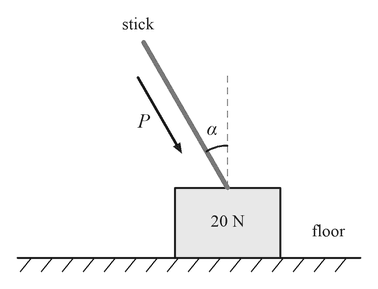
(a) Show that the block can be made to slide only if , with in newtons.
(b) Show that when the block will not slide, however hard the person pushes.
(c) Find the least push that makes the block slide when .
(d) Relate the result of part (b) to the angle of friction.
- 294 marks
Question 29
(Hypothetical data.) A uniform ladder long and of mass stands on rough ground and leans against a smooth vertical wall at to the ground, as shown. The coefficient of static friction between the ladder and the ground is . A painter of mass climbs slowly up the ladder. Take .
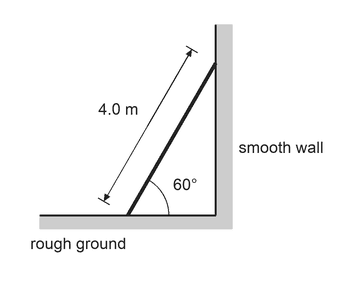
(a) How far along the ladder can the painter climb before the ladder starts to slip?
(b) The ladder is now set at to the ground instead. Show that the painter can climb right to the top.
- 303 marks
Question 30
A mass of 200 kg is resting on a rough inclined plane of angle 30°. If the coefficient of friction is , find the greatest and the least force acting parallel to the plane which can just maintain the mass in equilibrium.
- 313 marks
Question 31
A block of mass 50 kg rests on a rough horizontal plane whose coefficient of static friction is 0.3. What is the least force required to just move it if it is pulled (i) horizontally and (ii) at 45° to the horizontal?
- 323 marks
Question 32
Find the force required to pull a block of mass 100 kg up an incline of 8° at a uniform speed of 5 m/s. The coefficient of friction between the block and the plane is 0.3.
- 333 marks
Question 33
A piece of ice slides down a 45° incline in twice the time it takes to slide down a frictionless incline. Find the coefficient of kinetic friction between ice and the inclined plane.
- 343 marks
Question 34
A block placed on an inclined plane making an angle 17° with the horizontal slides down without any acceleration. What is the acceleration of the block if the inclination is increased to 30°?
- 353 marks
Question 35
A block kept on a inclined plane slides down the plane with constant velocity when the slope angle of the plane is . It is then projected up with an initial velocity . How far up the incline will it move before coming to rest? Will it slide down again?
- 363 marks
Question 36
A block is placed at the top of an inclined plane 5 m long. The plane makes an angle of 60° with the horizontal. If the coefficient of friction between the wood and the plane is 0.3, find the time taken by the block to slide down the bottom of the plane.
- 373 marks
Question 37
A block of mass 15 kg is placed on a long trolley. The coefficient of friction between the block and the trolley is 0.18. The trolley accelerates from rest with for 20 s and then moves with uniform velocity. Discuss the motion of the block as viewed by (a) a stationary observer on the ground and (b) an observer moving with the trolley.
- 383 marks
Question 38
A body of mass 20 kg is resting on a table. A light string is attached to it and passed over a smooth pulley at the edge of the table and a mass 3 kg is attached at the free end. What is the acceleration of the system if the coefficient of kinetic friction between the mass and the table is 0.04 ? What is the tension in the string?

- 393 marks
Question 39
A train of mass 400 tons climbs up an incline of 1/49 at the rate of . The force of friction is 4 kg wt per ton. Find the power of the engine.
- 403 marks
Question 40
A body of mass is kept on an inclined plane. The force required to just move a body up the inclined plane is double the force required to just prevent the body from sliding down the plane. If the coefficient of friction is , what is the inclination of the plane?
- 413 marks
Question 41
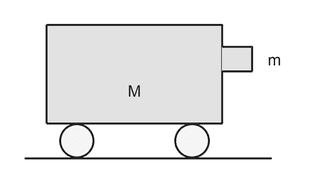
A block of mass is attached to a cart of mass as shown in the given figure. The coefficient of friction between the block and the cart is . What is the minimum acceleration of the cart so that the block does not fall?
- 423 marks
Question 42
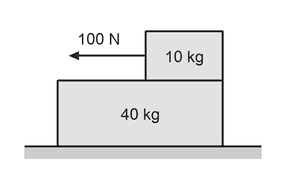
A 40 kg slab rests on a frictionless floor as shown in the given figure. A 10 kg block rests on the top of the slab. The static coefficient of friction between the block and the slab is 0.60, while kinetic friction is 0.40. The 10 kg block is acted upon by a horizontal force of 100 N. What is the resulting acceleration of the slab?
- 433 marks
Question 43
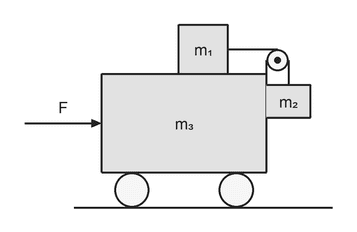
In the given figure, kg, kg and kg. Find the horizontal force that must be continuously applied on the system to so that and do not move relative to . (Assume that the whole system is frictionless.)
- 443 marks
Question 44
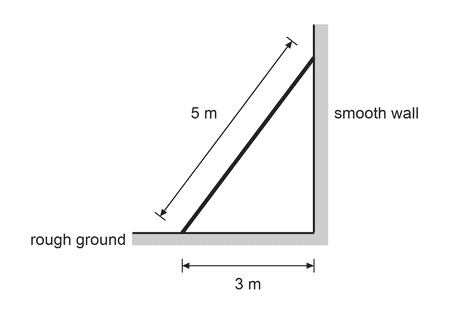
A uniform ladder which is 5 m long has a mass of 25 kg, leans with its upper end against a smooth vertical wall and its lower end on rough ground. The bottom of the ladder is 3 m from the wall. Calculate the frictional force between the ladder and the ground ().