
Competency: Analysis & Evaluation
A step-ladder has two identical legs, each long and of mass , hinged together at the top . It stands on a level floor, with no tie or spreader between the legs, and each leg makes with the floor, as shown. A painter of mass stands on a small platform at the very top, so that his weight acts at . Treat each leg as a uniform rod, take the floor as equally rough under both feet and , and take . (Hypothetical data.)
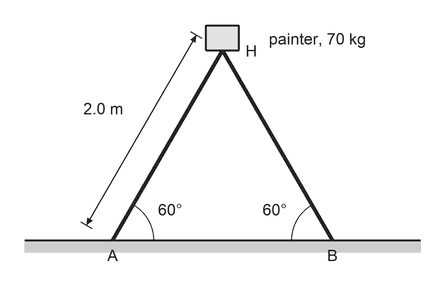
(a) Find the normal reaction of the floor on each leg.
(b) By taking moments about for one leg, find the friction force needed at its foot, and state its direction.
(c) The coefficient of static friction at the floor is . Will the step-ladder stand? Find the least angle with the floor at which it can stand, and explain how a spreader bar between the legs helps.