Answer: (A)
Concept: A body on a rough surface stays at rest as long as the total force along the surface does not exceed the limiting friction μR. Just at the limit, μ=Rforce along the surface.
Step 1 — Fix the directions. We take Q as pushing on the block downward, at angle θ to the vertical, with its horizontal part in the same direction as P (the reading the options are built on):
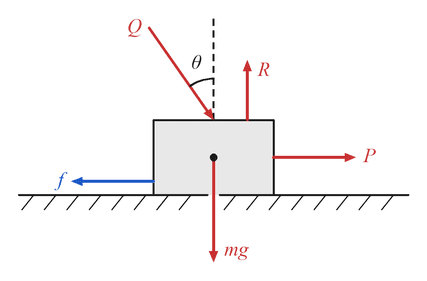
Step 2 — Resolve Q. The vertical part of Q is Qcosθ (downward) and its horizontal part is Qsinθ (along P).
Step 3 — Find the normal reaction. Vertically, R balances the weight and the downward part of Q:
R=mg+Qcosθ
Step 4 — Find the force along the surface. The horizontal forces trying to move the block add:
H=P+Qsinθ
Step 5 — Apply the condition at the limit. Friction must be able to balance H, so μR=H at the limit:
μ=mg+QcosθP+Qsinθ
The block stays in equilibrium for this value of μ or any larger one.
- (B) This is wrong because it resolves P instead of Q; P is horizontal and has no component to resolve, while Q is the inclined force.
- (C) This is wrong because it swaps sine and cosine, which would be correct only if θ were measured from the horizontal.
- (D) This is wrong because it subtracts Q from a component of P and reduces the normal reaction; neither step fits a downward push at θ to the vertical.
Therefore, the required coefficient of friction is mg+QcosθP+Qsinθ, option (A).
