
Question 413 marksMedium
What is friction? Explain classical view and modern view of friction.
Confirming your payment
Sign up now and get 250 free tokens.
Friction · Question 41 of 48
What is friction? Explain classical view and modern view of friction.
Solution:
Concept: Friction is the force that opposes the relative motion, or the tendency of relative motion, between two surfaces in contact. It acts along the surfaces.
Step 1 — Define friction. When one body slides, or tends to slide, over another, a force acts on each body along the common surface, opposing the relative motion. This force is called friction.
Step 2 — Note what the surfaces look like. Seen under a microscope, even polished surfaces have many hills and hollows, so two surfaces placed together actually touch only at a few high points:
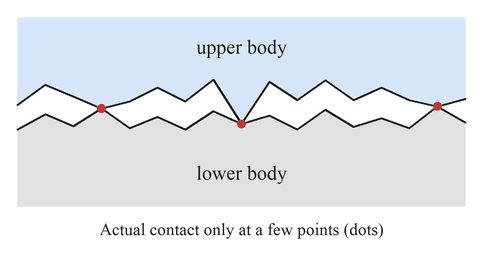
Step 3 — The classical view. In the older (classical) view, friction is due to the interlocking of these irregularities. To make one surface slide over the other, the irregularities must be lifted over each other or broken, and the force needed is the friction. This view explains why rough surfaces show more friction, but it cannot explain why friction increases again when surfaces are polished very smooth.
Step 4 — The modern view. In the modern view, the actual area of contact is very small, so the pressure at the contact points is very large. The surfaces are pressed so close there that the molecules of the two bodies attract each other strongly, and the bodies are almost welded together (cold welding) at these points. To slide one surface over the other, these welds must be broken, and the force needed is the friction. A larger normal force flattens the contact points more and increases the real area of contact in proportion, which explains why friction is proportional to the normal reaction and independent of the apparent area. It also explains why very smooth surfaces show more friction: their real area of contact is larger.
Therefore, friction is the force opposing relative motion between surfaces in contact; the classical view explains it by interlocking of irregularities, and the modern view by molecular attraction (cold welding) at the few points of actual contact.