
Question 475 marksMedium
Using suitable equations explain the motion of body along a rough inclined plane – both up and down the plane.
Confirming your payment
Sign up now and get 250 free tokens.
Friction · Question 47 of 48
Using suitable equations explain the motion of body along a rough inclined plane – both up and down the plane.
Solution:
Concept: On a plane inclined at to the horizontal, the weight of a body has a part down the plane and a part into the plane. The normal reaction balances , and kinetic friction, times the normal reaction, always acts along the plane opposite to the motion. Newton's second law along the plane gives the acceleration.
Step 1 — Find the normal reaction and the friction. There is no motion perpendicular to the plane, so:
Step 2 — Decide whether a body at rest slides down. A body placed at rest on the plane slides down only if the part of its weight down the plane is greater than the limiting friction, that is if :
Otherwise static friction holds it at rest.
Step 3 — Motion down the plane. When the body slides down, friction acts up the plane:

The net force down the plane gives its acceleration:
This is less than , the acceleration on a smooth plane. If , the acceleration is zero and the body slides down at constant speed.
Step 4 — Motion up the plane. When the body moves up the plane, both the weight component and friction act down the plane. If it is pulled up by a force parallel to the plane:
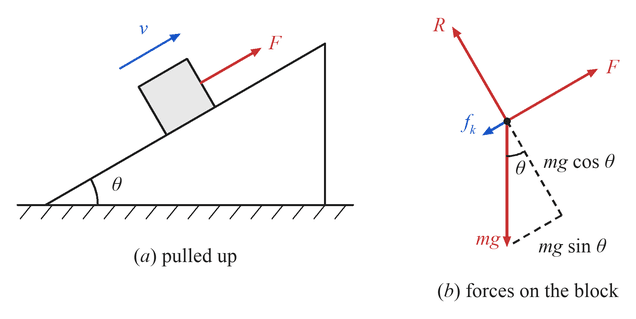
To move it up with uniform velocity () the force needed is:
Step 5 — A body sent up the plane and left to itself. If the body is given a push up the plane and then left (), it slows down with a retardation:
This retardation is larger than the acceleration down the plane, so the body takes less time to go up a given distance than to slide back down the same distance (if it slides back at all).
Step 6 — Holding back a body moving down. If and the body is to move down with uniform velocity, a force up the plane is needed:
So it takes a larger force to move a body up the plane uniformly than to let it down uniformly.
Therefore, a body slides down a rough incline with acceleration (if to start), while moving up it is retarded by and needs a force to be pulled up uniformly.