
Opening your dashboard
Class 11 Physics Chapter 7 Friction: Practice Questions
106 questions on Chapter 7, each worked through on its own page with the AI tutor. Class 11 Physics, ICSE 2026-27.
106 questions
1–4 marks · Mixed difficulty
- 11 mark
Question 1
In the modern view of friction, two solid surfaces touch only at the tips of their microscopic high points. These tips are squashed until together they can carry the load, so the actual area of contact is set by the load. A metal block rests on a flat metal plate. An identical block is then placed on top of it, doubling the load, while the same face stays in contact with the plate. The actual (microscopic) area of contact between the lower block and the plate
- 24 marks
Question 2
(Hypothetical data.) A metal block of mass rests on a flat metal plate, on a face measuring . A simple form of the modern view of friction works as follows. The high points in contact are squashed until the pressure on them equals the yield pressure of the softer metal, here , so the actual area of contact is the load divided by . To slide the block, the cold-welded junctions must be sheared, which needs a force of for every square metre of actual contact. Take .
(a) Find the actual area of contact, and the fraction of the face that it is.
(b) Find the limiting friction given by this model, and the coefficient of static friction.
(c) The block is turned so that it rests on a face measuring . Use the model to find the limiting friction now, and say which law of friction this explains.
- 31 mark
Question 3
A worker pushes a crate across a level floor at a steady speed, and then pushes it straight back to where it started. The coefficient of kinetic friction between the crate and the floor is . (Hypothetical data.) Take . The total work done by friction on the crate during the round trip is
- 42 marks
Question 4
Two pieces of the same metal are cleaned until no oxide is left on them, and they are then pressed together inside a vacuum chamber. They show a very large friction and may even stick together. The same pieces left in ordinary air soon become coated with thin films of oxide and adsorbed gas, and their friction is then much smaller. Explain both observations using the modern view of the origin of friction.
- 51 mark
Question 5
At an airport, a suitcase is carried up an inclined conveyor belt, as shown in the figure.
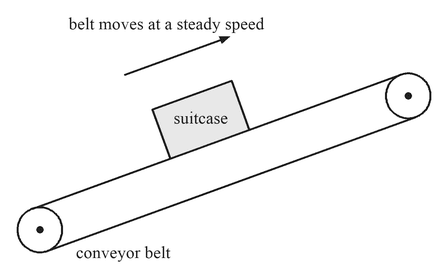
The belt moves at a steady speed, and the suitcase moves with it without slipping. The friction force that the belt exerts on the suitcase is
- 61 mark
Question 6
A block rests on a horizontal table. Two horizontal strings pull it, one with towards the east and the other with towards the north, as shown in the top view. The coefficient of static friction between the block and the table is . (Hypothetical data.) Take .
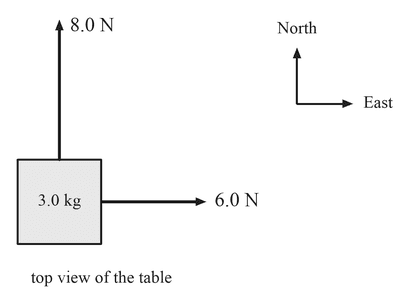
The friction force on the block is
- 71 mark
Question 7
A crate rests on a level floor. The coefficients of static and kinetic friction between the crate and the floor are and . A child pushes it horizontally, first with a force of and later with a force of . (Hypothetical data.) Take . The friction forces on the crate in the two cases are
- 83 marks
Question 8
(Hypothetical data.) A front-wheel-drive car has 60% of its weight on its front (driving) wheels. Its tyres roll without slipping, and the forward force on the car is the friction of the road on the driving wheels. The coefficient of static friction between the tyres and the road is on a dry road and on a wet road. Ignore air resistance, rolling friction and any shift of weight between the wheels as the car speeds up. Take .
(a) Why is the friction that drives the car forward static friction, even though the car is moving?
(b) Find the greatest acceleration that the road can give the car on the dry road and on the wet road.
(c) Find the least time in which the car can reach from rest on each road.
- 93 marks
Question 9
(Hypothetical data.) A crate rests on the floor of a goods lift. The coefficient of static friction between the crate and the floor is . A worker riding in the lift pushes the crate horizontally. Take . Find the least horizontal push that will start the crate sliding across the floor
(a) when the lift is at rest,
(b) when the lift is accelerating upward at , and
(c) when the lift is accelerating downward at .
(d) Explain why the three answers differ.
- 101 mark
Question 10
A block is given a short push and then slides across a rough, level floor until it stops. Ignore air resistance. Which description best fits its speed–time graph from the moment the push ends?
- 114 marks
Question 11
(Hypothetical data.) In a parcel-sorting centre, a parcel is dropped gently, with no horizontal speed, onto a horizontal conveyor belt that moves at a steady . The coefficient of kinetic friction between the parcel and the belt is . Take .
(a) In which direction does friction act on the parcel while it slips, and what acceleration does it give the parcel?
(b) For how long does the parcel slip, and how far does it move over the ground in this time?
(c) How far does the belt move in this time, and how far does the parcel slide relative to the belt?
(d) How much heat does friction produce?
- 123 marks
Question 12
(Hypothetical data.) In a laboratory, a wooden block of mass is pulled along a horizontal bench by a spring balance held horizontally, so that the block slides at a steady speed. The readings are:
Face in contact Speed Reading largest face smallest face largest face Take .
(a) Why must the block be pulled at a steady speed for the reading to equal the friction force?
(b) Which law of kinetic friction does each comparison of readings support?
(c) Find the coefficient of kinetic friction between the block and the bench.
- 133 marks
Question 13
(Hypothetical data.) After an accident on a dry, level road, the police find skid marks long, made by a car whose wheels had locked; the car came to rest at the end of the marks. Tests show that the coefficient of kinetic friction between such tyres and this road surface is . Take .
(a) Estimate the speed of the car, in , when it began to skid.
(b) The speed limit on the road is . Was the car over the limit?
(c) Would a heavier vehicle with the same tyres, skidding from the same speed, leave longer, shorter or equally long skid marks? Explain.
- 141 mark
Question 14
A block of weight rests on a horizontal surface. A horizontal force on the block is increased slowly from zero, and the friction force on the block is measured. (Hypothetical data.) The graph shows against .

The coefficients of static and kinetic friction between the block and the surface are
- 153 marks
Question 15
(Hypothetical data.) A small wooden block is given a push and then slides across a level floor. A video records its position every . The distances it covers in five successive intervals are , , , and . Take .
(a) Show that the block's deceleration is uniform, and find it.
(b) Find the coefficient of kinetic friction between the block and the floor.
(c) Find the speed of the block at the start of the first interval.
- 161 mark
Question 16
Two workers need a horizontal force of to drag a wooden crate across a floor at a steady speed. (Hypothetical data.) An identical crate is placed on top of the first, and they drag the pair across the same floor at a steady speed. Compared with before,
- 173 marks
Question 17
(Hypothetical data.) When a person walks, each foot pushes on the floor at heel strike and at push-off with a horizontal force of up to about times the vertical force on it. If the floor cannot supply that much static friction, the foot slips. A man of mass walks across four floors. The coefficients of static friction between his shoe soles and the floors are: dry concrete , dry ceramic tile , soapy wet tile and wet ice . Take the vertical force on a foot as equal to his weight, and .
(a) Find the largest horizontal force that a foot needs from the floor.
(b) Find the greatest static friction that each floor can supply, and say on which floors he is likely to slip.
(c) What is the least coefficient of static friction that a floor needs for safe walking, according to this model?
- 183 marks
Question 18
(Hypothetical data.) A pile of 500 identical sheets of paper lies on a table. Each sheet has a mass of , and the coefficient of static friction between two sheets is . One sheet, with 250 sheets above it, is pulled out horizontally, as shown, while the rest of the pile is held still at its sides without being pressed down. Take .

(a) Find the normal force on the upper face and on the lower face of this sheet.
(b) Find the least horizontal force needed to start pulling the sheet out.
(c) Compare this with the least force needed to start sliding the top sheet of the pile, and explain the difference.
- 191 mark
Question 19
A block rests on a horizontal floor, and a horizontal pull on it is increased slowly. Just before the block starts to slide, the resultant of the normal reaction and the friction force on the block makes the angle of friction with the vertical. When the pull is only half of this limiting value, the resultant of the normal reaction and the friction makes an angle with the vertical equal to
- 204 marks
Question 20
(Hypothetical data.) A truck tips dry sand onto level ground, where it forms a heap shaped like a cone with a circular base across. The sloping side of the heap stays at the angle of repose of the sand, : if more sand is added, grains on the surface slide down until this slope is restored. The bulk density of the heap is .
(a) Treating a grain on the surface as a small block on an incline, explain why the side of the heap settles at the angle of repose.
(b) Find the height of the heap.
(c) Find the volume of the heap and the mass of sand in it.
(d) What coefficient of static friction for grains on the surface does this angle imply?
- 211 mark
Question 21
An empty wooden box rests on a hinged board. When the board is tilted slowly, the box starts to slide at . (Hypothetical data.) The box is then filled with books, making it four times as heavy, the board is laid flat, and it is tilted slowly again. The box now starts to slide
- 224 marks
Question 22
(Hypothetical data.) The steepness of a hill road is often given as a percentage gradient: a 20% gradient rises for every measured horizontally, as shown. A parked car has all four wheels locked, so it can only slide down the road as a whole. The coefficient of static friction between its tyres and the road is when the road is dry and when it is covered with wet mud.
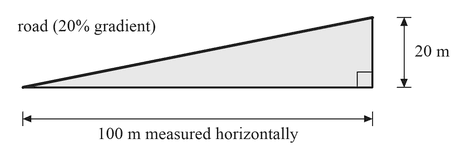
(a) Find the steepest slope, in degrees, on which the car can stay parked on the dry road, and give it as a percentage gradient.
(b) Do the same for the muddy road.
(c) A street has a gradient of 25%. Can the car stay parked on it when the street is muddy?
(d) Explain why the mass of the car does not appear in any of your answers.
- 231 mark
Question 23
(Hypothetical data.) A block rests on a rough plank tilted at to the horizontal. The coefficient of static friction between the block and the plank is , so the block stays at rest by itself. A force , parallel to the plank and directed up the slope, is now applied and increased slowly from zero until the block just starts to move up the plank, as shown. Take .
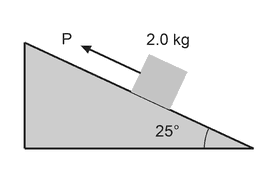
Which statement correctly describes the friction force on the block while increases?
- 243 marks
Question 24
(Hypothetical data.) A block rests on a rough plane inclined at to the horizontal. A light string tied to the block runs parallel to the slope, over a smooth pulley at the top of the plane, to a hanging mass , as shown. The coefficient of static friction between the block and the plane is . Take .
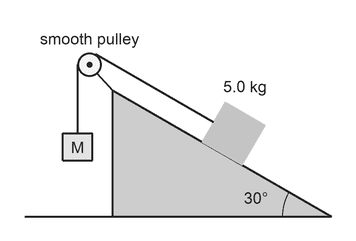
(a) Find the least and the greatest values of for which the block stays at rest.
(b) When , find the size and the direction of the friction force on the block.
- 251 mark
Question 25
(Hypothetical data.) A loaded sledge is sliding at down a straight track that slopes at to the horizontal when it runs off the snow on to a long patch of bare gravel on the same slope. The coefficient of kinetic friction between the runners and the gravel is . Taking , how far does the sledge slide on the gravel before it stops?
- 263 marks
Question 26
(Hypothetical data.) A crate is released from rest at the top of a loading ramp long, inclined at to the horizontal. It starts to slide at once, slides down the ramp, and then slides along the level floor (which joins the ramp smoothly) until it stops. The coefficient of kinetic friction between the crate and both the ramp and the floor is . Take and treat the crate as a small block.
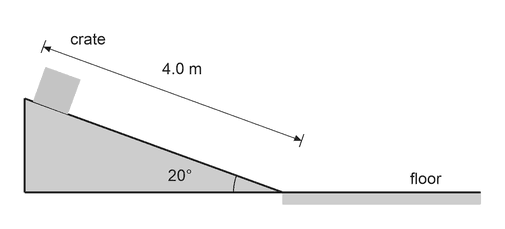
(a) Find the speed of the crate at the bottom of the ramp.
(b) How far does it slide along the floor?
(c) Find the total work done against friction over the whole trip, and compare it with the gravitational potential energy the crate loses.
- 273 marks
Question 27
(Hypothetical data.) A worker has to push a box on to a platform high. He can use either a ramp long or a steeper ramp long, each rising . On either ramp he pushes parallel to the ramp and moves the box at a steady speed. The coefficient of kinetic friction between the box and each ramp is . Take .
(a) Find the push needed on each ramp.
(b) Find the efficiency of each ramp, defined as the useful work divided by the work the worker does.
(c) Which ramp needs the smaller push, and which wastes less energy as heat? Explain the difference.
- 283 marks
Question 28
(Hypothetical data.) In a cement plant, sacks of cement are carried up to a loading platform by a conveyor belt inclined at to the horizontal. The coefficient of static friction between a sack and the belt is . A sack sits on the belt, as shown. Take .
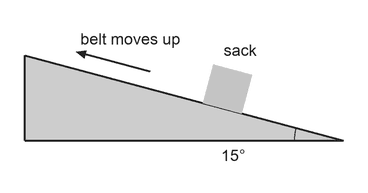
(a) When the belt is started, find the greatest acceleration up the slope that it can have without the sack slipping on it.
(b) While the belt is moving up, it is brought to rest. Find the greatest deceleration it can have without the sack slipping, and state the direction of the friction on the sack at that moment.
(c) What is the steepest angle at which such a belt could carry sacks up at a steady speed without slipping?
- 291 mark
Question 29
(Hypothetical data.) A small block is flicked up a rough plane inclined at to the horizontal. It slides up, stops for an instant, and then slides back down to its starting point. The coefficient of kinetic friction between the block and the plane is . The time the block takes to slide back down is how many times the time it took to slide up?
- 301 mark
Question 30
A steel ball is set rolling slowly across a thick rubber mat on a level floor. It rolls without slipping, yet it slows down and stops within a short distance. At such a low speed, air resistance is negligible. Which statement best explains why the ball slows down?
- 312 marks
Question 31
(Hypothetical data.) In a factory, a loaded trolley of total mass is given a push and let go at on a level concrete floor. It rolls before it stops. At this low speed air resistance is negligible, so take all the resistance as rolling friction. Take .
(a) Find the coefficient of rolling friction between the wheels and the floor.
(b) What steady horizontal push keeps the trolley moving at a constant speed? Compare it with the push needed to drag the same load in a crate along the floor, if the coefficient of kinetic friction for the crate is .
- 321 mark
Question 32
The rolling friction on a wheel is given by , where is the load on the wheel's axle, is the radius of the wheel, and depends only on the materials and their condition. A farmer doubles the load on his cart and also fits wheels of twice the radius, made of the same material and running on the same road. What happens to the rolling friction on the cart's wheels?
- 333 marks
Question 33
(Hypothetical data.) A railway goods wagon of mass stands on a level track. Its steel wheels have a radius of . The rolling friction is given by , where is the total load on the axles, is the radius of the wheels, and for steel wheels on steel rails. Take the whole weight of the wagon as the load, and take .
(a) Find the rolling friction on the wagon and the coefficient of rolling friction, .
(b) If the brakes locked every wheel, the wagon would have to be dragged along the rails against sliding friction with a coefficient of . How many times larger is this force?
(c) On a slight downward gradient, the wagon, once moving slowly, rolls on at a steady speed with no push and no brakes. Find this gradient in the form "1 in ".
- 342 marks
Question 34
(Hypothetical data.) A wheelchair ramp rises for every of horizontal distance, a common design limit for such ramps. A helper pushes a wheelchair and its user, of total mass , up the ramp at a steady speed, pushing parallel to the ramp. The coefficient of rolling friction is . Take .
(a) Find the push needed on the ramp.
(b) How many times the push needed on a level floor is this? Which force is the main one that the helper works against on the ramp?
- 351 mark
Question 35
Many cars have an anti-lock braking system (ABS), which stops the wheels from locking during hard braking, so the tyres keep turning instead of skidding. On a dry road, why does such a car usually stop in a shorter distance than a car whose wheels lock and skid?
- 363 marks
Question 36
(Hypothetical data.) A machine shaft of radius turns at revolutions per second in a bearing that carries a load of . Take the friction force at the rubbing surfaces as , where is the load. When the bearing is poorly lubricated, ; when it is kept well oiled, .
(a) Find the speed at which the surface of the shaft rubs past the bearing.
(b) Find the power wasted as heat in each case.
(c) How much energy does good lubrication save in one hour of running?
- 371 mark
Question 37
Friction is sometimes increased on purpose. Which of the following is NOT a way of increasing friction?
- 384 marks
Question 38
(Hypothetical data.) A loaded truck of mass comes down a long ghat road that slopes at to the horizontal. The driver uses the brakes to keep the truck at a steady (). Neglect air resistance and rolling friction, and take .
(a) Find the backward force along the road that the braking must produce on the truck.
(b) At what rate is energy turned into heat in the brakes?
(c) Find the heat produced in the brakes over of this road.
(d) Explain why such a long descent can make the brakes fail, and why drivers of heavy vehicles are told to use a low gear there.
- 392 marks
Question 39
In a bakery, trays of bread ride on a chain conveyor through an oven kept at about . The chain's sliding links are lubricated with a thin coat of graphite powder, not with ordinary machine oil. Give two reasons why graphite is the better lubricant here.
- 402 marks
Question 40
In an air-hockey table, air is blown up through many tiny holes in the table top, and a plastic puck glides a long way across it after a gentle push.
(a) Explain how the table reduces the friction on the puck.
(b) Which method of reducing friction described in this chapter does it use? Why does the puck still slow down slightly?
- 413 marks
Question 41
(Hypothetical data.) A lawn roller of weight is moved across a soft lawn at a steady speed by a force along its handle, which makes with the horizontal. The coefficient of rolling friction between the roller and the lawn is . The roller can be pushed, with the handle behind it, or pulled, with the handle in front of it, as shown.
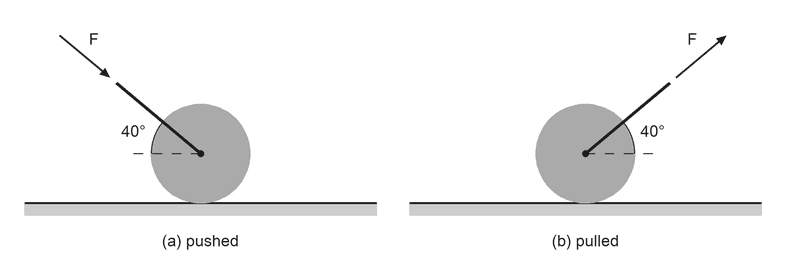
(a) Find when the roller is pushed and when it is pulled.
(b) Find the work the person does in moving the roller in each case, and how many per cent more work pushing takes.
- 421 mark
Question 42
(Hypothetical data.) A sledge of total weight is pulled at a steady speed across level snow by a rope at an angle above the horizontal, as shown. The coefficient of kinetic friction between the sledge and the snow is .

At which angle is the pull on the rope least, and how large is that pull?
- 433 marks
Question 43
(Hypothetical data.) A garden roller of radius and weight rests against the edge of a kerb high. It is pulled by a horizontal force applied at its axle, as shown.

(a) Find the least value of that will just lift the roller off the ground and over the edge of the kerb. (At that moment the ground no longer pushes up on the roller.)
(b) Find the least force for a roller of radius with the same weight, against the same kerb. What does this show about large rollers?
- 441 mark
Question 44
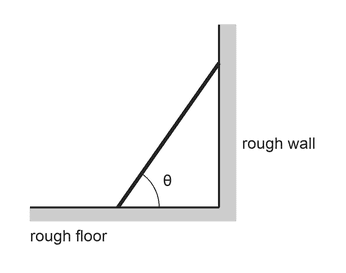
(Hypothetical data.) A uniform ladder stands on a rough floor and leans against a rough vertical wall, as shown. The coefficient of static friction is at the floor and at the wall. The angle between the ladder and the floor is slowly reduced. Taking the ladder to be about to slip at both ends at the same time, what is the least angle at which it can stand?
- 453 marks
Question 45
(Hypothetical data.) A uniform ladder long and of mass leans against a smooth vertical wall at to a polished floor, as shown. The coefficient of static friction between the ladder's feet and the floor is only . Take .
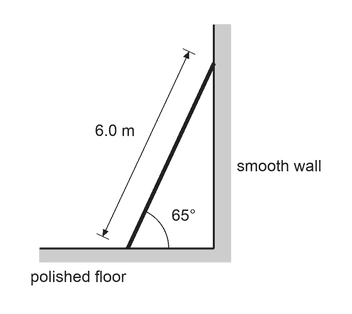
(a) Show that the ladder cannot stand on its own.
(b) A helper of mass now stands on a rung along the ladder from its foot. Show that the ladder can now stand, and explain why standing low down on the ladder helps.
- 461 mark
Question 46
A painter climbs slowly up a uniform ladder that rests on rough ground and leans against a smooth vertical wall. The ladder does not slip. As the painter climbs higher, which of the following increases?
- 471 mark
Question 47
‘We slip on a muddy road’. Why?
- 482 marks
Question 48
Is it unreasonable to expect a coefficient of friction to exceed unity?
- 492 marks
Question 49
There is a limit beyond which further polishing of a surface increases rather than decreases frictional force. Explain.
- 502 marks
Question 50
“When a person walks on a rough surface, the frictional force exerted by the surface on the person is opposite to the direction of his motion”. Is it true or false?
- 511 mark
Question 51
“It is easier to make a body roll over a surface than to slide”. Why?
- 522 marks
Question 52
“It is difficult to run fast on sand”. Why?
- 532 marks
Question 53
“It is difficult to move a cycle along the road with its brakes on”. Why?
- 542 marks
Question 54
Is a large brake on a bicycle more effective than a small one?
- 552 marks
Question 55
“A horse has to apply more force to start a cart than to keep it moving”. Why?
- 563 marks
Question 56
A force of 3 kg wt is sufficient to pull a block of 4 kg wt over a flat surface. What is the angle of friction?
- 573 marks
Question 57
A block of 10 kg is pulled at a constant speed on a rough horizontal plane by a force of 20 N. Calculate the coefficient of friction.
- 583 marks
Question 58
A body weighing 20 kg just slides down a rough inclined plane that rises 5 in 12. What is the coefficient of friction?
- 593 marks
Question 59
A motor car running at the rate of 7 m/s can be stopped by brakes in 10 m. Prove that the total resistance to the motion when the brakes are on is one-fourth of the weight of the car.
- 603 marks
Question 60
A block of mass 50 kg is placed on a horizontal table. A spring balance is attached to it and is pulled by gradually increasing the force. When the body just moves, the reading of the spring balance is 50 N. Find the coefficient of friction.
- 613 marks
Question 61
A block slides on ice with a velocity of 5 m/s comes to rest after moving through a distance of 13.5 m. Find the coefficient of friction?
- 623 marks
Question 62
A block of mass 5 kg is placed on a rough horizontal plane whose coefficient of friction is 0.3. Find the least horizontal force needed to move the block along the plane and the resultant of normal reaction and the force applied.
- 633 marks
Question 63
If the coefficient of friction between the tyres of a car and the road is , show that the maximum stopping distance of the car when moving with a velocity is .
- 643 marks
Question 64
A mass of 2 kg rests on a horizontal plane. The plane is gradually inclined until at an angle with the horizontal, the mass just begins to slide. What is the coefficient of static friction between the block and the surface?
- 653 marks
Question 65
A body of mass 2 kg collides with a horizontal weight spring of force constant . The body compresses the spring by 1 m from rest position. Find the speed of the block at the instant of collision. Given that the coefficient of kinetic friction between the body and the surface is 0.1.
- 663 marks
Question 66
A roller of mass 500 kg is attached by a light horizontal chain to a tractor of mass 500 kg. Assume the force of friction exerted by the ground to be 1000 N. If the system has a forward acceleration of , calculate (i) the total force required for the motion and (ii) the tension in the chain.
- 673 marks
Question 67
A block of mass 10 kg slides down an inclined plane of inclination 30° with an acceleration of . What is the coefficient of kinetic friction between the block and the plane?
- 683 marks
Question 68
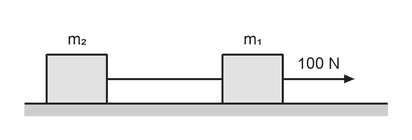
Two blocks of masses 22 kg and 18 kg are connected by a massless rope. They are dragged by a horizontal force of 100 N. The coefficient of friction between each block and the surface is 0.20. What is the magnitude of the acceleration of the system?
- 693 marks
Question 69
A horizontal force of 1 N is needed to keep a block of mass 0.25 kg sliding on a horizontal surface with a constant speed. Find the coefficient of sliding friction ().
- 703 marks
Question 70
A horizontal turn table rotates about its axis at the uniform rate of 2 revolutions per second. Find the maximum distance from the axis at which a small body will remain stationary on the turntable if the coefficient of static friction between the turntable and body is 0.8. Assume .
- 711 mark
Question 71
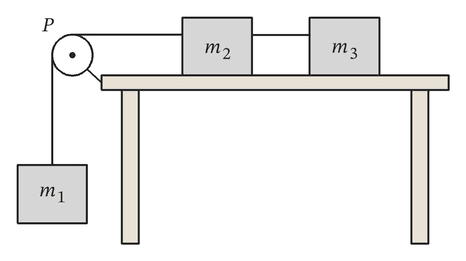
A system consists of three masses , and connected by a string passing over a pulley . The mass hangs freely and and are on a rough horizontal table (the coefficient of friction ). The pulley is frictionless and of negligible mass. The downward acceleration of mass is
(Assume )
- 721 mark
Question 72
A box of mass 2 kg is placed on the roof of a car. The box would remain stationary until the car attains a maximum acceleration. Coefficient of static friction between the box and the roof of the car is 0.2 and . This maximum acceleration of the car, for the box to remain stationary, is
- 731 mark
Question 73
Two masses A and B of 10 kg and 5 kg respectively are connected with a string passing over a frictionless pulley fixed at the corner of a table as shown in the given figure. The coefficient of static friction of A with table is 0.2. The minimum mass of C that may be placed on A to prevent it from moving is
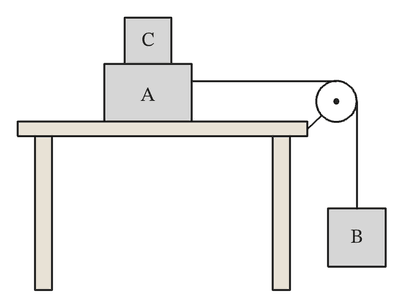
- 741 mark
Question 74
A uniform metal chain is placed on a rough table such that one end of chain hangs down over the edge of the table. When one-third of its length hangs over the edge, the chain starts sliding.
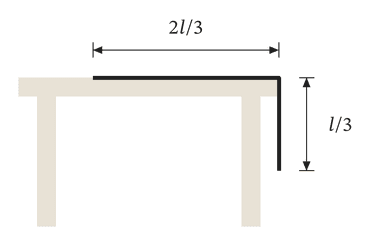
Then, the coefficient of static friction is
- 751 mark
Question 75
A block of mass is placed on a surface with a vertical cross-section given by . If the coefficient of friction is 0.5, the maximum height above the ground at which the block can be placed without slipping is
- 761 mark
Question 76
If a ladder weighing 250 N is placed against a smooth vertical wall having coefficient of friction between it and floor is 0.3, then what is the maximum force of friction available at the point of contact between the ladder and the floor?

- 771 mark
Question 77
The coefficient of static friction, , between block A of mass 2 kg and the table as shown in the given figure is 0.2. What would be the maximum mass value of block B so that the two blocks do not move? The string and the pulley are assumed to be smooth and massless. ()

- 781 mark
Question 78
When two surfaces are coated with a lubricant, then they
- 791 mark
Question 79
Block B lying on a table weighs . The coefficient of static friction between the block and the table is . Assume that the cord between B and the knot is horizontal. The maximum weight of the block A for which the system will be stationary is

- 801 mark
Question 80
Which activity is not based upon friction?
- 811 mark
Question 81
A block B is pushed momentarily along a horizontal surface with an initial velocity . If is the coefficient of sliding friction between B and the surface, block B will come to rest after a time
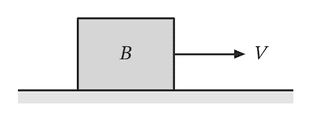
- 821 mark
Question 82
Which one of the following statements is incorrect?
- 831 mark
Question 83
A force of 20 N is applied on a body of mass 5 kg resting on a horizontal plane. The body gains a kinetic energy of 10 joule after it moves a distance of 2 m. The frictional force is
- 841 mark
Question 84
Consider a car moving along a straight horizontal road with a speed of 72 km/h. If the coefficient of kinetic friction between the tyres and the road is 0.5, the shortest distance in which the car can be stopped is []
- 851 mark
Question 85
A block of mass 50 kg slides over a horizontal distance of 1 m. If the coefficient of friction between their surfaces is 0.2, then work done against friction is
- 861 mark
Question 86
A block of mass 10 kg is placed on a rough horizontal surface having coefficient of friction . If a horizontal force of 100 N is acting on it, then acceleration of the block will be
- 871 mark
Question 87
It is easier to roll a barrel than pull it along the road. This statement is
- 881 mark
Question 88
A marble block of mass 2 kg lying on ice when given a velocity of 6 m/s is stopped by friction in 10 s. Then the coefficient of friction is
- 891 mark
Question 89
A coin of mass 10 g is placed over a book of length 50 cm. The coin is on the verge of sliding when one end of the book is lifted 10 cm up. The coefficient of static friction between the book and the coin is
- 901 mark
Question 90
A body of mass 10 kg is lying on a rough plane inclined at an angle of to the horizontal and the coefficient of friction is 0.5. The minimum force required to pull the body up the plane is
- 911 mark
Question 91
An insect crawls up a hemispherical surface very slowly. The coefficient of friction between the insect and the surface is . If the line joining the centre of the hemispherical surface to the insect makes an angle with the vertical, the maximum possible value of is given by
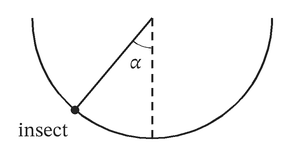
- 921 mark
Question 92
Two blocks A and B of masses kg and kg are kept on the table as shown in the given figure. The coefficient of friction between A and B is 0.2 and between B and the surface of the table is also 0.2. The maximum force F that can be applied on B horizontally so that the block A does not slide over the block B is [take ]

- 931 mark
Question 93
A block of mass 5 kg is (i) pushed in case (A) and (ii) pulled in case (B), by a force N, making an angle of with the horizontal, as shown in the given figure. The coefficient of friction between the block and floor is . The difference between the accelerations of the block, in case (B) and case (A) will be ()
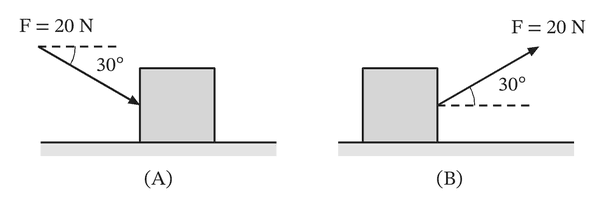
- 941 mark
Question 94
A block of mass slides along a floor while a force of magnitude is applied to it at an angle as shown in the given figure. The coefficient of kinetic friction is . Then, the block's acceleration '' is given by ( is acceleration due to gravity)
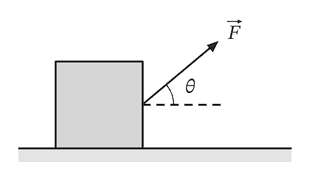
- 951 mark
Question 95
A solid cylinder of mass is wrapped with an inextensible light string and is placed on a rough inclined plane as shown in the given figure. The frictional force acting between the cylinder and the inclined plane is [The coefficient of static friction, , is 0.4]

- 961 mark
Question 96
Water falls from a height of 60 m at the rate of 15 kg/s to operate a turbine. The losses due to frictional force are 10% of the input energy. How much power is generated by the turbine ()
- 971 mark
Question 97
A system of two blocks of masses kg and kg is placed on a smooth table as shown in the given figure. The coefficient of static friction between two blocks is 0.5. The maximum horizontal force that can be applied to the block of mass so that the blocks move together will be
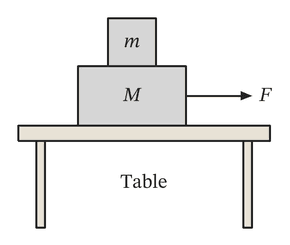
- 981 mark
Question 98
A block of mass slides down an inclined plane of angle with an acceleration . The value of coefficient of friction will be
- 991 mark
Question 99
As shown in the given figure, a 70 kg garden roller is pushed with a force of N at an angle with the horizontal. The normal reaction on the roller is ().
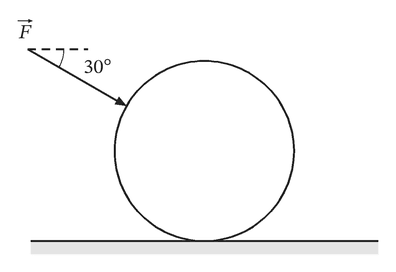
- 1001 mark
Question 100
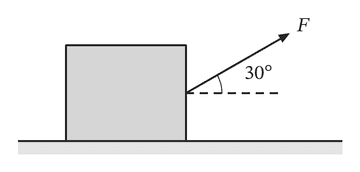
As shown in the given figure, a block of mass 10 kg lying on a horizontal surface is pulled by a force acting at an angle with horizontal. For , the block will just start to move for the value of , (given )
- 1011 mark
Question 101
Assertion: The velocity of a body at the bottom of an inclined plane of given height is more when it slides down the plane, compared to when it is rolling down the same plane.
Reason: In rolling down, a body acquires both kinetic energy of translation and rotation.
- 1021 mark
Question 102
Assertion: Use of ball bearings between two moving parts of machine is a common practice.
Reason: Ball bearings reduce vibrations and provide good stability.
- 1031 mark
Question 103
Assertion: The acceleration of a body down a rough inclined plane is greater than the acceleration due to gravity.
Reason: The body is able to slide on a inclined plane only when its acceleration is greater than acceleration due to gravity.
- 1041 mark
Question 104
Assertion: Angle of repose is equal to angle of limiting friction.
Reason: When the body is just at the point of motion, the force of friction in this stage is called as limiting friction.
- 1051 mark
Question 105
A small block of mass 0.1 kg lies on a fixed inclined plane which makes an angle with the horizontal. A horizontal force of 1 N acts on the block through its centre of mass as shown in the given figure. The block remains stationary if, ()

(A)
(B) and a frictional force acts on the block towards P
(C) and a frictional force acts on the block towards Q
(D) and a frictional force acts on the block towards Q
- 1061 mark
Question 106
A uniform chain of 6 m length is placed on a table such that a part of its length is hanging over the edge of the table. The system is at rest. The coefficient of static friction between the chain and the surface of the table is 0.5. The maximum length of the chain hanging from the table is ______ m.