
Question 443 marksMedium
Define angle of friction and angle of repose. Show that friction is a non-conservative force.
Confirming your payment
Sign up now and get 250 free tokens.
Friction · Question 44 of 48
Define angle of friction and angle of repose. Show that friction is a non-conservative force.
Solution:
Concept: The total force of a surface on a body is the resultant of the normal reaction and the friction. A force is conservative only if the work it does round every closed path is zero.
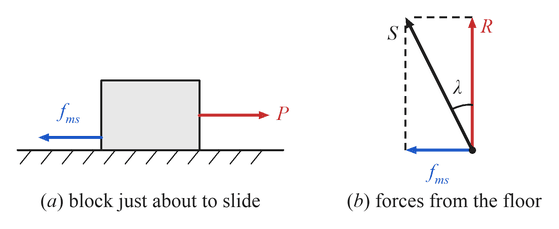
Step 1 — Define the angle of friction. When a body is just about to slide on a surface, the friction has its limiting value . The angle between the normal reaction and the resultant of and is called the angle of friction:
Step 2 — Define the angle of repose. The angle of repose is the angle that an inclined plane makes with the horizontal when a body placed on it just begins to slide down. At this angle the part of the weight down the plane equals the limiting friction:
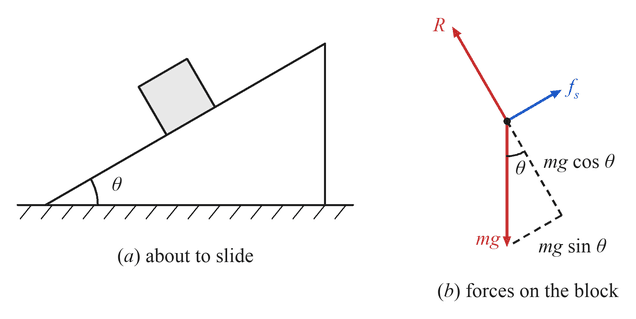
So the angle of repose equals the angle of friction.
Step 3 — Take a closed path. Let a block of mass be pushed a distance along a rough horizontal floor and then pushed back to its starting point. The kinetic friction on it has magnitude and always acts opposite to its motion.
Step 4 — Find the work done by friction. On the way out, friction acts backward while the block moves forward, so its work is . On the way back, the block moves backward and friction acts forward, so its work is again . The total over the closed path is:
For example, a block of mass with a coefficient of kinetic friction of 0.3, pushed out and back (), gives:
Step 5 — Conclude. The work done by friction round this closed path is not zero, and the energy lost appears as heat, which cannot be recovered as mechanical energy. Also, the work depends on the length of the path taken between two points, not just on the points themselves.
Therefore, the angle of friction is the angle between the normal reaction and the resultant of limiting friction and normal reaction, the angle of repose is the inclination at which a body just begins to slide down, and friction is non-conservative because the work it does round a closed path is not zero.