
Opening your dashboard
Class 11 Physics Chapter 26: Doppler Effect Solutions
33 textbook questions with step-by-step answers, free to read, for ISC 2026-27.
Get talked through Ch 26, not just shown the answer
Reading a finished solution is not the same as being able to do it. The AI tutor takes one question at a time and works it with you, in your own words, until you can.
- Ask it out loud, in your own words
- It gives you the next step, not the answer
- Stuck on part (ii)? Start there
33 questions with solutions
1–5 marks · Mixed difficulty
The first 29 solutions are on this page. This chapter is a long one, so the rest open on their own page to keep this one quick to load.
- 11 mark
Question 1
An observer moves towards a stationary source of sound of frequency . The apparent frequency heard by him is . If the velocity of sound in air is 332 m/s, then the velocity of the observer is
Solve with AIAnswer
(A) 166 m/s
(B) 664 m/s
- Correct
(C) 332 m/s
(D) 1328 m/s
Answer: (C) 332 m/s
Concept: For sound, the apparent frequency heard by a listener is , where is the true frequency, is the speed of sound in still air, and the velocities of the listener () and of the source () are taken positive in the direction in which the sound travels from the source to the listener, and negative against it.
Step 1 — Write the formula for this case. The source is at rest, so . The observer moves towards the source, that is, against the sound coming to the observer, so the observer's velocity is negative, . The formula becomes:
Step 2 — Put in the apparent frequency. The observer hears , so we cancel and solve for :
Step 3 — Check the other options. Each of the other speeds gives a different apparent frequency:
- (A) At 166 m/s, half the speed of sound, the observer would hear only , because the factor equals 1.5.
- (B) At 664 m/s, twice the speed of sound, the observer would meet the waves three times as often and hear .
- (D) At 1328 m/s, four times the speed of sound, the observer would hear .
Therefore, the observer must move at 332 m/s, the same as the speed of sound.
- 21 mark
Question 2
An observer is moving towards the stationary source of sound, then
Solve with AIAnswer
(A) Apparent frequency will be less than the real frequency
- Correct
(B) Apparent frequency will be greater than the real frequency
(C) Apparent frequency will be equal to real frequency
(D) Only the quality of sound will change
Answer: (B) Apparent frequency will be greater than the real frequency
Concept: When an observer moves towards a source at rest, the observer meets the wave crests more often than they would arrive while standing still, so the frequency heard goes up. For an observer moving towards the source with speed , the apparent frequency is .
Step 1 — Look at the factor. The factor is greater than 1 whenever is greater than zero, because the top is larger than the bottom.
Step 2 — Compare the frequencies. Since is multiplied by a number greater than 1, is greater than .
- (A) A lower apparent frequency is heard when the observer moves away from the source, not towards it.
- (C) The frequency stays the same only when there is no relative motion between the source and the observer along the line joining them.
- (D) The Doppler effect changes the frequency (pitch) of the sound; the quality depends on which overtones are present, and the motion does not change that.
Therefore, the apparent frequency is greater than the real frequency.
- 31 mark
Question 3
A whistle sends out 256 waves in a second. If the whistle approaches the observer with velocity 1/3 of the velocity of sound in air, the number of waves per second the observer will receive
Solve with AIAnswer
- Correct
(A) 384
(B) 192
(C) 300
(D) 200
Answer: (A) 384
Concept: When a source moves towards a stationary observer with speed , the waves it sends out are crowded together, and the observer receives waves per second, where is the speed of sound.
Step 1 — Put in the speed of the whistle. The whistle moves at , so the denominator becomes:
Step 2 — Find the number of waves received per second. We put this into the formula with :
- (B) This is , the number received if the whistle moved away at ; an approaching source gives more waves, not fewer.
- (C) 300 waves per second would need the ratio , which a source moving at only about 0.15 of the speed of sound would give, not one moving at of it.
- (D) 200 is fewer than 256, which could only happen if the whistle moved away from the observer.
Therefore, the observer receives 384 waves per second.
- 41 mark
Question 4
A sound source is moving towards a stationary observer with 1/10 of the speed of sound. The ratio of apparent to real frequency is
Solve with AIAnswer
- Correct
(A) 10/9
(B) 11/10
(C)
(D)
Answer: (A) 10/9
Concept: For a source moving towards a stationary observer with speed , the apparent frequency is , where is the speed of sound.
Step 1 — Write the ratio. We divide both sides by :
Step 2 — Put in the speed of the source. The source moves at :
- (B) This is the ratio for an observer moving towards a stationary source at , ; here it is the source that moves.
- (C) The Doppler factor is not squared; , which is larger than the true ratio .
- (D) is less than 1, which would mean a lower pitch, but an approaching source raises the pitch.
Therefore, the ratio of apparent to real frequency is .
- 51 mark
Question 5
A source and listener are both moving towards each other with speed , where is the speed of sound. If the frequency of the note emitted by the source is , the frequency heard by the listener would be nearly
Solve with AIAnswer
(A)
- Correct
(B)
(C)
(D)
Answer: (B)
Concept: For sound, the apparent frequency heard by a listener is , where is the true frequency, is the speed of sound in still air, and the velocities of the listener () and of the source () are taken positive in the direction in which the sound travels from the source to the listener, and negative against it.
Step 1 — Give the velocities their signs. The speed of sound is . The source moves towards the listener, in the direction of the sound, so its velocity is positive:
The listener moves towards the source, against the sound, so the listener's velocity is negative:
Step 2 — Put the values into the formula. The listener's motion raises the top of the fraction and the source's motion lowers the bottom:
- (A) This is , the result when only the source moves; it leaves out the listener's motion.
- (C) The frequency would stay only if there were no relative motion along the line joining them, but here the two approach each other.
- (D) This is more than the correct value: with both speeds the two factors are for the listener and for the source, and their product is .
Therefore, the listener hears a frequency of nearly .
- 61 mark
Question 6
A person carrying a whistle emitting continuously a note of 272 Hz is running towards a reflecting surface with a speed of 18 km/hour. The speed of sound in air is 345 m s. The number of beats heard by him is
Solve with AIAnswer
(A) 4
(B) 6
- Correct
(C) 8
(D) 3
Answer: (C) 8
Concept: For sound, the apparent frequency heard by a listener is , where is the true frequency, is the speed of sound in still air, and the velocities of the listener () and of the source () are taken positive in the direction in which the sound travels from the source to the listener, and negative against it.
Step 1 — Convert the running speed. We change km/h into m/s by multiplying by :
Step 2 — Picture the two sounds the person hears. The person hears the whistle directly at its true frequency, 272 Hz, because it moves with the person. The person also hears the echo from the wall, as the figure shows.
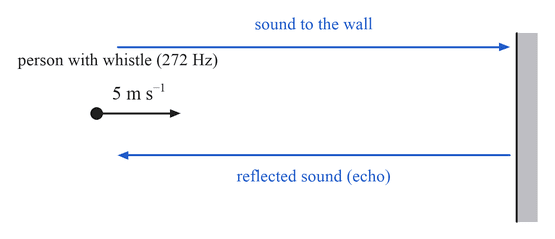
Step 3 — Find the frequency that reaches the wall. The whistle is a source moving towards the wall at 5 m/s, and the wall is at rest:
Step 4 — Find the frequency of the echo the person hears. The wall now acts as a source at rest sending out 276 Hz, and the person is a listener moving towards it at 5 m/s:
Step 5 — Count the beats. The number of beats per second is the difference between the two frequencies the person hears:
- (A) 4 beats per second is the difference between 276 Hz and 272 Hz; it forgets that the person is also a moving listener when the echo comes back.
- (B) 6 beats per second would need an echo of 278 Hz, but both changes together raise the echo to 280 Hz.
- (D) 3 beats per second would need an echo of 275 Hz, lower even than the 276 Hz that reaches the wall.
Therefore, the person hears 8 beats per second.
- 71 mark
Question 7
A source and an observer are moving towards each other with a speed equal to where is the speed of sound. The source is emitting sound of frequency . The frequency heard by the observer will be
Solve with AIAnswer
(A) Zero
(B)
(C)
- Correct
(D)
Answer: (D)
Concept: For sound, the apparent frequency heard by a listener is , where is the true frequency, is the speed of sound in still air, and the velocities of the listener () and of the source () are taken positive in the direction in which the sound travels from the source to the listener, and negative against it.
Step 1 — Give the velocities their signs. The source moves towards the observer, along the sound, so its velocity is positive:
The observer moves towards the source, against the sound, so the observer's velocity is negative:
Step 2 — Put the values into the formula. We substitute these velocities, and the speed of sound for :
- (A) A frequency of zero would mean no waves reach the observer, which happens only if the observer moves away from the source, with the sound, at the speed of sound.
- (B) The frequency stays only when there is no relative motion along the line joining them, but the two are approaching each other.
- (C) This is the result if both moved away from each other at : .
Therefore, the observer hears a frequency of .
- 81 mark
Question 8
A source of sound of frequency 500 Hz is moving towards an observer with velocity 30 m/s. The speed of sound is 330 m/s. The frequency heard by the observer will be
Solve with AIAnswer
- Correct
(A) 550 Hz
(B) 458.3 Hz
(C) 530 Hz
(D) 545.5 Hz
Answer: (A) 550 Hz
Concept: For a source moving towards a stationary observer with speed , the apparent frequency is , where is the speed of sound.
Step 1 — Put in the values. We use , and :
- (B) This is , the frequency heard when the source moves away at 30 m/s.
- (C) This simply adds the speed 30 to the frequency 500, which has no physical meaning.
- (D) This is , the result for an observer moving towards a stationary source at 30 m/s; a moving source changes the wavelength and gives a larger change.
Therefore, the observer hears 550 Hz.
- 91 mark
Question 9
A source of frequency 256 Hz is moving rapidly towards a wall with a velocity of 5 m/s. The speed of sound is 330 m/s. If the observer is between the wall and the source, then beats per second heard will be
Solve with AIAnswer
(A) 7.8 Hz
(B) 7.7 Hz
(C) 3.9 Hz
- Correct
(D) Zero
Answer: (D) Zero
Concept: Beats are heard only when two sounds of slightly different frequencies reach the ear together; the number of beats per second is the difference of the two frequencies. For a source moving towards a stationary observer with speed , the apparent frequency is .
Step 1 — Picture the two sounds. The observer hears the sound coming straight from the source and the sound reflected from the wall, as the figure shows.
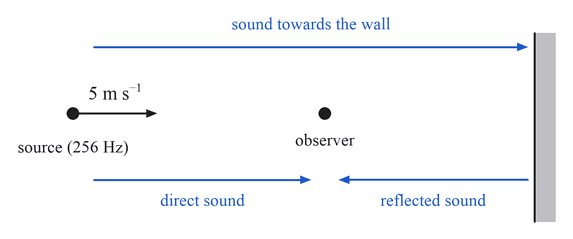
Step 2 — Find the frequency of the direct sound. The source moves towards the observer at 5 m/s:
Step 3 — Find the frequency of the reflected sound. The source also moves towards the wall at 5 m/s, so the wall receives the same raised frequency. The wall is at rest, so it sends this frequency back unchanged to the observer, who is at rest too:
Step 4 — Count the beats. The two frequencies are equal, so their difference is zero and no beats are heard.
- (A) 7.8 Hz is the beat frequency for an observer behind the source, on the side away from the wall, who hears a lowered direct sound (252.2 Hz) and a raised reflected sound (259.9 Hz).
- (B) 7.7 Hz is the same wrong arrangement worked with frequencies rounded first (259.9 − 252.2).
- (C) 3.9 Hz is the difference between the raised frequency and the true 256 Hz, but the observer never hears the true frequency, because the source is moving.
Therefore, the observer between the wall and the source hears zero beats per second.
- 101 mark
Question 10
What should be the velocity of a sound source moving towards a stationary observer so that apparent frequency is double the actual frequency (velocity of sound is )?
Solve with AIAnswer
(A)
(B)
- Correct
(C)
(D)
Answer: (C)
Concept: For a source moving towards a stationary observer with speed , the apparent frequency is , where is the speed of sound.
Step 1 — Write the condition. The apparent frequency is double the actual one, , so we cancel :
- (A) A source moving at the speed of sound would make the denominator zero: it keeps up with its own waves, and the formula no longer gives a finite frequency.
- (B) A source faster than sound outruns its waves, so the formula does not apply; it would give a negative frequency.
- (D) A source moving at gives , which is only .
Therefore, the source must move at , half the speed of sound.
- 111 mark
Question 11
A car sounding a horn of frequency 1000 Hz passes an observer. The ratio of frequencies of the horn noted by the observer before and after passing of the car is 11:9. If the speed of sound is , the speed of the car is
Solve with AIAnswer
- Correct
(A)
(B)
(C)
(D)
Answer: (A)
Concept: A source moving with speed is heard at while it approaches a stationary observer and at while it moves away.
Step 1 — Write the ratio. Dividing by cancels and :
Step 2 — Put in the given ratio and solve. We cross-multiply :
- (B) A car at would give the ratio , or 3 : 1, not 11 : 9.
- (C) A car at would give the ratio , or 3 : 2, not 11 : 9.
- (D) A car at the speed of sound would make infinitely large; no finite ratio would be heard.
Therefore, the speed of the car is .
- 121 mark
Question 12
A source and an observer move away from each other with a velocity of 10 m/s with respect to ground. If the observer finds the frequency of sound coming from the source as 1950 Hz, then actual frequency of the source is (velocity of sound in air = 340 m/s)
Solve with AIAnswer
(A) 1950 Hz
- Correct
(B) 2068 Hz
(C) 2132 Hz
(D) 2486 Hz
Answer: (B) 2068 Hz
Concept: For sound, the apparent frequency heard by a listener is , where is the true frequency, is the speed of sound in still air, and the velocities of the listener () and of the source () are taken positive in the direction in which the sound travels from the source to the listener, and negative against it.
Step 1 — Give the velocities their signs. The observer moves away from the source, in the direction of the sound, so the observer's velocity is positive:
The source moves away from the observer, against the sound, so its velocity is negative:
Step 2 — Put the values into the formula. We use and :
Step 3 — Solve for the actual frequency. We multiply both sides by :
- (A) 1950 Hz is the frequency heard; it would equal the actual frequency only if there were no relative motion along the line joining the source and the observer.
- (C) 2132 Hz would be heard as about , not 1950 Hz.
- (D) 2486 Hz would be heard as about , far above 1950 Hz.
Therefore, the actual frequency of the source is about 2068 Hz.
- 131 mark
Question 13
A small source of sound moves on a circle as shown in the given figure and an observer is standing on . Let , and be the frequencies heard when the source is at , and respectively. Then
 Solve with AI
Answer
(A)
- Correct
(B)
(C)
(D)
Answer: (B)
Concept: Only the part of the source's velocity along the line joining the source to the observer changes the frequency heard. A source moving towards the observer is heard above its true frequency , one moving away is heard below , and one moving at right angles to that line is heard at itself.
Step 1 — Look at the circle from above. The arrows show that the source moves along the far side of the circle, through , towards the observer's side, and along the near side, through , back away from it. Seen from above, the velocity at each point is along the circle, at right angles to the radius:
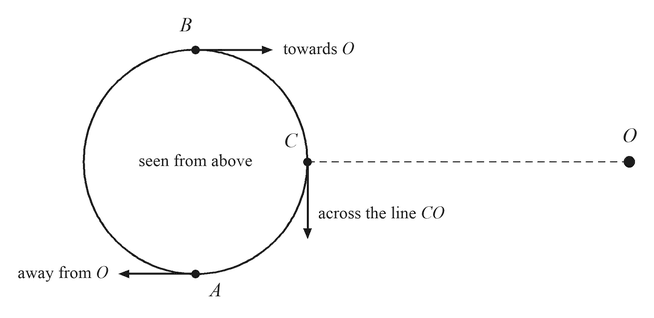
Step 2 — Judge each position. At the source moves towards the observer, so . At its velocity is at right angles to the line , so it moves neither towards nor away from , and . At it moves away from the observer, so .
Step 3 — Put them in order. Combining the three results gives with .
- (A) This puts highest, but at the source is moving away from , which gives the lowest frequency of the three.
- (C) This makes and equal, but the source moves towards at one point and away at the other.
- (D) This puts lowest, but at the source neither approaches nor recedes, so is the true frequency, above .
Therefore, .
- 141 mark
Question 14
A source and an observer approach each other with same velocity 50 m/s. If the apparent frequency is 435 s, then the real frequency is
Solve with AIAnswer
- Correct
(A) 320 s
(B) 360 s
(C) 390 s
(D) 420 s
Answer: (A) 320 s
Concept: For sound, the apparent frequency heard by a listener is , where is the true frequency, is the speed of sound in still air, and the velocities of the listener () and of the source () are taken positive in the direction in which the sound travels from the source to the listener, and negative against it.
Step 1 — Choose the speed of sound. The question does not give the speed of sound, so we take , a value often used for air (sound travels at about in air at and about at ).
Step 2 — Give the velocities their signs. The source moves towards the observer, along the sound, so its velocity is positive:
The observer moves towards the source, against the sound, so the observer's velocity is negative:
Step 3 — Put the values into the formula. The apparent frequency is 435 s:
Step 4 — Solve for the real frequency. We multiply both sides by :
This is nearest to 320 s. With the result is about 323.5 s, which is still nearest to 320 s.
- (B) A real frequency of 360 s would be heard as about , not 435.
- (C) A real frequency of 390 s would be heard as about 528 s.
- (D) A real frequency of 420 s would be heard as about 569 s.
Therefore, the real frequency is about 320 s.
- 151 mark
Question 15
A source emits a sound of frequency of 400 Hz, but the listener hears it to be 390 Hz. Then
Solve with AIAnswer
(A) The listener is moving towards the source
(B) The source is moving towards the listener
- Correct
(C) The listener is moving away from the source
(D) The listener has a defective ear
Answer: (C) The listener is moving away from the source
Concept: When the distance between a source and a listener grows, fewer wave crests reach the listener each second than the source sends out, so the frequency heard falls; when the distance shrinks, it rises.
Step 1 — Compare the frequencies. The listener hears 390 Hz, which is less than the true 400 Hz.
Step 2 — Decide what motion causes this. A lower frequency means the source and the listener are moving apart. Of the options given, only (C) describes such a motion.
- (A) A listener moving towards the source meets the crests more often and hears more than 400 Hz.
- (B) A source moving towards the listener crowds its waves together, so the listener hears more than 400 Hz.
- (D) The frequency of the sound reaching the ear is set by the waves that arrive; a drop of 10 Hz is exactly what motion apart produces, and nothing in the question points to a fault in the ear.
Note: A source moving away from the listener would also lower the frequency, but that is not one of the options.
Therefore, the listener is moving away from the source.
- 161 mark
Question 16
Name the main factors on which the Doppler effect depend.
Solve with AIWritten solution
Solution:
Concept: The Doppler effect is the change in the frequency heard when the source of sound, the listener or the medium moves.
Step 1 — List what the apparent frequency depends on. The formula for the apparent frequency contains the true frequency and three velocities, all measured along the line joining the source and the listener.
Step 2 — Name the factors. The Doppler effect depends on (i) the velocity of the source, (ii) the velocity of the listener, (iii) the velocity of the medium (wind), and (iv) the true frequency of the source. The speed of sound in the medium also enters the formula.
Therefore, the Doppler effect depends on the velocities of the source, the listener and the medium, and on the true frequency of the source.
- 171 mark
Question 17
Write down the expression for the apparent frequency heard when the listener moves away from the source and the source moves towards the listener.
Solve with AIWritten solution
Solution:
Concept: In the general formula , the velocities are positive in the direction in which the sound travels from the source to the listener.
Step 1 — Give the velocities their signs. The listener moves away from the source, that is, in the direction of the sound, so is positive. The source moves towards the listener, also in the direction of the sound, so is positive.
Step 2 — Write the expression. Both velocities are positive, so the general expression is used as it stands:
Here is the speed of sound, the speed of the listener, the speed of the source and the true frequency.
Therefore, .
- 181 mark
Question 18
What is red shift?
Solve with AIWritten solution
Solution:
Concept: When a source of light moves away from an observer, the light received has a lower frequency and a longer wavelength than the light emitted.
Step 1 — Describe the effect. The spectral lines in the light from a star or galaxy that is receding from the Earth appear at longer wavelengths than the same lines from a source at rest in the laboratory.
Step 2 — Name it. Since red is the long-wavelength end of the visible spectrum, this shift is called the red shift.
Note: For distant galaxies most of the red shift comes from the expansion of space itself while the light travels (the cosmological red shift); for nearby stars it is the ordinary Doppler shift.
Therefore, red shift is the shift of the spectral lines of a receding star or galaxy towards the red (longer-wavelength) end of the spectrum.
- 191 mark
Question 19
Mention an application of Doppler effect in sound.
Solve with AIWritten solution
Solution:
Concept: When sound is reflected from a moving object, the reflected sound comes back with a changed frequency, and the size of the change depends on the speed of the object.
Step 1 — Describe the method. Sound (or ultrasound) of known frequency is sent towards the moving object, and the frequency of the reflected sound is measured. The difference between the two frequencies gives the speed of the object, and whether it rises or falls tells us whether the object is approaching or moving away.
Step 2 — Give examples. SONAR uses this to find the speed of a submarine under water, and Doppler ultrasound uses it to measure the speed of blood flowing in arteries.
Note: Police speed guns for road traffic use radio waves or laser light, not sound.
Therefore, an application is finding the speed of a moving object, such as a submarine by SONAR, from the change in frequency of the sound reflected from it.
- 201 mark
Question 20
Name the effect used to conclude that ‘our universe is expanding’.
Solve with AIWritten solution
Solution:
Concept: Light from a source moving away from us is shifted towards longer wavelengths (red shift).
Step 1 — State the observation. The spectral lines in the light from distant galaxies are shifted towards the red end of the spectrum, and the farther a galaxy is, the larger its red shift.
Step 2 — State the conclusion. So the galaxies are moving away from us, and from one another, which means the universe is expanding.
Note: For distant galaxies most of the red shift comes from the expansion of space itself while the light travels (the cosmological red shift), not from the galaxies moving through space; at this level it is treated with the Doppler formula for light.
Therefore, the red shift of light from galaxies, an effect of the Doppler kind for light, shows that our universe is expanding.
- 212 marks
Question 21
What is Doppler effect in sound?
Solve with AIWritten solution
Solution:
Concept: The pitch of a sound depends on its frequency, the number of wave crests reaching the ear each second.
Step 1 — Give the definition. The Doppler effect is the apparent change in the frequency of a sound heard by a listener when there is relative motion between the source of sound and the listener. The motion of the medium (wind) also changes the frequency heard.
Step 2 — Give an everyday example. The whistle of an engine sounds higher in pitch while the train approaches a platform and lower after it has passed.
Therefore, the Doppler effect in sound is the apparent change in frequency caused by relative motion between the source and the listener.
- 222 marks
Question 22
“Doppler effect in sound is asymmetric”. Why?
Solve with AIWritten solution
Solution:
Concept: For sound, a source moving towards a listener at rest gives , while a listener moving towards a source at rest gives , where is the speed of sound and the speed of the moving body.
Step 1 — Explain why the two cases differ. A moving source changes the wavelength of the sound in the air, because it crowds its waves together. A moving listener leaves the wavelength unchanged but meets the waves more often. The two mechanisms are different, so they give different results.
Step 2 — Compare them with numbers. Take and . A moving source gives:
A moving listener gives:
Step 3 — Draw the conclusion. The frequencies differ although the relative velocity is the same in both cases. For sound it matters which of the two moves relative to the air.
Therefore, the Doppler effect in sound is asymmetric: the source approaching the listener and the listener approaching the source with the same speed give different apparent frequencies.
- 232 marks
Question 23
What is the effect of wind on Doppler effect in sound?
Solve with AIWritten solution
Solution:
Concept: Sound travels at speed relative to the air. If the air itself moves, the speed of sound relative to the ground changes.
Step 1 — Find the new speed of sound. If the wind blows with velocity in the direction in which the sound travels from the source to the listener, the sound moves over the ground at (against the wind, ).
Step 2 — Write the apparent frequency. We replace by in the usual formula:
Here and are the velocities of the listener and the source, positive in the direction of the sound.
Note: If the source and the listener are both at rest, wind alone does not change the frequency heard; it changes the frequency only when the source or the listener moves.
Therefore, wind changes the speed of sound to , and the apparent frequency becomes .
- 242 marks
Question 24
A whistle is rotated in a horizontal circle. Is there any change in the sound of the whistle heard by a person standing (i) at the centre of the circle and (ii) outside the circle.
Solve with AIWritten solution
Solution:
Concept: The frequency heard changes only when the source has a part of its velocity along the line joining it to the listener.
Step 1 — Picture the two listeners. The figure shows the whistle on its circle, the person at the centre and the person outside.

Step 2 — Answer part (i). For the person at the centre, the whistle's velocity is always along the circle, at right angles to the radius joining it to that person. The whistle never comes nearer or goes farther, so there is no change in the frequency heard at the centre.
Step 3 — Answer part (ii). For the person outside, the whistle comes towards that person during one half of each turn and goes away during the other half. The person hears the pitch rise above the true frequency and fall below it, again and again.
Therefore, (i) the person at the centre hears no change in frequency, and (ii) the person outside hears the frequency rise and fall periodically.
- 252 marks
Question 25
The source of sound, observer and the medium are all moving in the same direction with velocities , and respectively. is the actual frequency of sound and is the velocity of sound. Determine the apparent frequency.
Solve with AIWritten solution
Solution:
Concept: For a medium at rest, , with velocities positive in the direction of the sound. When the medium moves, the sound is carried along with it.
Step 1 — Picture the motion. We take all three velocities in the direction in which the sound travels from the source to the observer, as in the figure.

Step 2 — Find the speed of sound relative to the ground. The medium carries the sound with it, so the sound moves over the ground at .
Step 3 — Write the apparent frequency. We replace by in the formula:
Therefore, the apparent frequency is .
- 262 marks
Question 26
The sound heard from the whistle of a train approaching the platform is shriller than that from a receding train. Why?
Solve with AIWritten solution
Solution:
Concept: A shriller sound has a higher frequency (pitch). For a source moving with speed , the apparent frequency is while it approaches a listener at rest and while it moves away.
Step 1 — Approaching train. The denominator is less than , so is greater than .
Step 2 — Receding train. The denominator is greater than , so is less than .
Step 3 — Compare. So : the approaching whistle is heard at a higher frequency than the receding one.
Therefore, because of the Doppler effect, the approaching train's whistle is heard at a higher frequency and sounds shriller than that of a receding train.
- 272 marks
Question 27
With what velocity a listener should move towards a stationary source of sound such that the apparent frequency of the sound heard is double of its actual value?
Solve with AIWritten solution
Solution:
Concept: For a listener moving towards a stationary source with speed , the apparent frequency is , where is the speed of sound.
Step 1 — Write the condition. The frequency heard is double the actual value, :
Step 2 — Solve for the speed. We cancel and multiply both sides by :
Therefore, the listener must move towards the source with a speed equal to the speed of sound.
- 282 marks
Question 28
A listener moves away from a stationary source of sound in the same direction as sound wave. If the speed of the listener is same as that of sound, will the person hear any sound?
Solve with AIWritten solution
Solution:
Concept: For a listener moving away from a stationary source with speed , the apparent frequency is , where is the speed of sound.
Step 1 — Put in the listener's speed. The listener moves at the speed of sound, :
Step 2 — Explain the result. The listener travels along with the wave crests, so no new crest ever overtakes the listener. No sound waves reach the listener's ear.
Therefore, the person will not hear any sound, because the apparent frequency is zero.
- 292 marks
Question 29
The actual frequency of sound emitted from a source of sound moving with a velocity is . What is the apparent frequency heard by a stationary listener if the source is moving (i) towards the listener and (ii) away from the listener?
Solve with AIWritten solution
Solution:
Concept: A moving source crowds its waves together in front of it and spreads them out behind it, so the wavelength reaching a listener at rest becomes in front and behind, where is the speed of sound.
Step 1 — Answer part (i). In front of the source the wavelength is shorter, so the listener hears:
Step 2 — Answer part (ii). Behind the source the wavelength is longer, so the listener hears:
Therefore, the apparent frequency is (i) when the source approaches and (ii) when it moves away.
- 302 marks
Question 30
A listener and a source of sound are moving with the same velocity in the same direction as that of the sound wave. Will there be any Doppler effect?
- 313 marks
Question 31
What is Doppler effect? Name the factors on which Doppler effect depend. Mention the applications of Doppler effect.
- 323 marks
Question 32
Write down the expressions for the apparent frequency of sound heard by a listener when both the source and the listener are in motion.
- 335 marks
Question 33
Derive the general expression for the apparent frequency of sound heard when both the source and the listener are moving and hence, obtain the expressions for the apparent frequency for the following cases:
(i) The listener is at rest and source is in motion.
(ii) The listener is in motion and source is at rest.
(iii) Both the source and the listener are in motion.
What Class 11 Physics Ch 26 covers
The sections of the chapter, in the order the book takes them. Every question above comes from one of these.
- 01Doppler Effect for Sound
- 02Apparent Frequency - General Expression
- 03Doppler Effect for Light and Red Shift
- 04Applications of Doppler Effect
More ways to study this chapter
The same chapter asked three other ways. Practise it, revise it, and see what the board has set on Ch 26 before.
Class 11 Physics Ch 26 questions students ask
How many questions are there in Class 11 Physics Ch 26?
33 questions. Every one is solved step by step on this page.
Are these Class 11 Physics solutions free?
Yes. Every question and its full working is free to read, with no account needed.
Can I download the Class 11 Physics Ch 26 solutions as a PDF?
There is no PDF to download. Every solution is on this page instead, which means it is searchable, always the current syllabus, and readable on a phone. Use your browser's print option if you want it on paper.