
Question 91 markMCQMedium
A source of frequency 256 Hz is moving rapidly towards a wall with a velocity of 5 m/s. The speed of sound is 330 m/s. If the observer is between the wall and the source, then beats per second heard will be
Confirming your payment
Sign up now and get 250 free tokens.
Doppler Effect · Question 9 of 33
A source of frequency 256 Hz is moving rapidly towards a wall with a velocity of 5 m/s. The speed of sound is 330 m/s. If the observer is between the wall and the source, then beats per second heard will be
(A) 7.8 Hz
(B) 7.7 Hz
(C) 3.9 Hz
(D) Zero
Answer: (D) Zero
Concept: Beats are heard only when two sounds of slightly different frequencies reach the ear together; the number of beats per second is the difference of the two frequencies. For a source moving towards a stationary observer with speed , the apparent frequency is .
Step 1 — Picture the two sounds. The observer hears the sound coming straight from the source and the sound reflected from the wall, as the figure shows.
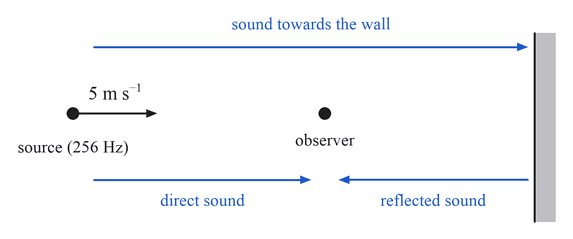
Step 2 — Find the frequency of the direct sound. The source moves towards the observer at 5 m/s:
Step 3 — Find the frequency of the reflected sound. The source also moves towards the wall at 5 m/s, so the wall receives the same raised frequency. The wall is at rest, so it sends this frequency back unchanged to the observer, who is at rest too:
Step 4 — Count the beats. The two frequencies are equal, so their difference is zero and no beats are heard.
Therefore, the observer between the wall and the source hears zero beats per second.