
Question 313 marksEasy
What is Doppler effect? Name the factors on which Doppler effect depend. Mention the applications of Doppler effect.
Confirming your payment
Sign up now and get 250 free tokens.
Doppler Effect · Question 31 of 33
What is Doppler effect? Name the factors on which Doppler effect depend. Mention the applications of Doppler effect.
Solution:
Concept: The frequency (pitch) heard depends on how many wave crests reach the listener each second; motion of the source, the listener or the medium changes this number.
Step 1 — Define the Doppler effect. The Doppler effect is the apparent change in the frequency of a wave (sound or light) received by an observer when there is relative motion between the source and the observer. For example, a train's whistle sounds higher while the train approaches and lower after it has passed. The figure shows why a moving source changes the wavelength: its crests are crowded in front of it and spread out behind it.
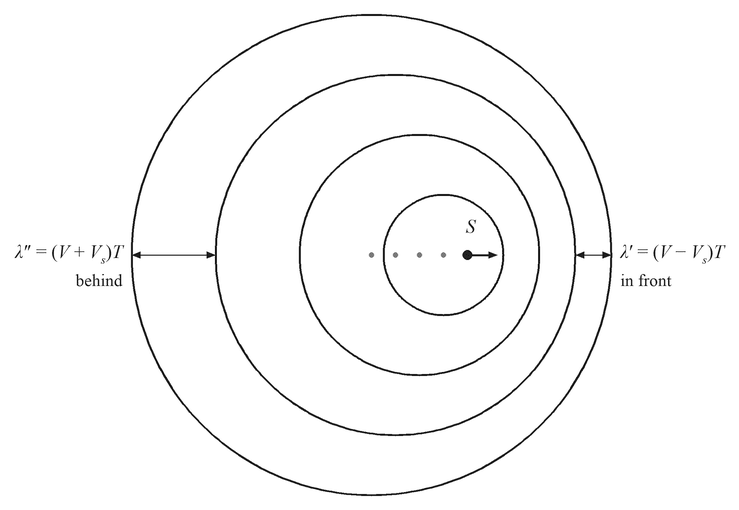
Step 2 — Name the factors. For sound, the apparent frequency depends on:
Step 3 — Mention the applications. The Doppler effect is used:
Therefore, the Doppler effect is the apparent change in frequency caused by relative motion; it depends on the velocities of the source, the listener and the medium and on the source frequency, and it is used in RADAR, SONAR, medical ultrasound, astronomy and satellite tracking.