
Opening your dashboard
Class 11 Physics Chapter 26 Doppler Effect: Practice Questions
84 questions on Chapter 26, each worked through on its own page with the AI tutor. Class 11 Physics, ICSE 2026-27.
84 questions
1–4 marks · Mixed difficulty
- 11 mark
Question 1
A small loudspeaker moves at a steady speed along a straight line through still air, sending out a steady note. Compared with when it is at rest, which statement is correct for the sound in the air straight ahead of it?
- 23 marks
Question 2
(Hypothetical data.) A quiet electric car plays a steady warning tone from a speaker at its front while it moves along a straight road at . The air is still, and the speed of sound in air is .
(a) Find the wavelength of the tone in the air directly ahead of the car and directly behind it.
(b) Does the sound travel through the air faster ahead of the car than behind it? Give a reason.
(c) Find the frequency heard by a pedestrian waiting at a crossing far ahead, in the car's line of motion.
- 31 mark
Question 3
A student runs at a steady speed straight towards a loudspeaker that is fixed in place and plays a steady note in still air. Which statement correctly explains why the student hears a higher pitch than a friend standing still beside the student's path?
- 43 marks
Question 4
(Hypothetical data.) A locator beacon resting on the sea floor sends out sound of frequency . A search boat tows an underwater listening device (a hydrophone) along a straight line that passes over the beacon, just above the sea floor. Take the speed of sound in sea water as , and treat the beacon and the water as at rest.
(a) On one run the hydrophone picks up the beacon's sound at . Is the hydrophone moving towards or away from the beacon, and at what speed?
(b) On the return run it picks up . Find its speed and direction now.
(c) Find the fractional change of frequency in (a) as a percentage. Compare it with the change that the same speed would cause in air, where sound travels at , and explain the difference.
- 51 mark
Question 5
A source moves straight towards a stationary listener in still air, and the listener hears a frequency higher than the true frequency. If, instead, the source were at rest and the listener moved straight towards it with the same speed, the frequency heard would be
- 63 marks
Question 6
(Hypothetical data.) A buzzer of frequency is fixed on a test sled that runs at a steady speed along a straight track through still air. Measurements show that the crests of its sound are apart directly ahead of the sled and apart directly behind it, as in the figure.
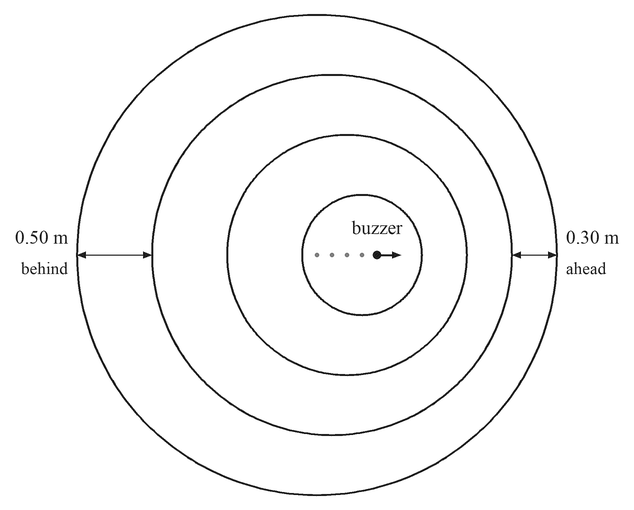
(a) Find the speed of sound in the air.
(b) Find the speed of the sled.
(c) Find the frequency heard by a stationary listener far ahead of the sled, in its line of motion.
- 71 mark
Question 7
(Hypothetical data.) A lorry reversing at a steady straight towards a worker standing behind it sounds its reversing alarm, which gives one short beep every . The air is still and sound travels at . The time between successive beeps heard by the worker is about
- 83 marks
Question 8
(Hypothetical data.) A bus moves at a steady straight towards a stationary listener, sounding its horn at . The air is still.
(a) Find the frequency heard by the listener on a winter morning at , when sound travels at .
(b) Find the frequency heard on a summer afternoon at , when sound travels at .
(c) Explain why the rise in pitch is greater on the colder day.
- 94 marks
Question 9
(Hypothetical data.) A train moves at a steady along a straight track, sounding its horn at . A listener L stands from the track, opposite the point P of the track, as shown. The air is still and sound travels at .
When a source does not move straight towards or away from the listener, only the part of its velocity along the line joining it to the listener changes the frequency: , where is the angle between the source's velocity and the line from the source to the listener at the moment the sound is sent out.
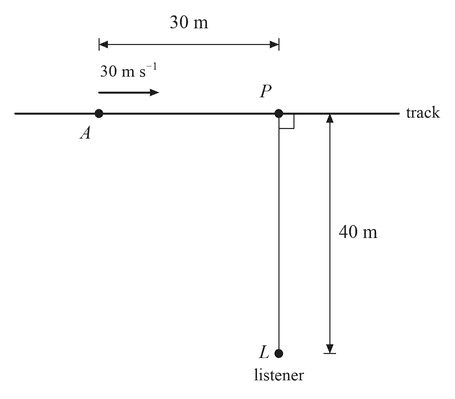
(a) Find the frequency the listener hears for the sound sent out when the horn is at A, before P.
(b) Find the frequency the listener hears for the sound sent out when the horn is at B, past P, and for the sound sent out when the horn is at P.
(c) Explain why the listener hears the pitch fall smoothly as the train passes, and not suddenly. How long after the horn passes P does the sound reach the listener?
- 103 marks
Question 10
(Hypothetical data.) A loudspeaker plays a low note of and a tone at the same time. The low note makes the speaker cone move back and forth in simple harmonic motion with an amplitude of , and the cone sends out the tone while it moves. A listener sits on the speaker's axis, in front of it. Take the speed of sound in still air as .
(a) Find the greatest speed of the cone.
(b) Find the highest and the lowest frequency of the tone that reach the listener.
(c) How many times each second does the pitch of the tone rise to its highest value?
- 111 mark
Question 11
A small siren of frequency moves straight away from a stationary listener through still air in which sound travels at speed . As the siren's speed is made closer and closer to (but always less than ), the frequency the listener hears gets closer and closer to
- 123 marks
Question 12
(Hypothetical data.) A student standing on top of a tall tower releases a small beeper that sends out a steady tone. The beeper falls freely from rest beside the tower. Take and the speed of sound in still air as , and neglect air resistance.
(a) Find the frequency the student hears for the sound sent out by the beeper after its release.
(b) At what time after the release does the student hear that sound?
(c) While the beeper is falling, does the pitch the student hears stay the same, rise or fall? Give a reason.
- 131 mark
Question 13
(Hypothetical data.) A small loudspeaker on a trolley sends out a steady note while the trolley runs at a steady along a straight track, directly towards a microphone fixed at the end of the track. The air is still and sound travels at . Before the trolley reaches it, the microphone picks up a sound whose
- 143 marks
Question 14
(Hypothetical data.) A source of frequency and a listener are on a straight line in still air, where sound travels at .
(a) The source is at rest and the listener moves towards it at speed . Write the frequency heard as a function of , and say what shape the graph of frequency heard against has.
(b) The listener is at rest and the source moves towards the listener at speed . Do the same.
(c) Sketch both graphs for from to , and find the frequency heard in each case when .
- 151 mark
Question 15
In the general expression for the apparent frequency of sound, , the quantity is
- 163 marks
Question 16
(Hypothetical data.) A fire engine moves at straight towards a listener standing on a straight road, sounding its siren at . A steady wind of blows along the road from the listener towards the fire engine. The speed of sound in still air is .
(a) Find the frequency the listener hears.
(b) Find the frequency the listener would hear if the air were still, and say by how much the wind changes it.
(c) Find the spacing of the crests of the siren's sound between the fire engine and the listener, with the wind and without it.
- 171 mark
Question 17
The speed of sound in still air is . For which one of these situations can the general expression for the apparent frequency of sound NOT be used as it stands?
- 183 marks
Question 18
(Hypothetical data.) On a cold, still winter night, a train moving at sounds a siren of frequency . A car moves at straight towards the train along a road that runs right beside the track, and a frequency meter in the car shows the siren's sound as .
(a) Find the speed of sound in the air that night.
(b) Find the wavelength of the siren's sound in the air in front of the train.
(c) Was the air colder or warmer than , at which sound travels at about ? Give a reason.
- 193 marks
Question 19
(Hypothetical data.) Two cyclists ride towards each other along a straight path in still air, one at and the other at . The faster cyclist rings a bell that gives a steady note of . Take the speed of sound as .
(a) Use the general expression to find the exact frequency heard by the slower cyclist.
(b) When both speeds are much smaller than , the expression is often replaced by , where is the speed at which the two come closer together. Show how this follows from the general expression, and use it to find the frequency.
(c) Find the difference between the two answers as a percentage of the exact answer, and say when the approximation should not be used.
- 201 mark
Question 20
(Hypothetical data.) A delivery drone flies at a steady straight away from a cyclist, sounding a warning beeper of frequency . The cyclist rides after it along the same straight line and hears the beeper at . The air is still and sound travels at . The cyclist's speed is about
- 211 mark
Question 21
A source S of frequency and a listener L move along one straight line in still air, where sound travels at . In which case does L hear a frequency lower than ?
- 223 marks
Question 22
(Hypothetical data.) Car A moves at and car B at towards each other along a straight road. Each car sounds a horn of the same frequency, . The air is still and sound travels at .
(a) Find the frequency at which the driver of A hears B's horn.
(b) Find the frequency at which the driver of B hears A's horn.
(c) Which driver hears the higher frequency, although the two cars approach each other at the same in both cases? Explain why.
- 234 marks
Question 23
(Hypothetical data.) A source S and a listener L move towards each other along a straight line in still air, S at and L at . When they are apart, S starts to sound a horn of frequency , and keeps it on for exactly . Take the speed of sound as .
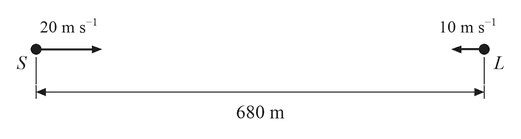
(a) Measuring time from the moment the horn starts, at what times does L begin and stop hearing the horn?
(b) For how long does L hear the horn, and how many complete waves does L receive?
(c) Hence find the frequency L hears, and check your answer with the general expression.
- 243 marks
Question 24
(Hypothetical data.) A wind blows steadily at . Hot-air balloon drifts with the wind, so it moves at in the direction of the wind, and its pilot sounds a horn of frequency . A hiker stands on a hilltop at the same height, directly downwind of . A second balloon , also drifting with the wind, is between them. The speed of sound in still air is .
(a) Find the frequency the hiker hears.
(b) Find the frequency the pilot of hears.
(c) Explain both results by thinking about how , and the hiker move relative to the air.
- 254 marks
Question 25
(Hypothetical data.) An ambulance moving at , with its siren sounding at , overtakes a car moving at in the same direction along a straight road. The air is still and sound travels at .
(a) Find the frequency the car's driver hears while the ambulance is coming up behind the car.
(b) Find the frequency the driver hears after the ambulance has passed the car.
(c) Find the drop in frequency the driver hears as the ambulance passes, and compare it with the drop heard by a person standing at the roadside as the ambulance passes.
- 261 mark
Question 26
The spectrum of a star that is moving away from the Earth contains two lines whose wavelengths in the laboratory are and . In the star's light the line is shifted by towards the red. (Hypothetical data.) Taking , the shift of the line is
- 271 mark
Question 27
At the moment it is observed, a star is moving at exactly at right angles to the line joining it to the Earth. The first-order Doppler formula for light, , uses the velocity along the line joining the source and the observer. Taking , according to this formula the star's spectral lines at that moment are
- 282 marks
Question 28
The Andromeda galaxy is approaching the Sun at about . A line in the spectrum of hydrogen has wavelength in the laboratory. Take .
(a) Find the wavelength at which this line is observed in the light from Andromeda.
(b) Is this a red shift or a blue shift? Give a reason.
- 293 marks
Question 29
The Earth moves round the Sun at about in a nearly circular orbit. A star lies very far away in the plane of the Earth's orbit, in the direction shown, and the star itself does not move relative to the Sun. A, B, C and D are four positions of the Earth a quarter of a year apart, and the Earth moves round the orbit in the sense shown by the arrows.

A line in the star's spectrum has wavelength for a source at rest. Take .
(a) At which position is this line observed at its longest wavelength, and at which at its shortest? Give reasons.
(b) Find these two wavelengths.
(c) At which positions is the line not shifted?
- 303 marks
Question 30
A source of light moves directly away from an observer with speed , much less than the speed of light , so the observer receives the frequency , where is the emitted frequency.
(a) Show that the wavelength received is longer than the emitted wavelength by .
(b) A laser on a space probe emits light of frequency while the probe moves directly away from the Earth at . (Hypothetical data.) Taking , find the change in frequency and the change in wavelength of the light received on the Earth.
- 311 mark
Question 31
In case 1 a lamp moves directly towards an observer at rest at . In case 2 the lamp is at rest and the observer moves directly towards it at . Take . Using the first-order Doppler formulae for light, which statement is correct?
- 322 marks
Question 32
Neutral hydrogen gas in space gives out radio waves of frequency (the "21 cm line"). A radio telescope studies this line in a galaxy that is moving away from us at . (Hypothetical data.) Taking , find
(a) the frequency to which the receiver must be tuned, and
(b) the wavelength of the radio waves received.
- 332 marks
Question 33
In a sodium flame the light-emitting atoms move in all directions; along any line of sight, most of them have velocities between towards the observer and away from the observer. (Hypothetical data.) The sodium line has wavelength for an atom at rest. Take .
(a) Explain why the line from the flame is broadened, rather than shifted to one side.
(b) Estimate the range of wavelengths over which most of the line's light is spread.
- 341 mark
Question 34
A galaxy is moving away from the Earth. Compared with the light it sends out, the light received on the Earth has
- 353 marks
Question 35
A spiral galaxy is seen edge-on. A spectral line whose wavelength is in the laboratory is observed at in the light from the left end of the galaxy's disc and at in the light from the right end. (Hypothetical data.) The galaxy as a whole is moving away from us, and its disc is turning, so that relative to the centre one end moves towards us and the other end away from us at the same speed. Take .
(a) Find the speed with which the galaxy as a whole is moving away from us.
(b) Find the speed at which the ends of the disc move round the centre.
(c) Which end is moving towards us relative to the centre?
- 361 mark
Question 36
Two stars, 1 and 2, of equal mass move round the same circular orbit about their common centre of mass C, always on opposite sides of it, in the sense shown by the arrows. The Earth is very far away in the plane of the orbit, in the direction shown.
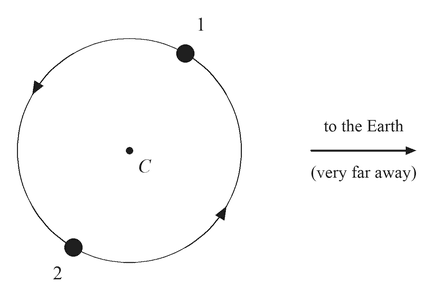
A line in the light of the pair splits into two lines, one from each star, and the gap between the two lines changes as the stars go round. The two lines appear farthest apart when
- 374 marks
Question 37
A star that looks single shows a line in its spectrum that splits into two and joins up again, over and over. The line has wavelength for a source at rest. When the two parts are farthest apart they are apart, with their middle still at , and they are farthest apart once every days. (Hypothetical data.) The "star" is really a pair of stars of equal mass moving round one circular orbit about their common centre of mass, and the Earth lies in the plane of the orbit. Take .
(a) Find the orbital speed of each star.
(b) Find the time taken for one orbit.
(c) Find the radius of the orbit and the distance between the two stars.
- 383 marks
Question 38
Light is received from the two opposite edges of the Sun's equator. A line whose wavelength is for a source at rest is observed at in the light from one edge and at in the light from the other edge. (Hypothetical data.) Take and the radius of the Sun as .
(a) Find the speed of each edge along the line of sight.
(b) Explain why one edge gives a shorter and the other a longer wavelength.
(c) Find the time the Sun takes to turn once on its axis at the equator, in days.
- 391 mark
Question 39
Doppler shifts of sunlight reflected from Saturn's rings show that the inner edge of the rings moves round Saturn at about , while the outer edge, about times as far from Saturn's centre, moves at only about . What does this show about the rings?
- 403 marks
Question 40
Astronomers search for planets round other stars by looking for a tiny back-and-forth Doppler shift in the star's light. Jupiter's pull makes our Sun move in a small circle with a speed of about , and a planet like Jupiter round another star would do the same to that star. Suppose a line of wavelength in such a star is studied, the Earth lying in the plane of the motion, with a spectrograph that can just detect a shift of . (Hypothetical data.) Take .
(a) Find the largest Doppler shift of the line caused by the star's motion.
(b) Can this spectrograph detect the planet in this way? Explain.
(c) Find the smallest speed along the line of sight that this spectrograph can detect.
- 411 mark
Question 41
Over many nights, the lines in a star's spectrum move slowly to longer wavelengths, then back to shorter ones, and so on, repeating every days. The star always looks like a single point of light, its brightness stays the same, and its lines never split into two. (Hypothetical data.) The most likely explanation is that
- 421 mark
Question 42
A satellite with a radio beacon of fixed frequency rises above the horizon, passes over a ground station and sets on the other side. During this pass, the frequency received at the station
- 433 marks
Question 43
A satellite's radio beacon sends out . During one pass over a ground station, the satellite's velocity along the line joining it to the station is at most , towards the station as it rises and away from the station as it sets, although its speed along its orbit is . (Hypothetical data.) Take .
(a) Find the highest and the lowest frequencies received during the pass.
(b) Find the total change in the received frequency during the pass.
(c) Explain why the largest shift corresponds to and not to the orbital speed of .
- 443 marks
Question 44
A traffic police radar gun sends out microwaves of frequency . A car approaches along a straight road at (). The gun stands at the side of the road, so its beam makes an angle of with the car's path, as shown.
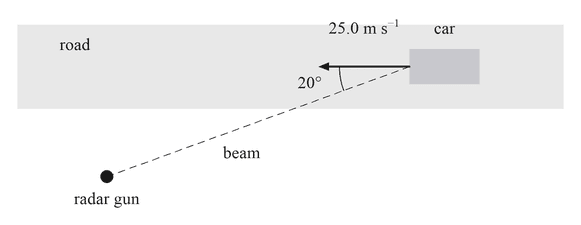
The gun measures the beat frequency between the waves it sends and the waves reflected from the car, , where is the car's speed towards the gun along the beam, and turns it into a speed reading. (Hypothetical data.) Take .
(a) Find the beat frequency if the gun pointed straight along the road at the car.
(b) Find the speed, in , that the gun shows at the angle.
(c) Does this angle error favour the driver or the police? Explain.
- 451 mark
Question 45
A Doppler ultrasound probe sends ultrasound of frequency into an artery. Its beam makes an angle of with the direction of the blood flow, as shown.

The echo from the moving blood cells comes back lower than the frequency sent. The shift is , where is the speed of the blood, the angle between the beam and the flow, and the speed of sound in soft tissue. (Hypothetical data.) The speed of the blood is about
- 463 marks
Question 46
A current meter fixed to a bridge pier under water sends a narrow beam of ultrasound of frequency straight downstream, along the flow. Fine particles carried by the water reflect some of it back to the meter. The water flows at , and sound travels at in still water. (Hypothetical data.)
(a) Will the echo have a higher or a lower frequency than the sound sent? Give a reason.
(b) Find the frequency of the echo, using , in which is the speed of sound in still water, and the velocities of the moving water (), the listener () and the source () are positive in the direction in which the sound travels.
- 473 marks
Question 47
An experimental roadside unit checks the speed of cars with ultrasound of frequency . A car comes straight towards the unit at through still air in which sound travels at . (Hypothetical data.)
(a) Find the frequency of the echo from the car received at the unit, and the beat frequency between the echo and the sound sent.
(b) Radar guns, which use microwaves, rely on the short formula . Find the beat frequency that the same short formula for sound, , predicts here, and its percentage error.
(c) If the unit turned the beat frequency measured in (a) into a speed using the short formula, what speed would it report?
- 481 mark
Question 48
A Doppler weather radar stands at the centre of a city and receives echoes from raindrops. Echoes from rain due east of the radar return at a slightly lower frequency than the frequency sent, and echoes from rain due west return at a slightly higher frequency. The raindrops are being carried by a wind blowing
- 491 mark
Question 49
Two stars, P and Q, move in circular orbits about their common centre of mass, which is at rest relative to the Sun, and the Earth lies in the plane of the orbits. A spectral line of the same wavelength in both stars swings to and fro by at most in the light of star P and by at most in the light of star Q. (Hypothetical data.) Which statement about the masses is correct?
- 502 marks
Question 50
A hand-held Doppler monitor used to listen to an unborn baby's heartbeat sends ultrasound of frequency into the mother's body. The wall of the baby's heart moves towards and away from the probe, along the beam, at up to . The speed of sound in soft tissue is , and for a moving reflector the shift is . (Hypothetical data.)
(a) Find the largest frequency shift of the echo.
(b) The monitor plays the shift through a loudspeaker. Explain why the operator can hear it, although the ultrasound itself cannot be heard.
- 513 marks
Question 51
A car moving with a speed of 30 m s is approaching a factory whistle having the frequency 700 Hz. Calculate the apparent pitch of the whistle as heard by the driver of the car. (Velocity of sound = 350 m/s)
- 523 marks
Question 52
At what speed should a car approach a stationary observer if he hears the music of the car radio with a frequency 20% higher than it actually is? The speed of sound is 340 m s.
- 533 marks
Question 53
A source and an observer is approaching closer with a relative velocity of 40 m s. If the true frequency of the source is 1200 Hz, calculate the observed frequency under these conditions: (i) the source alone is moving and (ii) the observer alone is moving. Take velocity of sound in air to be 340 m s.
- 543 marks
Question 54
A policeman on duty detects a drop of 10% in the pitch of the horn of a motor car as it crosses him. If the velocity of sound is 330 m/s, calculate the speed of car.
- 553 marks
Question 55
A train approaches a stationary observer, the velocity of train being (1/20)th of the velocity of sound. A sharp blast is blown with the whistle of the engine at equal intervals of a second. Find the interval between the successive blasts as heard by the observer.
- 563 marks
Question 56
Calculate the velocity of a source of sound emitting sound of frequency such that the apparent frequency is (i) double, (ii) half the original frequency, for a stationary listener.
- 573 marks
Question 57
Is it possible for an observer to move towards a stationary source emitting red light so that the red light appears to be green for the observer? Wavelength of green is 5400 Å and that of red is 6200 Å. Velocity of light is m/s.
- 581 mark
Question 58
Doppler phenomena is related with
- 591 mark
Question 59
If source and observer both are relatively at rest and if speed of sound is increased, then frequency heard by the observer
- 601 mark
Question 60
Doppler shift in frequency does not depend upon
- 611 mark
Question 61
A train moving at a speed of towards a stationary object, emits a sound of frequency 1000 Hz. Some of the sound reaching the object gets reflected back to the train as echo. The frequency of the echo as detected by the driver of the train is (speed of sound in air is )
- 621 mark
Question 62
A train moving at a speed towards a stationary observer on a platform emits sound of frequency and velocity . Then the apparent frequency heard by him is
- 631 mark
Question 63
A car moving at a velocity of towards an approaching bus that blows a horn at a frequency of 640 Hz on a straight track. The frequency of this horn appears to be 680 Hz to the car driver. If the velocity of sound in air is , then velocity of the approaching bus is
- 641 mark
Question 64
A source of sound is travelling towards a stationary observer. The frequency of sound heard by the observer is of three times the original frequency. The velocity of sound is m/s. The speed of source will be
- 651 mark
Question 65
A train is moving with a uniform speed of 33 m/s and an observer is approaching the train with the same speed. If the train blows a whistle of frequency 1000 Hz and the velocity of sound is 333 m/s, then the apparent frequency of the sound that the observer hears is
- 661 mark
Question 66
A siren emitting a sound of frequency 800 Hz moves away from an observer towards a cliff at a speed of . Then, the frequency of sound that the observer hears in the echo reflected from the cliff is (take velocity of sound in air )
- 671 mark
Question 67
Two cars moving in opposite directions approach each other with speed of 22 m/s and 16.5 m/s respectively. The driver of the first car blows a horn having a frequency 400 Hz. The frequency heard by the driver of the second car is [velocity of sound 340 m/s]
- 681 mark
Question 68
A motor car blowing a horn of frequency 124 vib/s moves with a velocity 72 km/h towards a tall wall. The frequency of the reflected sound heard by the driver will be (velocity of sound in air is 330 m/s)
- 691 mark
Question 69
A speeding motorcyclist sees traffic jam ahead of him. He slows down to 36 km/hour. He finds that traffic has eased and a car moving ahead of him at 18 km/hour is honking at a frequency of 1392 Hz. If the speed of sound is 343 m/s, the frequency of the honk as heard by him will be
- 701 mark
Question 70
An observer is moving away from source of sound of frequency 100 Hz. His speed is 33 m/s. If speed of sound is 330 m/s, then the observed frequency is
- 711 mark
Question 71
The speed of sound in air is 340 m/s. The speed with which a source of sound should move towards a stationary observer so that the apparent frequency becomes twice of the original is
- 721 mark
Question 72
A whistle giving out 450 Hz approaches a stationary observer at a speed of 33 m/s. The frequency heard by the observer in Hz is
- 731 mark
Question 73
A police car horn emits a sound at a frequency 240 Hz when the car is at rest. If the speed of the sound is 330 m/s, the frequency heard by an observer who is approaching the car at a speed of 11 m/s, is
- 741 mark
Question 74
An observer moves towards a stationary source of sound, with a velocity one-fifth of the velocity of sound. What is the percentage increase in the apparent frequency?
- 751 mark
Question 75
A source is moving towards an observer with a speed of 20 m/s and having frequency of 240 Hz. The observer is now moving towards the source with a speed of 20 m/s. Apparent frequency heard by observer, if velocity of sound is 340 m/s, is
- 761 mark
Question 76
A siren emitting sound of frequency 800 Hz is going away from a static listener with a speed of 30 m/s, frequency of the sound to be heard by the listener is (take velocity of sound as 330 m/s)
- 771 mark
Question 77
A musician using an open flute of length 50 cm produces second harmonic sound waves. A person runs towards the musician from another end of a hall at a speed of 10 km/h. If the wave speed is 330 m/s, the frequency heard by the running person shall be close to
- 781 mark
Question 78
Two cars and are moving away from each other in opposite directions. Both the cars are moving with a speed of with respect to the ground. If an observer in car detects a frequency 2000 Hz of the sound coming from car , what is the natural frequency of the sound source in car (speed of sound in air )?
- 791 mark
Question 79
A stationary source emits sound waves of frequency 500 Hz. Two observers moving along a line passing through the source detect sound to be of frequencies 480 Hz and 530 Hz. Their respective speeds are, in (Given speed of sound m/s)
- 801 mark
Question 80
Two sources of sound and produce sound waves of same frequency 660 Hz. A listener is moving from source towards with a constant speed m/s and he hears 10 beats/s. The velocity of sound is 330 m/s. Then, equal
- 811 mark
Question 81
A driver in a car approaching a vertical wall notices that the frequency of his car horn has changed from 440 Hz to 480 Hz when it gets reflected from the wall. If the speed of sound in air is 345 m/s, then the speed of the car is
- 821 mark
Question 82
An observer moves towards a stationary source of sound with a velocity equal to one-fifth of the velocity of sound. The percentage change in the frequency will be
- 831 mark
Question 83
A person observes two moving trains, reaching the station and leaving the station with equal speed of 30 m/s. If both trains emit sounds with frequency 300 Hz (speed of sound: 330 m/s), approximate difference of frequencies heard by the person will be
- 841 mark
Question 84
A train blowing a whistle of frequency 320 Hz approaches an observer standing on the platform at a speed of 66 m/s. The frequency observed by the observer will be (given speed of sound ) …… Hz.