
(Hypothetical data.) A train moves at a steady along a straight track, sounding its horn at . A listener L stands from the track, opposite the point P of the track, as shown. The air is still and sound travels at .
When a source does not move straight towards or away from the listener, only the part of its velocity along the line joining it to the listener changes the frequency: , where is the angle between the source's velocity and the line from the source to the listener at the moment the sound is sent out.
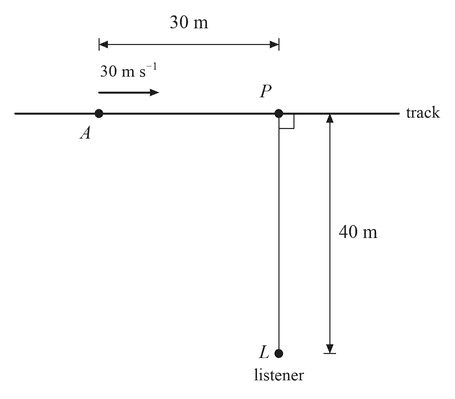
(a) Find the frequency the listener hears for the sound sent out when the horn is at A, before P.
(b) Find the frequency the listener hears for the sound sent out when the horn is at B, past P, and for the sound sent out when the horn is at P.
(c) Explain why the listener hears the pitch fall smoothly as the train passes, and not suddenly. How long after the horn passes P does the sound reach the listener?