
Question 131 markMCQMedium
A small source of sound moves on a circle as shown in the given figure and an observer is standing on . Let , and be the frequencies heard when the source is at , and respectively. Then

Confirming your payment
Sign up now and get 250 free tokens.
Doppler Effect · Question 13 of 33
A small source of sound moves on a circle as shown in the given figure and an observer is standing on . Let , and be the frequencies heard when the source is at , and respectively. Then
(A)
(B)
(C)
(D)
Answer: (B)
Concept: Only the part of the source's velocity along the line joining the source to the observer changes the frequency heard. A source moving towards the observer is heard above its true frequency , one moving away is heard below , and one moving at right angles to that line is heard at itself.
Step 1 — Look at the circle from above. The arrows show that the source moves along the far side of the circle, through , towards the observer's side, and along the near side, through , back away from it. Seen from above, the velocity at each point is along the circle, at right angles to the radius:
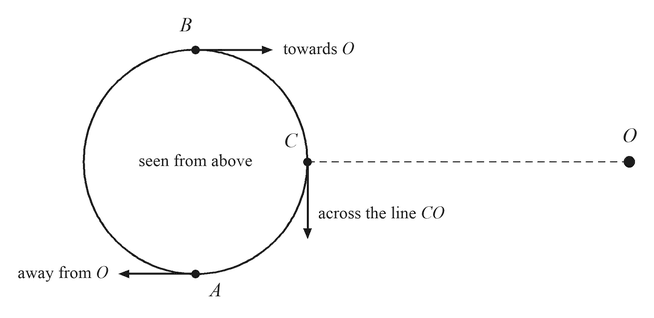
Step 2 — Judge each position. At the source moves towards the observer, so . At its velocity is at right angles to the line , so it moves neither towards nor away from , and . At it moves away from the observer, so .
Step 3 — Put them in order. Combining the three results gives with .
Therefore, .