
Opening your dashboard
Class 11 Physics Chapter 26 Doppler Effect: Competency-Based Questions (CBQ)
40 questions on Chapter 26, each worked through on its own page with the AI tutor. Class 11 Physics, ICSE 2026-27.
40 questions
1–4 marks · Mixed difficulty
- 13 marks
Question 1
Competency: Application
A speedboat moves at a steady straight towards a swimmer who floats at rest in a calm lake. The boat's engine and propeller give out a steady hum of frequency , which reaches the swimmer both through the air and through the water. The air is still. Sound travels at in air and at in the lake water. (Hypothetical data.)
(a) Find the frequency of the hum that the swimmer hears with their head above the water.
(b) Find the frequency that the swimmer hears when they put their head under the water.
(c) Explain why the rise in pitch is smaller under the water. Find the speed at which the boat would have to move for the rise heard under the water to be as large as the rise in (a).
- 23 marks
Question 2
Competency: Analysis & Evaluation
Sound engineers test an ultrasonic beacon that gives out a steady tone of . It is fixed on a car on an empty, straight runway, where the air is still and sound travels at . An engineer stands on the runway's centre line, far from the car, and the engineer's hearing reaches up to . (Hypothetical data.)
(a) Can the engineer hear the beacon while the car is at rest? Give a reason.
(b) The car drives straight away from the engineer at a steady speed. Find the least speed at which the engineer can hear the beacon.
(c) The car later drives straight back towards the engineer at this same speed. What frequency reaches the engineer now, and can it be heard?
- 34 marks
Question 3
Competency: Application
A train comes into a station along a straight track, slowing down steadily. The station master stands far ahead, close beside the track, so that the train moves practically straight towards the station master, who measures the pitch of its horn with a tuner app. The horn's true frequency is . For one blast the app reads . For a second blast, which the driver sounds exactly after the first, it reads . The air is still and sound travels at . (Hypothetical data.)
(a) Find the speed of the train at each blast.
(b) Assuming the train slows down uniformly, find its deceleration.
(c) If the train keeps the same deceleration, how long after the second blast does it stop, and how far does it travel in that time?
- 44 marks
Question 4
Competency: Analysis & Evaluation
In a school project, a loudspeaker fixed at one end of a long straight track plays a steady tone. A phone running a frequency app is fixed on a cart, which is driven straight towards the loudspeaker at several steady speeds . The air is still. Sound travels at roughly in air, but the student wants to find its value from the readings. (Hypothetical data.)
Speed of the cart (m s⁻¹) 1.0 2.0 3.0 4.0 Frequency picked up (Hz) 4011.8 4023.5 4035.3 4047.1 (a) Show that, for a listener moving towards a source at rest, should rise by equal steps for equal steps in , and check that the readings do so.
(b) Use the readings to find the true frequency of the tone and the speed of sound in the room.
(c) Predict the reading when the cart moves straight away from the loudspeaker at .
- 51 mark
Question 5
Competency: Analysis & Evaluation
A delivery van moves at straight towards a stationary listener through still air, in which sound travels at . It carries two bells, of frequencies and . (Hypothetical data.)
Assertion (A): The listener hears the pitch of the bell raised by twice as many hertz as the pitch of the bell.
Reason (R): For a given motion of the source and the listener, the ratio of the frequency heard to the true frequency depends only on their speeds and the speed of sound.
- 61 mark
Question 6
Competency: Application
A car's horn sounds the musical note A at . A music teacher stands beside a straight road, ahead of the car, and the car comes straight towards the teacher at a steady speed through still air, in which sound travels at . The teacher notices that the horn sounds exactly one semitone higher, the note A♯ at (a semitone raises a frequency by a factor of about ). (Hypothetical data.)
The speed of the car is about
- 71 mark
Question 7
Competency: Analysis & Evaluation
A student plans to measure walking speeds with sound. A buzzer of frequency is carried at a steady speed straight towards a phone lying at rest on a table, in still air where sound travels at . The phone's frequency app can just tell apart two frequencies that differ by . (Hypothetical data.)
The slowest walking speed whose effect on the frequency the app can detect is about
- 84 marks
Question 8
Competency: Application
In a warehouse, a self-driving follower cart keeps behind a lead cart by using an ultrasonic sensor on its front. The sensor sends out a steady tone and picks up the echo from the flat back of the lead cart, as shown. At one moment the follower moves at and the lead cart at , both in the same direction along one straight line. The air is still and sound travels at . (Hypothetical data.)

(a) Find the frequency of the ultrasound that reaches the back of the lead cart.
(b) Find the frequency of the echo picked up by the sensor, and by how much it differs from the frequency sent.
(c) The controller slows the follower until the echo comes back at exactly . What is the follower's speed then? Explain why this keeps the gap between the carts steady.
- 93 marks
Question 9
Competency: Analysis & Evaluation
A siren S sends out a steady note. A listener L stands at rest away. A drone D carrying a microphone and a loudspeaker flies between them, straight from S towards L, at a steady , as shown. The loudspeaker at once plays out whatever the microphone picks up. The air is still and sound travels at . (Hypothetical data.)
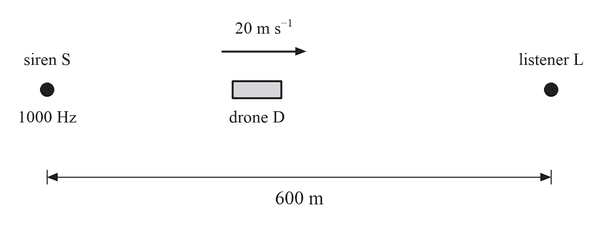
(a) Find the frequency that the drone's microphone picks up from the siren.
(b) Find the frequency at which L hears the sound from the drone's loudspeaker.
(c) L also hears the siren directly. Will L hear beats between the two sounds? Would your answer change if the drone flew back towards S at the same speed? Explain.
- 101 mark
Question 10
Competency: Understanding
A student uses the general expression for a source and a listener moving along one straight line in still air, in which sound travels at .
Assertion (A): Before substituting, the student must take and as positive when they point in the direction in which the sound travels from the source to the listener, and negative when they point the other way.
Reason (R): The speed of sound in still air does not depend on the speed of the source.
- 111 mark
Question 11
Competency: Analysis & Evaluation
A bat flies at after a moth that flies straight ahead of it at in the same direction, through still air in which sound travels at . The bat sends out a call of steady frequency and listens to the echo from the moth. (Hypothetical data.)
Assertion (A): By comparing the pitch of the echo with the pitch of its call, the bat can tell whether it is gaining on the moth or falling behind.
Reason (R): The echo comes back at a higher frequency than the call when the distance between the bat and the moth is decreasing, and at a lower frequency when it is increasing.
- 121 mark
Question 12
Competency: Application
In an airport corridor, a moving walkway carries passengers at through the still air of the building, in which sound travels at . A traveller walks forward on the walkway at relative to the walkway. A floor-cleaning machine on the corridor floor beside the walkway comes straight towards the traveller at , sending out a warning beep of . (Hypothetical data.)
The frequency of the beep that the traveller hears is about
- 133 marks
Question 13
Competency: Application
A planetary nebula is a shell of glowing gas thrown off by a dying star, expanding outwards from the star at the same speed in all directions. The nebula as a whole is not moving towards or away from us. Astronomers point a spectrograph at the middle of the nebula and study a line of oxygen whose wavelength for a source at rest is . They find that the line is split into two, at and . Take the speed of light as , and use for a source moving with speed along the line of sight. (Hypothetical data.)
(a) Explain why light from the middle of the nebula gives two lines, and say which of them comes from the near side of the shell.
(b) Find the speed at which the shell is expanding.
(c) The radius of the shell is light-year ( light-year ; year ). Estimate how long ago the shell was thrown off, assuming it has always expanded at this speed.
- 141 mark
Question 14
Competency: Analysis & Evaluation
On a highway at night, a police car closes in on the car ahead of it at a relative speed of . The red tail-lights of the car ahead give out light of wavelength about . For a source and an observer approaching each other with speed , the frequency received is , where . (Hypothetical data.)
Assertion (A): The police driver sees no noticeable change in the colour of the tail-lights as the gap closes.
Reason (R): The Doppler effect does not occur for light, because light needs no material medium.
- 151 mark
Question 15
Competency: Analysis & Evaluation
A distant galaxy and our own galaxy are moving apart at . A line in the galaxy's spectrum has wavelength when measured from a source at rest in the laboratory. Take . (Hypothetical data.)
Assertion (A): In the light received from the galaxy, this line is observed at .
Reason (R): For a source and an observer moving apart with speed , the wavelength received is longer than the emitted wavelength by .
- 161 mark
Question 16
Competency: Understanding
To measure the red shift of a distant galaxy, astronomers record its spectrum and, on the same detector, the spectrum of a lamp in the observatory that contains the same elements. Light travels at .
Assertion (A): The lamp's lines act as the reference wavelengths, because the lamp is at rest relative to the spectrograph, so its lines are not Doppler shifted.
Reason (R): Light from distant galaxies takes millions of years to reach the Earth.
- 171 mark
Question 17
Competency: Analysis & Evaluation
A star's spectrum is recorded from the Earth on many nights over a year; its light travels at . Most of the dark lines in the spectrum move slowly to longer wavelengths and back again, once a year, by about one part in ten thousand of their wavelength. A few dark lines due to oxygen, however, always stay exactly at their laboratory wavelengths.
The best explanation of these fixed lines is that
- 181 mark
Question 18
Competency: Application
A car drives at straight towards the transmitter of an FM radio station that broadcasts at . Radio waves travel at and show the same Doppler effect as light: for an observer approaching the source with speed , . On the car's radio, neighbouring stations are tuned apart. (Hypothetical data.)
Which statement is correct?
- 193 marks
Question 19
Competency: Application
The automatic door of a shop opens when a microwave sensor above it detects someone coming towards it. The sensor sends out microwaves of frequency and compares them with the waves reflected from people in front of the door. For a person moving with speed () along the line joining them to the sensor, the reflected waves differ in frequency from the waves sent by ; if the person's velocity makes an angle with that line, only the part counts. Microwaves travel at . The door opens only when is at least . (Hypothetical data.)

(a) Person 1 walks straight towards the sensor at . Find . Does the door open?
(b) Find the slowest speed at which a person walking straight towards the sensor makes the door open.
(c) Person 2 also walks at , but at to the line joining person 2 to the sensor, as shown. Does the door open for person 2? Give a reason.
- 204 marks
Question 20
Competency: Application
A ship measures its speed over the sea bed with a Doppler log. Two sonar beams of ultrasound of frequency point down at to the horizontal, one forward and one backward, as shown, and each picks up the echo from the sea bed. When the ship moves forward with speed , the part of its velocity along each beam is . The echo along a beam is shifted by , where is the speed at which the ship closes on, or moves away from, the sea bed along that beam (higher when closing, lower when moving away). Sound travels at in sea water. (Hypothetical data.)
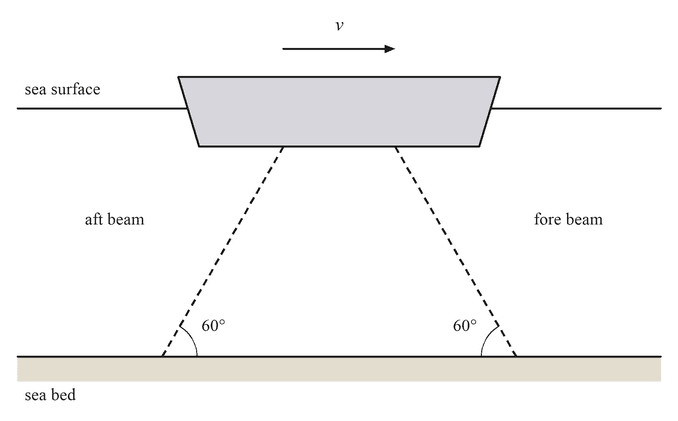
(a) The ship moves forward at . Find the frequencies of the echoes picked up along the forward and the backward beams.
(b) Later the forward echo is and the backward echo is . Find the ship's speed.
(c) The ship also rises gently on a swell at , so each beam moves away from the sea bed at along its length. Show that the difference between the two echo frequencies still gives the forward speed correctly.
- 213 marks
Question 21
Competency: Application
The light received from a distant galaxy contains a dark line of calcium at ; the same line has wavelength in the laboratory. Light travels at , and for a speed along the line of sight, . Distant galaxies obey Hubble's law, , where is the galaxy's distance; take per megaparsec, where megaparsec is about million light-years. (Hypothetical data.)
(a) Is the galaxy moving towards us or away from us? Find its speed.
(b) Estimate its distance, in megaparsecs and in light-years.
(c) Predict the wavelength at which the same calcium line would be observed for a galaxy twice as far away.
- 221 mark
Question 22
Competency: Analysis & Evaluation
A Doppler weather radar sends out radio waves, which travel at , and studies the echoes from raindrops in a thunderstorm north of it. Around one point X in the storm, the echoes from rain just to the west of X (on the left, as seen from the radar) come back at a slightly higher frequency than the waves sent, and the echoes from rain just to the east of X come back at a slightly lower frequency. (Hypothetical data.)
Assertion (A): This suggests that the rain near X is circling round X.
Reason (R): Raindrops reflect radio waves back to the radar only when they are moving towards it.
- 231 mark
Question 23
Competency: Understanding
A ship at anchor, at rest, uses an echo sounder: it sends short pulses of ultrasound of frequency straight down and picks up the echoes from the flat sea bed, which is also at rest. Sound travels at in sea water. (Hypothetical data.)
Assertion (A): The ship can find the depth of the water from the change in frequency between the pulses sent and the echoes received.
Reason (R): An echo from a sea bed at depth returns after a time , where is the speed of sound in water.
- 241 mark
Question 24
Competency: Understanding
Sound travels at about in air, and light, like every electromagnetic wave, at .
Which one of these does NOT depend on the Doppler effect?
- 251 mark
Question 25
Competency: Application
Horseshoe bats hear best in a narrow band of frequencies near . When such a bat flies towards a tree, it lowers the frequency of its call so that the echo from the tree comes back at . A bat flies at straight towards a tree trunk, which is at rest, through still air in which sound travels at . (Hypothetical data.)
The frequency at which the bat must call is about
- 263 marks
Question 26
A source of sound of frequency 256 Hz moves rapidly towards a wall with a velocity of 5 m s. How many beats per second will be heard if sound travels at a speed of 330 m/s?
- 273 marks
Question 27
A tuning fork of frequency 512 Hz approaches a wall with a velocity of 4 m s. How many beats are produced between the direct and the reflected sound if the velocity of sound is 332 m s?
- 283 marks
Question 28
A policewoman blows a whistle of frequency 500 Hz. A car speeds past her with a velocity of 72 km h. Find the change in frequency heard by the driver of the car just as he passes the policewoman. Velocity of sound = 350 m s.
- 293 marks
Question 29
A car , with a horn of frequency 700 Hz moves with a velocity 90 km h. It approaches another car , coming towards it with a velocity 72 km h. Calculate the apparent frequency of the sound heard by the driver in the car (a) before crossing and (b) after crossing. Velocity of sound = 350 m s.
- 303 marks
Question 30
A whistle of frequency 500 Hz is rotated in a circle of radius one metre with an angular speed of 10 radian/s. Calculate the lowest and the highest frequency heard by a listener at a long distance away at rest with respect to the centre of the circle. (Velocity of sound = 340 m/s)
- 313 marks
Question 31
A whistle giving 700 Hz moves away from a stationary observer towards a wall with a velocity of 2 m/s. How many beats per second are heard by the observer? [Velocity of sound = 348 m/s]
- 323 marks
Question 32
A rocket emitting a sound of frequency 1000 Hz is moving towards a stationary target with a speed of 200 m s. The sound reaching the target gets reflected as an echo. Calculate the frequency of sound as detected by a person at the position of the target and the frequency of an echo as detected by the rocket. Given the velocity of sound = 330 m s.
- 333 marks
Question 33
Microwaves are reflected from a distant airplane approaching a stationary observer. It is found that when the reflected waves beat against the waves radiating from the source, the beat frequency is 900 Hz. Calculate the approach speed of the airplane if the wavelength of the microwave is 0.1 m. Velocity of microwave is m/s.
- 341 mark
Question 34
Competency: Analysis & Evaluation
A siren fixed on a pole sends out a steady note of . A listener stands at rest on the ground away. On a windy afternoon a steady wind of blows straight from the siren towards the listener. Sound travels at relative to still air. (Hypothetical data.)
Assertion (A): The listener hears the siren at , the same frequency as on a calm day.
Reason (R): The wind makes the crests of the sound farther apart, in the air between the siren and the listener, than they are on a calm day.
- 351 mark
Question 35
Competency: Analysis
Two straight roads cross at right angles at a junction J. Car S is south of J and moves north, towards J, at , sounding its horn of frequency . At the same moment car L is east of J and moves east, away from J, at . The air is still and sound travels at . Only the part of each car's velocity along the line joining S and L changes the frequency, and the cars move only a few metres while the sound travels, so ignore that change in their positions. (Hypothetical data.)
The frequency at which the driver of car L hears the sound sent out at this moment is about
- 361 mark
Question 36
Competency: Analysis & Evaluation
An ambulance drives at a steady speed along a straight road, with its siren giving a steady note. A student standing close to the road records the siren on a phone frequency app, well before and well after the ambulance passes. The air is still. The student knows neither the siren's true frequency nor the ambulance's speed, and wants to find both of them.
Which set of readings is enough to find both?
- 372 marks
Question 37
Competency: Evaluation
Quasars are the very bright centres of some extremely distant galaxies. In the light from one quasar, a line of hydrogen whose wavelength in the laboratory is is observed at . A student uses , with , and claims: "The quasar is moving away from us at , twice the speed of light, so nothing limits the speed of a galaxy." (Hypothetical data.)
(a) Show how the student obtained this speed.
(b) Evaluate the student's claim.
- 382 marks
Question 38
Competency: Application & Analysis
A police car on a straight highway has a moving-mode radar that sends microwaves of frequency straight ahead along the road. For each echo it measures the difference between the frequency of the echo and the frequency sent. For a closing speed (with ) between the radar and the object that reflects the waves, , where . Take every motion as along the beam. Echoes from road signs and the road surface ahead give . Echoes from an oncoming car in the other lane give . The speed limit is . (Hypothetical data.)
(a) Find the speed of the police car.
(b) Find the speed of the oncoming car, and decide whether it is over the speed limit.
- 393 marks
Question 39
Competency: Creativity
A student reads that the Doppler effect for sound is not symmetric: a source moving towards a listener at rest gives a different frequency from a listener moving towards a source at rest at the same speed. The student plans a test on an empty straight road on a calm day, using a car that can move at a steady , a small loudspeaker playing a steady tone, and a phone frequency app that reads to . Sound travels at in still air. The driver holds the speed by the speedometer, so in any one run the true speed may differ from by up to about . (Hypothetical data.)
(a) Predict the frequency the phone shows when the loudspeaker is on the moving car and the phone is at rest ahead of it, and when the phone is on the moving car and the loudspeaker is at rest ahead of it.
(b) Describe how the student should carry out the test.
(c) Show that this run-to-run change of up to in the car's speed could hide the effect, and design a way round this problem.
- 404 marks
Question 40
Competency: Analysis & Evaluation
In 1929, Edwin Hubble reported that more distant galaxies move away from us faster. A student group repeats this kind of study with data for four galaxies, P, Q, R and S. Their distances were found from bright stars of known brightness inside them. In each galaxy's light, the red line of hydrogen, whose wavelength in the laboratory is , is observed at a longer wavelength. The group uses with , and measures distances in megaparsecs (Mpc), where . (Hypothetical data.)
Galaxy P Q R S Distance (Mpc) 20 40 60 80 Observed wavelength (nm) 659.4 662.3 665.6 668.5 (a) Find the speed at which each galaxy is moving away from us.
(b) Show that the speed is nearly proportional to the distance, and find the Hubble constant in .
(c) If every galaxy has always moved away at its present speed, all of them were together at a time ago. Estimate this time in years ( year ), and say whether the estimate is sensible.