
Competency: Application
A ship measures its speed over the sea bed with a Doppler log. Two sonar beams of ultrasound of frequency point down at to the horizontal, one forward and one backward, as shown, and each picks up the echo from the sea bed. When the ship moves forward with speed , the part of its velocity along each beam is . The echo along a beam is shifted by , where is the speed at which the ship closes on, or moves away from, the sea bed along that beam (higher when closing, lower when moving away). Sound travels at in sea water. (Hypothetical data.)
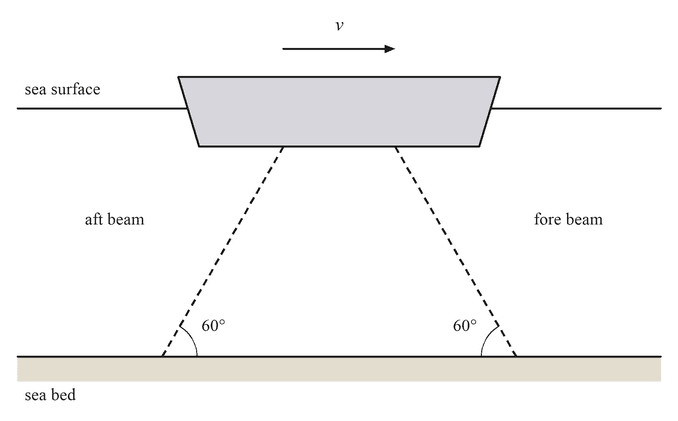
(a) The ship moves forward at . Find the frequencies of the echoes picked up along the forward and the backward beams.
(b) Later the forward echo is and the backward echo is . Find the ship's speed.
(c) The ship also rises gently on a swell at , so each beam moves away from the sea bed at along its length. Show that the difference between the two echo frequencies still gives the forward speed correctly.