
Question 61 markMCQMedium
A person carrying a whistle emitting continuously a note of 272 Hz is running towards a reflecting surface with a speed of 18 km/hour. The speed of sound in air is 345 m s. The number of beats heard by him is
Confirming your payment
Sign up now and get 250 free tokens.
Doppler Effect · Question 6 of 33
A person carrying a whistle emitting continuously a note of 272 Hz is running towards a reflecting surface with a speed of 18 km/hour. The speed of sound in air is 345 m s. The number of beats heard by him is
(A) 4
(B) 6
(C) 8
(D) 3
Answer: (C) 8
Concept: For sound, the apparent frequency heard by a listener is , where is the true frequency, is the speed of sound in still air, and the velocities of the listener () and of the source () are taken positive in the direction in which the sound travels from the source to the listener, and negative against it.
Step 1 — Convert the running speed. We change km/h into m/s by multiplying by :
Step 2 — Picture the two sounds the person hears. The person hears the whistle directly at its true frequency, 272 Hz, because it moves with the person. The person also hears the echo from the wall, as the figure shows.
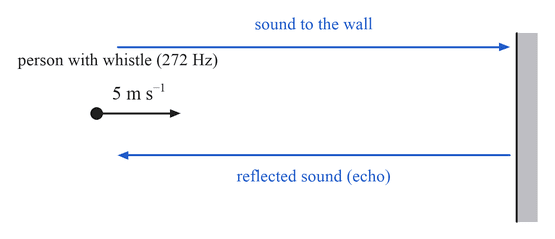
Step 3 — Find the frequency that reaches the wall. The whistle is a source moving towards the wall at 5 m/s, and the wall is at rest:
Step 4 — Find the frequency of the echo the person hears. The wall now acts as a source at rest sending out 276 Hz, and the person is a listener moving towards it at 5 m/s:
Step 5 — Count the beats. The number of beats per second is the difference between the two frequencies the person hears:
Therefore, the person hears 8 beats per second.