
Opening your dashboard
Class 11 Physics Chapter 21: Simple Harmonic Motion Solutions
63 textbook questions with step-by-step answers, free to read, for ISC 2026-27.
Get talked through Ch 21, not just shown the answer
Reading a finished solution is not the same as being able to do it. The AI tutor takes one question at a time and works it with you, in your own words, until you can.
- Ask it out loud, in your own words
- It gives you the next step, not the answer
- Stuck on part (ii)? Start there
63 questions with solutions
1–5 marks · Mixed difficulty
The first 29 solutions are on this page. This chapter is a long one, so the rest open on their own page to keep this one quick to load.
- 11 mark
Question 1
A particle moves such that its acceleration is given by , where is the displacement from equilibrium position and is a constant. The period of oscillation is
Solve with AIAnswer
(A)
- Correct
(B)
(C)
(D)
Answer: (B)
Concept: A particle is in SHM when its acceleration is ; the period is then .
Step 1 — Compare with the SHM equation. The given law has the same form as the SHM law in the Concept line, so
Step 2 — Find the period. We put this value of into :
- (A) Since has the unit , this expression has the unit , so it cannot be a time.
- (C) This treats as if it were ; but equals , and also has the unit .
- (D) This depends on the displacement , but the period of SHM is the same for every displacement.
Therefore, the period of oscillation is , option (B).
- 21 mark
Question 2
The motion of a particle executing simple harmonic motion is given by , where is in metres and in second. The time period in second is
Solve with AIAnswer
(A) 0.01
- Correct
(B) 0.02
(C) 0.1
(D) 0.2
Answer: (B) 0.02
Concept: For SHM written as , the number multiplying is the angular frequency , and the period is .
Step 1 — Read from the equation. Opening the bracket, . The coefficient of is
Step 2 — Find the period. We divide by :
- (A) 0.01 is the amplitude of the motion in metres, not a time.
- (C) A period of 0.1 s would need , five times smaller than the in the equation.
- (D) A period of 0.2 s would need ; the 0.05 inside the bracket only sets the starting phase and does not change the period.
Therefore, the time period is 0.02 s, option (B).
- 31 mark
Question 3
The differential equation of a particle executing simple harmonic motion along -axis is
Solve with AIAnswer
- Correct
(A)
(B)
(C)
(D)
Answer: (A)
Concept: In SHM the restoring force is ; by Newton's second law , so the acceleration is proportional to the displacement and opposite to it.
Step 1 — Write Newton's law for the particle. We equate the two expressions for the force:
Step 2 — Divide by . With this becomes
- (B) Here the acceleration depends on , so it would not be proportional to the displacement, and it would not change sign when the particle crosses to the other side.
- (C) The minus sign makes the acceleration point away from the mean position, so the particle would run away instead of oscillating.
- (D) This first-order equation gives , a steady decay towards zero with no oscillation.
Therefore, the differential equation of SHM along the -axis is , option (A).
- 41 mark
Question 4
The kinetic energy and potential energy of a particle executing simple harmonic motion will be equal when displacement (amplitude ) is
Solve with AIAnswer
(A)
(B)
- Correct
(C)
(D)
Answer: (C)
Concept: At displacement in SHM, the kinetic energy is and the potential energy is .
Step 1 — Set the two energies equal. We cancel the common factor :
Step 2 — Solve for . We collect the terms on one side:
- (A) At the potential energy is only of the total and the kinetic energy is , so they are not equal.
- (B) is larger than the amplitude, and the particle never moves farther than from the mean position.
- (D) At the potential energy is of the total and the kinetic energy , so they are not equal.
Therefore, the kinetic and potential energies are equal at a displacement of , option (C).
- 51 mark
Question 5
A spring has a force constant and a mass is suspended from it. The spring is cut in half and the same mass is suspended from one of the halves. If the frequency of oscillation in the first case is , then the frequency in the second case will be
Solve with AIAnswer
(A)
(B)
(C)
- Correct
(D)
Answer: (D)
Concept: The frequency of a mass on a spring of force constant is . The force constant of a piece of spring is inversely proportional to its length.
Step 1 — Find the force constant of a half. Half the spring stretches only half as much under the same load, so its force constant is .
Step 2 — Compare the frequencies. With the same mass, the frequency is proportional to :
- (A) Doubling the frequency would need the force constant to become four times as large, which would happen for a quarter of the spring, not a half.
- (B) This ignores the change of force constant; a shorter piece of the same spring is stiffer.
- (C) Halving the frequency would need the force constant to fall to one-quarter, but cutting the spring makes it larger.
Therefore, the frequency in the second case is , option (D).
- 61 mark
Question 6
If the period of oscillation of mass suspended from a spring is one second, then the period of will be
Solve with AIAnswer
(A) s
(B) s
- Correct
(C) 2 s
(D) 4 s
Answer: (C) 2 s
Concept: For a mass on a spring, , so with the same spring the period is proportional to .
Step 1 — Write the ratio of the periods. We divide the two periods for the same spring:
Step 2 — Find the new period. We multiply the first period by 2:
- (A) This takes the period as inversely proportional to ; a heavier mass actually oscillates more slowly.
- (B) This takes the period as inversely proportional to , which is wrong in both the power and the direction.
- (D) This takes the period as proportional to itself instead of to .
Therefore, the period with mass is 2 s, option (C).
- 71 mark
Question 7
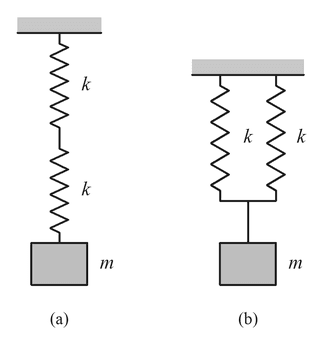
Two identical springs of constant are connected in series and parallel as shown in the figure. A mass is suspended from them. The ratio of their frequencies of vertical oscillations will be
 Solve with AI
Answer
(A) 2 : 1
(B) 1 : 1
- Correct
(C) 1 : 2
(D) 4 : 1
Answer: (C) 1 : 2
Concept: For springs in series the extensions add, so ; for springs in parallel the forces add, so ; the frequency is .
Step 1 — Find the series spring constant, Fig. (a). We put two springs of constant into the series rule:
Step 2 — Find the parallel spring constant, Fig. (b). The two springs share the load, so
Step 3 — Take the ratio of the frequencies. The same mass hangs in both cases, so the frequency is proportional to :
- (A) This is the ratio the other way round, parallel to series.
- (B) This would be true only if joining the springs in series and in parallel gave the same stiffness, but the parallel pair is four times as stiff.
- (D) This is the ratio of the spring constants, parallel to series ( to ), not of the frequencies.
Therefore, the frequencies for the series and parallel arrangements are in the ratio 1 : 2, option (C).
- 81 mark
Question 8
On a smooth inclined plane, a body of mass is attached between two springs as shown in the figure. The other ends of the springs are fixed to firm supports. If each spring has force constant , the period of oscillation of the body (assuming the springs as massless) is
 Solve with AI
Answer
- Correct
(A)
(B)
(C)
(D)
Answer: (A)
Concept: A constant force, such as the component of the weight along the incline, only shifts the equilibrium position of a body on springs; it does not change the period. The period depends only on the mass and on the total restoring force per unit displacement.
Step 1 — Find the equilibrium position. At equilibrium the two springs together balance . This fixes where the body rests but plays no further part.
Step 2 — Displace the body. Move the body a small distance up the incline from its equilibrium position. The lower spring is stretched by an extra and pulls it back with an extra force ; the upper spring is compressed by an extra and pushes it back with an extra . Both act down the incline, towards the equilibrium position:
So the two springs act like one spring of constant .
Step 3 — Write the period. We put the force constant into :
- (B) This uses a combined force constant of , as for springs joined end to end in series; here the springs pull on the body from opposite sides and add their forces.
- (C) is a length (the shift of the equilibrium position), so times it is not a time.
- (D) has the unit of the square root of a length, so this is not a time either; the period does not depend on .
Therefore, the period of oscillation is , option (A).
- 91 mark
Question 9
A simple pendulum with a bob of mass oscillates from to and back to as shown in the figure such that is . If the acceleration due to gravity is , the velocity of bob as it passes through is
 Solve with AI
Answer
(A) zero
(B)
(C)
- Correct
(D)
Answer: (D)
Concept: As the bob swings, the tension in the string is always at right angles to its motion and does no work, so the mechanical energy of the bob is conserved: the loss of potential energy equals the gain of kinetic energy.
Step 1 — Find the height through which the bob falls. In the figure, and are on the same level as the point of suspension , and the lowest point is a distance below . So the bob falls through a height from to , where it starts from rest.
Step 2 — Use conservation of energy. The loss of potential energy equals the kinetic energy at :
Watch out: A swing as wide as this is not simple harmonic, but conservation of energy holds for any amplitude, so the speed at is found this way.
- (A) The speed is zero only at the turning points and ; at the lowest point it is greatest.
- (B) is the square of the speed, with the unit .
- (C) has the form of a potential energy, measured in joules, not a speed.
Therefore, the velocity of the bob at is , option (D).
- 101 mark
Question 10
The kinetic energy of a particle, executing S.H.M. is 16 J when it is in its mean position. If the amplitude of oscillation is 25 cm and the mass of the particle is 5.12 kg, the time period of its oscillation is
Solve with AIAnswer
- Correct
(A) s
(B) s
(C) s
(D) s
Answer: (A) s
Concept: At the mean position the whole energy is kinetic, and it equals the total energy . The period is .
Step 1 — Write the energy equation in SI units. We change the amplitude of 25 cm to and write the energy equation:
Step 2 — Solve for . The left-hand side simplifies to :
Step 3 — Find the period. We divide by :
This is about 0.63 s.
- (B) s comes from taking the amplitude as 2.5 m; that slip makes only .
- (C) s comes from using 25 for the amplitude without changing centimetres to metres; that slip makes only .
- (D) s would need , but the data give .
Note: The book prints the first option as s and gives that as the answer. That value would need ; the energy equation gives and s, so the keyed option is shown here with the correct value.
Therefore, the time period is s (about 0.63 s), option (A).
- 111 mark
Question 11
Two masses and are suspended together by a massless spring of constant . When the masses are in equilibrium, is removed without disturbing the system. Then the angular frequency of oscillation of is
Solve with AIAnswer
(A)
- Correct
(B)
(C)
(D)
Answer: (B)
Concept: A mass on a spring of force constant oscillates with angular frequency , whatever the amplitude and wherever the motion starts.
Step 1 — See what starts the oscillation. When is removed, the spring is still stretched by the extra amount that had produced. The spring now pulls up more strongly than its weight, so starts oscillating about its own new equilibrium position, with amplitude .
Step 2 — Find the angular frequency. Only is now attached to the spring, so
- (A) This uses the mass , which has been removed; it only fixes the amplitude.
- (C) has the unit , not , so it cannot be an angular frequency.
- (D) has the unit , so it cannot be an angular frequency either.
Therefore, the angular frequency of oscillation of is , option (B).
- 121 mark
Question 12
The total energy of the body executing S.H.M. is . Then the kinetic energy when the displacement is half of the amplitude is
Solve with AIAnswer
(A)
(B)
- Correct
(C)
(D)
Answer: (C)
Concept: At displacement the kinetic energy is , while the total energy is .
Step 1 — Put in the kinetic energy. Then
Step 2 — Write it in terms of . The last factor is the total energy, so
- (A) The kinetic energy is half the total only at , which is farther from the mean position than .
- (B) is the potential energy at , not the kinetic energy.
- (D) is only about , which is less than ; but at the body is nearer the mean position than at , so its kinetic energy must be more than .
Therefore, the kinetic energy at half the amplitude is , option (C).
- 131 mark
Question 13
A simple pendulum is made of a hollow sphere containing mercury suspended by means of a wire. If a little mercury is drained off, the period of pendulum will
Solve with AIAnswer
(A) remain unchanged
- Correct
(B) increase
(C) decrease
(D) become erratic
Answer: (B) Increase
Concept: For small swings, the period of a simple pendulum is , where is measured from the point of suspension to the centre of gravity of the bob. The mass of the bob does not matter, but the position of its centre of gravity does.
Step 1 — See where the centre of gravity moves. When the sphere is full, the centre of gravity of the sphere and mercury is at the centre of the sphere. When a little mercury is drained off, the mercury left inside sits in the lower part of the sphere, so the centre of gravity of the bob moves down.
Step 2 — See the effect on the period. A lower centre of gravity means a larger effective length , and since the period increases.
- (A) The loss of mass alone would not change the period, but the shift of the centre of gravity does.
- (C) The period would decrease only if the centre of gravity rose; that happens later, when most of the mercury has gone and the centre of gravity moves back towards the centre of the sphere.
- (D) The pendulum still has a definite, steady period; only its value changes.
Therefore, the period of the pendulum will increase, option (B).
- 141 mark
Question 14
Two bodies and of equal masses are suspended from two separate massless springs of spring constants and respectively. If the two bodies oscillate vertically such that their maximum velocities are equal, the ratio of the amplitude of to that of is
Solve with AIAnswer
(A)
(B)
(C)
- Correct
(D)
Answer: (D)
Concept: In SHM the maximum velocity is , and for a mass on a spring .
Step 1 — Equate the maximum velocities. Let the amplitudes be for and for :
Step 2 — Put in the angular frequencies. The masses are equal, so the mass cancels:
- (A) This is upside down and also misses the square root.
- (B) This is the ratio upside down: the stiffer spring gives the higher , so it needs the smaller amplitude for the same maximum speed.
- (C) This has the right way up but misses the square root, since goes as , not .
Therefore, the ratio of the amplitude of to that of is , option (D).
- 151 mark
Question 15
Does the damping force remain constant on a system executing SHM?
Solve with AIWritten solution
Solution:
Concept: A damping force is a resistive force, such as air resistance or friction, that opposes the motion of an oscillating body and takes energy away from it. For a body moving slowly through air or a liquid, the damping force is proportional to the velocity of the body and opposite to it.
Step 1 — Follow the velocity. In an oscillation the velocity changes all the time. The speed is greatest at the mean position and zero at the extreme positions, and the direction of motion reverses at each extreme position.
Step 2 — Follow the damping force that depends on velocity. Since this damping force goes with the velocity, it is greatest when the body passes the mean position and becomes zero at the extreme positions. It always points opposite to the velocity, so its direction also reverses every half-oscillation.
Step 3 — Check damping by sliding friction. Sliding friction keeps roughly the same size while the body slides, but it too always opposes the motion, so it reverses its direction every time the body turns back. So in neither case does the damping force stay constant.
Note: A strictly simple harmonic motion keeps a constant amplitude and has no damping at all. The question refers to an oscillator whose motion is close to SHM but slowly loses energy.
Therefore, no; the damping force always opposes the velocity, so its direction reverses every half-oscillation; for slow motion in air or a liquid its size also changes, being greatest at the mean position and zero at the extremes.
- 161 mark
Question 16
What is the direction of velocity and acceleration in SHM?
Solve with AIWritten solution
Solution:
Concept: In SHM the acceleration always points towards the mean position, while the velocity points along the direction in which the body is moving.
Step 1 — Body moving towards the mean position. When the body moves from an extreme position towards the mean position, it moves towards the mean position and is pulled towards it, so velocity and acceleration are in the same direction (the body speeds up).
Step 2 — Body moving away from the mean position. When the body moves from the mean position towards an extreme position, it moves away from the mean position but is still pulled towards it, so velocity and acceleration are in opposite directions (the body slows down).
Therefore, the acceleration always points towards the mean position: it is along the velocity while the body moves towards the mean position, and opposite to the velocity while it moves away.
- 171 mark
Question 17
What is the direction of displacement and acceleration in SHM?
Solve with AIWritten solution
Solution:
Concept: In SHM the acceleration is , where is the displacement from the mean position.
Step 1 — Read the sign. The minus sign shows that the acceleration always has the opposite sign to the displacement: the displacement points away from the mean position, the acceleration points towards it.
Therefore, displacement and acceleration are always oppositely directed in SHM.
- 181 mark
Question 18
“A point on a rotating disc is not considered to be simple harmonic”. Why?
Solve with AIWritten solution
Solution:
Concept: SHM is a to and fro motion along a line about a fixed mean position, under a restoring force proportional to the displacement.
Step 1 — Look at the motion of the point. A point on a rotating disc goes round and round a circle in the same sense. Its motion is periodic, but it does not move to and fro about a mean position along a line.
Therefore, it is not SHM because the point moves round a circle and not to and fro about a mean position (only its projection on a diameter performs SHM).
- 191 mark
Question 19
A spring is made to oscillate horizontally and vertically. Will there be any change in the period?
Solve with AIWritten solution
Solution:
Concept: For a mass on a spring of force constant , the period is in both arrangements.
Step 1 — See the effect of gravity. When the spring hangs vertically, the weight only stretches it to a new equilibrium position; the extra restoring force for a further displacement is still . The formula contains no .
Therefore, no; the period is the same, , for horizontal and vertical oscillations, because it does not depend on .
- 201 mark
Question 20
A loaded spring is made to oscillate on the surface and then in the Moon. Will there be any change in the time period?
Solve with AIWritten solution
Solution:
Concept: The period of a loaded spring is ; it depends only on the mass and the force constant of the spring.
Step 1 — Compare the Earth and the Moon. Neither nor changes on the Moon. The weaker gravity only makes the spring stretch less when the load hangs at rest.
Therefore, no; the period of a loaded spring is the same on the Moon as on the Earth, because it does not depend on .
- 211 mark
Question 21
The period of oscillation of a harmonic oscillator is . Does depend on displacement?
Solve with AIWritten solution
Solution:
Concept: In SHM the acceleration is , so the size of the acceleration is proportional to the displacement.
Step 1 — Look at the ratio in the formula. Since the acceleration grows in the same proportion as the displacement, their ratio is the same at every point:
So has the same value whatever the displacement.
Therefore, no; does not depend on the displacement, because the acceleration changes in proportion to the displacement and their ratio stays constant.
- 221 mark
Question 22
On the surface of the Earth the length of the seconds pendulum is 1 m. What will be the length of the same pendulum on the surface of the Moon?
Solve with AIWritten solution
Solution:
Concept: A seconds pendulum has a period of 2 s. From , which holds for small swings, a fixed period needs . The value of on the Moon is about one-sixth of that on the Earth.
Step 1 — Scale the length with . We keep the period at 2 s, so the length must change in proportion to :
This is about 0.17 m.
Therefore, a seconds pendulum on the Moon must be m (about 0.17 m) long.
- 231 mark
Question 23
Two simple pendulums of equal length cross each other at mean position. What is their phase difference?
Solve with AIWritten solution
Solution:
Concept: Two particles in SHM with the same period are in the same phase if they pass the mean position at the same instant in the same direction, and their phase difference is if they pass it at the same instant in opposite directions.
Step 1 — Apply it to the pendulums. Equal lengths give equal periods. The bobs cross each other at the mean position, so they are there at the same instant but moving in opposite directions.
Therefore, their phase difference is radian (180°).
- 241 mark
Question 24
An oscillating simple pendulum is kept in a lift which is accelerating upwards. Will there be any change in the time period?
Solve with AIWritten solution
Solution:
Concept: In a frame with acceleration upwards, the effective acceleration due to gravity is , and the period of a pendulum is .
Step 1 — Compare with . In the upward-accelerating lift is larger than , so the restoring force on the bob is larger and is smaller.
Therefore, yes; the time period decreases, because the effective value of increases to .
- 251 mark
Question 25
The period of oscillation of a liquid in a U-tube is found to be . The first liquid is replaced by another one of higher density. Will there be any change in the period?
Solve with AIWritten solution
Solution:
Concept: For a liquid column in a U-tube, with height of liquid in each limb at rest, the period is
Step 1 — Look for the density. Both the restoring force (the weight of the extra column) and the mass being moved are proportional to the density, so the density cancels and does not appear in the formula.
Therefore, no; if the height of the liquid column is the same, the period stays , because it does not depend on the density of the liquid.
- 261 mark
Question 26
A boy who was sitting on a swing stands up while it was swinging. Will there be any change in the period?
Solve with AIWritten solution
Solution:
Concept: For small swings, a swing behaves like a simple pendulum with , where is measured from the point of suspension to the centre of gravity of the swing and the boy.
Step 1 — See the effect of standing up. When the boy stands up, his centre of gravity rises, so the effective length becomes smaller.
Therefore, yes; the period decreases, because the effective length of the swing becomes shorter.
- 271 mark
Question 27
In a stationary lift, a simple pendulum has a period . How does the period change when the lift
(i) moves up with (a) uniform velocity and (b) uniform acceleration and
(ii) move down with (a) uniform velocity and (b) uniform acceleration?
Solve with AIWritten solution
Solution:
Concept: In a lift with acceleration , the pendulum behaves as if the acceleration due to gravity were for upward acceleration and for downward acceleration; the period is . A lift moving with uniform velocity has no acceleration, so .
Step 1 — Uniform velocity, parts (i)(a) and (ii)(a). With no acceleration, , so the period stays .
Step 2 — Upward acceleration, part (i)(b). Now , which is larger than , so the period decreases.
Step 3 — Downward acceleration, part (ii)(b). Now , which is smaller than , so the period increases.
Therefore, (i)(a) no change, (i)(b) the period decreases; (ii)(a) no change, (ii)(b) the period increases.
- 282 marks
Question 28
How would the time period of a simple pendulum be affected if (a) the length is doubled and (b) the amplitude is doubled?
Solve with AIWritten solution
Solution:
Concept: For small oscillations the period of a simple pendulum is
It depends on the length and on , but not on the amplitude, as long as the amplitude stays small.
Step 1 — Double the length (part a). We replace by :
So the period becomes about 1.41 times as long.
Step 2 — Double the amplitude (part b). The amplitude does not appear in the formula, so as long as the swing stays small the period is unchanged (the oscillations are isochronous).
Watch out: If the amplitude becomes large, the restoring force is less than , and the period becomes slightly longer than .
Therefore, (a) doubling the length increases the period times, and (b) doubling a small amplitude causes no change in the period.
- 292 marks
Question 29
Sketch graphs showing the variation of (i) kinetic energy, (ii) potential energy and (iii) the total energy of a simple harmonic oscillator with displacement.
Solve with AIWritten solution
Solution:
Concept: For a harmonic oscillator of force constant and amplitude , at displacement :
Step 1 — Potential energy (part ii). is proportional to , so its graph is a parabola opening upwards: zero at the mean position and greatest, , at .
Step 2 — Kinetic energy (part i). is a constant minus a term in , so its graph is an inverted parabola: greatest, , at and zero at .
Step 3 — Total energy (part iii). does not depend on , so its graph is a straight line parallel to the displacement axis at height . At every displacement the two parabolas add up to this line.
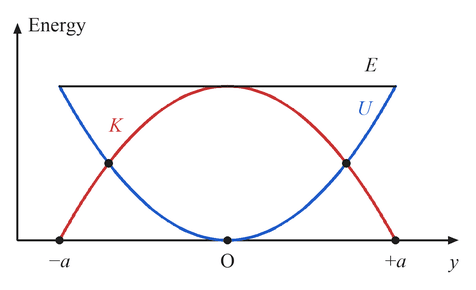
Therefore, the K.E. graph is an inverted parabola, the P.E. graph an upright parabola, and the total energy a horizontal straight line, all between and .
- 302 marks
Question 30
What is the difference between (i) periodic motion and (ii) oscillatory motion?
- 312 marks
Question 31
Explain why simple harmonic motion is called so?
- 322 marks
Question 32
Give examples of (i) linear SHM and (ii) angular SHM.
- 332 marks
Question 33
Is the motion of the Earth around the Sun oscillatory? Why?
- 342 marks
Question 34
Define displacement, amplitude, period and frequency.
- 352 marks
Question 35
Define simple harmonic motion.
- 362 marks
Question 36
Write down the differential equation of a body executing SHM. Give its solution.
- 372 marks
Question 37
At what position of a body executing SHM its velocity (i) maximum and (ii) zero?
- 382 marks
Question 38
At what position of a body executing SHM its acceleration (i) maximum and (ii) zero?
- 392 marks
Question 39
When the velocity of a body executing SHM is zero, its acceleration is not zero. Why?
- 402 marks
Question 40
Derive an expression for the P.E. and K.E. of a body executing SHM.
- 412 marks
Question 41
The graph showing the variation of K.E. or P.E. with displacement of a harmonic oscillator is a parabola; but that of total energy with displacement is a straight line. Why?
- 422 marks
Question 42
What are the characteristics of SHM?
- 432 marks
Question 43
What is the relation between linear SHM and uniform circular motion?
- 442 marks
Question 44
Define phase.
- 452 marks
Question 45
What is epoch?
- 462 marks
Question 46
Write down the expression for the period of oscillation of a mass attached to (i) a horizontal spring and (ii) a vertical spring.
- 472 marks
Question 47
Define spring constant or force constant.
- 482 marks
Question 48
What is simple pendulum? Define length of the pendulum.
- 492 marks
Question 49
What is a seconds pendulum?
- 502 marks
Question 50
Write down the expression for the period of oscillation of a light piece of cork floating in a liquid.
- 512 marks
Question 51
What is the period of oscillation of a liquid contained in a U-tube executing SHM?
- 522 marks
Question 52
At what positions of the simple pendulum its (i) P.E. is maximum (ii) K.E. is zero?
- 532 marks
Question 53
Draw the displacement–time, velocity–time and acceleration–time graph of a body executing SHM.
- 542 marks
Question 54
On what factors does the period of a simple pendulum depend?
- 552 marks
Question 55
At what displacement K.E. and P.E. are equal, for a body executing SHM.
- 563 marks
Question 56
Define simple harmonic motion. What are the characteristics of SHM. Define amplitude, phase and epoch.
- 573 marks
Question 57
Write down the differential equation of SHM. What is its solution? Using graph show the variation of its velocity and acceleration of a body executing SHM with displacement.
- 583 marks
Question 58
Derive an expression for the time period of oscillation of a mass attached to (i) horizontal spring and (ii) vertical spring.
- 593 marks
Question 59
Write down the expression for potential energy, kinetic energy and total energy of a particle executing SHM. Using graphs explain their variation with displacement.
- 605 marks
Question 60
(a) Show that the projection of uniform circular motion on the diameter of the circle of reference is SHM.
(b) Derive the relation for velocity and acceleration of a particle executing SHM.
- 615 marks
Question 61
(a) What is a simple pendulum? Define length of a simple pendulum.
(b) Derive an expression for the period of oscillation of a simple pendulum.
- 625 marks
Question 62
Derive an expression for (i) potential energy, (ii) kinetic energy and (iii) total energy of a body executing SHM. Explain the variation of potential energy, kinetic energy and total energy with displacement using graph.
- 635 marks
Question 63
Derive the equation for the frequency of oscillation of a mass attached to (a) horizontal spring and (b) vertical spring. Show that the frequency is not affected by gravity.
What Class 11 Physics Ch 21 covers
The sections of the chapter, in the order the book takes them. Every question above comes from one of these.
- 01Periodic and Oscillatory Motion
- 02Simple Harmonic Motion and Its Differential Equation
- 03Displacement, Velocity and Acceleration in SHM
- 04Energy of a Harmonic Oscillator
- 05SHM and Uniform Circular Motion
- 06Phase and Graphical Representation of SHM
More ways to study this chapter
The same chapter asked three other ways. Practise it, revise it, and see what the board has set on Ch 21 before.
Class 11 Physics Ch 21 questions students ask
How many questions are there in Class 11 Physics Ch 21?
63 questions. Every one is solved step by step on this page.
Are these Class 11 Physics solutions free?
Yes. Every question and its full working is free to read, with no account needed.
Can I download the Class 11 Physics Ch 21 solutions as a PDF?
There is no PDF to download. Every solution is on this page instead, which means it is searchable, always the current syllabus, and readable on a phone. Use your browser's print option if you want it on paper.