
Question 625 marksMedium
Derive an expression for (i) potential energy, (ii) kinetic energy and (iii) total energy of a body executing SHM. Explain the variation of potential energy, kinetic energy and total energy with displacement using graph.
Confirming your payment
Sign up now and get 250 free tokens.
Simple Harmonic Motion · Question 62 of 63
Derive an expression for (i) potential energy, (ii) kinetic energy and (iii) total energy of a body executing SHM. Explain the variation of potential energy, kinetic energy and total energy with displacement using graph.
Solution:
Concept: A body of mass executes SHM along a line under the restoring force , where is its displacement from the mean position and . To displace it, work must be done against this force; this work is stored as potential energy. Its speed at displacement is .
Step 1 — Find the work done in displacing the body (part i). To move the body a further small distance , an applied force , equal and opposite to the restoring force, does work
The total work done from the mean position to displacement is
This is the area of the triangle under the force–displacement graph.
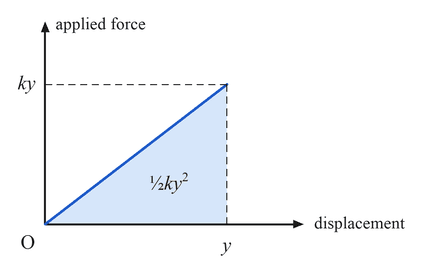
Step 2 — Write the potential energy (part i). The work done is stored as potential energy:
Step 3 — Write the kinetic energy (part ii). We use :
Step 4 — Find the total energy (part iii). The total energy is the sum of the two, so we add them:
It does not depend on the displacement , so the total energy is the same at every position (conserved, when there is no friction).
Step 5 — Explain the variation with the graph. Since contains , its graph against is a parabola: zero at the mean position and greatest, , at the extreme positions . The kinetic energy is an inverted parabola: greatest, , at the mean position and zero at the extremes. The total energy is a straight line parallel to the displacement axis. As the body moves away from the mean position, its potential energy increases and its kinetic energy decreases by exactly the same amount; at the two are equal.
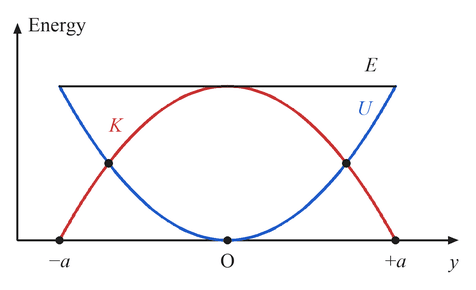
Therefore, (i) , (ii) and (iii) , a constant; the P.E. graph is a parabola, the K.E. graph an inverted parabola, and the total energy graph a horizontal straight line.