
Question 635 marksHard
Derive the equation for the frequency of oscillation of a mass attached to (a) horizontal spring and (b) vertical spring. Show that the frequency is not affected by gravity.
Confirming your payment
Sign up now and get 250 free tokens.
Simple Harmonic Motion · Question 63 of 63
Derive the equation for the frequency of oscillation of a mass attached to (a) horizontal spring and (b) vertical spring. Show that the frequency is not affected by gravity.
Solution:
Concept: If the net force on a body of mass is for a displacement from its equilibrium position, the body performs SHM with angular frequency and frequency .
Step 1 — Horizontal spring: find the restoring force (part a). A mass rests on a smooth horizontal table, fixed to a spring of force constant whose other end is clamped. If the mass is displaced by from its equilibrium position O, Hooke's law gives

Step 2 — Horizontal spring: find the frequency. By Newton's second law the acceleration is
This is SHM with , so
Step 3 — Vertical spring: find the equilibrium position (part b). When the mass hangs at rest from a vertical spring, the spring is stretched by , and its pull balances the weight:
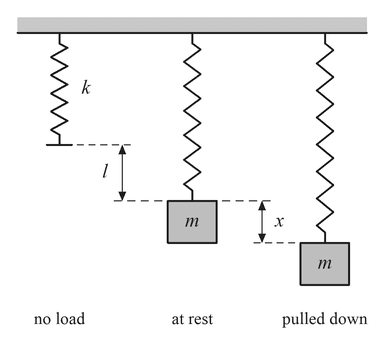
Step 4 — Vertical spring: find the restoring force. If the mass is pulled down a further distance , the spring is stretched by , so the net upward force is
Since (Step 3), these two terms cancel:
This force is opposite to the displacement, so , exactly as for the horizontal spring.
Step 5 — Vertical spring: find the frequency. The motion is SHM with again:
Using , it can also be written .
Step 6 — Show that gravity does not affect the frequency. In Step 4 the weight is cancelled by the part of the spring force; gravity only shifts the equilibrium position down by . The frequency, , contains only the mass and the force constant, and is the same as for the horizontal spring. (In the form , a larger gives a proportionally larger , so the ratio stays .) So the same spring and mass would oscillate with the same frequency on the Moon.
Therefore, for both the horizontal and the vertical spring the frequency is , which contains no : gravity only shifts the equilibrium position and does not affect the frequency.