
Opening your dashboard
Class 11 Physics Chapter 21 Simple Harmonic Motion: Competency-Based Questions (CBQ)
47 questions on Chapter 21, each worked through on its own page with the AI tutor. Class 11 Physics, ICSE 2026-27.
47 questions
1–4 marks · Mixed difficulty
- 14 marks
Question 1
Competency: Application
At a coastal port the sea level rises and falls twice a day. On one day, high water comes at 05:10 and again at 17:35, and the water level swings between above and below its mean level. (Hypothetical data.) Treat the rise and fall of the water level as simple harmonic motion.
(a) Find the period of the tide in hours and its frequency in hertz. Explain why the rise and fall of the water level is both periodic and oscillatory.
(b) A fishing boat can cross the sandbar at the harbour mouth only while the water is at least above its mean level. After the 05:10 high water, at what time does the level first fall to this mark?
(c) Find the greatest rate at which the water level rises, in centimetres per minute, and say at what level of the water this happens.
- 21 mark
Question 2
Competency: Analysis & Evaluation
Meena gives her little brother's swing one push and then leaves it alone. The swing moves to and fro, but each swing is a little smaller than the one before, and after a few minutes it comes to rest.
Assertion (A): Strictly speaking, the motion of the swing is oscillatory but not periodic.
Reason (R): A periodic motion repeats itself exactly after equal intervals of time.
- 34 marks
Question 3
Competency: Analysis & Evaluation
A long uniform plank of mass rests on two identical rollers whose axles are horizontal, parallel and apart. A motor turns the rollers quickly in opposite directions, so that the tops of the two rollers move towards each other, as shown. The rollers always slide under the plank, and the coefficient of kinetic friction between the plank and each roller is . At one instant the plank's centre G is to the right of M, the point midway between the axles. (Hypothetical data.) Take and treat the plank as thin, so that the friction forces have no turning effect about G.
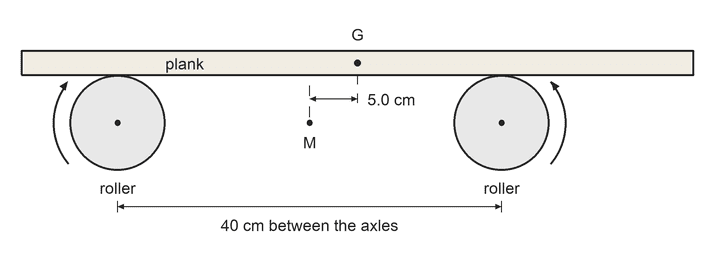
(a) Find the normal reaction of each roller on the plank at this instant, and the net friction force on the plank.
(b) Show that the plank moves to and fro in SHM about M, and find its period.
(c) The same plank is placed on rollers of a different material, spaced the same way, and is found to oscillate with a period of . Find the coefficient of kinetic friction for these rollers.
- 41 mark
Question 4
Competency: Analysis & Evaluation
A small trolley on a smooth track moves under a restoring force , where is its displacement from a point O on the track and is a positive constant. It is pulled aside and released from rest, and it oscillates about O.
Assertion (A): The time the trolley takes for one complete oscillation is the same however far it is pulled aside.
Reason (R): The force on the trolley always points towards O.
- 51 mark
Question 5
Competency: Understanding
Two identical trolleys stand on identical smooth horizontal tracks, and each is joined to a wall by an identical light spring. Trolley P is pulled from its equilibrium position and released from rest. Trolley Q is given a sharp tap at its equilibrium position, so that it moves off at . Both then move in SHM. (Hypothetical data.) Which pair of quantities must be the same for P and Q?
- 64 marks
Question 6
Competency: Application
In a sewing machine the needle moves up and down along a vertical line, making stitches per minute, with one complete up-and-down movement for each stitch. The tip of the needle moves between a highest and a lowest position apart, and its lowest position is below the top surface of the cloth, as shown. (Hypothetical data.) Treat the motion of the needle as SHM.

(a) Find the amplitude, the period and the greatest speed of the needle.
(b) Find the speed of the needle at the moment its tip reaches the top surface of the cloth.
(c) For how long in each stitch is the tip of the needle below the top surface of the cloth? Express this also as a fraction of the period.
- 71 mark
Question 7
Competency: Application
A vibration sensor is fixed to a machine part that moves in SHM with a frequency of and an amplitude of . (Hypothetical data.) At one instant the sensor shows that the part is moving at half its greatest speed. The size of the acceleration of the part at that instant is
- 84 marks
Question 8
Competency: Analysis & Evaluation
A block of mass on a smooth horizontal floor is joined to a wall by a light spring of force constant . It oscillates in SHM with an amplitude of , as shown. (Hypothetical data.)

(a) Find the total energy of the oscillation and the greatest speed of the block.
(b) A lump of putty of mass is dropped gently from just above the block. It lands on the block and sticks to it at an instant when the block is at an extreme position. Find the new amplitude, the new period and the new total energy.
(c) Suppose instead that the same lump lands on the block and sticks at an instant when the block is passing through its mean position. Find the new amplitude and the energy lost when the putty lands.
- 91 mark
Question 9
Competency: Analysis & Evaluation
A block hangs from a light vertical spring and bobs up and down in SHM. Air resistance is negligible.
Assertion (A): As the block moves, the sum of its kinetic energy and the elastic potential energy stored in the spring does not stay constant.
Reason (R): As the block moves up and down, its gravitational potential energy also changes.
- 101 mark
Question 10
Competency: Analysis & Evaluation
A data logger is fixed to a glider that oscillates in SHM on a spring. It sounds a beep whenever the kinetic energy of the glider is greater than the potential energy stored in the spring. For what fraction of each complete oscillation does it beep?
- 113 marks
Question 11
Competency: Application
Astronomers can detect a planet going round a distant star from the star's small "wobble". The star and the planet both move round their common centre of mass, so the star moves uniformly round a small circle. Our line of sight lies in the plane of this circle, so we can measure only the part of the star's velocity along the line of sight. The figure shows the circle seen from above its plane. The measured values rise and fall between (moving away from us) and (moving towards us), repeating every days. (Hypothetical data.)
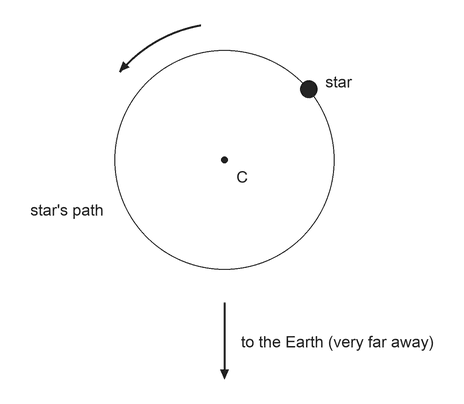
(a) Explain why the star's velocity along the line of sight varies with time in the same way as the velocity of a body in SHM. State the amplitude and the period of this variation.
(b) Find the radius of the small circle in which the star moves.
(c) At one moment the star's velocity along the line of sight is . How far is the star then from C, the centre of its circle, measured along the line of sight?
- 121 mark
Question 12
Competency: Analysis & Evaluation
A small ball P moves round a horizontal circle at constant speed. Q is the foot of the perpendicular from P on a fixed diameter of the circle, so Q moves in SHM along that diameter.
Assertion (A): The acceleration of Q is greatest at the moments when P passes through an end of that diameter.
Reason (R): The acceleration of P has the same size at every point of the circle.
- 133 marks
Question 13
Competency: Analysis & Evaluation
A glider of mass on a level air track is attached to a spring and oscillates in SHM. A motion sensor and a computer plot the kinetic energy of the glider against time, as shown. At the glider is at its extreme position on the positive side. (Hypothetical data.)
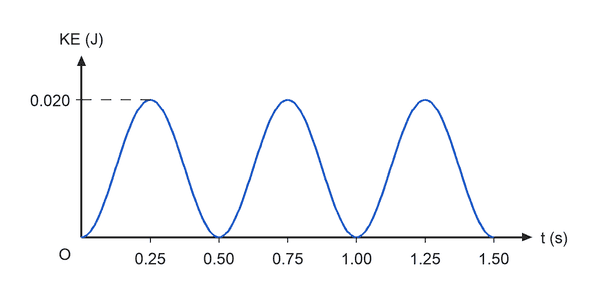
(a) Use the graph to find the period of oscillation of the glider. Explain why this is not the time between neighbouring peaks of the graph.
(b) Find the amplitude of the oscillation and the force constant of the spring.
(c) Write the displacement of the glider as a function of time, and find its velocity at .
- 141 mark
Question 14
Competency: Analysis & Evaluation
A student plots the displacement of a glider oscillating in SHM against time and gets the sine curve shown.
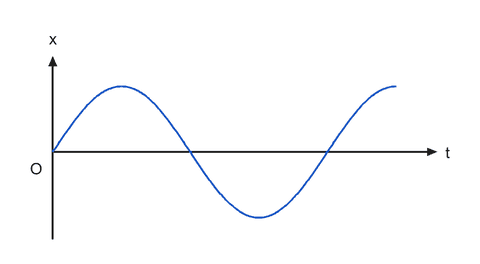
Assertion (A): The graph is steepest at the points where it crosses the time axis.
Reason (R): The glider moves fastest at its extreme positions.
- 151 mark
Question 15
Competency: Analysis & Evaluation
Two identical spring–block oscillators X and Y have the same period. At one instant, block X is at its positive extreme position, and block Y is passing through its mean position.
Assertion (A): The phase difference between the motions of X and Y is .
Reason (R): A body in SHM takes a quarter of a period to move from an extreme position to its mean position.
- 161 mark
Question 16
Competency: Analysis & Evaluation
A motion sensor follows a glider oscillating in SHM, and a computer plots the glider's velocity against its displacement . The plot is the ellipse shown. (Hypothetical data.)
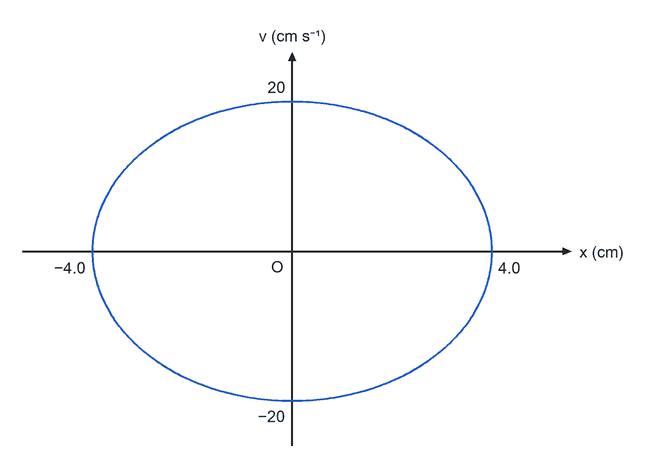
The period of the oscillation is
- 173 marks
Question 17
Competency: Application
A tiny silicon cantilever in a mass sensor vibrates like a mass on a spring. Its stiffness is equivalent to a force constant of , and it vibrates at a natural frequency of . When a single bacterium settles on its tip, the frequency falls to . (Hypothetical data.) Treat the cantilever as a light spring of this force constant carrying an effective mass at its tip, and treat the bacterium as an extra mass at the tip.
(a) Find the effective mass of the cantilever.
(b) Find the mass of the bacterium.
(c) The electronics can detect a change in frequency of . Estimate the smallest extra mass that the sensor can detect.
- 183 marks
Question 18
Competency: Analysis & Evaluation
Anita, a bungee jumper of mass , jumps from a bridge on an elastic cord. When the cord is stretched it obeys Hooke's law with a force constant of ; when it is slack it exerts no force. After the first big bounces have died down a little, she bobs up and down at the end of the cord. (Hypothetical data.) Take , treat the cord as light and ignore air resistance.
(a) Find the extension of the cord when she hangs at rest.
(b) Show that, while the cord stays stretched, her bobbing is SHM, and find its period.
(c) Find the largest amplitude for which the cord stays stretched throughout the motion, and her greatest speed at that amplitude. Explain why her motion is no longer SHM if the amplitude is larger than this.
- 191 mark
Question 19
Competency: Analysis & Evaluation
Two gliders A and B, of masses and , stand on a level air track and are joined by a light spring of force constant , as shown. They are pulled apart a little and released from rest at the same moment, so that they oscillate to and fro along the track. (Hypothetical data.) Friction is negligible.
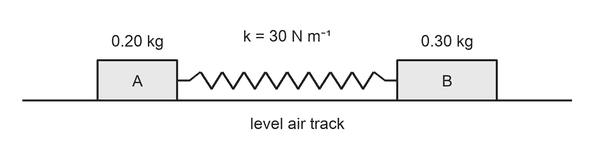
The period of their oscillation is about
- 201 mark
Question 20
Competency: Analysis & Evaluation
A load stretches a stiff spring by , and a load stretches a soft spring by the same . Each load is then pulled down slightly and released, so that it bobs up and down. (Hypothetical data.) Take .
Assertion (A): The two loads bob up and down with the same period.
Reason (R): When each spring is stretched by , the stiff spring stores more elastic potential energy than the soft one.
- 214 marks
Question 21
Competency: Application
A small toy hangs from the roof of a car on a light string, and it can be treated as a simple pendulum of length . The car is at rest at first, as shown. It then moves forward along a straight, level road with a steady acceleration of . (Hypothetical data.) Take .
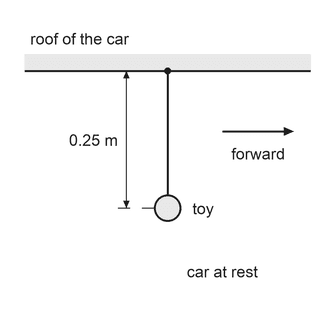
(a) While the car accelerates, the toy hangs at rest relative to the car, with its string at an angle to the vertical. Find this angle, and say whether the toy hangs towards the front or the back of the car.
(b) The toy is now set swinging slightly about this new position. Find the period of its small oscillations, and compare it with the period when the car is at rest.
(c) Later the car slows down with a steady deceleration of . Say how the toy now hangs, and find the period of its small oscillations.
- 221 mark
Question 22
Competency: Analysis & Evaluation
In a laboratory, a student replaces the bob of a simple pendulum with a bob of the same size, keeping the same thread and the same length, and times small swings.
Assertion (A): The period of the pendulum stays the same.
Reason (R): The restoring force on the bob does not depend on its mass.
- 231 mark
Question 23
Competency: Application
Riya pushes her little sister on a garden swing. The swing can be treated as a simple pendulum of length moving through small angles. Riya stands behind the swing and gives it a gentle push each time it comes back to her. (Hypothetical data.) Take . About how many pushes does she give each minute?
- 244 marks
Question 24
Competency: Analysis & Evaluation
Imagine a straight, smooth, airless tunnel bored through the Earth between two cities A and B that are apart in a straight line. A train released from rest at A moves along the tunnel under gravity alone. Treat the Earth as a uniform sphere of radius , and use the result that inside a uniform Earth the gravitational force on a body of mass at a distance from the centre O is , directed towards O, with . Ignore the Earth's rotation. In the figure, M is the mid-point of the tunnel and P is the train, at a distance from M. (Hypothetical data.)

(a) Show that the train moves in SHM about M.
(b) Find the time the train takes to go from A to B. Would a tunnel between two cities farther apart take a longer time?
(c) Find the greatest speed of the train, and say where it occurs.
- 251 mark
Question 25
Competency: Analysis & Evaluation
A small bead of mass is fixed at the middle of a light elastic cord. The cord lies on a smooth horizontal table, stretched between two hooks A and B that are apart, with a tension of . The bead is pulled a few millimetres sideways along the table, at right angles to AB, and released, as shown. For such small displacements the tension stays . (Hypothetical data.)

The frequency of the bead's oscillation is about
- 264 marks
Question 26
In an experiment to find , a student measures the length of a simple pendulum from the point of suspension to the top of the bob, forgetting to add the radius of the bob. For each length the student times 20 oscillations. (Hypothetical data.)
(m) 0.400 0.600 0.800 1.000 Time for 20 oscillations (s) 25.86 31.48 36.24 40.44 (a) Find for each length and plot against .
(b) Use the slope of the graph to find .
(c) The line does not pass through the origin. Explain why, and use the graph to find the radius of the bob.
(d) Why is plotted against , rather than against ?
- 274 marks
Question 27
A glass tube of uniform bore is bent into a V, with both arms inclined at to the horizontal, as shown. It holds a column of liquid whose total length, measured along the tube, is . The liquid is pushed a little way along the tube and released. (Hypothetical data.) Take and ignore friction, surface tension and the short bend at the bottom.

(a) Show that the liquid column executes SHM, and obtain an expression for its period in terms of the length of the column, and the angle of the arms with the horizontal.
(b) Find the period.
(c) Compare it with the period of the same column in a U-tube whose arms are vertical.
- 283 marks
Question 28
A body executing SHM completes 120 oscillations per minute. If the amplitude of oscillations is 6 cm, find the velocity and acceleration of the particle when it is at a distance of 4 cm from the mean position?
- 293 marks
Question 29
A body of mass 4 kg is executing SHM of amplitude 0.4 m and period 2 s. Find (i) the maximum restoring force and (ii) the restoring force at a distance of 0.1 m from extreme position.
- 303 marks
Question 30
In SHM, what is the minimum time required for a particle to move between two points 10 cm on either side of the mean position? The amplitude and time period of the particle are 20 cm and 2 seconds respectively.
- 313 marks
Question 31
A particle is moving with SHM in a straight line. When the distance of the particle from the equilibrium position has the values 2 cm and 4 cm, the corresponding values of velocities are and respectively. Find the length of the path and the period.
- 324 marks
Question 32
A body of mass 1 kg is executing SHM given by cm. What is the (i) amplitude of displacement, (ii) frequency, (iii) initial phase, (iv) velocity, (v) acceleration and (vi) maximum kinetic energy?
- 333 marks
Question 33
A body of mass 0.2 kg has a velocity of after one second of its starting from the mean position. If the time period is 6 seconds, find the kinetic energy, potential energy and total energy.
- 343 marks
Question 34
A particle executes SHM of amplitude . (i) At what distance from the mean position is its kinetic energy equal to its potential energy? (ii) At what points is its speed half the maximum speed?
- 353 marks
Question 35
The amplitude of a system moving in SHM is doubled. Determine the change in (a) total energy, (b) the maximum speed, (c) the maximum acceleration and (d) the period.
- 363 marks
Question 36
A 0.02 kg weight produces an extension of 0.02 m in a vertical spring. A mass of 0.1 kg is suspended at its bottom and is left after putting down. What is the period of oscillation?
- 373 marks
Question 37
A mass is suspended from a spring of force constant . The period of oscillation is . The spring is cut into 4 equal parts. The same mass is suspended from one of the parts. What is the new period?
- 383 marks
Question 38
An impulsive force gives an initial velocity of to the mass in the unstretched spring position. What is the amplitude of motion? Give as a function of time for the oscillating mass. Given kg, .
- 393 marks
Question 39
If two springs of force constants and are connected in series and is fixed to a body of mass 100 g. Find the period of oscillation.
- 403 marks
Question 40
In the given figure, is a horizontal plank of length and mass . It is pivoted at one end and the other end is attached to a spring of force constant . The moment of inertia of the plank about the pivot is . If the plank is displaced by a small angle from the horizontal and released, show that its motion is SHM. What is the period of oscillation?
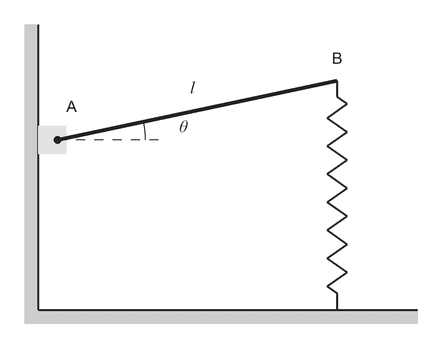
- 413 marks
Question 41
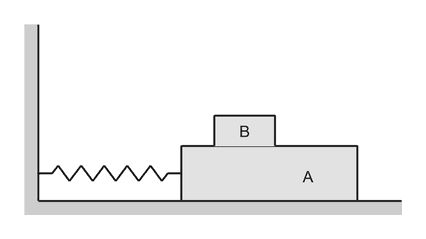
In the given figure, is a large block which executes SHM by sliding across a frictionless surface with a frequency . The block is at rest on the surface of the block . The coefficient of static friction between the two is . Find the maximum amplitude of oscillation of the system so that the block does not slip.
- 423 marks
Question 42
Two springs of force constants and are connected in parallel and is fixed to body of mass 100 g. Find the period of oscillation.
- 433 marks
Question 43
What is the length of a simple pendulum whose time period of oscillation is 2 second? If this pendulum is mounted in a lift which accelerates downwards at , by what factor does its period of oscillations change from the original value?
- 443 marks
Question 44
If the length of a seconds pendulum is decreased by 2%, find the gain or loss in time per day.
- 453 marks
Question 45
A U-tube contains a liquid to a height of 9.8 cm in one of the limbs. The tube is vertical. If the liquid on one side is depressed a little and released, its motion in the tube is simple harmonic motion. Find its period.
- 463 marks
Question 46
The period of a piston in an engine, moving simple harmonically is 2 s. A body of mass 10 kg is placed on the piston. Calculate the maximum amplitude of the piston such that the mass is not thrown out from the platform.
- 473 marks
Question 47
If the Earth was a homogeneous sphere and a straight hole was bored through its centre, show that a body dropped into this hole will execute SHM. Calculate the time period if the radius of the Earth is 6400 km and .