
Competency: Application
Astronomers can detect a planet going round a distant star from the star's small "wobble". The star and the planet both move round their common centre of mass, so the star moves uniformly round a small circle. Our line of sight lies in the plane of this circle, so we can measure only the part of the star's velocity along the line of sight. The figure shows the circle seen from above its plane. The measured values rise and fall between (moving away from us) and (moving towards us), repeating every days. (Hypothetical data.)
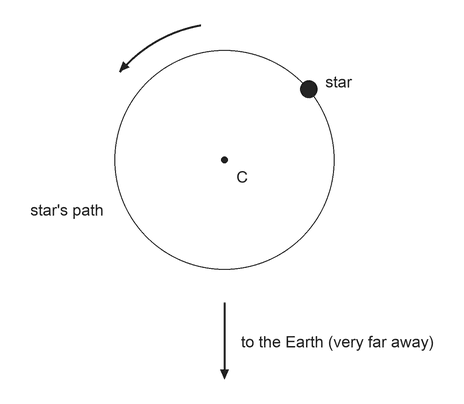
(a) Explain why the star's velocity along the line of sight varies with time in the same way as the velocity of a body in SHM. State the amplitude and the period of this variation.
(b) Find the radius of the small circle in which the star moves.
(c) At one moment the star's velocity along the line of sight is . How far is the star then from C, the centre of its circle, measured along the line of sight?