
Question 583 marksMedium
Derive an expression for the time period of oscillation of a mass attached to (i) horizontal spring and (ii) vertical spring.
Confirming your payment
Sign up now and get 250 free tokens.
Simple Harmonic Motion · Question 58 of 63
Derive an expression for the time period of oscillation of a mass attached to (i) horizontal spring and (ii) vertical spring.
Solution:
Concept: If the net force on a body of mass is for a displacement from its equilibrium position, the body performs SHM with and period .
Step 1 — Horizontal spring: find the restoring force (part i). A mass rests on a smooth horizontal table, fixed to one end of a spring of force constant whose other end is clamped. When the mass is pulled a distance from its equilibrium position O, Hooke's law gives the force of the spring:

Step 2 — Horizontal spring: find the period. By Newton's second law the acceleration is
This is SHM with , so
Step 3 — Vertical spring: find the equilibrium position (part ii). When the mass hangs from the spring at rest, the spring is stretched by , and its upward pull balances the weight:
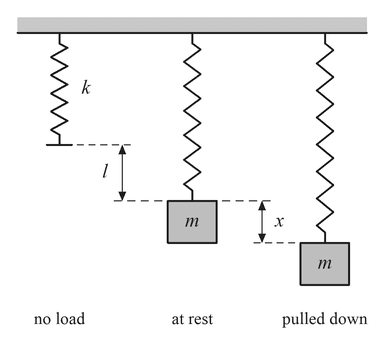
Step 4 — Vertical spring: find the restoring force. Now pull the mass down a further distance . The spring is stretched by , so the net upward force is
Since (Step 3), these two terms cancel:
This force acts upwards, opposite to the displacement, so again.
Step 5 — Vertical spring: find the period. The motion is SHM with the same :
Using , this can also be written
Therefore, for both the horizontal and the vertical spring the period is ; for the vertical spring it also equals , where is the extension produced by the mass.