
Opening your dashboard
Class 11 Physics Chapter 21 Simple Harmonic Motion: Practice Questions
153 questions on Chapter 21, each worked through on its own page with the AI tutor. Class 11 Physics, ICSE 2026-27.
153 questions
1–4 marks · Mixed difficulty
- 11 mark
Question 1
A mechanical metronome is set to ticks per minute. It makes one tick in each swing of its arm from one end to the other. (Hypothetical data.) The period of oscillation of the arm is
- 23 marks
Question 2
A pulsar is a rapidly spinning neutron star that sends out a narrow beam of radio waves. The beam sweeps past the Earth once in every rotation of the star, so a radio telescope picks up a short pulse every . (Hypothetical data.)
(i) Find the frequency and the angular frequency of the star's rotation.
(ii) How many rotations does the star make in one hour?
(iii) Is the star's rotation periodic? Is it oscillatory? Give a reason for each answer.
- 31 mark
Question 3
A wooden block resting on a rough floor is joined to a wall by a horizontal spring, as shown. The block is pulled to the right of the position where the spring is unstretched, and then released. It slides back towards the wall but comes to rest before it reaches that position, and it never crosses it.
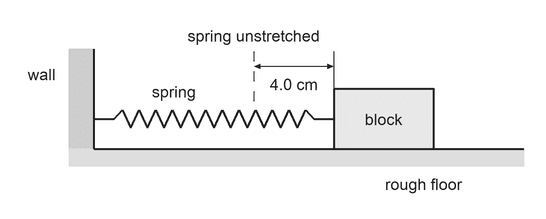
For a body to oscillate, three conditions must be met. Which of them is NOT met here?
- 43 marks
Question 4
(i) The displacement of a vibrating body is , where is in centimetres and in seconds. Find the period of the motion.
(ii) Is the motion periodic? Give a reason.
- 53 marks
Question 5
A small steel ball is dropped from a height of onto a hard steel plate. Assume that it rebounds to the same height after every bounce and that air resistance can be neglected; take . (Hypothetical data.)
(i) Show that the motion of the ball is periodic, and find its period.
(ii) Find the period if the ball is dropped from instead.
(iii) Give two reasons why the motion is not simple harmonic.
- 61 mark
Question 6
A small block of mass moves along the -axis under a single force , where is in metres. (Hypothetical data.) About which point does the block oscillate, and what is the period of its oscillation?
- 73 marks
Question 7
A motion sensor records the acceleration of a trolley oscillating on a level track at five positions , measured from the trolley's equilibrium position. (Hypothetical data.)
(cm) () (i) Show that the data fit simple harmonic motion, and write the differential equation of the motion.
(ii) Find the angular frequency and the period.
(iii) The trolley has a mass of . Find the restoring force on it at and the force constant of the system.
- 83 marks
Question 8
A particle moves along the -axis according to , with in metres and in seconds. At it is at and is moving in the direction with a speed of .
(i) Find its angular frequency and its period.
(ii) Writing the solution as , find the amplitude and the initial phase .
(iii) Find the maximum speed of the particle.
- 91 mark
Question 9
A particle moves along the -axis according to , with in metres and in seconds. The frequency of its oscillation is
- 103 marks
Question 10
The acceleration of a particle moving along the -axis is , where is in and in seconds. At the particle is at and has a velocity of .
(i) Find its velocity and its displacement as functions of time.
(ii) Show that the particle executes SHM, and find its amplitude and its period.
- 111 mark
Question 11
A particle executes SHM. Its average speed while it moves from the mean position to an extreme position is what fraction of its maximum speed?
- 123 marks
Question 12
A particle executes SHM of amplitude and period . At it is at its extreme position .
(i) Find the total distance it travels in the first .
(ii) Where is it at , and what is its displacement from its starting point?
(iii) How far is it from its starting point at ?
- 131 mark
Question 13
At one instant, a particle executing SHM with an angular frequency of has a velocity of and an acceleration of . The amplitude of its motion is
- 143 marks
Question 14
An electrodynamic shaker is used to test electronic parts. It moves a small table up and down in SHM at a frequency of with an amplitude of . (Hypothetical data.) Take .
(i) Find the maximum speed and the maximum acceleration of the table, and express the maximum acceleration as a multiple of .
(ii) A circuit board bolted to the table is rated to survive accelerations of up to . Is it safe in this test?
(iii) Keeping the frequency at , find the largest amplitude for which the board stays within its rating.
- 151 mark
Question 15
The frequency of a particle's SHM is tripled while its amplitude is halved. Its maximum speed and its maximum acceleration become
- 161 mark
Question 16
A body of mass executes SHM along the -axis. The graph shows how its potential energy depends on its displacement . The body turns back at . (Hypothetical data.)
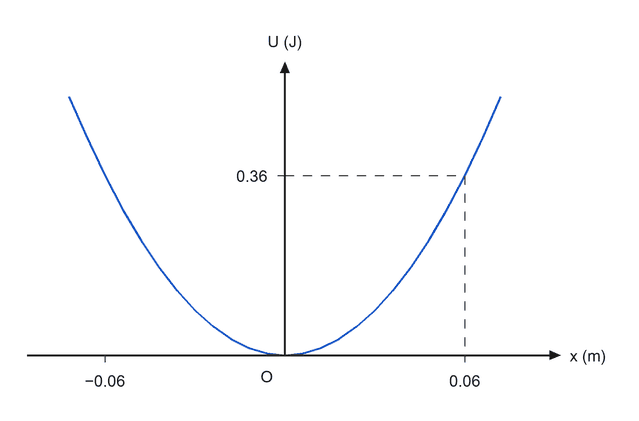
The greatest speed of the body is
- 173 marks
Question 17
A glider of mass on a level air track is attached to a spring and moves in SHM. When it is from its equilibrium position, its speed is and the restoring force on it is . (Hypothetical data.)
(i) Find the force constant of the spring and the total energy of the glider.
(ii) Find the amplitude of the motion and the greatest speed of the glider.
- 183 marks
Question 18
A particle executes SHM of amplitude under a restoring force , with . Find the work done by the restoring force on the particle as it moves
(i) from the mean position to the extreme position ,
(ii) from that extreme position back to the mean position, and
(iii) through one complete oscillation.
Explain the sign of each answer.
- 191 mark
Question 19
Two blocks of equal mass execute SHM. Block A has an amplitude of and a frequency of ; block B has an amplitude of and a frequency of . (Hypothetical data.) The ratio of the total energy of A to that of B is
- 203 marks
Question 20
For a particle executing SHM, its kinetic energy when it is from the mean position is three times its kinetic energy when it is from the mean position.
(i) Find the amplitude of the motion.
(ii) The particle has a mass of and a period of . Find its kinetic energy when it is from the mean position. (Hypothetical data.)
- 213 marks
Question 21
A small peg P is fixed on a turntable at from its axis, and the turntable rotates uniformly at revolutions per minute. A parallel beam of light falls on the turntable from one side, so that the shadow S of the peg moves to and fro along a screen, as shown. (Hypothetical data.)

(i) Find the amplitude and the period of the motion of the shadow.
(ii) Find the greatest speed of the shadow.
(iii) Find the speed and the size of the acceleration of the shadow when it is from the centre of its path.
- 221 mark
Question 22
A particle P moves anticlockwise round a circle of radius with a constant angular speed of . Q is the foot of the perpendicular from P on the diameter X′OX. At the instant shown, OP makes an angle of with OX.
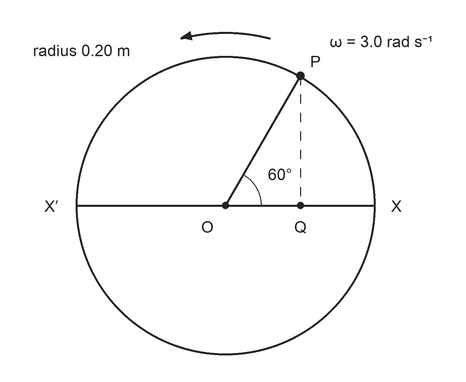
The size of the acceleration of Q at this instant is
- 233 marks
Question 23
A particle P moves anticlockwise round a circle of radius with a period of . At it is at , where makes an angle of with OX, as shown. Q is the foot of the perpendicular from P on the diameter X′OX, and is the displacement of Q from O, positive towards X.

(i) Write as a function of time in the form .
(ii) Find the displacement and the velocity of Q at .
(iii) At what time does Q first pass through O?
- 241 mark
Question 24
A particle P moves round a circle with uniform speed, and Q is the foot of the perpendicular from P on a fixed diameter of the circle. Which quantity is always the same for P and for Q?
- 253 marks
Question 25
Io, one of Jupiter's moons, moves round Jupiter in a nearly circular orbit of radius about , taking about days for each orbit. We see this orbit almost edge-on from the Earth, so Io appears to move to and fro along a straight line through Jupiter.
(i) Explain why Io's apparent motion is simple harmonic, and give its amplitude and its period.
(ii) Find the greatest speed of Io's apparent motion relative to Jupiter, in .
(iii) How many hours does Io take to move from its greatest apparent distance from Jupiter (greatest elongation) to the moment when it crosses in front of Jupiter (transit)?
- 261 mark
Question 26
The displacement–time graph of a particle executing SHM along the -axis is shown. Its displacement can be written as , with the initial phase between and .
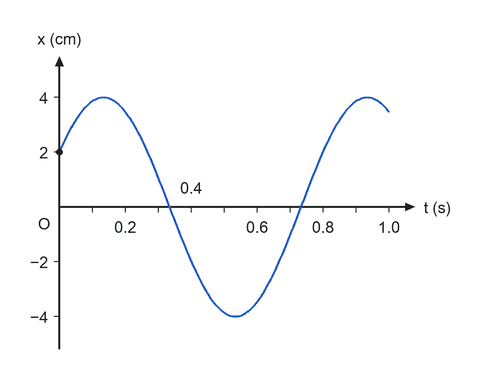
The initial phase of the motion is
- 273 marks
Question 27
Two particles P and Q oscillate side by side along two parallel lines, with their mean positions level with each other. Their displacements are
Here is in seconds.
(a) Find the phase difference between the two motions and say which particle leads.
(b) Find the earliest time after at which the two particles have the same displacement, and find that displacement.
(c) At that instant, are they moving in the same direction or in opposite directions? Explain.
- 281 mark
Question 28
The graph shows how the acceleration of a particle executing SHM along the -axis varies with time .
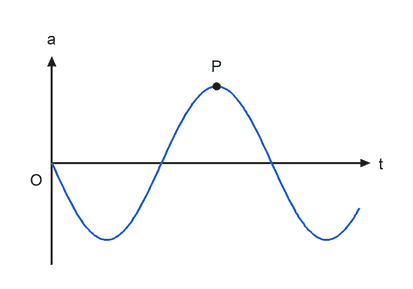
At the instant marked P, the particle is
- 293 marks
Question 29
The phase of a particle executing SHM can be stated by the time that has passed since it last crossed its mean position moving in the positive direction. A particle executes SHM along the -axis with an amplitude of and a period of ; its displacement is , where is its phase. It crossed its mean position in the direction ago. (Hypothetical data.)
(a) Find its phase now, in radians and in degrees.
(b) Find its displacement and its velocity now.
(c) How much later will its phase be , and where will the particle be then?
- 301 mark
Question 30
The graphs show the displacements of two particles A (solid line) and B (dashed line) executing SHM along parallel lines.
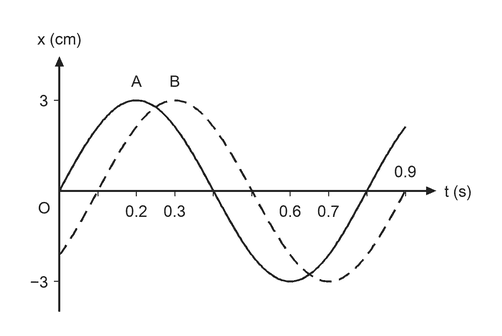
Which statement about their phases is correct?
- 313 marks
Question 31
The velocity–time graph of a particle executing SHM is shown.
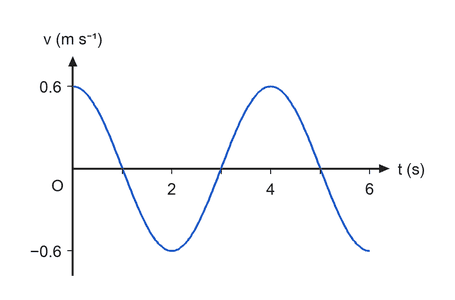
(a) Find the period and the angular frequency of the motion.
(b) Find the amplitude and the maximum acceleration.
(c) Taking the displacement to be zero at , write the displacement as a function of time and sketch the displacement–time graph.
- 323 marks
Question 32
The phase of a particle executing SHM along the -axis is plotted against time . The particle's displacement is , with an amplitude .
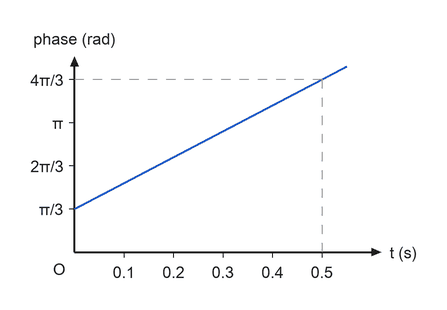
(a) Use the graph to find the angular frequency and the period of the motion.
(b) Find the initial phase, and write the displacement as a function of time.
(c) Find the displacement and the velocity of the particle at , and say which way it is moving then.
- 333 marks
Question 33
Ordinary weighing scales cannot measure an astronaut's mass in an orbiting space station, so oscillating mass-measuring chairs have been used instead. In one such chair, the seat is fixed to springs with an effective force constant of and can oscillate to and fro. With the seat empty, the period of oscillation is ; with an astronaut strapped in, it is . (Hypothetical data.)
(a) Why does an ordinary weighing scale fail in orbit, while the oscillating chair still works?
(b) Find the mass of the moving part of the empty chair.
(c) Find the astronaut's mass.
- 343 marks
Question 34
A car of mass (including the driver) stands on level ground. When four passengers of total mass get in, the car body sinks by . (Hypothetical data.) Treat the four springs of the suspension together as one spring carrying the whole loaded car, ignore the damping by the shock absorbers, and take .
(a) Find the force constant of the suspension.
(b) Find the period and the frequency of the vertical oscillations of the loaded car.
(c) A softer suspension with half this force constant is fitted instead. Find the new period of the loaded car, and how far the car body would now sink when the same passengers get in.
- 351 mark
Question 35
A block of mass hangs from a spring of force constant fixed to the ceiling of a lift. With the lift at rest, the block oscillates vertically with a period of about . (Hypothetical data.) The lift now moves upwards with a steady acceleration of while the block keeps oscillating. Take . Which statement is correct?
- 364 marks
Question 36
A body of mass hangs at rest from a light vertical spring of force constant . It is pulled down below this rest position and released at . (Hypothetical data.) Take and measure the displacement downwards from the rest position.
(a) Find the extension of the spring when the body hangs at rest.
(b) Write as a function of time in the form .
(c) Find the speed of the body when it is above the rest position, and find its greatest acceleration.
(d) Does the spring ever become shorter than its natural length during this motion? Explain.
- 371 mark
Question 37
A student hangs different masses on the same light spring and measures the period of their vertical oscillations. Which graph of the results is a straight line passing through the origin?
- 382 marks
Question 38
An angler hangs a fish of mass from a spring balance whose spring has a force constant of . The fish hangs still until a small jolt sets it bobbing up and down in SHM with an amplitude of . The balance shows the force exerted by its spring. (Hypothetical data.) Take .
(a) Find the period of the bobbing.
(b) Find the largest and the smallest readings of the balance, in newtons.
- 391 mark
Question 39
A block of mass on a smooth horizontal table is attached to a light spring of force constant . A sharp tap at its equilibrium position gives it a speed of , and it oscillates. (Hypothetical data.) If instead the tap gives it a speed of , the amplitude and the period of its oscillation are
- 401 mark
Question 40
At the same place, a simple pendulum P makes 30 complete oscillations in the time that another simple pendulum Q makes 20. Both swing through small angles. The ratio of their lengths, , is
- 411 mark
Question 41
A child watching a simple pendulum notices that the bob passes through its lowest point once every . (Hypothetical data.) Taking , the length of the pendulum is about
- 424 marks
Question 42
A simple pendulum is long, measured from the point of suspension O to the centre of the bob. A thin peg P is fixed vertically below O, just beside the string. When the bob swings to the side of the peg, the string catches on P and only the lowest of the string swings about P; on the other side the whole string swings about O. (Hypothetical data.) Take and assume small swings.
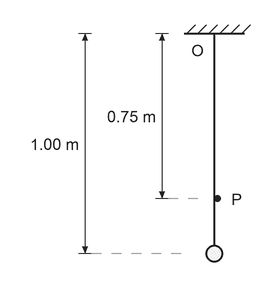
(a) Find the time for one complete to-and-fro swing.
(b) Is this motion periodic? Is it simple harmonic? Explain.
(c) The bob is pulled to the side away from the peg until the string makes with the vertical, and released. Find the greatest angle that the short part of the string makes with the vertical on the peg's side.
- 433 marks
Question 43
A simple pendulum long is pulled aside until its string makes with the vertical, and is then released from rest. (Hypothetical data.) Take .
(a) Treating the motion as SHM along the arc, find the greatest speed of the bob.
(b) Find the greatest speed again from the conservation of energy, without the small-angle approximation, and compare the two answers.
(c) How long after its release does the bob first reach its lowest point?
- 442 marks
Question 44
In deriving for a simple pendulum, the restoring force is replaced by , with in radians.
(a) By what percentage of the true restoring force does exceed it when the string makes with the vertical? And when it makes ?
(b) Why must a pendulum swing through small angles for the formula to hold?
- 451 mark
Question 45
A uniform wooden cylinder floats upright in water (density ) with of its length under water. When pushed down slightly and released, it bobs up and down in SHM. The same cylinder is then floated upright in a salt solution of density and set bobbing in the same way. (Hypothetical data.) The ratio of its period in the salt solution to its period in water is about
- 463 marks
Question 46
A cylindrical wooden marker buoy is tall and has a cross-sectional area of . It floats upright in sea water of density ; the density of the wood is . (Hypothetical data.) Take and ignore damping by the water.
(a) How deep is the bottom of the buoy below the water surface?
(b) Find the period of its small up-and-down oscillations.
(c) The designer wants this period to be . What mass of ballast must be fixed inside the buoy (adding no volume outside it), and will the buoy still float?
- 473 marks
Question 47
In an experiment to measure the ratio of the principal specific heats of air, , a steel ball of mass fits closely in the vertical neck of a large bottle and can slide without friction. The bottle holds of air, the neck has a cross-sectional area of , and the pressure of the air inside is . When the ball is pushed down slightly and released, it oscillates with a period of . (Hypothetical data.)

(a) Find the period the ball would have if the air were compressed and expanded isothermally.
(b) Use the measured period to find , and say what the result shows about the compressions and expansions of the air.
- 481 mark
Question 48
A ball of mass oscillates in the vertical neck of an air-filled bottle with a period of . The neck is replaced by a wider one of twice the cross-sectional area, and a hollow ball of the same mass that fits it closely is used instead. The volume and pressure of the air inside are unchanged. (Hypothetical data.) The new period is
- 492 marks
Question 49
Which of the following examples represents periodic motion?
(i) A swimmer completing one (return) trip from one bank of a river to the other bank.
(ii) A freely suspended bar magnet displaced from its N–S direction and released.
(iii) Halley's comet
(iv) A hydrogen molecule rotating about its centre of mass.
(v) An arrow released from a bow.
- 502 marks
Question 50
Which of the following examples represents (nearly) SHM and which represents periodic but not SHM.
(i) The rotation of the Earth about its axis.
(ii) Motion of an oscillating mercury column in a U-tube.
(iii) Motion of a ball bearing inside a smooth curved bowl when released from a point slightly above the lowermost position.
(iv) General vibration of a polyatomic molecule about its equilibrium configuration.
- 512 marks
Question 51
Which of the following – plots represent periodic motion? What is its period?
(i) Fig. (a)
(ii) Fig. (b)

- 522 marks
Question 52
Give the characteristics of SHM.
- 532 marks
Question 53
Can pendulum clocks be used in artificial satellite? Explain.
- 542 marks
Question 54
Suppose the bob in a simple pendulum is a hollow sphere with a small hole at the bottom. The sphere is filled with water and is made to oscillate. What happens to the period?
- 552 marks
Question 55
How will you determine the period of oscillation of a mass without the use of a clock? You are given a weightless spring, a metre scale and a known mass.
- 562 marks
Question 56
The amplitude of a simple pendulum decreases with time. But there is no decrease in the amplitude of a pendulum clock. Why?
- 572 marks
Question 57
The displacement of a harmonic oscillator is half of its amplitude. What fraction of the total energy is kinetic and what fraction is potential?
- 582 marks
Question 58
Write down the expression for the average K.E. and average P.E. of a harmonic oscillator. How are they related?
- 592 marks
Question 59
For an oscillating simple pendulum, is the tension in the string constant throughout the oscillation? If not, when is it (a) the least and (b) the greatest?
- 602 marks
Question 60
A spring is cut into two halves. What happens to its period of oscillation of a mass suspended from it, before cutting and after cutting?
- 612 marks
Question 61
What is the period of oscillation of a simple pendulum if its bob is made of ice?
- 622 marks
Question 62
Distant explosion can break glass windows. How?
- 632 marks
Question 63
Draw the velocity–displacement graph of a body executing SHM.
- 642 marks
Question 64
If is the displacement of a simple harmonic oscillator at a certain instant and its acceleration at that instant, draw graph of at all instants in one complete oscillation.
- 651 mark
Question 65
A pendulum clock is taken to the Moon. Will it gain or lose time?
- 663 marks
Question 66
A particle executes SHM in a line 10 cm long. When it passes through the mean position, its velocity is . Find the period.
- 673 marks
Question 67
The displacement of a particle executing SHM is m. Find (i) amplitude and (ii) period.
- 683 marks
Question 68
The amplitude of a body executing SHM is 2 cm. Its mass is 20 g and the frequency of vibration is 20 Hz. Find its (i) maximum velocity and (ii) energy.
- 693 marks
Question 69
In what time after its motion began, will a particle oscillating according to the equation move from the mean position to the maximum displacement.
- 703 marks
Question 70
Two particles start oscillating together in SHM along the same straight line. Their periods are 2 s and 4 s. What is their phase difference after 1 s from the start?
- 713 marks
Question 71
A body has a time period of 3 s under the action of one force and 4 s under the action of another force. Calculate the time period when both the forces act in the same direction simultaneously. Assume that the body undergoes the same displacement, under the action of the two different forces.
- 723 marks
Question 72
In a HCl molecule, we may treat Cl to be of infinite mass and H alone oscillating. If the oscillations of HCl molecule shows frequency , deduce the force constant. Given Avogadro's number per kg mole.
- 733 marks
Question 73
The shortest distance travelled by a particle moving in SHM from its mean position in 2 second is of its amplitude. Find the period.
- 743 marks
Question 74
A particle moving with SHM has a period 0.001 s and amplitude 0.5 cm. Find the acceleration, when it is 0.2 cm apart from its mean position.
- 753 marks
Question 75
A particle executes SHM of period 8 s. After what time of its passing through the mean position, the energy will be half kinetic and half potential?
- 763 marks
Question 76
Calculate the ratio of displacement to amplitude when kinetic energy of a body is thrice its potential energy.
- 773 marks
Question 77
A simple harmonic oscillator of period 6 second has 6 joule potential energy when its displacement is 3 cm. Calculate (i) force constant and (ii) average kinetic energy when the amplitude is 5 cm.
- 783 marks
Question 78
A body of mass 2 kg is executing simple harmonic motions according to the equation m, where is in seconds. What is the maximum kinetic energy?
- 793 marks
Question 79
A particle is executing SHM. What fraction of its energy is kinetic when the displacement is half the amplitude?
- 803 marks
Question 80
The kinetic energy of a particle executing SHM is 32 J when it passes through the mean position. If the mass of the particle is 4 kg and the amplitude is one metre, find its time period.
- 813 marks
Question 81
The period of oscillation of a simple pendulum is 3.145. What is the length of the pendulum?
- 823 marks
Question 82
A body of mass 4 kg is made to oscillate on a spring of force constant 10 N/m. Calculate (i) angular frequency (ii) frequency of vibration and (iii) time period of vibration.
- 833 marks
Question 83
A mass attached to a spring oscillates with a period of 3 second. If the mass is increased by 2 kg, the period increases by one second. Calculate the initial mass . (Assume that elastic limit is not crossed)
- 843 marks
Question 84
A spring balance has a scale that reads from 0 to 50 kg. The length of the scale is 20 cm. A body suspended from this spring, when displaced and released, oscillates with a period of 0.6 s. What is the weight of the body? When 50 kg is put, the extension of spring is 20 cm.
- 853 marks
Question 85
A small trolley of mass 2.0 kg resting on a horizontal turntable is connected by a light spring to the centre of the table. When the turntable is set into rotation at a speed of 300 rev/min, the length of the stretched spring is 40 cm. If the original length of the spring is 35 cm, determine the force constant of the spring.
- 863 marks
Question 86
A block of mass 0.01 kg is attached to a spring of force constant . If the energy of oscillation is J, find the angular frequency and amplitude of oscillation.
- 874 marks
Question 87
A horizontal coiled spring is found to stretch 3 cm by a force of N. A bob of kg is attached to the end of the spring and the spring is pulled by 4 cm along a horizontal frictionless table and then released. Find the force constant, period, potential energy and kinetic energy when the displacement is 2 cm.
- 883 marks
Question 88
A body weighing 0.02 kg has a velocity of after one second of start from the mean position. If the time period is 6 s, find the K.E., P.E. and the total energy.
- 893 marks
Question 89
What is the period of a simple pendulum whose length is 50 cm?
- 903 marks
Question 90
The period of a simple pendulum on the surface of the Earth is 2 s. Find its period on the surface of the Moon, if the acceleration due to gravity on the Moon is one-sixth that on the Earth?
- 913 marks
Question 91
A test tube weighs kg and having an external diameter of m is floated in water by placing kg of mercury at the bottom of the tube. When the tube is depressed and released, it executes SHM. Find the time period.
- 923 marks
Question 92
A cubical wood piece of mass 13.5 g and volume float in water. It is depressed and released, then it executes simple harmonic motion. Calculate the period of oscillation.
- 933 marks
Question 93
A cylindrical piece of cork of height 4.9 cm floats in water with its axis vertical and is made to execute SHM. Calculate its time period of oscillation if its density is 0.2 g/cc.
- 943 marks
Question 94
A horizontal board is oscillating with an amplitude of 3 m. If the frequency of oscillation is 15 per minute, find the minimum value of coefficient of friction in order that a body placed on the board will not slide when the board oscillates.
- 953 marks
Question 95
A small lead sphere is made to execute SHM inside a concave dish of radius of curvature 1 m. What is its period?
- 963 marks
Question 96
A particle is dropped down in a deep hole which extends to the centre of the Earth. Calculate the velocity at a depth of one km from the surface of the Earth? Assume that and radius of the Earth km.
- 971 mark
Question 97
Two particles are executing simple harmonic motion of the same amplitude and frequency along the -axis. Their mean position is separated by distance . If the maximum separation between them is , the phase difference between their motion is
- 981 mark
Question 98
A particle moves in – plane according to rule and . The particle follows
- 991 mark
Question 99
A particle is moving in a circle with uniform speed. Its motion is
- 1001 mark
Question 100
A particle is executing SHM along a straight line. Its velocities at distances and from the mean position are and respectively. Its time period is
- 1011 mark
Question 101
A particle is executing a simple harmonic motion. Its maximum acceleration is and maximum velocity is . The time period is
- 1021 mark
Question 102
A particle executing simple harmonic motion of amplitude has maximum speed of . The frequency of its oscillation is
- 1031 mark
Question 103
A particle executes simple harmonic oscillation with an amplitude . The period of oscillation is . The minimum time taken by the particle to travel half of the amplitude from the equilibrium position is
- 1041 mark
Question 104
A simple pendulum has time period . The bob is given negative charge and surface below it is given positive charge. The new time period will be
- 1051 mark
Question 105
A wave travelling in the -direction having displacement along -direction as , wavelength and frequency of is represented by
- 1061 mark
Question 106
Which one of the following is simple harmonic?
- 1071 mark
Question 107
A simple pendulum is executing simple harmonic motion with a time period . If the length of the pendulum is increased by , the percentage increase in the time period of the pendulum of increased length is
- 1081 mark
Question 108
The acceleration due to gravity at a place is . Then the time period of a simple pendulum of length one metre is
- 1091 mark
Question 109
A pendulum is hung from the roof of a sufficiently high building and is moving freely to and fro like a simple harmonic oscillator. The acceleration of the bob of the pendulum is at a distance of from the mean position. The time period of oscillation is
- 1101 mark
Question 110
Two springs of force constants and are connected to a mass as shown in the given figure. The frequency of oscillation of the mass is

- 1111 mark
Question 111
The frequency of oscillation of the springs shown in the figure will be
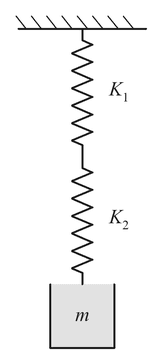
- 1121 mark
Question 112
A spring of force constant is cut into lengths of ratio . They are connected in series and the new force constant is . Then they are connected in parallel and force constant is . Then is
- 1131 mark
Question 113
Which of the following function represents a simple harmonic oscillation?
(A)
(B)
(C)
(D)
- 1141 mark
Question 114
Two simple pendulums of length and respectively are given small linear displacement in one direction at the same time. They will again be in the phase when the pendulum of shorter length has completed ________ oscillation.
- 1151 mark
Question 115
A silver atom in a solid oscillates in simple harmonic motion in some direction with a frequency of . What is the force constant of the bonds connecting one atom with the other? (Mole wt. of silver and Avogadro number )
- 1161 mark
Question 116
A particle undergoing simple harmonic motion has time dependent displacement given by . The ratio of kinetic to potential energy of this particle at will be
- 1171 mark
Question 117
A particle executes simple harmonic motion with an amplitude of . When the particle is at from the mean position, the magnitude of its velocity in S.I. units is equal to that of its acceleration. Then, its periodic time in seconds is
- 1181 mark
Question 118
A particle is executing simple harmonic motion (SHM) of amplitude , along the -axis, about . When its potential Energy (PE) equals kinetic energy (KE), the position of the particle will be
- 1191 mark
Question 119
Average velocity of a particle executing SHM in one complete vibration is
- 1201 mark
Question 120
A simple harmonic motion is represented by . The amplitude and time period of the motion are
- 1211 mark
Question 121
The phase difference between displacement and acceleration of a particle in a simple harmonic motion is
- 1221 mark
Question 122
A block of mass attached to a massless spring is performing oscillatory motion of amplitude '' on a frictionless horizontal plane. If half of the mass of the block breaks off when it is passing through its equilibrium point, the amplitude of oscillation for the remaining system become . The value of is
- 1231 mark
Question 123
In the given figure, a mass is attached to a horizontal spring which is fixed on one side to a rigid support. The spring constant of the spring is . The mass oscillates on a frictionless surface with time period and amplitude . When the mass is in equilibrium position, as shown in the figure, another mass is gently fixed upon it. The new amplitude of oscillation will be
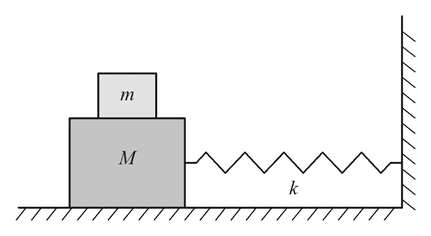
- 1241 mark
Question 124
Two masses and , each of mass are fixed together by a massless spring. A force acts on the mass as shown in the given figure. If the mass starts moving away from mass with acceleration '', then the acceleration of mass will be

- 1251 mark
Question 125
If two similar springs each of spring constant are joined in series, the new spring constant and time period would be changed by a factor
- 1261 mark
Question 126
Given below are two statements
Statement I: A second's pendulum has a time period of 1 second.
Statement II: It takes precisely one second to move between the two extreme positions.
In the light of the above statements, choose the correct answer from the options given below.
- 1271 mark
Question 127
If the time period of a two meter long simple pendulum is , the acceleration due to gravity at the place where pendulum is executing S.H.M. is
- 1281 mark
Question 128
The point shown in the figure moves with a uniform speed along the circumference of a circle of radius and covers in . The perpendicular projection '' from '' on the diameter represents the simple harmonic motion of ''. The restoration force per unit mass when touches will be
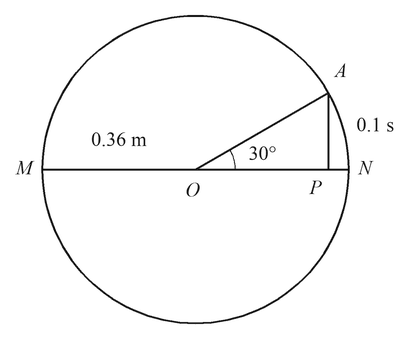
- 1291 mark
Question 129
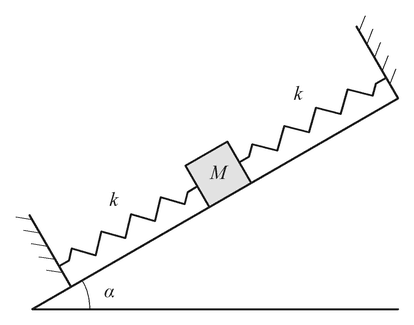
In the given figure, a body of mass is held between two massless springs, on a smooth inclined plane. The free ends of the springs are attached to firm supports. If each spring has spring constant , the frequency of oscillation of given body is
- 1301 mark
Question 130
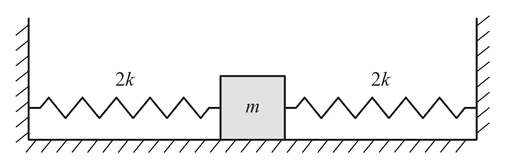
Two identical springs of spring constant '' are attached to a block of mass and to fixed support as shown in the figure. When the mass is displaced from equilibrium position on either side, it executes simple harmonic motion. The time period of oscillations of this system is
- 1311 mark
Question 131
When a particle executes SHM, the nature of graphical representation of velocity as a function of displacement is
- 1321 mark
Question 132
If the length of the pendulum in pendulum clock increases by , then the error in time per day is
- 1331 mark
Question 133
A particle starts executing simple harmonic motion (SHM) of amplitude '' and total energy . At any instant, its kinetic energy is then its displacement '' is given by
- 1341 mark
Question 134
is the time period of a simple pendulum at a place. If the length of the pendulum is reduced to times of its initial value, the modified time period is
- 1351 mark
Question 135
A particle is making simple harmonic motion along the -axis. If at a distances and from the mean position the velocities of the particle are and respectively. The time period of its oscillation is given as
- 1361 mark
Question 136
In a simple harmonic oscillation, what fraction of total mechanical energy is in the form of kinetic energy, when the particle is midway between mean and extreme position?
- 1371 mark
Question 137
For what value of displacement, the kinetic energy and potential energy of a simple harmonic oscillation become equal?
- 1381 mark
Question 138
Two particles and of equal masses are suspended from two massless springs of spring constants and respectively. If the maximum velocities during oscillations are equal, the ratio of the amplitude of and is
- 1391 mark
Question 139
A spring is stretched by by a force . The time period of the oscillations when a mass of is suspended by it is
- 1401 mark
Question 140
A body is executing simple harmonic motion with frequency '', the frequency of its potential energy is
- 1411 mark
Question 141
A body of mass executes simple harmonic motion (S.H.M.) about under the influence of a force as shown in the figure. The period of the S.H.M. is

- 1421 mark
Question 142
For a simple pendulum, a graph is plotted between its kinetic energy (KE) and potential energy (PE) against its displacement . Which one of the following represents these correctly? (graphs shown in the figure are schematic and not drawn to scale)

- 1431 mark
Question 143
The motion of a simple pendulum executing SHM is represented by the following equation, where time is measured in second. The length of the pendulum is
- 1441 mark
Question 144
The equation of a particle executing simple harmonic motion is given by . At , the speed of particle will be (given: )
- 1451 mark
Question 145
The time period of a simple pendulum in a stationary lift is . If the lift accelerates with vertically upwards, then the time period will be: (where = acceleration due to gravity)
- 1461 mark
Question 146
The maximum potential energy of a block executing simple harmonic motion is . '' is amplitude of oscillation. At , the kinetic energy of the block is
- 1471 mark
Question 147
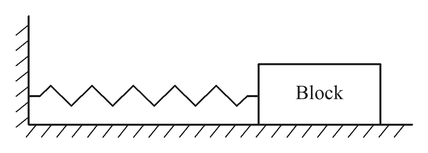
For a simple harmonic motion in a mass spring system shown in the given figure, the surface is frictionless. When the mass of the block is , the angular frequency is and when the mass of the block is , the angular frequency is . The ratio is
- 1481 mark
Question 148
The potential energy of a long spring when stretched by is . If the spring is stretched by , potential energy stored in it will be
- 1491 mark
Question 149
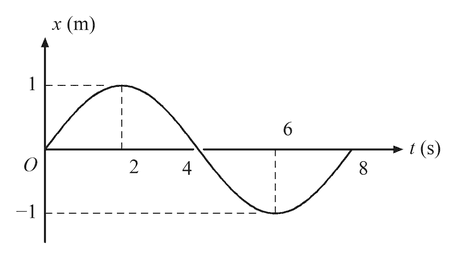
The – graph of a particle performing simple harmonic motion is shown in the given figure. The acceleration of the particle at is
- 1501 mark
Question 150
A particle executes simple harmonic motion. Its amplitude is and time period is . The time it will take to travel from its position of maximum displacement to the point corresponding to half of its amplitude is ________ s.
- 1511 mark
Question 151
A mass attached to the free end of a spring executes SHM with a period of . If the mass is increased by , the period increases by one second, the value of mass is ________ kg.
- 1521 mark
Question 152
The general displacement of a simple harmonic oscillator is . Let be its time period. The slope of its potential energy () – time () curve will be maximum when . The value of is ________.
- 1531 mark
Question 153
The amplitude of a particle executing SHM is . The displacement at which its kinetic energy will be more than the potential energy is ________ cm.