
Question 605 marksHard
(a) Show that the projection of uniform circular motion on the diameter of the circle of reference is SHM.
(b) Derive the relation for velocity and acceleration of a particle executing SHM.
Confirming your payment
Sign up now and get 250 free tokens.
Simple Harmonic Motion · Question 60 of 63
(a) Show that the projection of uniform circular motion on the diameter of the circle of reference is SHM.
(b) Derive the relation for velocity and acceleration of a particle executing SHM.
Solution:
Concept: Let a particle P move round a circle of radius (the circle of reference) with uniform angular velocity , and let Q be the foot of the perpendicular from P on the diameter YY′. As P goes round, Q moves to and fro along YY′ about the centre O.
Step 1 — Find the displacement of Q (part a). Let P start from X at . After time , , and in the right triangle OQP the displacement of Q from O is
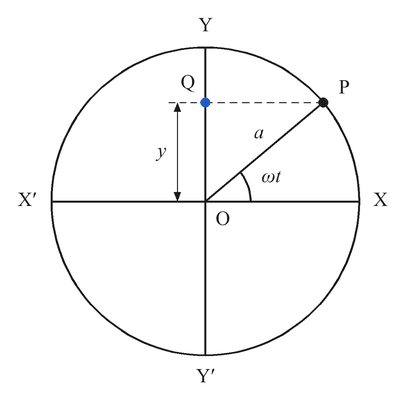
Step 2 — Find the acceleration of Q (part a). P has a centripetal acceleration directed along PO towards the centre. Its component parallel to YY′ is the acceleration of Q, and it points towards O (downwards when Q is above O):
Step 3 — Conclude (part a). The acceleration of Q is proportional to its displacement from O and always directed towards O, which is the condition for SHM. Q completes one oscillation (O → Y → O → Y′ → O) while P goes once round the circle, in the time . So the projection of uniform circular motion on a diameter is SHM, with amplitude equal to the radius .
Step 4 — Find the velocity (part b). P moves along the tangent with speed . The tangent makes the angle with YY′, so the component of P's velocity parallel to YY′, which is the velocity of Q, is

Step 5 — Write the velocity in terms of displacement (part b). Since , we have (plus while Q moves towards Y, minus while it moves towards Y′), so
At the mean position () the speed is greatest, ; at the extreme positions () it is zero.
Step 6 — Write the acceleration (part b). From Step 2, the acceleration is
It is zero at the mean position and greatest, , at the extreme positions, always pointing towards the mean position.
Therefore, (a) the projection Q of uniform circular motion has and acceleration , so it executes SHM; (b) in SHM the velocity is and the acceleration is .