
Opening your dashboard
Class 11 Physics Chapter 19: Carnot Cycle - Second Law of Thermodynamics Solutions
42 textbook questions with step-by-step answers, free to read, for ISC 2026-27.
Get talked through Ch 19, not just shown the answer
Reading a finished solution is not the same as being able to do it. The AI tutor takes one question at a time and works it with you, in your own words, until you can.
- Ask it out loud, in your own words
- It gives you the next step, not the answer
- Stuck on part (ii)? Start there
42 questions with solutions
1–5 marks · Mixed difficulty
The first 35 solutions are on this page. This chapter is a long one, so the rest open on their own page to keep this one quick to load.
- 11 mark
Question 1
A Carnot engine operates with a source at 500 K and sink at 375 K. Engine consumes 600 kcal. of heat per cycle. The heat rejected to sink per cycle is
Solve with AIAnswer
(A) 250 kcal
(B) 350 kcal
- Correct
(C) 450 kcal
(D) 550 kcal
Answer: (C) 450 kcal
Concept: A Carnot engine takes heat from a source at absolute temperature and rejects heat to a sink at absolute temperature ; the work it does is . For it, the heats are in the ratio of the temperatures, ; so its efficiency, defined as , is . Temperatures must be in kelvin.
Step 1 — Write the data. The source is at , the sink at , and the heat taken in per cycle is .
Step 2 — Use the Carnot ratio of heats. The heat rejected is , so:
Step 3 — Check with the efficiency. The efficiency is , so the work per cycle is:
The heat rejected is then , as found.
- (A) Rejecting 250 kcal would mean 350 kcal of work, an efficiency of about 58%, which is more than the Carnot value of 25%; no engine can do that.
- (B) Rejecting 350 kcal would mean 250 kcal of work, an efficiency of about 42%, again more than the Carnot limit of 25%.
- (D) Rejecting 550 kcal would mean only 50 kcal of work, an efficiency of about 8%; a Carnot engine between these temperatures has exactly 25%.
Therefore, the heat rejected to the sink per cycle is 450 kcal, option (C).
- 21 mark
Question 2
A frictionless heat engine can be efficient only if its exhaust temperature is
Solve with AIAnswer
(A) 0°C
- Correct
(B) 0 K
(C) equal to its input temperature
(D) half of its input temperature
Answer: (B) 0 K
Concept: No engine working between a source at and an exhaust (sink) at can be more efficient than a Carnot engine, whose efficiency is with temperatures in kelvin. Removing friction can at best raise an engine's efficiency to this value.
Step 1 — Write the condition for 100% efficiency. For , the term must be zero.
Step 2 — Find the exhaust temperature. If the source temperature is finite, the ratio is zero only when the exhaust (sink) is at absolute zero, .
Note: Absolute zero cannot actually be reached, so even a frictionless engine is never 100% efficient; the question asks only for the condition.
- (A) 0°C is 273 K, not absolute zero, so is not zero and the efficiency is below 100%.
- (C) If the exhaust were at the input temperature, and the efficiency would be zero: no work at all.
- (D) If the exhaust were at half the input temperature (in kelvin), the efficiency would be .
Therefore, the engine can be 100% efficient only if its exhaust temperature is 0 K, option (B).
- 31 mark
Question 3
An ideal gas heat engine operates in a Carnot cycle between 227°C and 127°C. It absorbs cal at higher temperature. The amount of heat converted into work is
Solve with AIAnswer
(A) cal
(B) cal
(C) cal
- Correct
(D) cal
Answer: (D) cal
Concept: A Carnot engine takes heat from a source at absolute temperature and rejects heat to a sink at absolute temperature ; the work it does is . For it, the heats are in the ratio of the temperatures, ; so its efficiency, defined as , is . Temperatures must be in kelvin.
Step 1 — Change the temperatures to kelvin. The source is at () and the sink at ().
Step 2 — Find the efficiency. We put the kelvin temperatures into the Carnot formula:
Step 3 — Find the heat converted into work. The work is the efficiency times the heat absorbed, :
- (A) cal is the heat rejected to the sink, , not the heat converted into work.
- (B) Converting cal would mean an efficiency of about 58%, far above the Carnot value of 20%.
- (C) Converting cal would mean an efficiency of about 27%, still above the Carnot limit of 20%.
Therefore, the heat converted into work is cal, option (D).
- 41 mark
Question 4
A refrigerator with its power on is kept in a closed room with its door open, the temperature of the room will
Solve with AIAnswer
- Correct
(A) rise
(B) fall
(C) remains the same
(D) depends on area of the room
Answer: (A) rise
Concept: A refrigerator takes heat from the cold body at absolute temperature , has work done on it, and gives heat to the hot body at absolute temperature ; its coefficient of performance is ; for an ideal (Carnot) refrigerator, this becomes , with both temperatures in kelvin.
Step 1 — Find where the heat goes. With the door open, the heat is taken from the room air at the door and the heat is given back to the same room air by the coils at the back, as the figure shows.

Step 2 — Find the net heat given to the room. The net heat gained by the room in each cycle is:
Step 3 — Decide the effect. The work supplied by the electricity is always positive, so the room gains energy continuously and its temperature rises.
- (B) The room would cool only if heat were sent outside it; here the heat taken in at the door comes back out at the coils, together with .
- (C) The temperature could stay the same only if no net energy entered the room, but the electrical energy enters it all the time.
- (D) The size of the room changes only how fast its temperature rises, not whether it rises.
Therefore, the temperature of the room will rise, option (A).
- 51 mark
Question 5
The coefficient of performance of a Carnot refrigerator working between 30°C and 0°C is
Solve with AIAnswer
(A) 10
(B) 1
- Correct
(C) 9
(D) 0
Answer: (C) 9
Concept: A refrigerator takes heat from the cold body at absolute temperature , has work done on it, and gives heat to the hot body at absolute temperature ; its coefficient of performance is ; for an ideal (Carnot) refrigerator, this becomes , with both temperatures in kelvin.
Step 1 — Change the temperatures to kelvin. The hot body is at () and the cold body at ().
Step 2 — Find the coefficient of performance. We put these into the Carnot formula:
Step 3 — Pick the option. The value 9.1 is nearest to 9.
- (A) 10 is close to , the value of ; that is the coefficient of performance of a heat pump, which counts the heat given out, not the heat removed.
- (B) A value of 1 would mean the work equals the heat removed; here the work is only of the heat removed.
- (D) 0 comes from using Celsius temperatures, ; the formula needs kelvin.
Therefore, the coefficient of performance is 9.1, about 9, option (C).
- 61 mark
Question 6
Choose the incorrect statement from the following:
S1: The efficiency of a heat engine can be 1, but the coefficient of performance of a refrigerator can never be infinity.
S2: The first law of thermodynamics is basically the principle of conservation of energy.
S3: The second law of thermodynamics does not allow several phenomena consistent with the first law.
S4: A process, whose sole result is the transfer of heat from a colder object to a hotter object is impossible.
Solve with AIAnswer
- Correct
(A) S1
(B) S3
(C) S2
(D) S4
Answer: (A) S1
Concept: The first law is energy conservation. The second law adds limits the first law does not: no engine turns all the heat it takes in into work (Kelvin–Planck), and heat does not pass by itself from a colder to a hotter body (Clausius).
Step 1 — Test statement S1. An efficiency of 1 would mean that all the heat taken in is turned into work with nothing rejected to a sink, which the Kelvin–Planck statement forbids. So the first part of S1 is false, and S1 is the incorrect statement.
Step 2 — Check the other statements. S2 is true: the first law, , is the conservation of energy applied to heat and work. S3 is true: many processes allowed by energy conservation, such as heat flowing by itself from cold to hot, never happen, and the second law rules them out. S4 is true: it is the Clausius statement of the second law.
- (B) Statement S3 is correct, as Step 2 explains, so it is not the incorrect statement.
- (C) Statement S2 is correct: the first law is the principle of conservation of energy.
- (D) Statement S4 is correct: it is the Clausius statement of the second law.
Therefore, the incorrect statement is S1, option (A).
- 71 mark
Question 7
An ideal heat engine working between temperature and has an efficiency , the new efficiency if both the source and sink temperature are doubled, will be
Solve with AIAnswer
(A)
- Correct
(B)
(C)
(D)
Answer: (B)
Concept: The efficiency of an ideal (Carnot) engine depends only on the ratio of the absolute temperatures of the sink and the source: .
Step 1 — Write the new efficiency. With the source at and the sink at , the new efficiency is:
Step 2 — Compare. This is the same expression as before, so : doubling both temperatures leaves their ratio, and hence the efficiency, unchanged.
- (A) Halving would need the ratio to rise, but doubling both temperatures keeps the ratio the same.
- (C) Doubling the efficiency would need the ratio to fall, which again does not happen when both temperatures are doubled.
- (D) Tripling cannot happen for the same reason; besides, would exceed 1 whenever .
Therefore, the new efficiency is , option (B).
- 81 mark
Question 8
In a mechanical refrigerator, the low temperature coils are at a temperature of −23°C and the compressed gas in the condenser has a temperature of 27°C. The theoretical coefficient of performance is
Solve with AIAnswer
- Correct
(A) 5
(B) 8
(C) 6
(D) 6.5
Answer: (A) 5
Concept: A refrigerator takes heat from the cold body at absolute temperature , has work done on it, and gives heat to the hot body at absolute temperature ; its coefficient of performance is ; for an ideal (Carnot) refrigerator, this becomes , with both temperatures in kelvin.
Step 1 — Change the temperatures to kelvin. The cold coils are at () and the condenser at ().
Step 2 — Find the theoretical coefficient of performance. The theoretical value is the Carnot value:
- (B) A value of 8 would need the cold coils at about 266.7 K (about −6°C), much warmer than −23°C.
- (C) 6 is , the coefficient of performance of a heat pump between these temperatures, not of a refrigerator.
- (D) 6.5 is the value for coils at −13°C, since , not at −23°C.
Therefore, the theoretical coefficient of performance is 5, option (A).
- 91 mark
Question 9
A refrigerator with coefficient of performance releases 200 J of heat to a hot reservoir. Then the work done on the working substance is
Solve with AIAnswer
(A) J
(B) 100 J
(C) J
- Correct
(D) 150 J
(E) 50 J
Answer: (D) 150 J
Concept: A refrigerator takes heat from the cold body at absolute temperature , has work done on it, and gives heat to the hot body at absolute temperature ; its coefficient of performance is ; for an ideal (Carnot) refrigerator, this becomes , with both temperatures in kelvin.
Step 1 — Write the two equations. The heat released to the hot reservoir is , and the coefficient of performance gives the heat taken from the cold body:
Step 2 — Use the energy balance. The heat released is the heat taken in plus the work done, so:
Step 3 — Check the answer. The energy balance gives the heat taken from the cold body:
The coefficient of performance is then:
This is the given value.
- (A) With , the heat taken in would be , giving a coefficient of performance of 5, not .
- (B) With , the heat taken in would also be 100 J, giving a coefficient of performance of 1.
- (C) is ; it wrongly multiplies the heat released by the coefficient of performance (it would give a coefficient of performance of 2).
- (E) 50 J is the heat taken from the cold body, , not the work; taking it as the work would give a coefficient of performance of .
Therefore, the work done on the working substance is 150 J, option (D).
- 101 mark
Question 10
An ideal refrigerator has a freezer at a temperature of −13°C. The coefficient of performance of the engine is 5. The temperature of the air (to which heat is rejected) will be
Solve with AIAnswer
(A) 325°C
(B) 325 K
- Correct
(C) 39°C
(D) 320°C
Answer: (C) 39°C
Concept: A refrigerator takes heat from the cold body at absolute temperature , has work done on it, and gives heat to the hot body at absolute temperature ; its coefficient of performance is ; for an ideal (Carnot) refrigerator, this becomes , with both temperatures in kelvin.
Step 1 — Change the freezer temperature to kelvin. The cold body is at ().
Step 2 — Solve the formula for . We put and into the formula for :
Step 3 — Change back to Celsius. We subtract 273:
- (A) 325°C is the number from the slip in (B) written with the wrong unit; air at 325°C would give .
- (B) 325 K comes from using the heat-pump formula ; with air at 325 K the refrigerator's would be .
- (D) Air at 320°C (593 K) would give , far below 5.
Therefore, the air is at 312 K (39°C), option (C).
- 111 mark
Question 11
An engine is supposed to operate between two reservoirs at temperature 727°C and 227°C. The maximum possible efficiency of such an engine is
Solve with AIAnswer
- Correct
(A)
(B)
(C)
(D) 1
Answer: (A)
Concept: A Carnot engine takes heat from a source at absolute temperature and rejects heat to a sink at absolute temperature ; the work it does is . For it, the heats are in the ratio of the temperatures, ; so its efficiency, defined as , is . Temperatures must be in kelvin. No engine between two given temperatures can beat this value.
Step 1 — Change the temperatures to kelvin. The source is at () and the sink at ().
Step 2 — Find the maximum efficiency. We use the Carnot formula:
- (B) An efficiency of would need a sink at 750 K, not 500 K.
- (C) An efficiency of would need a sink at 250 K, colder than the given 500 K.
- (D) An efficiency of 1 would need the sink at absolute zero; it is impossible for any engine.
Therefore, the maximum possible efficiency is (50%), option (A).
- 121 mark
Question 12
A Carnot engine working between 300 K and 600 K has work output of 800 J per cycle. What is amount of heat energy supplied to the engine from source per cycle?
Solve with AIAnswer
(A) 1800 J/cycle
(B) 1000 J/cycle
(C) 2000 J/cycle
- Correct
(D) 1600 J/cycle
Answer: (D) 1600 J/cycle
Concept: A Carnot engine takes heat from a source at absolute temperature and rejects heat to a sink at absolute temperature ; the work it does is . For it, the heats are in the ratio of the temperatures, ; so its efficiency, defined as , is . Temperatures must be in kelvin.
Step 1 — Find the efficiency. The source is at and the sink at :
Step 2 — Find the heat supplied. Since , the heat supplied per cycle is :
- (A) With 1800 J supplied, the efficiency would be , not the Carnot value of 50%.
- (B) With 1000 J supplied, the efficiency would be 80%, more than the Carnot limit of 50%; this is impossible.
- (C) With 2000 J supplied, the efficiency would be 40%, not 50%.
Therefore, the heat supplied from the source is 1600 J per cycle, option (D).
- 131 mark
Question 13
Give one example each for (i) reversible process and (ii) irreversible process.
Solve with AIWritten solution
Solution:
Concept: A reversible process can be retraced in the reverse order and in the opposite sense, passing through exactly the same states. It must take place infinitely slowly, with no friction and no loss of heat. Any other process is irreversible.
Step 1 — Give a reversible process. A very slow (infinitesimally slow) isothermal expansion of an ideal gas in a cylinder fitted with a frictionless piston is (very nearly) reversible: by compressing the gas just as slowly, we can take it back through the same states. In general, thermal processes carried out infinitely slowly, with no friction or heat loss, are reversible.
Step 2 — Give an irreversible process. The rusting of iron is irreversible: the rust does not turn back into iron and oxygen by reversing the conditions.
Therefore, (i) a very slow (quasi-static) isothermal expansion of an ideal gas with a frictionless piston is a reversible process, and (ii) the rusting of iron is an irreversible process.
- 141 mark
Question 14
What is a heat engine?
Solve with AIWritten solution
Solution:
Concept: Work can be turned completely into heat, but heat can be turned into work only partly, by a device that works in a cycle between a hot body and a cold body.
Step 1 — Define the device. A heat engine is a thermodynamic device that takes heat from a source at a high temperature, converts part of it into mechanical work , and rejects the rest, , to a sink at a lower temperature. It repeats this cycle, so it gives work continuously.

Step 2 — Give examples. Steam engines, petrol and diesel engines, and gas turbines are heat engines.
Therefore, a heat engine is a thermodynamic device used to convert the heat supplied to it into mechanical work continuously, working in a cycle.
- 151 mark
Question 15
The efficiency of a heat engine is always less than one. Why?
Solve with AIWritten solution
Solution:
Concept: The efficiency of a heat engine is , where is the heat taken from the source; since the work is , where is the heat rejected to the sink, the efficiency is also .
Step 1 — See what an efficiency of one would need. For , the heat rejected would have to be zero, so all the heat taken in would become work.
Step 2 — Apply the second law. The Kelvin–Planck statement of the second law says that no engine working in a cycle can do this: some heat must always be rejected to a sink, so and . Even for a Carnot engine, would be 1 only for a sink at 0 K, which cannot be reached.
Therefore, the efficiency is always less than one because no heat engine can convert all the heat absorbed from the source into work; some heat must always be rejected to the sink.
- 161 mark
Question 16
Name the four processes involved in a Carnot cycle.
Solve with AIWritten solution
Solution:
Concept: In a Carnot cycle the working substance (an ideal gas) is taken through two isothermal processes, at the source temperature and the sink temperature , joined by two adiabatic processes.
Step 1 — Follow the cycle on the – diagram. Starting from state A, the gas goes round the loop ABCDA shown in the figure.
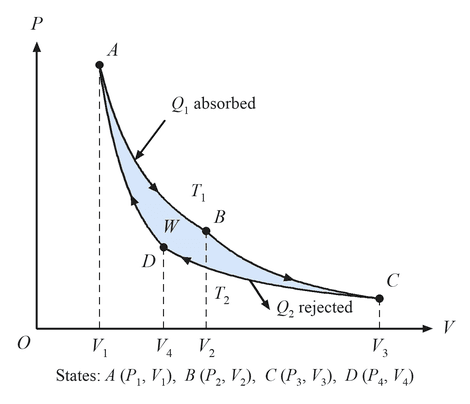
Step 2 — Name the processes in order. AB is an isothermal expansion at (heat absorbed), BC is an adiabatic expansion (temperature falls from to ), CD is an isothermal compression at (heat rejected), and DA is an adiabatic compression (temperature rises from to ).
Therefore, the four processes are (i) isothermal expansion, (ii) adiabatic expansion, (iii) isothermal compression and (iv) adiabatic compression.
- 171 mark
Question 17
Does the efficiency of a Carnot engine depend upon the nature of working substance?
Solve with AIWritten solution
Solution:
Concept: For a Carnot engine the heats exchanged with the reservoirs are in the ratio of the absolute temperatures, .
Step 1 — Write the efficiency. We substitute this ratio into the efficiency:
Step 2 — Read off what it depends on. The final expression contains only the temperatures of the source and the sink. Nothing in it belongs to the working substance.
Therefore, no: the efficiency of a Carnot engine, , depends only on the temperatures of the source and the sink, not on the nature of the working substance.
- 181 mark
Question 18
State second law of thermodynamics, applicable to refrigerators.
Solve with AIWritten solution
Solution:
Concept: A refrigerator moves heat from a cold body to a hot body. The form of the second law that applies to it is the Clausius statement.
Step 1 — State the law. Clausius' statement: it is impossible for a self-acting machine, unaided by any external agency, to convey heat from a body at a lower temperature to a body at a higher temperature.
Step 2 — Apply it to a refrigerator. So a refrigerator can take heat out of its cold cabinet and give it to the warmer room only because work is done on it by the compressor.
Therefore, the law is: we cannot make heat flow from a colder body to a warmer body without doing external work (Clausius' statement).
- 191 mark
Question 19
In a Carnot engine, the temperature of the sink is 27°C and that of the source is 327°C. What is the efficiency of the Carnot engine?
Solve with AIWritten solution
Solution:
Concept: The efficiency of a Carnot engine is , with the sink temperature and the source temperature in kelvin.
Step 1 — Change the temperatures to kelvin. The sink is at () and the source at ().
Step 2 — Find the efficiency. We put these values into the formula:
Therefore, the efficiency of the Carnot engine is (50%).
- 201 mark
Question 20
A refrigerator transfers heat from a low temperature body to a high temperature body. How is it possible?
Solve with AIWritten solution
Solution:
Concept: By the second law (Clausius' statement), heat cannot flow by itself from a colder body to a hotter body; it can be made to do so only if work is done.
Step 1 — Find the work in a refrigerator. In a refrigerator the compressor, run by electricity, does work on the working substance in every cycle.
Step 2 — Follow the energy. With this work, the working substance takes heat from the cold body and gives heat to the hot body, as the figure shows. No law is broken, because the transfer is not "by itself": external work is supplied.
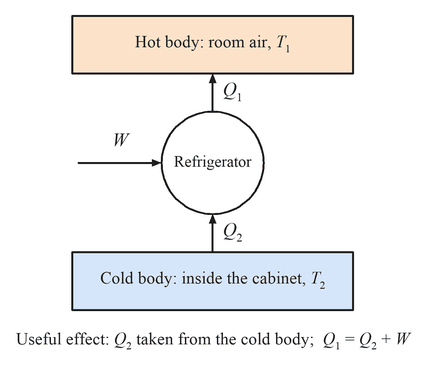
Therefore, it is possible because external work is done on the working substance (by the compressor), and the second law allows heat to go from a cold body to a hot body when work is supplied.
- 211 mark
Question 21
What is a heat pump?
Solve with AIWritten solution
Solution:
Concept: Moving heat from a colder region to a warmer one needs work (Clausius' statement of the second law).
Step 1 — Describe the device. A heat pump takes heat from a body at a low temperature (such as the outside air), has work done on it, and gives heat to a body at a high temperature (such as a room).
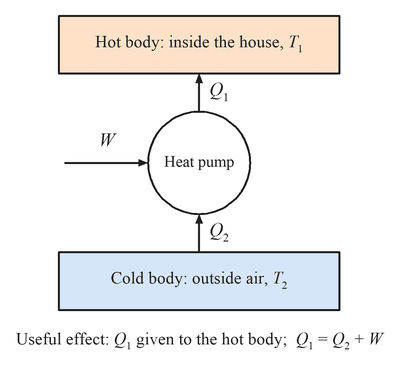
Step 2 — State its purpose. It is used to heat the warmer region, so its useful output is the heat delivered.
Therefore, a heat pump is a device used to absorb heat from a low-temperature body and give it to a high-temperature body, using work.
- 221 mark
Question 22
Give one use of heat pump.
Solve with AIWritten solution
Solution:
Concept: A heat pump uses work to take heat from a colder region and deliver it to a warmer region, which it heats.
Step 1 — Apply this to a house in winter. In cold weather a heat pump takes heat from the cold outside air (or the ground) and gives it to the inside of the house, as in the figure.
Step 2 — See why this is useful. The heat delivered, , is more than the electrical energy used, so it heats the room more cheaply than an electric heater.
Therefore, a heat pump is used to keep a room warm in cold countries (it is also used to heat water).
- 231 mark
Question 23
What is refrigerant? Give an example.
Solve with AIWritten solution
Solution:
Concept: In a refrigerator a working substance is compressed, condensed, expanded and evaporated over and over, carrying heat from the cabinet to the room.
Step 1 — Define a refrigerant. The working substance used in a refrigerator is called the refrigerant. It should have a large latent heat of vaporisation and should vaporise easily at low temperature and condense easily when compressed.
Step 2 — Give an example. Freon (a chlorofluorocarbon) and ammonia are examples.
Note: Freons (CFCs) damage the ozone layer and have been phased out under the Montreal Protocol; household refrigerators today mostly use isobutane (R-600a) or HFC-134a, while ammonia is still used in large cold stores.
Therefore, a refrigerant is the working substance used in a refrigerator; examples are freon gas and ammonia (household refrigerators today mostly use isobutane).
- 241 mark
Question 24
“A Carnot engine is called a reversible engine”. Why?
Solve with AIWritten solution
Solution:
Concept: A reversible process can be retraced in the reverse order and in the opposite sense, passing through exactly the same states, with every heat and work flow reversed.
Step 1 — Look at the processes in the cycle. The Carnot cycle is made of two isothermal and two adiabatic processes carried out infinitely slowly with no friction and no heat loss, so each one is reversible.
Step 2 — Run the cycle backwards. The whole cycle can therefore be performed in the opposite direction: the engine then takes in heat from the sink, has work done on it, and gives heat to the source. It then works as a refrigerator.
Therefore, a Carnot engine is called a reversible engine because its whole cycle of operations can be performed in the opposite direction also.
- 252 marks
Question 25
Distinguish between reversible process and irreversible process.
Solve with AIWritten solution
Solution:
Concept: A process changes the state of a system (its pressure, volume, temperature). Whether it can be undone exactly decides whether it is reversible.
Step 1 — Define a reversible process. A reversible process is one which can be retraced in the reverse order and in the opposite sense, so that it passes through exactly the same states as in the direct process. If heat is absorbed in the direct process, the same heat is given out in the reverse process, and if work is done by the system, the same work is done on it; at the end both the system and the surroundings are back in their initial states.
Step 2 — Give its conditions and an example. It must take place infinitely slowly, so that the system is always in equilibrium, and with no loss of energy by friction, conduction, convection or radiation. A very slow isothermal expansion of an ideal gas with a frictionless piston is an example (an ideal case only).
Step 3 — Define an irreversible process. An irreversible process is any process that cannot be retraced in the reverse order and opposite sense. All real processes, which are fast and involve friction or heat flow across a finite temperature difference, are irreversible. Examples: rusting of iron, dissolving soap in water, heat flowing from a hot body to a cold one, and a gas rushing into a vacuum.
Therefore, a reversible process can be retraced exactly through the same states in the opposite sense and needs ideal conditions (infinitely slow, no friction or heat loss), while an irreversible process cannot be retraced; all natural processes are irreversible.
- 262 marks
Question 26
What are the main parts of a Carnot engine?
Solve with AIWritten solution
Solution:
Concept: Carnot's ideal engine is an imaginary engine with no losses, built so that its working substance can be taken through a reversible cycle.
Step 1 — Describe the cylinder and the working substance. A cylinder with perfectly insulating walls and a perfectly conducting base holds an ideal (perfect) gas as the working substance. It is fitted with a perfectly insulating, frictionless piston, as the figure shows.
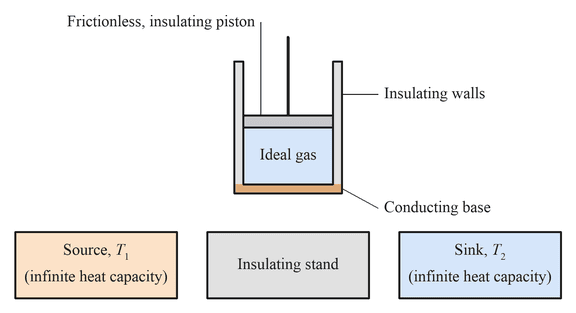
Step 2 — Describe the source and the sink. The source is a hot reservoir of infinite heat capacity kept at a constant high temperature , and the sink is a cold reservoir of infinite heat capacity kept at a constant lower temperature . Because their heat capacities are infinite, taking heat from or giving heat to them does not change their temperatures.
Step 3 — Describe the insulating stand. A perfectly non-conducting stand is used when the gas must neither gain nor lose heat; placing the cylinder on it makes the process adiabatic.
Therefore, the main parts of a Carnot engine are (i) the source at , (ii) the sink at , (iii) the insulating stand and (iv) the working substance (an ideal gas) in a cylinder with insulating walls, a conducting base and a frictionless insulating piston.
- 272 marks
Question 27
Name the working substance used in (i) Carnot engine, (ii) petrol engine and (iii) diesel engine.
Solve with AIWritten solution
Solution:
Concept: The working substance of a heat engine is the material that takes in heat, does work on a piston and rejects heat in each cycle.
Step 1 — Name it for the Carnot engine. Carnot's ideal engine uses a perfect (ideal) gas, because its behaviour follows the gas laws exactly.
Step 2 — Name it for the petrol engine. A petrol engine draws in air mixed with a little petrol vapour; this charge, which is mostly air, is compressed and burnt, and the hot gases push the piston. So its working substance is air (strictly, the air–petrol mixture and its burnt gases).
Step 3 — Name it for the diesel engine. A diesel engine draws in and compresses air alone; the diesel fuel is sprayed into the hot compressed air at the end of the compression stroke. So its working substance is air.
Therefore, the working substance is (i) a perfect gas in a Carnot engine, (ii) air (mixed with petrol vapour) in a petrol engine and (iii) air in a diesel engine.
- 282 marks
Question 28
Define efficiency of a Carnot engine. On what factors, the efficiency of a Carnot engine depend.
Solve with AIWritten solution
Solution:
Concept: A Carnot engine takes heat from a source at absolute temperature and rejects heat to a sink at absolute temperature , doing work ; for it, .
Step 1 — Define the efficiency. The efficiency (thermal efficiency) is the ratio of the external work done by the engine to the heat absorbed by the working substance from the source:
Step 2 — Write it in terms of temperatures. We use and the Carnot ratio of heats:
Step 3 — State the factors. The final form contains only the absolute temperatures of the source and the sink; the efficiency does not depend on the working substance.
Therefore, the efficiency of a Carnot engine is the ratio of the work done to the heat absorbed from the source, , and it depends only on the temperatures of the source () and the sink ().
- 292 marks
Question 29
State second law of thermodynamics.
Solve with AIWritten solution
Solution:
Concept: The first law says energy is conserved; the second law says which energy changes can actually happen, for example how much heat can be turned into work.
Step 1 — Give the Kelvin–Planck statement. It is impossible for an engine working in a cycle to have, as its only effect, the taking of heat from a single reservoir and the doing of an equal amount of work.
Step 2 — Give the Clausius statement. It is impossible for a self-acting machine, unaided by any external agency, to convey heat from a body at a lower temperature to a body at a higher temperature; that is, heat cannot be made to flow from a colder body to a warmer body without doing external work.
Step 3 — Picture the two statements. The figure shows the two devices the law forbids: (a) an engine with no sink, and (b) a device that moves heat from cold to hot with no work.

Therefore, the second law of thermodynamics (Kelvin–Planck statement) says that it is impossible for an engine working in a cycle to have, as its only effect, the taking of heat from a single reservoir and the doing of an equal amount of work; equivalently (Clausius), heat cannot flow from a colder body to a hotter body without external work.
- 302 marks
Question 30
How is a heat engine different from a refrigerator?
Solve with AIWritten solution
Solution:
Concept: Both devices work in cycles between a hot body at and a cold body at , but the flows of heat and work go opposite ways.
Step 1 — Describe the heat engine. A heat engine takes heat from the hot source, does work on the surroundings, and rejects heat to the cold sink. Its output is work.
Step 2 — Describe the refrigerator. A refrigerator has work done on it, takes heat from the cold body and gives heat to the hot body. Its output is cooling of the cold body.
Step 3 — Compare how they are rated. A heat engine is rated by its efficiency , which is less than 1; a refrigerator is rated by its coefficient of performance , which is usually more than 1.
Therefore, a refrigerator is a heat engine working backward: an engine takes heat from a hot body and gives out work, while a refrigerator uses work to take heat from a cold body and give it to a hot body.
- 312 marks
Question 31
Milk is poured into a cup of tea and is mixed with a spoon. Is this an example of reversible process? Give reason in support of your answer.
Solve with AIWritten solution
Solution:
Concept: A process is reversible only if it can be retraced in the reverse order and opposite sense, so that the system and its surroundings both return exactly to their initial states.
Step 1 — Try to reverse the mixing. Once the milk has spread through the tea, stirring the spoon the other way does not separate the milk from the tea again; the mixture never un-mixes by itself. So the process cannot be retraced.
Step 2 — Look at the work done. The work done by the spoon in stirring is turned into a tiny amount of heat in the liquid (through friction between its layers), and this work cannot be recovered. Heat also flows from the hot tea to the cooler milk across a finite temperature difference, which cannot be reversed either.
Therefore, no: mixing milk into tea is an irreversible process, because the mixing cannot be undone by reversing the steps and the work done in stirring is lost as heat and cannot be recovered.
- 322 marks
Question 32
“Defrosting is necessary for refrigerators”. Why?
Solve with AIWritten solution
Solution:
Concept: The coefficient of performance of a refrigerator is , where is the temperature of its cold coils and that of the room. For a given room temperature, the colder the coils must be, the smaller is and the more work is needed to remove the same heat.
Step 1 — See what the ice layer does. Water vapour from the air and the food freezes on the cold coils (the evaporator) and builds up a layer of frost and ice. Ice is a poor conductor of heat, so it slows the flow of heat from the cabinet into the coils.
Step 2 — See the effect on and . To take out the same heat through the ice, the coils must run colder, so keeps falling while (the room) stays the same. Then grows and decreases: the refrigerator uses more electrical energy and cools the food less well.
Step 3 — Explain the remedy. Removing the ice from time to time (defrosting) restores good contact between the coils and the cabinet air, so the refrigerator again works with a higher coefficient of performance.
Therefore, defrosting is necessary because the ice that forms on the cooling coils insulates them, so the coils must run colder, which lowers the coefficient of performance ; removing the ice keeps high.
- 332 marks
Question 33
What is cyclic process? Give an example.
Solve with AIWritten solution
Solution:
Concept: The state of a system is fixed by its pressure, volume and temperature, and its internal energy depends only on the state.
Step 1 — Define a cyclic process. If a thermodynamic system, starting from its original state, passes through different states and returns to its original state, the process is called a cyclic process. On a – diagram it is a closed loop, and the change in internal energy over one cycle is zero.
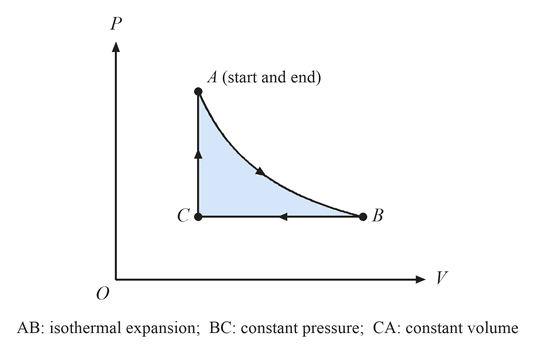
Step 2 — Give an example. The Carnot cycle, in which an ideal gas is taken through isothermal expansion, adiabatic expansion, isothermal compression and adiabatic compression and returns to its starting state, is a cyclic process. The working of a heat engine or a refrigerator is also cyclic.
Therefore, a cyclic process is one in which a system returns to its original state after passing through different states; an example is the Carnot cycle (the working cycle of any heat engine).
- 342 marks
Question 34
Write down the expression for the efficiency of a Carnot engine. How can the efficiency of Carnot engine be increased?
Solve with AIWritten solution
Solution:
Concept: For a Carnot engine the heats exchanged with the source and the sink are in the ratio of their absolute temperatures.
Step 1 — Write the expression. The efficiency of a Carnot engine depends only on the absolute temperatures of its source and its sink:
Here is the absolute temperature of the source and is the absolute temperature of the sink, both in kelvin.
Step 2 — See how to increase it. The efficiency rises when the ratio falls. This can be done by raising the source temperature , by lowering the sink temperature , or both.
Therefore, , and the efficiency can be increased by decreasing , that is, by using a hotter source (higher ) or a colder sink (lower ).
- 352 marks
Question 35
Is it possible to convert heat into work without a sink at a lower temperature?
Solve with AIWritten solution
Solution:
Concept: The greatest efficiency of an engine working between a source at and a sink at is that of a Carnot engine, .
Step 1 — Remove the colder sink. If there is no body at a lower temperature, the only place the engine could reject heat is a body at the same temperature as the source, so .
Step 2 — Find the efficiency. We put into the formula:
So the engine does no work at all. This agrees with the Kelvin–Planck statement of the second law: no engine working in a cycle can take heat from a single reservoir and turn it into work.
Therefore, no: without a sink at a lower temperature the efficiency is zero, so heat cannot be converted into work continuously.
- 362 marks
Question 36
Mention two differences between a heat pump and a refrigerator.
- 373 marks
Question 37
Explain (i) reversible process and (ii) irreversible process. Give examples. State second law of thermodynamics.
- 383 marks
Question 38
What is Carnot cycle? Using a diagram, explain the various processes involved in a Carnot cycle.
- 393 marks
Question 39
What is a heat engine? What are the main parts of a heat engine? Define thermal efficiency of a heat engine.
- 403 marks
Question 40
Explain the working of (i) refrigerator and (ii) heat pump.
- 415 marks
Question 41
(a) Explain the working of a Carnot engine.
(b) Write down the expression for the efficiency of a Carnot engine.
(c) How will you increase the efficiency of the heat engine?
- 425 marks
Question 42
(a) Give (i) Kelvin's statement and (ii) Clausius statement of the second law of thermodynamics.
(b) “A Carnot engine is called a reversible engine.” Why? Explain the working of a refrigerator. Obtain equation for its coefficient of performance. What is the difference between a refrigerator and a heat pump?
What Class 11 Physics Ch 19 covers
The sections of the chapter, in the order the book takes them. Every question above comes from one of these.
- 01Reversible and Irreversible Processes
- 02Heat Engines and Efficiency
- 03Carnot Cycle and Carnot Engine
- 04Second Law of Thermodynamics
- 05Refrigerators and Heat Pumps
More ways to study this chapter
The same chapter asked three other ways. Practise it, revise it, and see what the board has set on Ch 19 before.
Class 11 Physics Ch 19 questions students ask
How many questions are there in Class 11 Physics Ch 19?
42 questions. Every one is solved step by step on this page.
Are these Class 11 Physics solutions free?
Yes. Every question and its full working is free to read, with no account needed.
Can I download the Class 11 Physics Ch 19 solutions as a PDF?
There is no PDF to download. Every solution is on this page instead, which means it is searchable, always the current syllabus, and readable on a phone. Use your browser's print option if you want it on paper.