
Opening your dashboard
Class 11 Physics Chapter 19 Carnot Cycle - Second Law of Thermodynamics: Competency-Based Questions (CBQ)
42 questions on Chapter 19, each worked through on its own page with the AI tutor. Class 11 Physics, ICSE 2026-27.
42 questions
1–4 marks · Mixed difficulty
- 14 marks
Question 1
Competency: Analysis & Evaluation
In a laboratory activity, some air is trapped in a gas syringe fitted with a pressure sensor; treat the plunger as frictionless. The air starts in state A, with volume , pressure and temperature . The student then takes it round the cycle ABCDA shown in the figure.
Stage AB: the plunger is pushed in very quickly to , so quickly that no heat leaves the air.
Stage BC: the plunger is held still until the air has cooled back to .
Stage CD: the plunger is pulled out very quickly to , so quickly that no heat enters the air.
Stage DA: the plunger is held still until the air has warmed back to .
Treat the air as an ideal gas with , and treat the two quick strokes as reversible adiabatic changes. In such a change and stay constant, and the work done on the gas is , where and mark the initial and final states. (Hypothetical data.)
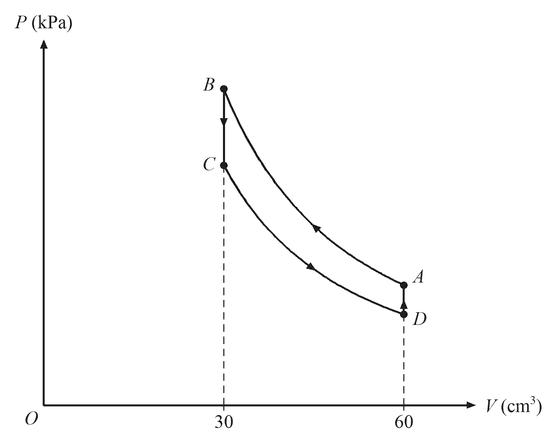
(a) Find the pressure and the temperature of the air at B and at D.
(b) Find the work done on the air in stage AB and the work done by the air in stage CD. Hence find the net work done on the air in one cycle.
(c) The air ends each cycle in its starting state. What becomes of the net work done on it?
(d) Both quick strokes are reversible, yet the whole cycle is irreversible. Explain why, and say how the cycle could be brought closer to a reversible one.
- 21 mark
Question 2
Competency: Analysis & Evaluation
A gas in a cylinder stands on a large reservoir at room temperature. A student pushes the piston in extremely slowly, so that the gas is always very nearly in equilibrium, but the piston rubs against the wall of the cylinder.
Assertion (A): Even though it is carried out extremely slowly, this compression is not a reversible process.
Reason (R): Friction turns part of the work done on the piston into internal energy whichever way the piston moves, so running the process backwards cannot undo this, and the surroundings are left changed.
- 31 mark
Question 3
Competency: Analysis & Evaluation
A tray of ice at is placed in a large tank of water that is kept a tiny fraction of a degree above , so the ice melts extremely slowly.
Assertion (A): In the ideal limit, this melting is a reversible process.
Reason (R): Every change of state is irreversible, because latent heat has to be supplied or removed for it to happen.
- 41 mark
Question 4
Competency: Analysis & Evaluation
A student claims: “If no heat enters or leaves a system during a process, the process must be reversible.” Which example shows that the claim is wrong?
- 54 marks
Question 5
Competency: Application
An electric city bus of total mass is travelling at when it brakes to rest at a stop. It has two braking systems. In friction braking, pads press on steel discs. In regenerative braking, the motor works as a generator and charges the battery; about of the bus's kinetic energy is stored in the battery in this way. (Hypothetical data.)
(a) Find the kinetic energy of the bus before it brakes.
(b) How much energy is stored in the battery in one stop when only regenerative braking is used?
(c) When only friction braking is used, all the kinetic energy becomes internal energy of the discs, which warm up to about in air at . Suppose an ideal (Carnot) engine could take heat from the discs, treated as a source at a steady , and give heat to the air. What is the greatest amount of this internal energy that it could turn back into work?
(d) Use your answers to explain which kind of braking is closer to a reversible process.
- 64 marks
Question 6
Competency: Application
A solar thermal power plant uses a large field of mirrors to focus sunlight on a receiver at the top of a tower. Molten salt flowing through the receiver is heated to and stored in an insulated tank, so that the plant can also run after sunset. The hot salt boils water to drive a steam turbine, whose exhaust steam is condensed at . Of the sunlight reaching the mirrors, ends up as heat in the salt, and the turbine and generator together turn of the heat they receive from the salt into electrical energy. (Hypothetical data.)
(a) Find the efficiency of an ideal (Carnot) engine working between the hot salt and the condensing steam, and compare it with the actually achieved.
(b) Find the overall efficiency with which the plant turns the sunlight reaching its mirrors into electrical energy.
(c) On a clear day sunlight brings to each square metre of mirror. What area of mirrors is needed for the plant to deliver of electrical power while the Sun shines?
(d) Explain why the engineers try to heat the salt as hot as it can safely go.
- 71 mark
Question 7
Competency: Analysis & Evaluation
In a sports laboratory, a cyclist's leg muscles are found to turn about of the energy released from food into mechanical work. The cyclist's body is at and the air in the laboratory is at . (Hypothetical data.)
Assertion (A): The cyclist's muscles turn energy into work more efficiently than any heat engine working between and could.
Reason (R): Muscles are not heat engines: they turn the chemical energy of food directly into work, without first turning it into heat at a higher temperature.
- 81 mark
Question 8
Competency: Application
A hospital runs a gas engine that drives an electric generator. Of the heat released by the burning gas, becomes electrical energy, and is recovered from the engine's cooling water and exhaust to heat the hospital's hot-water supply; the remaining escapes up the flue. (Hypothetical data.) Which statement about this plant is correct?
- 93 marks
Question 9
Competency: Application
A low-temperature-difference Stirling engine is a small model engine that runs on a small difference in temperature between its flat bottom plate and its flat top plate. A student stands one on a mug of hot water at in a room at , as shown in the figure, and gives the flywheel a push; it keeps turning. (Hypothetical data.)

(a) Name the source and the sink of this engine, and find the greatest efficiency it could have.
(b) An hour later the water has cooled to and the engine has stopped. Find the greatest efficiency the engine could have now, and explain why it slowed down and stopped.
(c) The student then stands the engine on a large block of ice at in the same room. Will the engine run? Name its source and its sink now, and find its greatest efficiency.
- 101 mark
Question 10
Competency: Analysis & Evaluation
In a dry region, a thermal power station gets rid of the heat from its steam by passing the steam through large air-cooled condensers, where fans blow the outside air over pipes in which the steam condenses.
Assertion (A): Such a power station is usually slightly less efficient on a hot summer afternoon than on a cold winter night.
Reason (R): Warm air can hold more water vapour than cold air.
- 113 marks
Question 11
Competency: Analysis & Evaluation
A student draws the Carnot cycle of an ideal gas on a temperature–volume (–) graph instead of the usual – graph, as shown in the figure. AB and CD are horizontal lines at and , and BC and DA are curves along which stays constant. The cycle is traced in the order ABCDA. (Hypothetical data.)
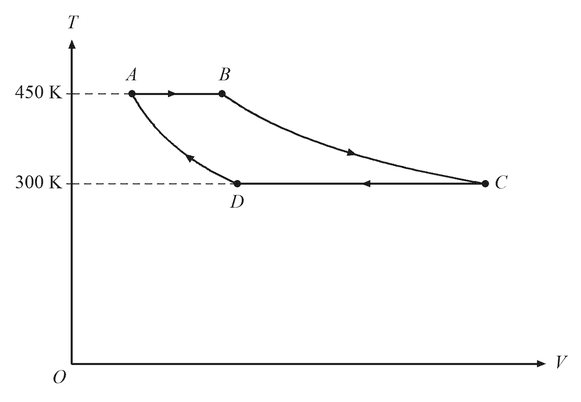
(a) Name the process in each stage AB, BC, CD and DA. In which stage does the gas take in heat from the source, and in which does it give heat to the sink?
(b) At which corner of the cycle is the pressure of the gas greatest, and at which is it least? Give reasons.
(c) The student says that, just as on a – graph, the area enclosed by this loop gives the work done in one cycle. Explain why the student is wrong, and find the efficiency of this cycle.
- 123 marks
Question 12
Competency: Application
Kelvin showed that a reversible (Carnot) engine can serve as a thermometer, because for such an engine , whatever its working substance. In a thought experiment, a Carnot engine works between a bath of a boiling liquid X, at an unknown temperature , and a cell kept at the triple point of water, , as shown in the figure. In each cycle it takes in of heat from the bath and gives out to the cell. (Hypothetical data.) Take as .
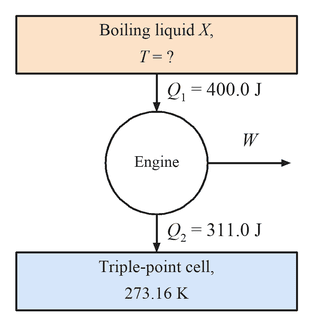
(a) Find the temperature of the boiling liquid in kelvin and in degrees Celsius.
(b) A mercury thermometer and a gas thermometer can disagree slightly at temperatures between their fixed points. Explain why a temperature found in this way does not depend on the material of any thermometer.
(c) Suppose the engine actually has a little friction, so it is not reversible, and it still takes in per cycle from the same bath. Would it give out more or less than to the cell? If the student still used , would the temperature found be too high or too low?
- 131 mark
Question 13
Competency: Analysis & Evaluation
In a Carnot cycle, an ideal gas expands from A through B to C (isothermally at the source temperature, then adiabatically) and is then compressed from C through D back to A (isothermally at the sink temperature, then adiabatically).
Assertion (A): The gas does a positive net amount of work in each cycle because it expands at lower pressures than those at which it is compressed.
Reason (R): At every volume between the smallest and the largest volumes of the cycle, the gas is hotter during the expansion than during the compression, so its pressure is higher while it expands.
- 141 mark
Question 14
Competency: Analysis & Evaluation
A student reads that the Carnot engine is an ideal engine which can never actually be built.
Assertion (A): A Carnot engine cannot be built in practice.
Reason (R): No real gas behaves exactly like an ideal gas.
- 153 marks
Question 15
Competency: Application
Some meteorologists model a mature tropical cyclone as a heat engine. Moist air spiralling in over the warm sea takes in heat, mostly as the latent heat of water evaporated from the sea, at about the sea-surface temperature of . The air rises in the clouds around the eye, flows outwards at a height of about , and there gives out heat, by radiation to space, at about . The work done keeps the winds blowing against friction at the sea surface. (Hypothetical data.)
(a) Name the source and the sink of this engine, and find the greatest efficiency it could have.
(b) If the sea surface warmed to while the outflow temperature stayed the same, find the new greatest efficiency and the percentage by which it has increased.
(c) A cyclone weakens quickly after it moves from the sea over land. Explain why, using the engine model.
- 161 mark
Question 16
Competency: Analysis & Evaluation
At a solar furnace, a large field of mirrors concentrates sunlight on to a small target. The surface of the Sun is at about .
Assertion (A): No arrangement of mirrors and lenses, with no other supply of energy, can heat the target above about .
Reason (R): Heat cannot flow by itself from a colder body to a hotter body.
- 171 mark
Question 17
Competency: Analysis & Evaluation
Some refrigerators used in places without mains electricity have no motor or compressor. A small kerosene flame supplies heat to them, and they keep their cabinet cold while giving out heat to the room. Which statement about such a refrigerator is correct?
- 183 marks
Question 18
Competency: Analysis & Evaluation
A factory has two streams of waste heat. Hot flue gases carry away heat at at about , and warm cooling water carries away heat at at about . The surroundings are at . Treat each stream as a reservoir at a steady temperature. (Hypothetical data.)
(a) Find the greatest power that an ideal (Carnot) engine could deliver from each stream, using the surroundings as its sink.
(b) Both streams carry the same energy each second. Explain, using the second law, why engineers call the heat in the flue gases “high-grade” and the heat in the cooling water “low-grade”.
(c) Suggest a sensible use for the heat in the cooling water that does not turn it into work, and explain why that use is not held back by the second-law limit you found in (a).
- 191 mark
Question 19
Competency: Evaluation
A student notices that a laptop's processor runs at about and that all the electrical energy it uses ends up as heat, which a fan blows into the room at . The student suggests fitting a small engine that turns this heat back into electrical energy to recharge the battery, so that the laptop would never need charging. (Hypothetical data.) Which statement is correct?
- 201 mark
Question 20
Competency: Analysis & Evaluation
A refrigerator keeps food cold in a warm kitchen.
Assertion (A): In this refrigerator, heat is made to flow from the colder cabinet to the warmer kitchen.
Reason (R): The Clausius statement of the second law says that heat can never flow from a colder body to a hotter body.
- 213 marks
Question 21
Competency: Analysis & Evaluation
The superconducting magnet of an MRI scanner in a hospital is kept at by liquid helium. A cryocooler, a refrigerator for very low temperatures, removes the heat that leaks in, about , and gives it out into the machine room at . (Hypothetical data.)
(a) Find the coefficient of performance of an ideal (Carnot) refrigerator working between and , and the least electrical power it would need.
(b) Find the least power needed to remove of heat from a food freezer at in the same room, and compare it with your answer to (a).
(c) Show that the least work needed to remove a fixed amount of heat from a body at temperature , with the surroundings at , grows without limit as approaches . What does this tell us about cooling a body to absolute zero?
- 221 mark
Question 22
Competency: Application
Many new domestic refrigerators in India use isobutane (R-600a) as the refrigerant. It replaces HFC-134a and, before that, the chlorofluorocarbons (CFCs), which damaged the ozone layer and have been phased out. Isobutane boils at about at atmospheric pressure. Why is a low boiling point like this needed in the evaporator coils inside the cabinet?
- 234 marks
Question 23
Competency: Application & Evaluation
On a day when the outside air is at , an air-conditioner keeps a room cool. Heat leaks into the room through the walls and windows at a rate proportional to the difference between the outside and inside temperatures: for each kelvin of difference. The Bureau of Energy Efficiency suggests setting air-conditioners to , but one family sets theirs to . Treat the air-conditioner as an ideal (Carnot) refrigerator working between the room and the outside air. (Hypothetical data.)
(a) Find the rate at which heat leaks into the room when it is kept at , and when it is kept at .
(b) Find the ideal coefficient of performance and the least electrical power needed at each setting.
(c) By what percentage does the setting reduce the least electrical power?
(d) For a real air-conditioner the saving is smaller than in (c), though still well worth having. Suggest why.
- 241 mark
Question 24
Competency: Application
A refrigerator keeps its cabinet at in a kitchen at . Its refrigerant evaporates in the coils inside the cabinet (the evaporator) and condenses in the coils at the back (the condenser). (Hypothetical data.) For the refrigerator to remove heat from the cabinet at a useful rate, which pair of refrigerant temperatures could it have?
- 251 mark
Question 25
Competency: Analysis & Evaluation
A small thermoelectric (Peltier) drinks cooler has no moving parts. It removes heat from its box at while it draws of electrical power, and a heat sink on its outside gives heat to the room. (Hypothetical data.) Which statement about it is correct?
- 264 marks
Question 26
An ideal (Carnot) refrigerator, driven by a motor that does work at a steady 20 W, keeps a box cold in a room at 300 K. Heat leaks into the box through its walls at 2.0 W for each kelvin of temperature difference between the room and the box. (Hypothetical data.)
(a) Write an expression for the rate at which heat leaks in when the box is at temperature .
(b) In the steady state, the refrigerator removes heat exactly as fast as it leaks in. Show that the steady temperature of the box satisfies .
(c) Find the lowest temperature the box can be kept at, in kelvin and in degrees Celsius.
- 273 marks
Question 27
What is the efficiency of a Carnot engine working between ice point and steam point?
- 283 marks
Question 28
The efficiency of an engine is found to increase from 0.3 to 0.4 when the temperature of the sink is lowered by 50°C. Calculate the temperature of sink and source.
- 293 marks
Question 29
The heat absorbed by a Carnot engine from the source in each cycle is 500 J and the efficiency of the engine is 20%. Calculate the work done in each cycle?
- 303 marks
Question 30
A Carnot engine is operated between two reservoirs at temperatures of 500 K and 400 K. The engine receives 840 joules of heat from the source in each cycle. Calculate (a) the amount of heat rejected to sink in each cycle, (b) the efficiency of the engine and (c) the work done in each cycle.
- 313 marks
Question 31
The efficiency of a Carnot engine is 40%, whose sink is at a temperature of 300 K. By how much should the temperature of the source be increased to get an efficiency of 60%?
- 323 marks
Question 32
A Carnot engine works between a source at 100°C and a sink maintained at 0°C by using ice. It is working at the rate of 100 W. Then how much ice would melt in one minute. L.H. of ice J kg.
- 333 marks
Question 33
The efficiency of a Carnot engine is . When the temperature of the source is increased by 20°C, then its efficiency is found to increase to . Calculate the temperature of source and sink.
- 343 marks
Question 34
A Carnot engine works between 200°C and 0°C first and then between 0°C and −200°C. Compare the values of efficiencies in the two cases.
- 353 marks
Question 35
A reversible engine converts one-sixth of heat input into work. When the temperature of sink is reduced by 62°C, its efficiency is doubled. Find the temperature of the source and the sink.
- 363 marks
Question 36
A Carnot engine has an efficiency 0.4. When the temperature of the source is increased by 20°C and the sink is reduced by 20°C, its efficiency is found to increase to 0.5. Calculate the temperature of source and sink.
- 373 marks
Question 37
One of the most efficient engines ever developed operates between 1800 K and 600 K. Its actual efficiency is 40%. What percentage of its maximum possible efficiency is this?
- 383 marks
Question 38
A Carnot engine whose source is at 300°C takes in 5000 J of heat in each cycle and gives 3000 J of heat to the sink. Find the temperature of the sink.
- 393 marks
Question 39
Calculate the coefficient of performance of refrigerator working between the temperatures 0°C and 30°C.
- 403 marks
Question 40
A refrigerator is working between the temperature of melting ice and room temperature, which is 290 K. Calculate work done by the refrigerator to freeze 2 kg of water.
- 413 marks
Question 41
The minimum power of a motor used to drive a refrigerator to just prevent the melting of ice in a cold storage is 20.98 watt. Calculate the rate of melting of ice per hour if the external temperature is 298 K.
- 423 marks
Question 42
How much energy in watt hours may be required to convert 2 kg of water to ice at 0°C assuming that the refrigerator is ideal? Given temperature of freezing chamber is −15°C and temperature of room as well as water is 25°C. Given cal/g.