
Competency: Analysis & Evaluation
In a laboratory activity, some air is trapped in a gas syringe fitted with a pressure sensor; treat the plunger as frictionless. The air starts in state A, with volume , pressure and temperature . The student then takes it round the cycle ABCDA shown in the figure.
Stage AB: the plunger is pushed in very quickly to , so quickly that no heat leaves the air.
Stage BC: the plunger is held still until the air has cooled back to .
Stage CD: the plunger is pulled out very quickly to , so quickly that no heat enters the air.
Stage DA: the plunger is held still until the air has warmed back to .
Treat the air as an ideal gas with , and treat the two quick strokes as reversible adiabatic changes. In such a change and stay constant, and the work done on the gas is , where and mark the initial and final states. (Hypothetical data.)
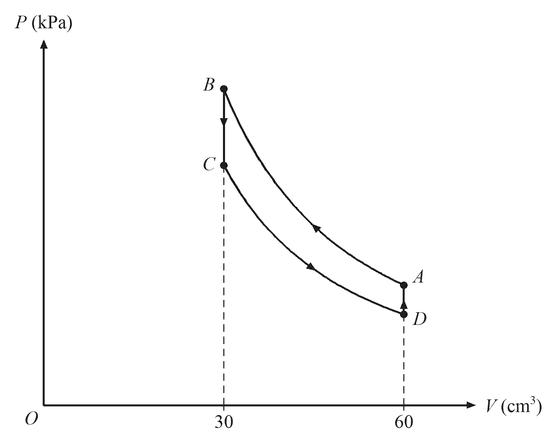
(a) Find the pressure and the temperature of the air at B and at D.
(b) Find the work done on the air in stage AB and the work done by the air in stage CD. Hence find the net work done on the air in one cycle.
(c) The air ends each cycle in its starting state. What becomes of the net work done on it?
(d) Both quick strokes are reversible, yet the whole cycle is irreversible. Explain why, and say how the cycle could be brought closer to a reversible one.