
Question 262 marksEasy
What are the main parts of a Carnot engine?
Confirming your payment
Sign up now and get 250 free tokens.
Carnot Cycle - Second Law of Thermodynamics · Question 26 of 42
What are the main parts of a Carnot engine?
Solution:
Concept: Carnot's ideal engine is an imaginary engine with no losses, built so that its working substance can be taken through a reversible cycle.
Step 1 — Describe the cylinder and the working substance. A cylinder with perfectly insulating walls and a perfectly conducting base holds an ideal (perfect) gas as the working substance. It is fitted with a perfectly insulating, frictionless piston, as the figure shows.
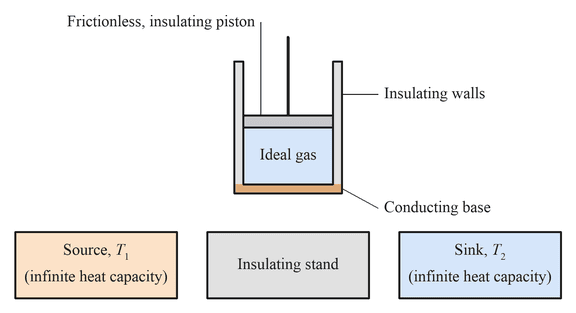
Step 2 — Describe the source and the sink. The source is a hot reservoir of infinite heat capacity kept at a constant high temperature , and the sink is a cold reservoir of infinite heat capacity kept at a constant lower temperature . Because their heat capacities are infinite, taking heat from or giving heat to them does not change their temperatures.
Step 3 — Describe the insulating stand. A perfectly non-conducting stand is used when the gas must neither gain nor lose heat; placing the cylinder on it makes the process adiabatic.
Therefore, the main parts of a Carnot engine are (i) the source at , (ii) the sink at , (iii) the insulating stand and (iv) the working substance (an ideal gas) in a cylinder with insulating walls, a conducting base and a frictionless insulating piston.