
Question 383 marksMedium
What is Carnot cycle? Using a diagram, explain the various processes involved in a Carnot cycle.
Confirming your payment
Sign up now and get 250 free tokens.
Carnot Cycle - Second Law of Thermodynamics · Question 38 of 42
What is Carnot cycle? Using a diagram, explain the various processes involved in a Carnot cycle.
Solution:
Concept: Carnot's ideal engine uses an ideal gas in a cylinder with insulating walls, a conducting base and a frictionless insulating piston, together with a source at , a sink at (both of infinite heat capacity) and an insulating stand, as in the first figure.
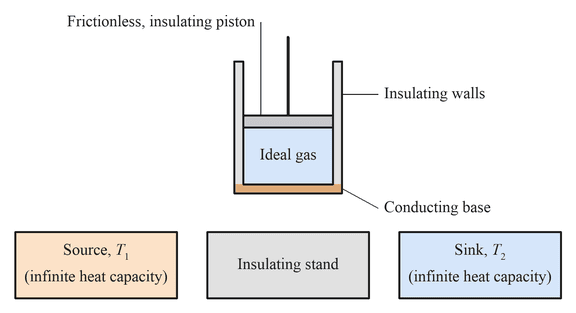
Step 1 — Define the Carnot cycle. The Carnot cycle is the ideal reversible cycle in which the working substance is taken through two isothermal and two adiabatic processes, all carried out infinitely slowly: isothermal expansion, adiabatic expansion, isothermal compression and adiabatic compression. On the – (indicator) diagram it is the loop ABCDA.
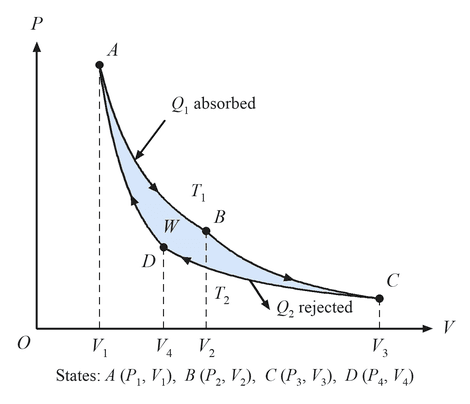
Step 2 — Explain process AB (isothermal expansion). The cylinder is placed on the source at . The gas expands infinitely slowly from A to B , keeping the temperature . It absorbs heat from the source and does work on the piston equal to the area under AB.
Step 3 — Explain process BC (adiabatic expansion). The cylinder is moved to the insulating stand. The gas expands further, slowly, to C with no heat exchanged; it does work at the expense of its internal energy, so its temperature falls from to .
Step 4 — Explain process CD (isothermal compression). The cylinder is placed on the sink at . The gas is compressed slowly from C to D at the constant temperature . Work is done on the gas, and it rejects heat to the sink.
Step 5 — Explain process DA (adiabatic compression). The cylinder is put back on the insulating stand and the gas is compressed slowly back to A. No heat is exchanged, the work done on the gas raises its internal energy, and its temperature rises from back to . The cycle is complete.
Step 6 — Find the net work. In one cycle the gas returns to its initial state, so and the net work done equals the net heat taken in:
This net work equals the area ABCD enclosed by the loop.
Therefore, the Carnot cycle is the ideal reversible cycle ABCDA of isothermal expansion at (heat absorbed), adiabatic expansion (cooling to ), isothermal compression at (heat rejected) and adiabatic compression (heating back to ); the net work done, , is the area of the loop.