Solution:
Concept: The second law of thermodynamics tells us which conversions of heat and work can happen: heat cannot be turned wholly into work in a cycle, and heat does not flow by itself from a colder body to a hotter one.
(a)
Step 1 — Give Kelvin's statement. It is impossible, by means of an inanimate material agency, to derive mechanical effect (work) from any portion of matter by cooling it below the temperature of the coldest of the surrounding objects. Combined with Planck's form, this gives the Kelvin–Planck statement: it is impossible for an engine working in a cycle to have, as its only effect, the taking of heat from a single reservoir and the doing of an equal amount of work.
Step 2 — Give the Clausius statement. It is impossible for a self-acting machine, unaided by any external agency, to convey heat from a body at a lower temperature to a body at a higher temperature; that is, heat cannot flow from a colder body to a warmer body without external work being done. The figure shows the two forbidden devices.

(b)
Step 3 — Explain why a Carnot engine is reversible. Every process in the Carnot cycle (two isothermals and two adiabatics) is carried out infinitely slowly, with no friction and no heat loss. So the whole cycle can be performed in the opposite direction: the engine then takes heat Q2 from the sink, has work W done on it, and gives heat Q1 to the source. Run backward, it acts as a refrigerator.
Step 4 — Explain the working of a refrigerator. The figure shows the circuit of the refrigerant.

The compressor does work W on the refrigerant vapour, raising its pressure and temperature. The hot vapour gives heat Q1 to the room in the condenser and becomes a liquid. The liquid passes through the expansion (throttle) valve into the evaporator inside the cabinet, where the pressure is low; it evaporates there, taking heat Q2 from the food and air in the cabinet. The vapour returns to the compressor and the cycle repeats, so the cabinet is cooled continuously.
Step 5 — Obtain the coefficient of performance. The coefficient of performance is the heat taken from the cold body per unit work done on the refrigerant. Since W=Q1−Q2:
ω=WQ2
ω=Q1−Q2Q2
For an ideal (Carnot) refrigerator, Q1Q2=T1T2. Dividing the top and bottom by Q1 and using this ratio gives:
ω=1−Q2/Q1Q2/Q1
ω=1−T2/T1T2/T1
ω=T1−T2T2
The smaller the temperature difference T1−T2, the larger the coefficient of performance.
Step 6 — Compare a refrigerator with a heat pump. Both take heat Q2 from a cold body and give Q1=Q2+W to a hot body. A refrigerator is used to cool the cold body, so its useful output is Q2 and its coefficient of performance is WQ2. A heat pump is used to heat the hot body (for example, a room in winter), so its useful output is Q1 and its coefficient of performance is WQ1, which is larger by 1 between the same temperatures.
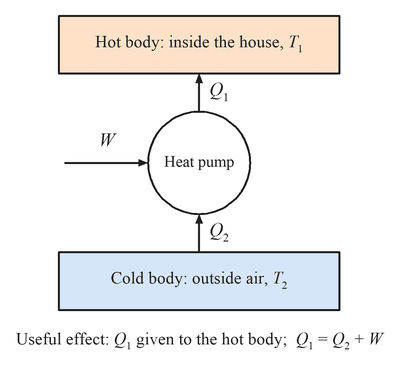
Therefore, (a) Kelvin: no work can be obtained by cooling matter below the coldest of its surroundings; Clausius: heat cannot flow from a colder to a hotter body without external work. (b) A Carnot engine is reversible because its whole cycle can be run in the opposite direction; a refrigerator uses work to take heat Q2 from the cold cabinet and give Q1=Q2+W to the room; its coefficient of performance is ω=Q1−Q2Q2, which for an ideal refrigerator becomes T1−T2T2; and a refrigerator is used to cool while a heat pump, working the same way, is used to heat, with a higher coefficient of performance WQ1.
