
Question 415 marksMedium
(a) Explain the working of a Carnot engine.
(b) Write down the expression for the efficiency of a Carnot engine.
(c) How will you increase the efficiency of the heat engine?
Confirming your payment
Sign up now and get 250 free tokens.
Carnot Cycle - Second Law of Thermodynamics · Question 41 of 42
(a) Explain the working of a Carnot engine.
(b) Write down the expression for the efficiency of a Carnot engine.
(c) How will you increase the efficiency of the heat engine?
Solution:
Concept: Carnot's ideal engine has four parts: a cylinder holding an ideal gas, with perfectly insulating walls, a perfectly conducting base and a frictionless insulating piston; a source of infinite heat capacity at ; a sink of infinite heat capacity at ; and a perfectly insulating stand. The figure shows them.
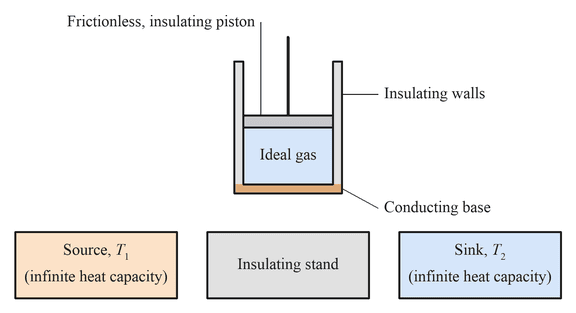
(a)
Step 1 — Follow the cycle on the indicator diagram. For a continuous supply of work, the gas is taken through the cycle ABCDA shown in the figure, every step being carried out infinitely slowly.
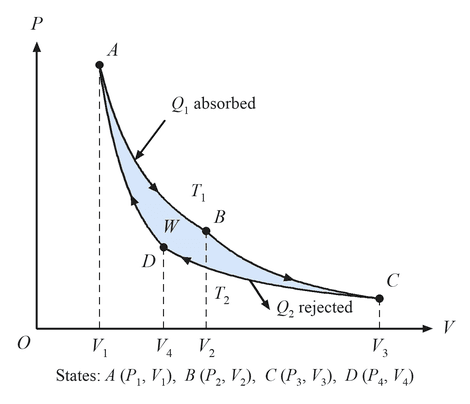
Step 2 — Explain the isothermal expansion AB. The cylinder is placed on the source at and the load on the piston is reduced by tiny amounts, so the gas expands slowly from A to B at the constant temperature . It absorbs heat from the source and does work equal to the area under AB.
Step 3 — Explain the adiabatic expansion BC. The cylinder is moved to the insulating stand and the gas expands slowly to C . No heat enters, so the work it does comes from its internal energy and its temperature falls to .
Step 4 — Explain the isothermal compression CD. The cylinder is placed on the sink at and the load is increased by tiny amounts, so the gas is compressed slowly to D at the constant temperature . Work is done on the gas and it rejects heat to the sink.
Step 5 — Explain the adiabatic compression DA. The cylinder is put back on the stand and the gas is compressed slowly back to A. With no heat exchanged, the work done on it raises its temperature back to , completing the cycle.
Step 6 — Find the net work. The work done by the gas in AB and BC is the area under ABC, and the work done on it in CD and DA is the area under CDA. The difference, the net work done by the engine in one cycle, is the area ABCD enclosed by the loop. Since the gas returns to its initial state, , so:
(b)
Step 7 — Define the efficiency. The efficiency is the work done divided by the heat taken from the source:
Step 8 — Write the heats for one mole of ideal gas. In the isothermal processes the heat equals the work, so:
Step 9 — Use the two adiabatic processes. B and C lie on one adiabatic, and A and D on another, so is the same at each pair of points:
Dividing the first equation by the second gives:
Step 10 — Obtain the expression. The two logarithms are therefore equal, so the ratio of the heats is the ratio of the temperatures:
(c)
Step 11 — Increase the efficiency. Since , the efficiency increases when the ratio decreases: by raising the temperature of the source, by lowering the temperature of the sink, or both. In a real engine, reducing friction and heat losses also brings its efficiency closer to this Carnot limit.
Therefore, (a) a Carnot engine takes an ideal gas through isothermal expansion at , adiabatic expansion, isothermal compression at and adiabatic compression, doing net work (the area of the loop); (b) its efficiency is , obtained from ; and (c) the efficiency is increased by raising the source temperature or lowering the sink temperature .