
Opening your dashboard
Class 11 Physics Chapter 19 Carnot Cycle - Second Law of Thermodynamics: Practice Questions
97 questions on Chapter 19, each worked through on its own page with the AI tutor. Class 11 Physics, ICSE 2026-27.
97 questions
1–4 marks · Mixed difficulty
- 11 mark
Question 1
A rigid, thermally insulated box is divided into two equal halves by a thin partition. One half holds an ideal gas and the other half is a vacuum. The partition is punctured, and the gas rushes out to fill the whole box. Which statement about this free expansion is correct?
- 21 mark
Question 2
A gas in a cylinder is to take in heat while it expands slowly at a steady . In which of these ways could this transfer of heat be reversible, in the ideal limit?
- 34 marks
Question 3
A cylinder holds of an ideal gas. Its base stays in contact with a large reservoir at , so the gas is at before and after each change. The gas is compressed from to in two different ways. (Hypothetical data.) Take .
(a) In the first way the compression is slow and reversible: the frictionless piston is pushed in so gently that the pressure on it is always only infinitesimally greater than the gas pressure. The work done on the gas in such a compression is . Find this work.
(b) In the second way, a load is placed on the piston all at once, so that the external pressure stays equal to the final pressure of the gas throughout the compression. The gas then settles at and . Find the work done on the gas.
(c) In each case, how much heat does the gas give to the reservoir? Use your answers to explain why the sudden compression is irreversible.
- 43 marks
Question 4
A steel block of mass slides across a rough concrete floor at and comes to rest. (Hypothetical data.)
(a) How much mechanical energy is changed into internal energy of the block and the floor?
(b) If all of this energy stayed in the block (specific heat capacity of steel ), by how much would its temperature rise?
(c) Energy would still be conserved if the block and the floor cooled slightly and the block started to slide again. Explain why this never happens.
- 51 mark
Question 5
A process takes a system from state 1 to state 2. The process is called reversible only if it can be run backwards so that
- 62 marks
Question 6
State whether each process below is reversible (in the ideal limit) or irreversible, and give the reason in one sentence.
(a) A current flows through the heating coil of an electric kettle and warms the water.
(b) A gas in contact with a large reservoir is compressed very slowly by a frictionless piston.
(c) A few drops of perfume are left in an open dish, and the smell spreads through the room.
(d) A pendulum swings in a vacuum from a frictionless pivot.
- 73 marks
Question 7
A metal rod joins the wall of a furnace, kept at , to the outside air at . In a certain time of heat flows along the rod from the furnace to the air. (Hypothetical data.)
(a) How much work is obtained from this flow of heat?
(b) Suppose instead that the same is taken from the furnace by a Carnot (reversible) engine working between and . How much work does it give, and how much heat reaches the outside air?
(c) Use your answers to explain why the flow of heat along the rod is an irreversible process.
- 81 mark
Question 8
An inventor claims that in every cycle their engine takes in of heat from a hot source, rejects to a cold sink and delivers of work. (Hypothetical data.) Which statement about the claim is correct?
- 93 marks
Question 9
The figure shows the indicator (–) diagram of the gas in one cylinder of an engine. In each cycle the gas is taken round the loop ABCDA in the direction of the arrows, through the states A (, ), B (, ), C (, ) and D (, ). In each cycle the gas absorbs of heat. (Hypothetical data.)
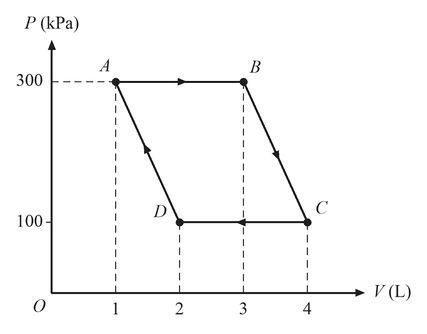
(a) Find the net work done by the gas in one cycle.
(b) Find the efficiency of the engine and the heat it rejects in each cycle.
(c) The engine completes 30 cycles each second. Find its power output.
- 101 mark
Question 10
In an external combustion engine, the fuel burns outside the engine and its heat is passed to a separate working substance. Which of these is an external combustion engine?
- 113 marks
Question 11
In a combined-cycle power station, natural gas burns in a gas turbine, which turns of the heat from the fuel into work. The hot exhaust gases leaving the turbine then boil water for a steam plant, which turns of the heat it receives into work. (Hypothetical data.) Assume that all the heat rejected by the gas turbine reaches the steam plant.
(a) For every of heat from the fuel, find the power from each turbine and the heat finally rejected.
(b) Find the overall efficiency of the station.
(c) Show that the overall efficiency is , and explain why it is less than .
- 121 mark
Question 12
In each cycle, the working gas of an engine absorbs of heat while it is heated at constant volume and a further while it expands at constant pressure. During the rest of the cycle it rejects of heat. (Hypothetical data.) The efficiency of the engine is
- 132 marks
Question 13
(a) Apply the first law of thermodynamics to one complete cycle of a heat engine that takes in heat and rejects heat , and show that the work it does in the cycle is .
(b) The indicator (–) diagram of a gas taken round a cycle is a closed loop. Explain what it means if the loop is traced anticlockwise instead of clockwise, and whether the device is then a heat engine.
- 142 marks
Question 14
A car engine has an efficiency of . In each cycle it rejects of heat through its exhaust and cooling system. (Hypothetical data.)
(a) Find the heat it takes in and the work it does in each cycle.
(b) The engine completes 25 cycles each second. Find its mechanical power output.
- 153 marks
Question 15
A steam engine pumps water out of a mine. In one hour it lifts tonnes of water through a height of , and its efficiency is . (Hypothetical data.) Take .
(a) Find the work done in lifting one tonne () of water.
(b) Find the heat that must be supplied to the engine, and the heat it rejects, for each tonne lifted.
(c) Find the average useful power of the engine.
- 161 mark
Question 16
An ideal gas is taken once round a Carnot cycle. In which stage of the cycle does the gas do work on the piston while its internal energy decreases and no heat enters or leaves it?
- 173 marks
Question 17
A Carnot engine uses of a monatomic ideal gas as its working substance. Its source is at and its sink at . During the isothermal expansion AB the volume of the gas increases from to , as shown in the figure. (Hypothetical data.) The work done by an ideal gas in an isothermal expansion is ; take .

(a) Find the heat absorbed from the source in each cycle.
(b) Find the efficiency of the engine and the work it does in each cycle.
(c) Find the heat rejected to the sink in each cycle, and the heat the sink receives in one minute if the engine makes 40 cycles per minute.
- 181 mark
Question 18
The figure shows two curves for the same sample of a diatomic ideal gas () on a – diagram. Both curves end at the state B. One curve is an isothermal and the other is an adiabatic, like the pair that meets at each corner of a Carnot cycle.
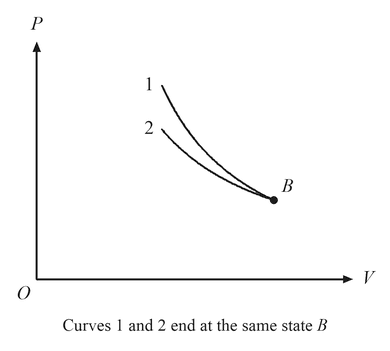
Which statement is correct?
- 193 marks
Question 19
A Carnot engine has its sink at and its source at . A student says, "If I double the source temperature to , the efficiency of the engine will double."
(a) Find the efficiency with the source at .
(b) Find the efficiency with the source at , and say whether the student is right.
(c) Find the efficiency when the absolute (kelvin) temperature of the source is doubled instead, and explain why the efficiency is not proportional to the source temperature on either scale.
- 203 marks
Question 20
A Carnot engine works between a source at and a sink at . An engineer can either raise the source temperature by or lower the sink temperature by , but not both.
(a) Find the efficiency in each case, and say which change gives the greater efficiency.
(b) Show that, for the same change , lowering the sink temperature always raises the efficiency more than raising the source temperature does.
- 213 marks
Question 21
An ideal gas is taken once round the Carnot cycle ABCDA shown in the figure, with the source at . In one cycle the gas does of work during the isothermal expansion AB and during the adiabatic expansion BC, and of work is done on the gas during the isothermal compression CD. (Hypothetical data.)
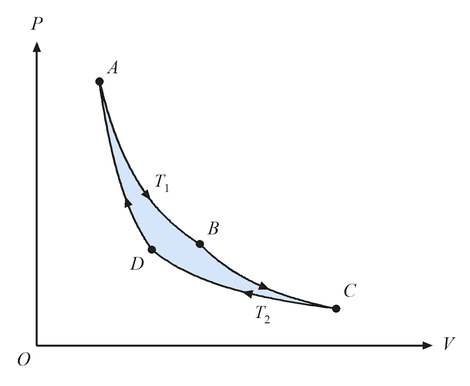
(a) How much work is done on the gas during the adiabatic compression DA? Give a reason.
(b) Find the net work done by the gas in one cycle and the efficiency of the engine.
(c) Find the temperature of the sink.
- 221 mark
Question 22
In the first stage of the Carnot cycle, the gas expands isothermally while the cylinder stands on the source. Carnot's ideal engine requires this expansion to be carried out infinitely slowly. The main reason is
- 233 marks
Question 23
A student builds a small engine whose source is not a large reservoir but a aluminium block, heated to and then left on its own. The sink is the room air at . In each cycle the engine takes of heat from the block. (Hypothetical data.) The specific heat capacity of aluminium is ; ignore any heat the block loses directly to the air.
(a) By how much does the temperature of the block fall in each cycle?
(b) Find the highest possible efficiency of the engine at the start, and again when the block has cooled to .
(c) Explain why a Carnot engine needs a source of very large (ideally infinite) heat capacity, and say what finally happens to this engine.
- 241 mark
Question 24
For a Carnot engine with a fixed source temperature, the graph shows the efficiency plotted against the sink temperature . The straight line passes through the point P (, ), as shown.
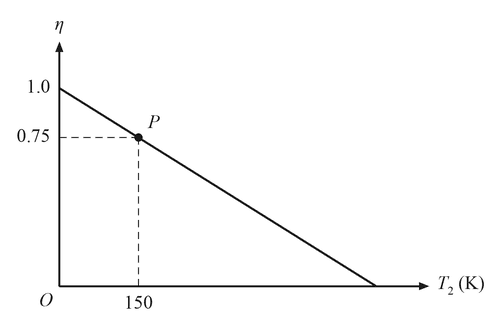
What is the efficiency of this engine when its sink is at ?
- 254 marks
Question 25
A Carnot engine uses of a monatomic ideal gas (). The isothermal expansion AB takes place at from to , and the isothermal compression CD at , as shown in the figure. (Hypothetical data.) For an adiabatic change of an ideal gas, stays constant. Take .
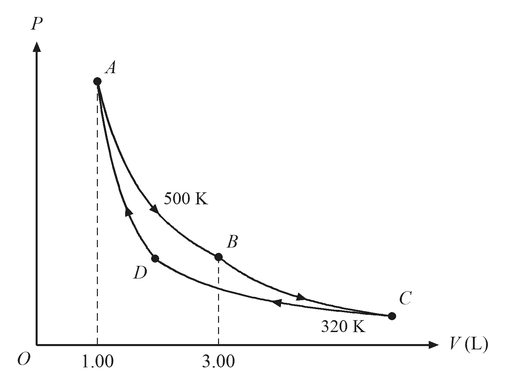
(a) Find the volumes and .
(b) Find the pressure of the gas at each of the four corners A, B, C and D.
(c) Using for the heat exchanged in an isothermal change, find and , and check that the efficiency equals .
- 261 mark
Question 26
Which of the following would break the Kelvin–Planck statement of the second law of thermodynamics?
- 271 mark
Question 27
A cup of tea at 80 °C stands on a table in a large room whose air is at 25 °C. The air in the room holds far more internal energy than the tea. Which statement is correct?
- 281 mark
Question 28
A testing laboratory checks four refrigerator designs that work between a cabinet at 5 °C and a room at 30 °C. For each design it lists, per cycle, the heat taken from the cabinet, the work done on the refrigerant and the heat given to the room. (Hypothetical data.) Which design obeys the first law of thermodynamics but breaks the second law?
- 291 mark
Question 29
An engine works between a reservoir at 900 K and a reservoir at 300 K. According to the second law, for every joule of work it delivers, the least heat it must reject to the 300 K reservoir is
- 301 mark
Question 30
An engine takes in 800 J of heat in each cycle from a reservoir at 600 K and gives out heat to a reservoir at 300 K. (Hypothetical data.) Friction and heat leaks are present in it, as in every real engine. Which of these could be the work it does in each cycle?
- 312 marks
Question 31
An ideal gas in a cylinder is allowed to expand slowly while it is kept in contact with a hot reservoir, so its temperature stays constant. Its internal energy does not change, so all the heat it takes in is turned into work. A student says that this proves the Kelvin–Planck statement wrong. Explain why the student is mistaken.
- 323 marks
Question 32
Suppose someone built a “perfect refrigerator” that, in every cycle, moves 600 J of heat from a cold reservoir at temperature to a hot reservoir at temperature with no work done on it. It runs beside an ordinary engine which, in every cycle, takes 1000 J of heat from the same hot reservoir, does 400 J of work and gives 600 J of heat to the same cold reservoir, as shown in the figure. (Hypothetical data.)
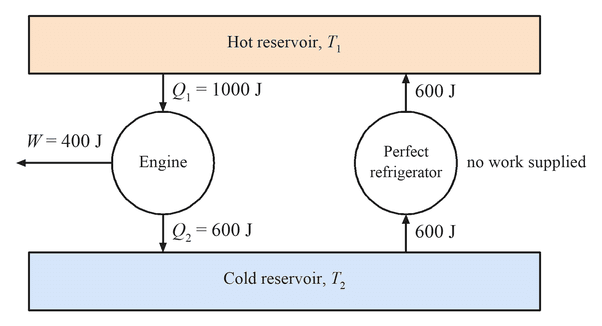
(a) Treating the two devices together as one machine, find the net heat taken from the hot reservoir and the net heat given to the cold reservoir in each cycle.
(b) Show that this combined machine would break the Kelvin–Planck statement.
(c) What does this tell you about the Clausius and the Kelvin–Planck statements of the second law?
- 334 marks
Question 33
A coal-fired power station delivers electrical power at 500 MW, and its overall efficiency (electrical power out ÷ rate at which the burning coal releases heat) is 38%. (Hypothetical data.)
(a) At what rate does the burning coal release heat?
(b) At what rate must the station give heat to its surroundings?
(c) This heat is carried away in cooling towers by evaporating water. Taking the latent heat of vaporisation of water at the temperature of the towers as , and assuming all the rejected heat goes into evaporation, estimate the mass of water evaporated each second.
(d) The rejected heat leaves at about 35 °C. Using the second law, explain why it cannot simply be sent back into the boiler to make more steam.
- 343 marks
Question 34
An ocean thermal energy conversion (OTEC) power plant uses warm surface sea water at 27 °C as its hot reservoir and cold water pumped up from about 1000 m below the surface, at 5 °C, as its cold reservoir. (Hypothetical data.)
(a) What is the greatest efficiency the second law allows for this plant?
(b) A small plant of this kind delivers 100 kW of electrical power with an actual efficiency of 2.5%. At what rate does it take heat from the warm water?
(c) The warm water cools by 3.0 K as it passes through the plant. Taking the specific heat capacity of sea water as , find the mass of warm water that must flow through the plant each second.
- 353 marks
Question 35
The figure shows a toy “drinking bird”. Two glass bulbs, the head and the body, are joined by a glass tube and partly filled with a liquid that evaporates easily; the rest of the space inside holds only the vapour of this liquid. The head is covered with felt. Once the felt has been wetted, the bird keeps swinging down to dip its beak into the glass of water and back up again for hours, with no battery or spring.
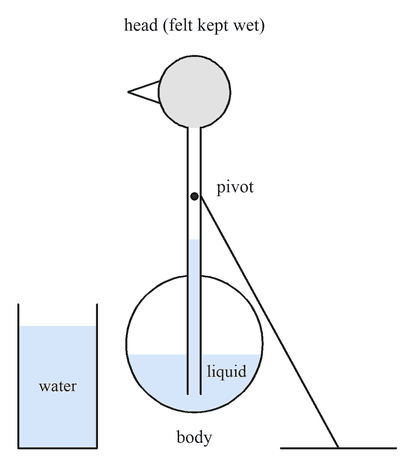
(a) Is the bird a machine that gets work out of nothing, against the laws of thermodynamics? Explain how it works, naming its hot body and its cold body.
(b) In a closed room where the air is already saturated with water vapour, the bird soon stops. Explain why.
- 363 marks
Question 36
A space probe travelling far from the Sun gets its electrical power from a radioisotope generator. The decay of its radioactive fuel keeps releasing heat at about 2000 W, and the generator delivers 110 W of electrical power. Large metal fins on the outside of the generator radiate heat into space. (Hypothetical data.)
(a) Find the efficiency of the generator.
(b) At what rate must the fins get rid of heat when the generator is working steadily?
(c) Using the second law, explain why the generator could not deliver any electrical power if the fins were as hot as the fuel.
- 372 marks
Question 37
A vortex tube is a simple device with no moving parts. Compressed air at room temperature is blown into it from the side, and two streams come out of its ends: one much hotter than the room and one much colder. A student says that the tube “makes heat flow from cold to hot all by itself”, against the Clausius statement. Explain why the second law is not broken.
- 381 mark
Question 38
A refrigerator has a coefficient of performance of 4.0. For each 1.0 J of electrical work done on its refrigerant, it
- 391 mark
Question 39
An air-source heat pump keeps a house warm by delivering heat to it at 10 kW. Its coefficient of performance as a heater, , is 3.5. (Hypothetical data.) At what rate does it take heat from the outside air?
- 403 marks
Question 40
A split air-conditioner removes heat from a room at 3.5 kW while it draws 1.0 kW of electrical power. The room is kept at 25 °C and the outdoor air is at 40 °C. (Hypothetical data.)
(a) Find its coefficient of performance.
(b) At what rate does its outdoor unit give heat to the outside air?
(c) Find the coefficient of performance of an ideal (Carnot) refrigerator working between 25 °C and 40 °C, and find what fraction of this ideal value the air-conditioner achieves.
- 412 marks
Question 41
The instruction booklet of a refrigerator says: “Leave at least 10 cm of free space behind the refrigerator, and do not install it next to a cooking stove.” Using the flow of heat in a refrigerator, explain how following this advice saves electrical energy.
- 421 mark
Question 42
Heat is removed from the freezer compartment of a refrigerator at −18 °C and from its fresh-food compartment at 3 °C, and given to a kitchen at 27 °C. Treat each compartment as served by its own ideal (Carnot) refrigerator. To remove the same amount of heat, the work needed for the freezer is about how many times the work needed for the fresh-food compartment?
- 433 marks
Question 43
A vaccine refrigerator at a rural health centre must keep vaccines at 5 °C while the room around it is at 35 °C. Heat leaks into its cabinet at 60 W. Its actual coefficient of performance is 35% of the ideal (Carnot) value for these temperatures. (Hypothetical data.)
(a) Find the ideal coefficient of performance.
(b) Find the electrical power the refrigerator needs to keep the vaccines at 5 °C.
(c) At what rate does it give heat to the room?
- 443 marks
Question 44
A family heats 150 L of water every day from 20 °C to 55 °C. Compare the electrical energy used each day by (i) an immersion heater (a heating coil in the water) and (ii) a heat-pump water heater whose coefficient of performance (heat given to the water ÷ electrical energy used) is 3.0. Take the density of water as , its specific heat capacity as and , and ignore heat losses. (Hypothetical data.) Where does the rest of the heat come from in the heat-pump heater?
- 451 mark
Question 45
The figure shows the circuit of a refrigerator. The refrigerant flows round it in the direction of the arrows; is the compressor and is the expansion valve.

Which coil must be placed inside the cabinet to take heat from it, and why?
- 464 marks
Question 46
A reversible engine takes 1000 J of heat in each cycle from a hot reservoir at 600 K and gives heat to the surroundings at 300 K. All the work it does drives a reversible refrigerator, which takes heat from a cold store at 250 K and also gives heat to the surroundings at 300 K, as shown in the figure. (Hypothetical data.)
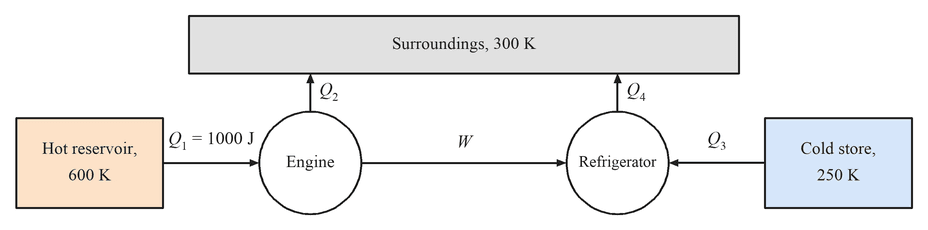
(a) Find the work done by the engine in each cycle and the heat it gives to the surroundings.
(b) Find the heat taken from the cold store in each cycle.
(c) Find the total heat given to the surroundings in each cycle, and check that energy is conserved.
- 471 mark
Question 47
An ideal (Carnot) heat pump keeps a house at 20 °C. The outdoor temperature falls from 10 °C to −10 °C, and the heat pump must still deliver heat to the house at the same rate. The electrical power it needs becomes
- 483 marks
Question 48
The refrigeration plant of an ice rink keeps the ice at −5 °C. Heat reaches the ice from the air and the skaters at 150 kW. The plant gives out its heat at 30 °C, and this heat is used to warm a swimming pool next door. Treat the plant as an ideal (Carnot) refrigerator. (Hypothetical data.)
(a) Find the least electrical power the plant needs.
(b) At what rate does it deliver heat to the pool?
(c) Counting the heat delivered to the pool as its useful output, find the plant's coefficient of performance as a heat pump, and show that it is 1 more than its coefficient of performance as a refrigerator.
- 491 mark
Question 49
A refrigerator uses 1.2 kWh of electrical energy in a day, and its average coefficient of performance is 2.5. (Hypothetical data.) How much heat does it remove from its cabinet in that day? (Take .)
- 502 marks
Question 50
Can you cool a room by keeping the fridge open?
- 511 mark
Question 51
What is the use of the indicator diagram or diagram?
- 521 mark
Question 52
What is meant by a cyclic process?
- 532 marks
Question 53
“The efficiency of all real engines are less than that of the Carnot engine.” Why?
- 541 mark
Question 54
What is a heat pump?
- 551 mark
Question 55
Under what conditions can a Carnot engine have efficiency?
- 562 marks
Question 56
“A Carnot engine is called an ideal engine.” Why?
- 572 marks
Question 57
Can a ship make use of internal energy of sea water for the working of its engine?
- 583 marks
Question 58
A Carnot engine working between an unknown temperature and ice point gives an efficiency of 50%. What is the unknown temperature?
- 593 marks
Question 59
A Carnot engine has the same efficiency (i) between 100 K and 500 K and (ii) between K and 900 K. Calculate the temperature of the sink.
- 603 marks
Question 60
An engine consumes 20 kg of fuel per hour. The calorific value of the fuel is 12 kcal g. Calculate the efficiency of the engine if the power of the engine is 42 kW.
- 611 mark
Question 61
A refrigerator works between and . It is required to remove 600 calories of heat every second in order to keep the temperature of the refrigerated space constant. The power is (Take 1 cal = 4.2 joules)
- 621 mark
Question 62
What is the value of sink temperature when efficiency of engine is 100%?
- 631 mark
Question 63
In a Carnot engine, the temperature of reservoir is and that of sink is . If the work done by the engine when it transfers heat from reservoir to sink is , the quantity of heat absorbed by the engine from the reservoir is
- 641 mark
Question 64
The coefficient of performance of a refrigerator is 5. If the temperature inside freezer is , the temperature of the surroundings to which it rejects heat is
- 651 mark
Question 65
Which of the following is a true statement?
- 661 mark
Question 66
A Carnot engine, having an efficiency of as heat engine, is used as a refrigerator. If the work done on the system is 10 J, the amount of energy absorbed from the reservoir at lower temperature is
- 671 mark
Question 67
The efficiency of a Carnot engine which operates between the two temperature and is
- 681 mark
Question 68
Even Carnot engine cannot give 100% efficiency because we cannot
- 691 mark
Question 69
“Heat cannot by itself flow from a body at lower temperature to a body at higher temperature” is a statement or consequence of
- 701 mark
Question 70
Which of the following processes is reversible?
- 711 mark
Question 71
Efficiency of a Carnot engine is 50% when temperature of outlet is 500 K. In order to increase efficiency up to 60% keeping temperature of intake the same, what is temperature of outlet?
- 721 mark
Question 72
A Carnot engine, having efficiency of as heat engine, is used as a refrigerator. If the work done on the system is 10 J, the amount of energy absorbed from the reservoir at lower temperature is
- 731 mark
Question 73
An ideal gas heat engine operates in Carnot cycle between and . It absorbs of heat at higher temperature. Amount of heat converted to work is
- 741 mark
Question 74
When you make ice cubes, the entropy of water
- 751 mark
Question 75
A Carnot cycle has the reversible processes in the following order
- 761 mark
Question 76
A Carnot engine operating between temperature and has efficiency . When is lowered by 62 K, its efficiency increases to . Then and are, respectively
- 771 mark
Question 77
A Carnot engine, whose efficiency is 40%, takes in heat from a source maintained at a temperature of 500 K. It is desired to have an engine of efficiency 60%. Then, the intake temperature for the same exhaust (sink) temperature must be
- 781 mark
Question 78
200 cal of heat is given to a heat engine so that it rejects 150 cal of heat, if source temperature is 400 K, then the sink temperature is
- 791 mark
Question 79
The temperature inside a refrigerator is and the room temperature is . The amount of heat delivered to the room for each joule of electrical energy consumed ideally will be
- 801 mark
Question 80
The efficiency of an ideal heat engine working between the freezing point and boiling point of water is
- 811 mark
Question 81
A diatomic ideal gas is used in a Carnot engine as the working substance. If during the adiabatic expansion part of the cycle, the volume of the gas increases from to , the efficiency of the engine is
- 821 mark
Question 82
A Carnot engine whose low temperature reservoir is at has an efficiency of 50%. It is desired to increase the efficiency to 70%. By how many degrees should the temperature of the high temperature reservoir be increased?
- 831 mark
Question 83
Two Carnot engines and are operated in succession. The first one, receives heat from a source at and rejects to sink at K. The second engine receives heat rejected by the first engine and rejects to another sink at . If the work outputs of two engines are equal, then the value of is
- 841 mark
Question 84
A reversible engine converts one-sixth of the heat input into work. When the temperature of the sink is reduced by , the efficiency of the engine is doubled. The temperatures of the source and sink are
- 851 mark
Question 85
A Carnot engine has an efficiency of 1/6. When the temperature of the sink is reduced by , its efficiency is doubled. The temperature of the source and the sink are, respectively
- 861 mark
Question 86
A Carnot engine having an efficiency of 1/10 is being used as a refrigerator. If the work done on the refrigerator is 10 J, the amount of heat absorbed from the reservoir at lower temperature is
- 871 mark
Question 87
A balloon filled with helium ( and ) bursts. Immediately afterwards, the expansion of helium can be considered as
- 881 mark
Question 88
A Carnot engine working between 400 K and 800 K has work output of 1200 J per cycle. The amount of heat energy supplied to the engine from the source in each cycle is
- 891 mark
Question 89
A refrigerator consumes an average 35 W power to operate between temperature to . If there is no loss of energy, then how much average heat per second does it transfer?
- 901 mark
Question 90
No process is possible whose sole result is the transfer of heat from a colder object to a hotter object. This is Clausius statement for
- 911 mark
Question 91
An ideal Carnot engine working with source temperature and sink temperature , has efficiency . Then the value of the ratio is
- 921 mark
Question 92
A Carnot engine has an efficiency of 50% when its source is at a temperature of . The temperature of the sink is
- 931 mark
Question 93
If is the efficiency of an engine at and while is the efficiency at and , then the ratio will be
- 941 mark
Question 94
A Carnot engine has efficiency of 50%. If the temperature of sink is reduced by , its efficiency increases by 30%. The temperature of the source will be
- 951 mark
Question 95
A Carnot engine with efficiency 50% takes heat from a source at 600 K. In order to increase the efficiency to 70%, keeping the temperature of the sink same, the new temperature of the source will be
- 961 mark
Question 96
A Carnot engine operating between two reservoirs has efficiency . When the temperature of cold reservoir is raised by , its efficiency decreases to . The value of , if the temperature of hot reservoir is , will be
- 971 mark
Question 97
Given below are two statements: One is labelled as Assertion A and the other is labelled as Reason R.
Assertion A: Efficiency of a reversible heat engine will be highest at temperature of the cold reservoir.
Reason R: The efficiency of Carnot engine depends not only on the temperature of cold reservoir but it depends on the temperature of the hot reservoir too and is given by .
In the light of the above statements, choose the correct answer from the options given below: