
Question 323 marksMedium
Suppose someone built a “perfect refrigerator” that, in every cycle, moves 600 J of heat from a cold reservoir at temperature to a hot reservoir at temperature with no work done on it. It runs beside an ordinary engine which, in every cycle, takes 1000 J of heat from the same hot reservoir, does 400 J of work and gives 600 J of heat to the same cold reservoir, as shown in the figure. (Hypothetical data.)
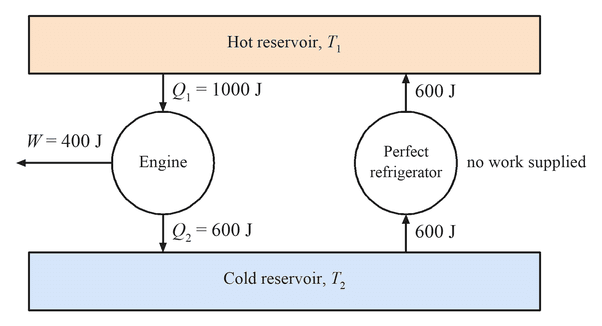
(a) Treating the two devices together as one machine, find the net heat taken from the hot reservoir and the net heat given to the cold reservoir in each cycle.
(b) Show that this combined machine would break the Kelvin–Planck statement.
(c) What does this tell you about the Clausius and the Kelvin–Planck statements of the second law?