
Opening your dashboard
Class 11 Physics Chapter 12: Gravitation - Gravitational Field Solutions
56 textbook questions with step-by-step answers, free to read, for ISC 2026-27.
Get talked through Ch 12, not just shown the answer
Reading a finished solution is not the same as being able to do it. The AI tutor takes one question at a time and works it with you, in your own words, until you can.
- Ask it out loud, in your own words
- It gives you the next step, not the answer
- Stuck on part (ii)? Start there
56 questions with solutions
1–5 marks · Mixed difficulty
The first 35 solutions are on this page. This chapter is a long one, so the rest open on their own page to keep this one quick to load.
- 11 mark
Question 1
The gravitational force between two stones of mass 1 kg each separated by a distance of 1 metre in vacuum is
Solve with AIAnswer
(A) zero
(B) newton
- Correct
(C) newton
(D) newton
Answer: (C) newton
Concept: Newton's law of gravitation gives , with . The force does not depend on the medium, so it acts in vacuum too.
Step 1 — Substitute the data. We take both masses as and , with as used in the options:
Step 2 — Read the result. Numerically, the force equals itself, which is why is described as the force between two unit masses a unit distance apart.
- (A) Two masses always attract each other; a vacuum between them does not stop gravity, so the force cannot be zero.
- (B) This is a million times the correct value; it would need to be times larger than it is.
- (D) This number is the value of in CGS units (dyn cm² g⁻²), not a force in newtons; it is a thousand times too large.
Note: The current measured value is ; option (C) is the one that matches it.
Therefore, the force is about N, option (C).
- 21 mark
Question 2
Two particles of equal mass go around a circle of radius under the action of their mutual gravitational attraction. The speed of each particle is
Solve with AIAnswer
(A)
(B)
- Correct
(C)
(D)
Answer: (C)
Concept: The two particles stay at opposite ends of a diameter, so they are apart. The gravitational pull of each on the other provides the centripetal force for its circular motion.
Step 1 — Write the force between them. The particles are apart, so the force is:
Step 2 — Equate it to the centripetal force. Each particle moves in a circle of radius :
Step 3 — Solve for . We cancel and multiply both sides by :
Watch out: The radius of each circle is , but the distance between the particles is ; using for both is the common slip.
- (A) This has the wrong units: it does not give metres per second, so it cannot be a speed.
- (B) This comes from writing the force as , squaring but not the factor 2 in the separation .
- (D) This comes from taking the separation as instead of , which makes the pull 16 times too large and the speed 4 times too large.
Therefore, the speed of each particle is , option (C).
- 31 mark
Question 3
Force of gravitational attraction is least
Solve with AIAnswer
- Correct
(A) at the equator
(B) at the poles
(C) at a point in between equator and any pole
(D) none of the above
Answer: (A) At the equator
Concept: The Earth's pull on a body at its surface is , where is the distance from the Earth's centre. The larger is, the smaller the force.
Step 1 — Compare the distances. The Earth is slightly flattened at the poles: its equatorial radius (about 6378 km) is greater than its polar radius (about 6357 km).
Step 2 — Apply the inverse-square law. A body at the equator is farthest from the centre, so the gravitational pull on it is least there.
- (B) At the poles a body is nearest the centre, so the pull there is the greatest, not the least.
- (C) Between the equator and a pole the distance from the centre is in between, so the pull is in between too.
- (D) Option (A) is correct, so "none of the above" is wrong.
Therefore, the force of gravitational attraction is least at the equator, option (A).
- 41 mark
Question 4
If the radius of the Earth is reduced to 2%, keeping mass constant, then weight of the body on its surface
Solve with AIAnswer
(A) decreases
- Correct
(B) increases
(C) remains same
(D) is more than that at pole
Answer: (B) Increases
Concept: The weight of a body of mass on the surface is . With fixed, .
Step 1 — Write the new radius. "Reduced to 2 %" means the new radius is:
Step 2 — Find the new weight. We put into the formula:
So the weight increases (2500 times). Even if the stem meant "reduced by 2 %", would still give a larger weight, about 1.04 times.
- (A) A smaller radius brings the surface nearer the centre, so the pull grows; it cannot decrease.
- (C) The weight stays the same only if does not change.
- (D) At the equator part of the pull is used for the Earth's rotation, so the weight there is never more than at a pole; this stays true after the shrinking.
Therefore, the weight of the body on the surface increases, option (B).
- 51 mark
Question 5
If the gravitational force had varied as instead of , the potential energy of a particle at a distance '' from the centre of the Earth would be proportional to
Solve with AIAnswer
(A)
(B)
- Correct
(C)
(D)
Answer: (C)
Concept: Potential energy (zero at infinity) is minus the work done by the force when the particle is brought from infinity: for an attractive force of size .
Step 1 — Write the force. Let the attractive force be , where is a constant.
Step 2 — Integrate. The integral of is , so:
Step 3 — Read off the power. Integrating lowers the power of in size by one, from to , so .
- (A) is the potential energy for the real inverse-square force, .
- (B) is the real force law itself, not a potential energy.
- (D) is the assumed force; the potential energy has a power smaller in size by one.
Therefore, the potential energy would be proportional to , option (C).
- 61 mark
Question 6
If the radius of the Earth were to decrease by 1%, its mass remaining the same, the acceleration due to gravity on the surface of the Earth will
Solve with AIAnswer
(A) increase by 1%
(B) decrease by 2%
(C) decrease by 1%
- Correct
(D) increase by 2%
Answer: (D) Increase by 2%
Concept: On the surface . For a small fractional change in , the fractional change in is .
Step 1 — Put in the change in radius. The radius decreases by 1 %, so :
Step 2 — Check with the exact value. With , , an increase of about 2 %.
- (A) An increase of 1 % forgets that depends on the square of .
- (B) grows when shrinks, so it cannot decrease.
- (C) This has both the wrong direction and no factor 2.
Therefore, will increase by about 2 %, option (D).
- 71 mark
Question 7
A satellite is moving around the Earth with speed in a circular orbit of radius . If the orbit radius is decreased by 1%, its speed will
Solve with AIAnswer
(A) increase by 1%
- Correct
(B) increase by 0.5%
(C) decrease by 1%
(D) decrease by 0.5%
Answer: (B) Increase by 0.5%
Concept: The orbital speed is , so . For a small change, .
Step 1 — Put in the change in radius. The radius decreases by 1 %, so :
Step 2 — Check with the exact value. With , .
- (A) An increase of 1 % forgets the square root in .
- (C) A smaller orbit needs a larger speed, so the speed cannot decrease; this also misses the factor .
- (D) The size, 0.5 %, is right, but the direction is wrong: the speed rises in a smaller orbit.
Therefore, the speed will increase by 0.5 %, option (B).
- 81 mark
Question 8
A body of mass rises to height from the Earth's surface, where is the Earth's radius. If is acceleration due to gravity at the Earth's surface, the increase in potential energy is
Solve with AIAnswer
(A)
(B)
- Correct
(C)
(D)
Answer: (C)
Concept: The gravitational potential energy at distance from the Earth's centre is . The simple form holds only when is very small compared with ; here is not small. Also, .
Step 1 — Write the increase in potential energy. The body moves from distance to distance from the centre; with this is :
Step 2 — Replace by . We substitute :
Step 3 — Write it in terms of . Since , :
- (A) treats as constant all the way up; at a height of , falls noticeably, so this overestimates the energy.
- (B) comes from using the depth formula for the value of , which applies below the surface, not above it.
- (D) is what gives for , not for .
Therefore, the increase in potential energy is , option (C).
- 91 mark
Question 9
If the Earth stops rotating, the value of '' at the equator will
Solve with AIAnswer
- Correct
(A) increase
(B) remains same
(C) decrease
(D) none of the above
Answer: (A) Increase
Concept: Because of the Earth's rotation, the effective value of at the equator is , where is the Earth's angular velocity and its radius.
Step 1 — Put . If the rotation stops:
Step 2 — Compare. The term (about ) is no longer subtracted, so the value at the equator rises.
- (B) The value would stay the same only at the poles, where does not act; at the equator its effect is greatest.
- (C) Removing a term that is subtracted cannot make smaller.
- (D) Option (A) is correct, so "none of the above" is wrong.
Therefore, at the equator will increase, option (A).
- 101 mark
Question 10
The escape velocity on the surface of the Earth is 11.2 km/s. If mass and radius of a planet is 4 and 2 times respectively than that of the Earth, what is the escape velocity from the planet?
Solve with AIAnswer
(A) 11.2 km/s
(B) 1.112 km/s
- Correct
(C) 15.8 km/s
(D) 22.4 km/s
Answer: (C) 15.8 km/s
Concept: The escape velocity from a planet of mass and radius is , so .
Step 1 — Write the ratio. The planet has and , so the ratio is:
Step 2 — Find the planet's value. We multiply the Earth's value by :
- (A) This is the Earth's own value; it would hold only if were unchanged, but it has doubled.
- (B) This is ten times smaller than the Earth's value; no combination of the factors 4 and 2 gives that.
- (D) This doubles the Earth's value: it uses the factor without taking its square root.
Therefore, the escape velocity from the planet is about 15.8 km/s, option (C).
- 111 mark
Question 11
If the change in the value of at the height above the surface of the Earth is the same as at a depth below it, then (both and being much smaller than the radius of the Earth)
Solve with AIAnswer
(A)
- Correct
(B)
(C)
(D)
Answer: (B)
Concept: For a small height , . At a depth , .
Step 1 — Write the two changes. The decrease at height is , and the decrease at depth is .
Step 2 — Equate them. We set the two decreases equal:
- (A) forgets the factor 2 in the height formula: falls twice as fast going up as going down.
- (C) puts the factor 2 on the wrong side.
- (D) cannot be right, because a length cannot equal the square of a length.
Therefore, , option (B).
- 121 mark
Question 12
The period of revolution of planet around the Sun is 8 times that of . The distance of from the Sun is how many times greater than that of from the Sun?
Solve with AIAnswer
(A) 2
(B) 3
- Correct
(C) 4
(D) 5
Answer: (C) 4
Concept: Kepler's third law: , where is the period and the mean distance from the Sun.
Step 1 — Write the ratio. We put :
Step 2 — Take the cube root. We take the cube root of 64:
- (A) 2 is the cube root of 8; it comes from forgetting to square the period ratio.
- (B) A distance ratio of 3 would need a period ratio of , not 8.
- (D) A distance ratio of 5 would need a period ratio of , not 8.
Therefore, is 4 times as far from the Sun as , option (C).
- 131 mark
Question 13
There is no atmosphere on the Moon because
Solve with AIAnswer
(A) it is closer to the Earth
(B) it revolves round the Earth
(C) it gets light from the Sun
- Correct
(D) the escape velocity of gas molecules is lesser than their root mean square velocity here
Answer: (D) The escape velocity of gas molecules is lesser than their root mean square velocity here
Concept: A gas stays round a body only if very few of its molecules move faster than the body's escape velocity.
Step 1 — Compare the speeds on the Moon. The Moon's escape velocity is only about . For hydrogen in the Moon's daytime heat the r.m.s. speed is about , so about a third of the hydrogen molecules move faster than the escape velocity at any moment.
Step 2 — Conclude. Molecules faster than the escape velocity leave for good, so over time the gases escaped.
- (A) Being near the Earth does not remove gases; the Earth itself keeps its atmosphere.
- (B) The Earth also revolves (round the Sun) and still has an atmosphere, so revolving is not the cause.
- (C) The Earth also gets light from the Sun and keeps its atmosphere.
Note: Strictly, for heavier gases the r.m.s. speed is below the Moon's escape velocity; they were lost because a small fraction of their molecules, in the fast tail of the speed spread, always exceeds it, over millions of years. A gas is kept for billions of years only if the escape velocity is roughly six or more times its r.m.s. speed. The printed key states the idea loosely: the Moon's escape velocity is not large enough, compared with molecular speeds, to hold on to a gas.
Note: Also, the Moon is not completely bare: it has an extremely thin layer of gas called an exosphere (mainly helium, argon and neon), with a surface pressure less than a billionth of the Earth's. So "no atmosphere" here means no appreciable atmosphere.
Therefore, the Moon has practically no atmosphere because its escape velocity is small, only a few times the r.m.s. speeds of gas molecules there, so the fastest molecules escaped over time, option (D).
- 141 mark
Question 14
The radius of a planet is of and its acceleration due to gravity is . What would be the value of escape velocity on the planet, if escape velocity on the Earth is ?
Solve with AIAnswer
- Correct
(A)
(B)
(C)
(D)
Answer: (A)
Concept: The escape velocity from the surface is , so .
Step 1 — Write the planet's escape velocity. The planet has and , so its escape velocity is:
Step 2 — Compare with the Earth. Since :
- (B) turns the ratio upside down.
- (C) would need to be , but here .
- (D) uses the ratio without taking its square root.
Therefore, the escape velocity on the planet is , option (A).
- 151 mark
Question 15
The period of a satellite in a circular orbit of radius is . What is the period of another satellite in a circular orbit of radius ?
Solve with AIAnswer
(A)
(B)
(C)
- Correct
(D)
Answer: (D)
Concept: For satellites of the same planet, (Kepler's third law, ).
Step 1 — Write the ratio. The radius becomes :
Step 2 — Take the square root. We take the positive square root:
- (A) assumes the period is simply proportional to the radius.
- (B) has the right factor but upside down: a larger orbit takes longer, not shorter.
- (C) is upside down and also assumes .
Therefore, the period of the second satellite is , option (D).
- 161 mark
Question 16
According to Newton's law of gravitation, each particle attracts every other particle. But we do not see bodies on the surface of the Earth moving towards each other. Why?
Solve with AIWritten solution
Solution:
Concept: The gravitational force between two bodies is , and is very small.
Step 1 — Size the force. For ordinary bodies (masses of a few kilograms, a metre apart) the force is only about N or less, while the Earth pulls each of them with a force of many newtons.
Step 2 — Compare with friction. Friction from the ground easily balances such a tiny sideways pull, so the bodies stay where they are.
Therefore, we do not see bodies moving towards each other because the gravitational force between them is extremely small compared with the Earth's pull on them and the friction that holds them in place.
- 171 mark
Question 17
The force of gravity is proportional to the masses of the bodies. Then why doesn't a heavy body fall faster than a light body?
Solve with AIWritten solution
Solution:
Concept: By Newton's second law, the acceleration of a body is .
Step 1 — Write the pull. The Earth pulls a body of mass with ; a heavier body is pulled harder.
Step 2 — Find the acceleration. We divide by the mass of the body:
The mass cancels, so a heavy body needs a larger force for the same acceleration, and gets exactly that.
Therefore, a heavy body does not fall faster because the acceleration due to gravity, , does not depend on the mass of the falling body (air resistance being neglected).
- 181 mark
Question 18
Is it possible to shield a body from the gravitational attraction of other bodies?
Solve with AIWritten solution
Solution:
Concept: The gravitational force between two masses does not depend on the medium between them.
Step 1 — Look for a way to block it. Any screen put in between has mass of its own, so it only adds its own pull; it does not stop the pull of the other bodies.
Step 2 — Look for a way to cancel it. There is no negative mass that could cancel gravity, as opposite charges cancel electric fields.
Therefore, no: a body cannot be shielded from the gravitational attraction of other bodies, because gravity does not depend on the intervening medium.
- 191 mark
Question 19
Suppose the Earth stops rotating about its axis, what will be its effect on the weight of a body?
Solve with AIWritten solution
Solution:
Concept: At latitude the effective value of is , where is the Earth's angular velocity.
Step 1 — Put . If the Earth stops rotating, the subtracted term disappears, so everywhere and the weight becomes .
Step 2 — See where it changes. At every latitude except the poles, , so the weight increases; the increase is greatest at the equator. At the poles () the term was already zero, so the weight there does not change.
Therefore, if the Earth stopped rotating, the weight of a body would increase everywhere except at the poles, where it would stay the same.
- 201 mark
Question 20
Is it possible to put an artificial satellite in an orbit in such a way that it always remains visible directly over New Delhi?
Solve with AIWritten solution
Solution:
Concept: A satellite can stay over one place only if it is geostationary: its orbit must lie in the equatorial plane, because the centre of every orbit must be the Earth's centre, and its period must equal the Earth's rotation period, one sidereal day (about 23 h 56 min).
Step 1 — Check the position of New Delhi. New Delhi lies at about N, not on the equator.
Step 2 — Apply the condition. A satellite always directly over New Delhi would have to move in a circle whose centre is on the Earth's axis but not at the Earth's centre. The Earth's pull points to its centre, so it cannot keep a satellite in such an orbit.
Therefore, no: a satellite cannot always stay directly over New Delhi, because a stationary satellite must orbit in the equatorial plane and New Delhi is not on the equator.
- 211 mark
Question 21
What is the weight of a body in geostationary satellite?
Solve with AIWritten solution
Solution:
Concept: The weight we feel or read on a spring balance is the apparent weight, the force with which the floor or support pushes on the body.
Step 1 — Describe the motion. A geostationary satellite and everything in it fall freely round the Earth with the same acceleration.
Step 2 — Find the apparent weight. Because the body and the satellite have the same acceleration, the floor does not push on the body, so its apparent weight is zero. The Earth's pull on it is not zero (at that distance it is about of its value on the ground), but all of it is used as the centripetal force.
Therefore, the weight of a body in a geostationary satellite (its apparent weight) is zero.
- 221 mark
Question 22
A person in an artificial satellite of the Earth feels weightlessness. But a person on the Moon has weight, even though the Moon is also a satellite. Why?
Solve with AIWritten solution
Solution:
Concept: A person feels weight when a surface pushes on them. When the person and the support fall freely together, this push is zero.
Step 1 — Explain the artificial satellite. The person and the satellite fall freely round the Earth together. The Earth's pull on the person is used up as the person's centripetal force, so the floor does not push on them and they feel weightless.
Step 2 — Explain the Moon. On the Moon the person and the Moon also fall freely round the Earth together, so the Earth's pull is not felt there either. But the person is also pulled by the Moon's own gravity towards its surface. The ground pushes back against this pull, so the person feels weight.
Therefore, a person on the Moon has weight because of the Moon's own gravitational pull, which the Moon's surface opposes; an artificial satellite's own pull on the person is negligible, so inside it the person feels weightless.
- 231 mark
Question 23
Can we find the mass of a satellite by finding its period?
Solve with AIWritten solution
Solution:
Concept: For a satellite in a circular orbit of radius round the Earth of mass , .
Step 1 — Look at the formula. The period depends only on and the Earth's mass . The satellite's own mass cancels when its centripetal force is equated to the Earth's pull.
Step 2 — Conclude. So two satellites of different masses in the same orbit have the same period, and the period tells us nothing about the satellite's mass.
Therefore, no: the mass of a satellite cannot be found from its period, because the period does not depend on the satellite's mass.
- 241 mark
Question 24
“The atmosphere on the Moon is much rare than on the Earth”. Why?
Solve with AIWritten solution
Solution:
Concept: A body keeps a gas only if very few of its molecules move faster than the body's escape velocity.
Step 1 — Compare the escape velocities. The escape velocity is about on the Moon but on the Earth.
Step 2 — Compare with molecular speeds. At the Moon's daytime temperature (about 390 K) the r.m.s. speeds of gas molecules range from about (oxygen, carbon dioxide) to about (hydrogen). About a third of the hydrogen molecules therefore exceed the Moon's escape velocity at any moment, and for heavier gases a very small fraction always does.
Step 3 — See what happens over time. Molecules faster than the escape velocity leave for good, and collisions keep giving other molecules such speeds, so over millions of years most of the gas leaks away. On the Earth, with an escape velocity of , practically no molecule near the surface reaches escape speed, so the Earth keeps its atmosphere.
Therefore, the Moon's atmosphere is very rare because its escape velocity (about 2.4 km/s) is much smaller than the Earth's, so over time most of its gas molecules have escaped into space.
- 251 mark
Question 25
What is the energy required by a satellite to keep it orbiting?
Solve with AIWritten solution
Solution:
Concept: Work done by a force is ; a force perpendicular to the motion does no work.
Step 1 — Find the work done by gravity. In a circular orbit the Earth's pull (the centripetal force) is always perpendicular to the satellite's velocity, so and it does no work.
Step 2 — Find the energy needed. Above the dense atmosphere there is almost no air resistance, so practically no energy is lost and none has to be supplied. (Satellites in very low orbits meet a trace of air and need an occasional boost.)
Note: In an elliptical orbit gravity is not perpendicular to the motion everywhere, but it is a conservative force: it only exchanges kinetic and potential energy, so the total energy stays constant and still no energy has to be supplied.
Therefore, zero energy is required to keep a satellite orbiting, because in a circular orbit the centripetal force (gravity) does no work on it, and in any orbit gravity only exchanges kinetic and potential energy.
- 261 mark
Question 26
Why are rockets launched from west to east in the equatorial plane?
Solve with AIWritten solution
Solution:
Concept: A rocket on the ground already shares the speed of the rotating Earth.
Step 1 — State the Earth's motion. The Earth rotates from west to east, and the speed of its surface is greatest at the equator (about ).
Step 2 — Use it. A rocket launched eastward from near the equatorial plane gets this speed in addition to the speed from its engines, so less fuel is needed.
Therefore, rockets are launched from west to east in the equatorial plane so that the Earth's rotational speed, greatest at the equator, adds to the rocket's own speed.
- 271 mark
Question 27
What is the frequency of oscillation of a simple pendulum mounted in a cabin that is freely falling under gravity?
Solve with AIWritten solution
Solution:
Concept: The frequency of a simple pendulum is , where is the effective acceleration due to gravity in the cabin.
Step 1 — Find . In a freely falling cabin the bob and its support fall with the same acceleration , so relative to the cabin:
Step 2 — Find the frequency. With there is no restoring force on the displaced bob (it is weightless), so:
Therefore, the pendulum does not oscillate: its frequency is zero.
- 282 marks
Question 28
Define intensity of gravitational field.
Solve with AIWritten solution
Solution:
Concept: A gravitational field is the region round a mass in which another mass feels a gravitational force.
Step 1 — State the definition. The intensity of the gravitational field at a point is the force experienced by a unit mass placed at that point:
Step 2 — Give its value, unit and direction. At distance from a mass its size is . It is a vector, directed towards the mass , and its SI unit is .
Therefore, the intensity of the gravitational field at a point is the force experienced by a unit mass placed at that point; its unit is N/kg.
- 292 marks
Question 29
Define gravitational potential and gravitational potential energy.
Solve with AIWritten solution
Solution:
Concept: Both quantities are measured from infinity, where they are taken as zero. Work is done by an outside agent moving the mass slowly, without giving it kinetic energy.
Step 1 — Define gravitational potential. The gravitational potential at a point is the work done in bringing a unit mass from infinity to that point:
Near a mass , at distance , , and its unit is .
Step 2 — Define gravitational potential energy. The gravitational potential energy of a mass at a point is the work done in bringing that mass from infinity to the point:
Its unit is the joule, and .
Watch out: Both are negative, because gravity attracts: the mass is pulled in, so the outside agent does negative work.
Therefore, gravitational potential is the work done in bringing a unit mass from infinity to the point, and gravitational potential energy is the work done in bringing the given mass from infinity to the point.
- 302 marks
Question 30
Obtain the dimensional formula of and gravitational potential.
Solve with AIWritten solution
Solution:
Concept: A dimensional formula expresses a quantity in powers of mass [M], length [L] and time [T]. Force has dimensions and work (energy) .
Step 1 — Write from Newton's law. From :
Step 2 — Put in the dimensions. We replace each quantity by its dimensions:
Step 3 — Do the same for potential. Potential is work per unit mass, :
Therefore, the dimensional formula of is and that of gravitational potential is .
- 312 marks
Question 31
Distinguish between inertial and gravitational mass.
Solve with AIWritten solution
Solution:
Concept: Mass appears in two different laws: in Newton's second law (resistance to change of motion) and in Newton's law of gravitation (strength of the gravitational pull).
Step 1 — Define inertial mass. The inertial mass of a body measures its inertia. It is found from the acceleration produced by a known force :
It can be measured anywhere with an inertial balance, even where bodies are weightless, for example in an orbiting spacecraft, where gravity still acts but everything falls freely together.
Step 2 — Define gravitational mass. The gravitational mass of a body measures how strongly gravity pulls it. It is found from the Earth's pull on it, , for example with a common balance:
Step 3 — Compare them. The two are defined in different ways, but experiments show they are equal for every body (to better than one part in ). This is why all bodies fall with the same acceleration.
Therefore, inertial mass is measured by a body's resistance to acceleration (), while gravitational mass is measured by the gravitational pull on it; the two are found to be equal.
- 322 marks
Question 32
What is a satellite? What is the difference between natural satellite and artificial satellite?
Solve with AIWritten solution
Solution:
Concept: A satellite is held in its orbit by the gravitational pull of the body it goes round.
Step 1 — Define a satellite. A satellite is a body that revolves continuously round a planet (or another larger body) in a closed, stable orbit.
Step 2 — Explain a natural satellite. A natural satellite is one made by nature. The Moon is the natural satellite of the Earth.
Step 3 — Explain an artificial satellite. An artificial satellite is one built by people and placed in orbit by a rocket. Aryabhata, India's first satellite, and the INSAT communication satellites are artificial satellites of the Earth.
Therefore, a satellite is a body revolving round a planet in a stable orbit; a natural satellite (such as the Moon) is made by nature, while an artificial satellite (such as INSAT) is built by people and launched into orbit.
- 332 marks
Question 33
Give the full form of (i) INTELSAT and (ii) INSAT.
Solve with AIWritten solution
Solution:
Concept: Both names are short forms used for communication satellite systems.
Step 1 — (i) INTELSAT. INTELSAT stands for the International Telecommunications Satellite Organization, which set up a worldwide network of communication satellites.
Step 2 — (ii) INSAT. INSAT stands for the Indian National Satellite System, India's system of geostationary satellites for communication, broadcasting and weather study.
Note: Since 2001 the Intelsat satellites have been run by a private company, Intelsat; the original intergovernmental body continues as the International Telecommunications Satellite Organization (ITSO).
Therefore, (i) INTELSAT is the International Telecommunications Satellite Organization, and (ii) INSAT is the Indian National Satellite System.
- 342 marks
Question 34
Write a note on synchronous satellite.
Solve with AIWritten solution
Solution:
Concept: A satellite whose period equals the Earth's period of rotation keeps pace with the Earth.
Step 1 — Define it. A synchronous (geostationary) satellite revolves round the Earth in the equatorial plane, from west to east, with a period equal to the Earth's rotation period, one sidereal day (about 23 h 56 min). It therefore appears to stand still above one point of the equator, as the figure shows.
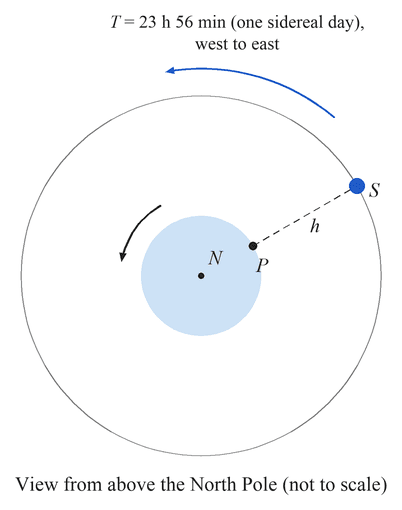
Step 2 — Give its orbit. For this period, gives an orbit radius of about 42 200 km (42 164 km), a height of about 36 000 km (35 786 km) above the surface, and an orbital speed of about .
Step 3 — Give its uses. Because it stays over one place, a ground aerial can point at it all the time. Such satellites are used for television broadcasting, telephone and internet links, and weather watching (for example, the INSAT series).
Therefore, a synchronous satellite moves in the equatorial plane from west to east with a period of one sidereal day (about 23 h 56 min) at a height of about 36 000 km, so it appears stationary above one point of the Earth and is used for communication and weather study.
- 352 marks
Question 35
Derive an expression for the period of a geostationary satellite.
Solve with AIWritten solution
Solution:
Concept: A satellite of mass moves in a circular orbit of radius round the Earth (mass , radius ), where is its height above the surface. The Earth's pull provides the centripetal force.
Step 1 — Draw the set-up. The figure shows the satellite , the pull towards the centre , and the velocity along the tangent.

Step 2 — Find the orbital speed. We equate the gravitational pull to the centripetal force:
Step 3 — Find the period. The period is the time for one round, the circumference divided by the speed:
Step 4 — Write it for a geostationary satellite. With , and the period equal to the Earth's rotation period, one sidereal day (about 23 h 56 min, or 86 164 s), this gives a height of about 36 000 km:
Therefore, the period of a geostationary satellite is , which equals one sidereal day (about 23 h 56 min) when km.
- 362 marks
Question 36
Derive an expression for the escape velocity of a body from any planet.
- 372 marks
Question 37
Can you find the mass of the Sun without weighing?
- 382 marks
Question 38
Explain why some planets do not have atmosphere.
- 392 marks
Question 39
What are the conditions for a satellite to be stationary?
- 402 marks
Question 40
What is the energy of a satellite revolving in a stable orbit?
- 412 marks
Question 41
Suppose a body is carried from the Earth to the Moon. What happens to its weight?
- 422 marks
Question 42
How is a satellite launched?
- 432 marks
Question 43
What is a parking orbit? Why is it called so?
- 442 marks
Question 44
Which of the following observations points to the equivalence of inertial and gravitational mass?
(a) Two spheres of different mass dropped from the top of a long evacuated tube reach the bottom of the tube at the same time.
(b) The time period of a simple pendulum is independent of its mass.
(c) The gravitational force on a particle inside a hollow isolated sphere is zero.
(d) A man in a closed cabin that is falling freely under gravity 'disappears'.
(e) An astronaut inside a spaceship orbiting around the Earth feels weightless.
(f) Planets orbiting around the Sun obey Kepler's third law (approximately).
(g) The gravitational force on a body due to the Earth is equal and opposite to the gravitational force on the Earth due to the body.
- 453 marks
Question 45
State and explain Kepler's laws of planetary motion.
- 463 marks
Question 46
State Newton's law of universal gravitation. Define . Derive the relation connecting and .
- 473 marks
Question 47
Define intensity of gravitational field and potential at a point in Earth's gravitational field. Derive the expression for the gravitational potential difference
- 483 marks
Question 48
Show that the gravitational potential energy . Derive the relation between gravitational intensity and the acceleration due to gravity at a place.
- 493 marks
Question 49
Derive an expression for the escape velocity of the Earth using energy consideration. Mention the uses of artificial satellites.
- 503 marks
Question 50
What are synchronous satellites? What are (i) equatorial orbit and (ii) polar orbits of a satellite? Mention the uses of polar satellites.
- 513 marks
Question 51
Explain weightlessness in space. Derive an expression for the total energy of a satellite moving in a circular orbit.
- 525 marks
Question 52
A satellite of mass is moving in a circular orbit of radius around the Earth. The radius of the Earth is and the acceleration due to gravity at the surface of the Earth is . Obtain expressions for the following:
(a) The acceleration due to gravity at a distance from the centre of the Earth.
(b) The linear speed of the satellite.
(c) The periodic time of the satellite.
- 535 marks
Question 53
(a) (i) Deduce an expression for the minimum velocity with which a rocket must be fired to escape the Earth's gravitational field.
(ii) Explain why hydrogen is found in abundance around the sun while it is absent from the Earth's atmosphere. Why there is no atmosphere on the moon?
(b) How is an artificial satellite positioned above the Earth to serve as a relay station for television or telecommunications?
(c) Derive an expression to explain the decrease in acceleration due to gravity inside the Earth as one approaches the centre.
- 545 marks
Question 54
(a) Define gravitational potential and its unit.
(b) State the conditions for an artificial satellite to appear stationary to an observer on the Earth. Give one use of such a satellite.
- 555 marks
Question 55
(a) (i) State Newton's law of gravitation.
(ii) Write down the relation between the universal gravitation constant and the acceleration due to gravity at the Earth's surface.
(b) (i) What do you understand by the term velocity of escape?
(ii) Explain the absence of atmosphere round the Moon.
- 565 marks
Question 56
(a) Explain the variation of above the surface of the Earth.
(b) What are the conditions for satellite to be geostationary?
(c) What is parking orbit? Calculate its radius and height.
What Class 11 Physics Ch 12 covers
The sections of the chapter, in the order the book takes them. Every question above comes from one of these.
- 01Newton's Universal Law of Gravitation
- 02Acceleration Due to Gravity
- 03Variation of g
- 04Gravitational Field and Intensity
- 05Gravitational Potential and Potential Energy
- 06Escape Velocity
More ways to study this chapter
The same chapter asked three other ways. Practise it, revise it, and see what the board has set on Ch 12 before.
Class 11 Physics Ch 12 questions students ask
How many questions are there in Class 11 Physics Ch 12?
56 questions. Every one is solved step by step on this page.
Are these Class 11 Physics solutions free?
Yes. Every question and its full working is free to read, with no account needed.
Can I download the Class 11 Physics Ch 12 solutions as a PDF?
There is no PDF to download. Every solution is on this page instead, which means it is searchable, always the current syllabus, and readable on a phone. Use your browser's print option if you want it on paper.