
Question 503 marksMedium
What are synchronous satellites? What are (i) equatorial orbit and (ii) polar orbits of a satellite? Mention the uses of polar satellites.
Confirming your payment
Sign up now and get 250 free tokens.
Gravitation - Gravitational Field · Question 50 of 56
What are synchronous satellites? What are (i) equatorial orbit and (ii) polar orbits of a satellite? Mention the uses of polar satellites.
Solution:
Concept: The orbit of every satellite is a closed path whose plane passes through the Earth's centre. Its height fixes its period through .
Step 1 — Define synchronous satellites. A synchronous (geostationary) satellite revolves round the Earth in the equatorial plane, from west to east, with a period equal to the Earth's period of rotation, one sidereal day (about 23 h 56 min). It stays above one point of the equator at a height of about 36 000 km.
Step 2 — (i) Equatorial orbit. An equatorial orbit lies in the plane of the Earth's equator, as in part (i) of the figure. Geostationary satellites use this orbit.
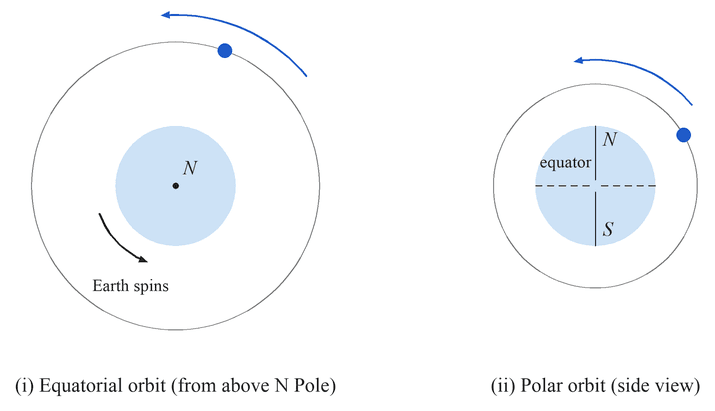
Step 3 — (ii) Polar orbit. A polar orbit lies in a plane that passes over (or near) both poles, as in part (ii) of the figure. Polar satellites are usually low, at about 500–800 km, with a period of about 100 minutes. As the Earth turns beneath the orbit, the satellite passes over a different strip of the surface on each round, so it covers the whole Earth.
Step 4 — Uses of polar satellites. Because they see the whole Earth at close range, polar satellites are used for:
Therefore, synchronous satellites move in the equatorial plane with a period of one sidereal day (about 23 h 56 min); an equatorial orbit lies in the plane of the equator, a polar orbit passes over the poles, and polar satellites are used for remote sensing, mapping, weather and environmental study.