
Question 565 marksMedium
(a) Explain the variation of above the surface of the Earth.
(b) What are the conditions for satellite to be geostationary?
(c) What is parking orbit? Calculate its radius and height.
Confirming your payment
Sign up now and get 250 free tokens.
Gravitation - Gravitational Field · Question 56 of 56
(a) Explain the variation of above the surface of the Earth.
(b) What are the conditions for satellite to be geostationary?
(c) What is parking orbit? Calculate its radius and height.
Solution:
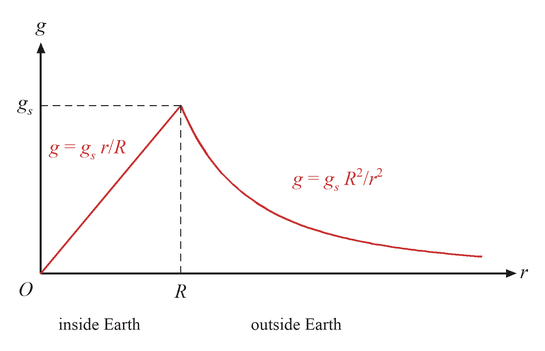
Concept: At distance from the Earth's centre, ; at the surface, where , this is , so . A geostationary satellite has a period equal to the Earth's rotation period, one sidereal day (about 23 h 56 min, or 86 164 s).
Step 1 — (a) Write at height . A point at height is at distance from the centre, as in the figure.
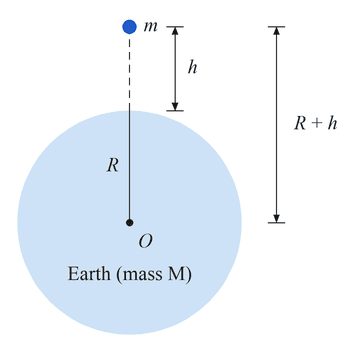
The value of there is:
Step 2 — (a) Simplify for small heights. When , the binomial approximation gives:
So decreases as we go up: slowly and almost linearly at first, and as far from the Earth, as the graph shows.
Step 3 — (b) State the conditions. A satellite is geostationary when it moves in a circular orbit in the equatorial plane, from west to east, with a period equal to the Earth's period of rotation, one sidereal day (about 23 h 56 min).
Step 4 — (c) Say what the parking orbit is. The orbit of a geostationary satellite is called the parking orbit, because a satellite in it appears parked at one place in the sky.
Step 5 — (c) Find its radius. We use for a circular orbit, with , so:
We put , and :
Taking the cube root:
Step 6 — (c) Find its height. We subtract the Earth's radius:
Note: With precise constants ( and an equatorial radius of 6378 km) the radius is 42 164 km and the height 35 786 km. Using 24 h (86 400 s) instead of the sidereal day changes the height by only about 0.2 %.
Therefore, (a) above the surface , about for small , so decreases with height; (b) the satellite must orbit in the equatorial plane, west to east, with a period of one sidereal day (about 23 h 56 min); (c) the parking orbit is the geostationary orbit, of radius about 42 300 km and height about 36 000 km.