
Opening your dashboard
Class 11 Physics Chapter 12 Gravitation - Gravitational Field: Practice Questions
160 questions on Chapter 12, each worked through on its own page with the AI tutor. Class 11 Physics, ICSE 2026-27.
160 questions
1–4 marks · Mixed difficulty
- 11 mark
Question 1
Two identical uniform solid spheres made of the same metal rest touching each other, and the gravitational force between them is . They are replaced by two spheres of the same metal, each with twice the radius, again touching each other. A uniform sphere attracts as if all its mass were at its centre. The force between the new spheres is
- 24 marks
Question 2
At first quarter, the Moon, the Earth and the Sun form a right angle at the Moon: the line from the Moon to the Earth is perpendicular to the line from the Moon to the Sun, as shown in the figure. Take the masses of the Sun, the Earth and the Moon as kg, kg and kg, the Earth–Moon distance as m, the Sun–Moon distance as m, and .
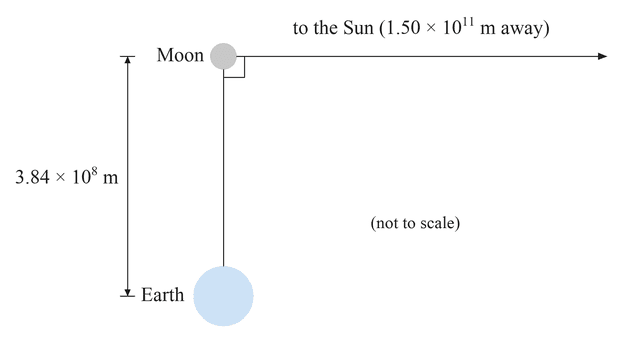
(a) Find the gravitational force on the Moon due to the Earth and due to the Sun.
(b) Find the magnitude of the resultant gravitational force on the Moon and the angle it makes with the line from the Moon to the Sun.
(c) The Sun pulls the Moon about twice as hard as the Earth does. Explain why the Moon still goes round the Earth.
- 33 marks
Question 3
In 1774 the Astronomer Royal, Nevil Maskelyne, measured how far a plumb line beside the Scottish mountain Schiehallion was pulled sideways by the mountain. Model the situation simply: a plumb bob of mass hangs where the mountain's pull is horizontal and equal to that of a point mass of kg placed at , km away, as shown in the figure. (Hypothetical data.) Take and .
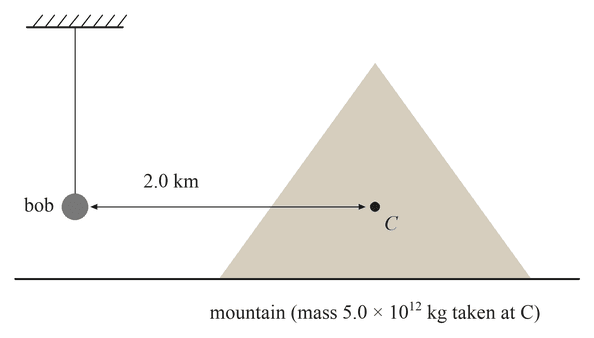
(a) Find the horizontal acceleration that the mountain's pull alone would give the bob.
(b) Find the angle, in seconds of arc, through which the plumb line is tilted from the true vertical.
(c) Explain why such a measurement can help us to find the mass of the Earth.
- 43 marks
Question 4
Newton tested his inverse-square law by comparing the fall of an apple with the "fall" of the Moon towards the Earth. The Moon goes round the Earth in a nearly circular orbit of radius m once every days. The radius of the Earth is m, and at its surface.
(a) Find the centripetal acceleration of the Moon.
(b) If the Earth's pull falls off as , where is the distance from the Earth's centre, what acceleration should the Earth give a body at the Moon's distance?
(c) What do the two results show?
- 51 mark
Question 5
Three point masses , and are placed at points , and on a straight line, with between and , and , as shown in the figure.
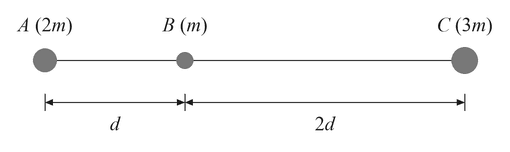
The resultant gravitational force on the mass at is
- 63 marks
Question 6
A lander on Mars swings a simple pendulum of length m and finds its period to be s. (Hypothetical data.) The period of a simple pendulum is . The mean radius of Mars is m, and .
(a) Find the acceleration due to gravity on Mars.
(b) Find the mass of Mars.
(c) Would a heavier pendulum bob change your answer to (a)? Give a reason.
- 73 marks
Question 7
Ceres, the largest body in the asteroid belt, has a mass of kg and a mean radius of m. A future lander on Ceres releases an instrument package of mass kg from rest, m above the ground. (Hypothetical data.) Ignore the spin of Ceres, and take and on the Earth.
(a) Find the acceleration due to gravity at the surface of Ceres.
(b) Find the weight of the package on Ceres and on the Earth.
(c) Find how long the package takes to fall the m on Ceres, and how many times longer this is than the same fall on the Earth.
- 81 mark
Question 8
A student finds the weight of several objects of different masses with a spring balance graduated in newtons, first on the Earth () and then, in a thought experiment, on Mars (). The student plots against for each planet on the same axes. Which statement describes the two graphs?
- 92 marks
Question 9
A shopkeeper's spring balance, with its scale marked in kilograms, was calibrated on the Earth, where . A beam balance compares a load with standard masses. Both balances are taken to the Moon, where , and a packet of rice that reads kg on both balances on the Earth is weighed again. What does each balance read on the Moon? Explain.
- 101 mark
Question 10
A uniform sphere is made of lead of density . Take . For the acceleration due to gravity produced by the sphere's own pull at its surface to be , its radius must be about
- 111 mark
Question 11
A pendulum clock keeps correct time at ground level. It is carried up to an observation deck m higher in a tall tower. (Hypothetical data.) Take the period of the pendulum as , the value of at a small height as , and m. In one day ( s) on the deck, the clock
- 123 marks
Question 12
A field gravimeter can detect a change in as small as . (Hypothetical data.) Close to the Earth's surface, the value of at a small height is , with and m.
(a) By how much does decrease for each metre of height gained?
(b) What is the smallest change in height that this gravimeter can detect?
(c) Why may the approximate formula be used here?
- 131 mark
Question 13
Because of the Earth's spin, the acceleration due to gravity at latitude is , where is the value the Earth's pull alone would give, is the Earth's radius and is its angular speed. At the equator the spin reduces by . At which latitude is the reduction one-quarter of its value at the equator?
- 143 marks
Question 14
Measured values of at sea level are about at the poles and at the equator. The Earth's equatorial radius is m, and the Earth turns once on its axis in s.
(a) Find the reduction in at the equator caused by the Earth's spin.
(b) What fraction of the difference between the polar and equatorial values does the spin explain?
(c) Suggest the main cause of the rest of the difference.
- 151 mark
Question 15
Four point masses , , and are placed at the corners , , and of a square of side , as shown in the figure.
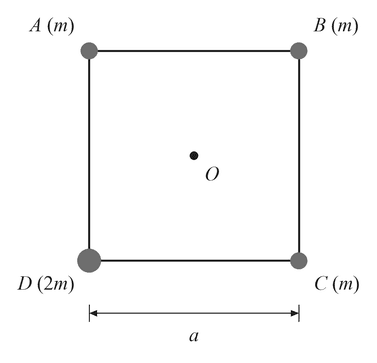
The gravitational field at the centre of the square is
- 163 marks
Question 16
Two stars and , of masses kg and kg, are m apart. At one instant a space probe is at the point that forms an equilateral triangle with the two stars, as shown in the figure. (Hypothetical data.) Take .
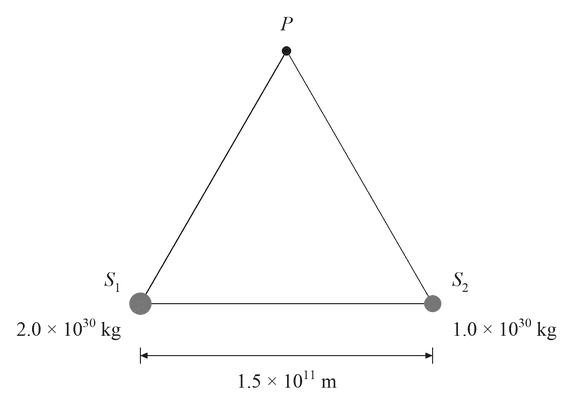
(a) Find the gravitational field at due to each star.
(b) Find the magnitude of the resultant field at and the angle it makes with .
(c) Find the gravitational force on the probe, of mass kg.
- 172 marks
Question 17
Sketch the gravitational field lines around an isolated uniform sphere. Use your sketch to explain
(a) how the spacing of the lines shows where the field is stronger, and
(b) why two gravitational field lines can never cross.
- 181 mark
Question 18
Planet is a uniform solid sphere with a narrow tunnel along a diameter, and planet is a thin uniform spherical shell. Both have mass and radius . The point is at a distance from the centre of each planet, as shown in the figure.
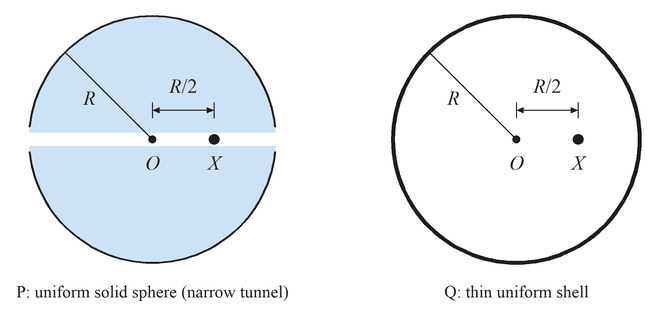
The magnitudes of the gravitational fields at are
- 191 mark
Question 19
Two equipotential surfaces round the Earth are spheres on which the gravitational potential is and . Take and the Earth's mass as kg. The distance between the two surfaces is
- 203 marks
Question 20
Three small spheres, each of mass kg, are held at the corners of an equilateral triangle of side m, as shown in the figure. (Hypothetical data.) Take .

(a) Find the gravitational potential energy of the system.
(b) How much work must be done on the spheres to move them apart slowly until the side of the triangle is m?
(c) Why is the gravitational potential energy of the system negative?
- 211 mark
Question 21
In a certain region the gravitational potential depends only on and is given by , where is in and is in metres. (Hypothetical data.) The gravitational force on a particle of mass kg at m is
- 223 marks
Question 22
A rock of mass kg moves through space from a point , where the gravitational potential is , to a point , where it is . (Hypothetical data.) On the way from to only gravity acts on the rock.
(a) Find the change in its gravitational potential energy.
(b) Find the work done on it by the gravitational field.
(c) The rock is later pushed back from to very slowly by a small rocket motor. How much work does the motor do on it? Would this work be different along a different path from to ? Explain.
- 233 marks
Question 23
(Hypothetical data.) A small lander touches down on the nucleus of a comet. Treat the nucleus as a uniform sphere of radius and mean density (comet nuclei are very porous). Ignore the nucleus's rotation, and take .
(a) Find the mass of the nucleus and the escape speed from its surface.
(b) The lander's harpoons fail to fire, and it bounces straight up from the surface at . Does it escape from the comet? What is the largest bounce speed for which it would still come back down?
(c) On the Earth, a body thrown up at rises only about . Explain why landers for such small bodies are fitted with harpoons or ice screws to hold them down.
- 241 mark
Question 24
A small meteoroid starts from rest very far from the Moon and falls straight onto the Moon's airless surface. Consider only the Moon's gravity. (Mass of the Moon , radius of the Moon , .) Its speed just before it hits the surface is about
- 253 marks
Question 25
(Hypothetical data.) A space probe of mass is to be sent away from the Earth for ever. The mission planners compare two starting points: at rest on the ground (ignore the Earth's rotation and air resistance), or moving in a circular parking orbit above the ground. Take , the mass of the Earth and the radius of the Earth .
(a) Find the least energy that must be given to the probe for it to escape, starting from each place.
(b) What fraction of the energy needed from the ground is still needed from the parking orbit?
- 262 marks
Question 26
(Hypothetical data.) In an old science-fiction story, travellers are fired towards the Moon from a giant gun. Suppose the gun's barrel is long and the shell leaves its mouth at the Earth's escape speed, .
(a) Assuming a uniform acceleration along the barrel, find the acceleration of the shell, and express it as a multiple of .
(b) Give two physical reasons why this plan would fail: one about the travellers, and one about the shell's motion after it leaves the gun.
- 273 marks
Question 27
Mars has a mass of and a radius of , and its thin atmosphere is mostly carbon dioxide. Near the top of the Martian atmosphere (at about ), the root-mean-square speeds of the molecules are about for carbon dioxide and for hydrogen. A rule of thumb used by planetary scientists says that a planet keeps a gas for billions of years only if its escape speed is more than about six times the root-mean-square speed of that gas's molecules. Take .
(a) Find the escape speed from the surface of Mars.
(b) Use the rule to decide whether Mars can keep each of the two gases.
(c) Why do light molecules escape from a planet more easily than heavy ones at the same temperature?
- 281 mark
Question 28
For Mars's two moons, Phobos and Deimos, and for a spacecraft in a low circular orbit round Mars, the square of the orbital speed is plotted against , where is the radius of the orbit (all three orbits are nearly circular), as shown.

The points lie on a straight line through the origin, with slope . Taking , the mass of Mars is about
- 293 marks
Question 29
(Hypothetical data.) A Earth-observation satellite is to be placed in a circular orbit above the ground. Ignore air resistance and the Earth's rotation. Take for the Earth and the radius of the Earth as .
(a) Find the kinetic energy the satellite must have in its orbit.
(b) Find the total energy that must be given to the satellite to take it from rest on the ground into this orbit.
(c) What fraction of this energy ends up as the satellite's kinetic energy? What does this tell you about the main job of a launch rocket?
- 301 mark
Question 30
During a spacewalk outside a space station in a circular orbit about above the Earth, an astronaut gently lets go of a wrench, so that at the moment of release it has exactly the same velocity as the station. Ignoring the very thin air at that height, the wrench will
- 312 marks
Question 31
(Hypothetical data.) Two identical satellites, A and B, move in the same circular orbit round the Earth, with B about behind A. B has to catch up with A. A student says, “Fire B's engine for a moment to push it forward, so that it moves faster and catches up.” Using how the period of an orbit depends on its size, explain why this does not work, and say what B should do instead.
- 321 mark
Question 32
A television signal is sent from a ground station on the equator straight up to a geostationary satellite directly overhead, and the satellite relays it straight back down to a receiving dish next to the station. The height of a geostationary orbit above the ground is , and the signal travels at . The shortest time between sending and receiving the signal is about
- 331 mark
Question 33
By mistake, a communication satellite meant to be geostationary is left in a circular orbit above the equator, moving from west to east, a few kilometres below the geostationary height. As seen from the ground, the satellite will
- 343 marks
Question 34
(Hypothetical data.) An Earth-imaging satellite moves in a circular polar orbit above the ground. Its camera photographs a strip of ground wide beneath it, and it takes pictures only on the daytime half of each orbit, while it is moving northward. Take for the Earth, the radius of the Earth as , and the Earth as turning once in relative to the plane of the orbit.
(a) Find the period of the satellite and the number of orbits it makes in a day.
(b) How far apart, along the equator, are the points where two successive northward passes cross the equator?
(c) Show that the camera needs at least about 15 days to photograph the whole length of the equator.
- 351 mark
Question 35
A geostationary satellite moves in an orbit of radius , always directly above the same point on the equator. The radius of the Earth is . The ratio of the satellite's speed to the speed of that point on the equator (carried round by the Earth's rotation) is about
- 361 mark
Question 36
(Hypothetical data.) A research aircraft can give its passengers a short spell of weightlessness. At the start of this stage the aircraft is climbing at at above the horizontal. From then on, the engines' thrust is set just to cancel the air drag, so the aircraft moves exactly like a projectile, until it is diving at below the horizontal. Taking , the passengers are weightless for about
- 373 marks
Question 37
(Hypothetical data.) In a drop tower, an experiment capsule is released from rest and falls freely through inside a tall tube from which the air has been pumped out. Inside the capsule, a mass hangs from a spring balance fixed to the capsule's ceiling, as shown. Take .
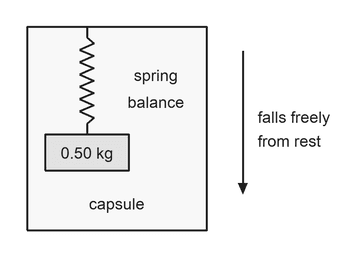
(a) For how long does the capsule fall freely?
(b) What does the spring balance read during the fall? Explain.
(c) At the bottom, the capsule is brought to rest with a uniform deceleration over a distance of . What does the balance read while the capsule is being stopped?
- 381 mark
Question 38
A plastic bottle with a small hole near its bottom is filled with water, and a jet of water spurts out of the hole, as shown. The bottle is then dropped and falls freely (ignore air resistance).
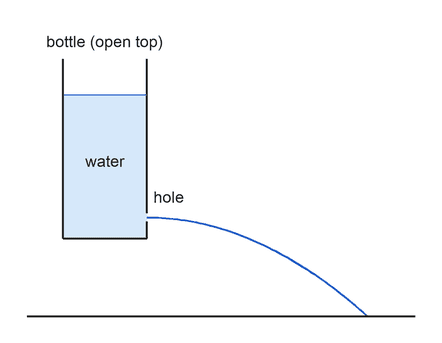
While the bottle is falling,
- 393 marks
Question 39
(Hypothetical data.) Astronauts in an orbiting space station keep track of their body mass with a chair fixed to the station's frame by a spring, as shown. The chair is pulled aside and released, and the time of one oscillation is measured. For a total mass on a spring of spring constant , the time of one oscillation is . The spring constant is . The empty chair oscillates with period ; with an astronaut strapped in, the period is .
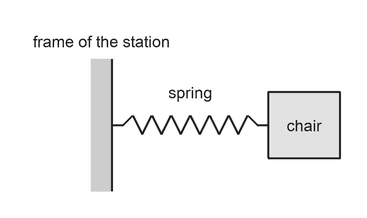
(a) Why can the astronaut not simply stand on a bathroom scale in the station?
(b) Find the mass of the astronaut.
- 403 marks
Question 40
(Hypothetical data.) A proposed space station far from any planet is a large ring of radius that spins about its own axis. The astronauts walk on the inside of the ring's outer wall.
(a) How many turns per minute must the ring make so that an astronaut presses on the floor as hard as on the Earth, where ?
(b) Which way does “down” feel to the astronaut, and what force keeps the astronaut moving in a circle?
(c) An astronaut tall stands upright on the floor. By what percentage is the effect at head height smaller than at the feet?
- 411 mark
Question 41
Halley's comet goes round the Sun about once every years, and its closest distance from the Sun (perihelion) is about . Taking the Earth's orbit as a circle of radius with a period of 1 year, the comet's greatest distance from the Sun (aphelion) is about
- 423 marks
Question 42
(Hypothetical data.) A comet moves round the Sun in an elliptical orbit with semi-major axis and perihelion distance . Its orbit crosses the Earth's orbit (a circle of radius , period 1 year) at A and B, as shown. The shaded region, bounded by the lines from the Sun to A and B and by the comet's path through perihelion, has an area equal to of the area of the whole ellipse.
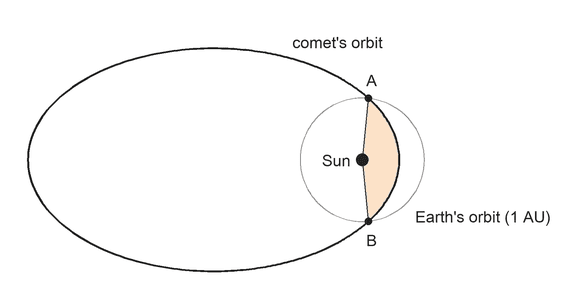
(a) Find the period of the comet.
(b) How many days does the comet spend inside the Earth's orbit on each trip round the Sun?
(c) The comet's path from A to B is about of the whole length of its orbit. Explain why the comet spends a much smaller fraction of its time on this part.
- 431 mark
Question 43
For the planets of the solar system, is plotted against , where is the period of revolution and is the semi-major axis of the orbit. The points lie on a straight line whose slope is
- 441 mark
Question 44
For the planets going round the Sun, the value of is . The mass of the Sun is times the mass of the Earth. For satellites in circular orbits round the Earth, the value of is about
- 451 mark
Question 45
is called the universal gravitational constant. Why?
- 462 marks
Question 46
Two bodies on the surface of the Earth do not move towards each other due to force of attraction given by Newton's law of gravitation. Why?
- 472 marks
Question 47
A body is taken from equator to pole. What happens to (i) its mass and (ii) its weight?
- 482 marks
Question 48
What will happen to the weight of a body at the equator if the Earth stops rotating?
- 491 mark
Question 49
The mass of a body is less in a mine. Is it true?
- 501 mark
Question 50
What is the height of a synchronous satellite?
- 511 mark
Question 51
What is the difference between gravitational potential energy and potential energy?
- 522 marks
Question 52
A satellite needs no fuel to move round a planet in a stable orbit. Why?
- 531 mark
Question 53
What is the maximum value of gravitational potential? Where?
- 542 marks
Question 54
Why does the Earth not fall towards the Sun due to its attraction?
- 552 marks
Question 55
A body is taken to a height equal to radius of the Earth and then to a depth equal to radius of the Earth. What will be its weight in each case?
- 562 marks
Question 56
The space rockets are launched from west to east. Why?
- 572 marks
Question 57
Explain the weightlessness of a man in a satellite.
- 582 marks
Question 58
Explain why the Moon has no atmosphere.
- 592 marks
Question 59
Among the known types of forces in nature, the gravitational force is the weakest. Why then does it play dominant role for motion of bodies on the terrestrial, astronomical and cosmological scale?
- 601 mark
Question 60
Do the forces of friction and other contact forces arise due to gravitational attraction? If not, what is the origin of these forces?
- 611 mark
Question 61
You can shield a charge from electrical forces by putting it inside a hollow conductor. Can you shield a body from the gravitational influence of nearby matter by putting it inside a hollow sphere or by some other means?
- 622 marks
Question 62
An astronaut inside a small spaceship orbiting around the Earth cannot detect gravity. If the space station orbiting around the Earth has a large size, can he hope to detect gravity?
- 632 marks
Question 63
If you compare the gravitational force on the Earth due to the Sun to that due to the Moon, you will find that the Sun's pull is greater than the Moon's pull. However, the tidal effect of the Moon's pull is greater than the tidal effect of the Sun. Why?
- 642 marks
Question 64
A comet orbits the Sun in a highly elliptical orbit. Does the comet have a constant (a) linear speed, (b) angular speed, (c) angular momentum, (d) kinetic energy, (e) potential energy and (f) total energy throughout its orbit? Neglect any mass loss of the comet when it comes very close to the Sun.
- 652 marks
Question 65
Does the escape velocity of a body when launched from the Earth depends on (a) the mass of the body, (b) the location from where it is projected, (c) the direction of projection and (d) the height of the location from where the body is launched? Explain your answer?
- 662 marks
Question 66
What are the conditions required for a body to become earth's satellite when fired by a rocket?
- 673 marks
Question 67
Two spheres of masses 38 kg and 15 kg each are placed with their centres 20 cm apart. The force of attraction between them is equal to 0.1 milligram wt. Calculate the constant of gravitation.
- 683 marks
Question 68
Calculate the gravitational force of attraction between a proton of mass kg and an electron of mass kg separated by distance of 1 fermi. Given, .
- 693 marks
Question 69
A 50 kg boy is standing near a 60 kg girl. If the distance between them is 1 m, calculate the gravitational force of attraction between them.
- 703 marks
Question 70
The force of attraction between two particles of masses 12 kg and 25 kg is N. Calculate the separation between the particles.
- 713 marks
Question 71
The radius of the Moon is 1/4th the radius of the Earth and its mass is 1/80th the mass of the Earth. Calculate the value of on the surface of the Moon.
- 723 marks
Question 72
Mass of Moon is kg and its radius is m. Calculate its mean density and acceleration due to gravity on its surface. Given .
- 733 marks
Question 73
If the mass of Mars is and its radius is , estimate the gravitational field at the surface of Mars.
- 743 marks
Question 74
If the radius of the Earth shrinks by 3.5% (mass remains constant), then how would the value of acceleration due to gravity change?
- 753 marks
Question 75
The acceleration due to gravity at the surface of the Earth is . Calculate its value at the surface of the Sun. Given that the radius of the Sun is 110 times that of the Earth and its mass is times that of the Earth.
- 763 marks
Question 76
The mass of Mars is (1/9) times that of the Earth and its radius is (1/2) that of the Earth. What is the weight of a body having a mass of 100 kg on the surface of the Earth?
- 773 marks
Question 77
What is the value of at a height 8848 m above sea level? Given on the surface of the Earth is . Mean radius of the Earth m.
- 783 marks
Question 78
A body weighs 63 N on the surface of the Earth. What is the gravitational force on it due to the Earth at a height equal to half the radius of the Earth?
- 793 marks
Question 79
Assuming the Earth to be a sphere of radius 6400 km, calculate the height above the Earth's surface at which the value of acceleration due to gravity reduces to half its value on the Earth's surface.
- 803 marks
Question 80
Calculate the height at which a man's weight becomes (4/9) of his weight on the surface of the Earth, if the radius of the Earth is 6400 km.
- 813 marks
Question 81
At what height above the Earth's surface the value of becomes 25 % of its value on the Earth if radius of the Earth is 6400 km.
- 823 marks
Question 82
A body of mass 100 kg is raised to height of 100 m from the surface of the Earth. What is the loss in weight due to variation of if the radius of the Earth is 6400 km?
- 833 marks
Question 83
With what speed should the Earth rotate in order that the weight of a man on the equator is reduced to half his present weight, if the radius of the Earth is 6400 km.
- 843 marks
Question 84
Assuming the Earth to be a sphere of uniform mass density, how much would a body weigh halfway down to the centre of the Earth if it weighed 250 N on the surface?
- 853 marks
Question 85
Find the acceleration due to gravity at a point 64 km below the surface of the Earth. km. on the surface of the Earth .
- 863 marks
Question 86
Calculate the percentage decrease in the weight of a body when taken 32 km below the surface of the Earth. Radius of the Earth is 6400 km and .
- 873 marks
Question 87
Compare the weights of a body when it is kept (i) 400 m above the surface of the Earth and (ii) 800 m below the surface of the Earth.
- 883 marks
Question 88
What is the ratio of the weights of a body when it is kept at a height 500 m above the surface of the Earth and 500 m below the surface of the Earth, if the radius of the Earth is 6400 km.
- 893 marks
Question 89
Calculate the intensity of gravitational field due to a body of mass 20 kg at a distance of 50 cm from the body.
- 903 marks
Question 90
Calculate the surface potential of the Earth. Use the known value of gravitational constant G, mass of the Earth and the radius of the Earth.
- 913 marks
Question 91
Calculate the gravitational potential energy of a body of mass 100 kg at a distance of 6 km from the centre of the Earth.
- 923 marks
Question 92
If the Earth has mass 9 times and radius twice that of the planet Mars, calculate the minimum velocity required by a rocket to pull out of the gravitational force of Mars. Escape velocity on the surface of the Earth is 11.2 km/s.
- 933 marks
Question 93
The escape velocity of a particle on the Earth (radius and mass ) is . What is the escape velocity on another planet with radius and mass ?
- 943 marks
Question 94
Jupiter has a mass 318 times that of the Earth and its radius is 11.2 times the Earth's radius. Estimate the escape velocity of a body from Jupiter surface, given that the escape velocity from Earth's surface is .
- 953 marks
Question 95
Calculate the escape velocity of an atmospheric particle 1000 km above the surface of the Earth. Given m and .
- 963 marks
Question 96
A stone has a mass of 500 g. How much energy must be imparted to the stone in order that it escapes from the Earth?
- 973 marks
Question 97
What is the ratio of the escape velocities from two planets of equal densities but different masses and ?
- 983 marks
Question 98
An artificial satellite circles round the Earth at a distance of 3400 km. Calculate the orbital velocity. Given, the radius of the Earth is 6400 km and .
- 993 marks
Question 99
A spaceship is launched into a circular orbit close to the Earth's surface. What additional velocity has now to be imparted to the spaceship in the orbit to overcome the gravitational pull? Given radius of the Earth = 6400 km and .
- 1003 marks
Question 100
What should be the percentage increase in the kinetic energy of a satellite to enable it to escape?
- 1013 marks
Question 101
Find the period of revolution of a satellite revolving the Earth at a height of 200 km above the Earth's surface? Radius of the Earth = 6400 km.
- 1023 marks
Question 102
A satellite revolves round a planet in an orbit just above the surface of a planet. Taking and mean density of the planet , find the period of the planet.
- 1033 marks
Question 103
A Saturn year is 29.5 times the Earth year. How far is the Saturn from the Sun if the Earth is km away from the Sun?
- 1043 marks
Question 104
The distances of two planets from the Sun are m and m respectively. Calculate the ratio of time periods and the speed of the two planets.
- 1053 marks
Question 105
If the Earth is 1/4 of its present distance from the Sun, then what is the duration of the year?
- 1063 marks
Question 106
The mass of the Hubble space telescope is 11600 kg. What is its weight when it is in its orbit 598 km above the Earth's surface? Take km.
- 1073 marks
Question 107
Calculate the orbital speed of the Hubble space telescope orbiting at a height of 598 km above the Earth's surface. Take km. Mass of the Earth kg.
- 1081 mark
Question 108
For a satellite moving in an orbit around the Earth, the ratio of kinetic energy to potential energy is
- 1091 mark
Question 109
The speed of Earth's rotation about its axis is . Its speed is increased to times to make the effective acceleration due to gravity equal to zero at the equator. Then is
- 1101 mark
Question 110
If radius of the Earth is , then the height '' at which value of '' becomes one-fourth is
- 1111 mark
Question 111
The value of on the Earth's surface is . Its value at a height of 64 km from the Earth's surface is
(Radius of the Earth = 6400 kilometres)
- 1121 mark
Question 112
Two satellites and go round a planet in circular orbits having radii and , respectively. If the speed of satellite is , then speed of satellite is
- 1131 mark
Question 113
Two bodies of masses and are placed at a distance . The gravitational potential at a point on the line joining them where the gravitational field is zero is
- 1141 mark
Question 114
The mass of a spaceship is 1000 kg. It is to be launched from the Earth's surface out into free space. The value of '' and '' (radius of the Earth) are and 6400 km respectively. The required energy for this work will be
- 1151 mark
Question 115
An artificial satellite moving in a circular orbit at a distance from the centre of the Earth has a total energy . Its potential energy is
- 1161 mark
Question 116
A body of mass '' is taken from the Earth's surface to the height equal to twice the radius () of the Earth. The change in potential energy of body will be
- 1171 mark
Question 117
Infinite number of masses, each 1 kg, are placed along the -axis at The magnitude of the resultant gravitational potential in terms of gravitational constant at the origin () is

- 1181 mark
Question 118
A black hole is an object whose gravitational field is so strong that even light cannot escape from it. To what approximate radius would the Earth (mass kg) have to be compressed to be a black hole
- 1191 mark
Question 119
Two particles of equal mass go round a circle of radius under the action of their mutual gravitational attraction. The speed of each particle is
- 1201 mark
Question 120
A remote sensing satellite of the Earth revolves in a circular orbit at a height of m above the surface of the Earth. If the Earth's radius is m and , then the orbital speed of the satellite is
- 1211 mark
Question 121
When a body moves in a circular orbit, its total energy is
- 1221 mark
Question 122
The ratio of escape velocity at the Earth () to the escape velocity at a planet () whose radius and mean density are twice as that of the Earth is
- 1231 mark
Question 123
The masses of two planets are in the ratio 1 : 2. Their radii are in the ratio 1 : 2. The acceleration due to gravity on the planets are in the ratio
- 1241 mark
Question 124
Two astronauts are floating in gravitational free space after having lost contact with their spaceship. The two will
- 1251 mark
Question 125
If the change in the value of '' at a height above the surface of the Earth is the same as at a depth below it, then (both and being much smaller than the radius of the Earth)
- 1261 mark
Question 126
If the mass of the Sun were ten times smaller and the universal gravitational constant were ten times larger in magnitude, which of the following is not correct?
- 1271 mark
Question 127
A satellite is moving with a constant speed '' in a circular orbit about the Earth. An object of mass '' is ejected from the satellite such that it just escapes from the gravitational pull of the Earth. At the time of its ejection, the kinetic energy of the object is
- 1281 mark
Question 128
A satellite is revolving in a circular orbit at a height '' from the Earth's surface (radius of the Earth ; ). The minimum increase in its orbital velocity required, so that the satellite could escape from the Earth's gravitational field, is close to (Neglect the effect of atmosphere)
- 1291 mark
Question 129
Two satellites, and have masses and respectively. is in a circular orbit of radius and is in a circular orbit of radius around the Earth. The ratio of their kinetic energies, , is
- 1301 mark
Question 130
The value of acceleration due to gravity at the Earth's surface is . The altitude above its surface at which the acceleration due to gravity decreases to , is close to (radius of the Earth m)
- 1311 mark
Question 131
A spaceship orbits around a planet at a height of 20 km from its surface. Assuming that only gravitational field of the planet acts on the spaceship, what will be the number of complete revolutions made by the spaceship in 24 hours around the planet?
[Given: Mass of planet kg;
Radius of planet m;
Gravitational constant ]
- 1321 mark
Question 132
A body weighs 200 N on the surface of the Earth. How much will it weigh halfway down to the centre of the Earth?
- 1331 mark
Question 133
The work done to raise a mass from the surface of the Earth to a height , which equal to the radius of the Earth is
- 1341 mark
Question 134
A box weighs 196 N on a spring balance at the North pole. Its weight recorded on the same balance if it is shifted to the equator is close to (take at the north pole and the radius of the Earth km)
- 1351 mark
Question 135
Planet has mass and radius . Planet has half the mass and half the radius of Planet . If the escape velocities from the Planets and are and respectively, then . The value of is
- 1361 mark
Question 136
The height '' at which the weight of a body will be the same as that at the same depth '' from the surface of the Earth is (radius of the Earth is and effect of the rotation of the Earth is neglected)
- 1371 mark
Question 137
A body is moving in a low circular orbit about a planet of mass and radius . The radius of the orbit can be taken to be itself. Then the ratio of the speed of this body in the orbit of the escape velocity from the planet is
- 1381 mark
Question 138
The value of the acceleration due to gravity is at a height ( = radius of the Earth) from the surface of the Earth. It is again equal to at a depth below the surface of the Earth. The ratio equals
- 1391 mark
Question 139
A spaceship in space sweeps stationary interplanetary dust. As a result, its mass increases at a rate , where is its instantaneous velocity. The instantaneous acceleration of the satellite is
- 1401 mark
Question 140
A body weighs 72 N on the surface of the Earth. What is the gravitational force on it, at a height equal to half the radius of the Earth?
- 1411 mark
Question 141
Consider two satellites and with periods of revolution 1 h and 8 h respectively revolving around a planet in circular orbits. The ratio of angular velocity of satellite to the angular velocity of satellites is
- 1421 mark
Question 142
A body weighs 49 N on a spring balance at the north pole. What will be its weight recorded on the same weighing machine, if it is shifted to the equator (use and radius of the Earth, = 6400 km)
- 1431 mark
Question 143
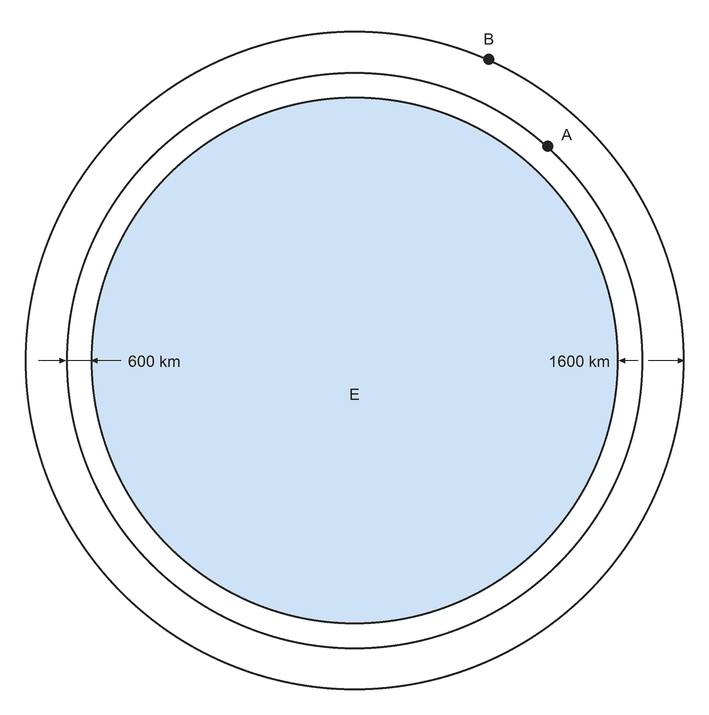
Two satellites and of masses 200 kg and 400 kg are revolving round the Earth at height of 600 km and 1600 km respectively. If and are the time periods of A and B respectively, then the value of .
[Given: radius of the Earth = 6400 km, mass of the Earth kg]
- 1441 mark
Question 144
A planet revolving in elliptical orbit has
P. A constant velocity of revolution
Q. The least velocity when it is nearest to the Sun
R. Its areal velocity is directly proportional to its velocity
S. Areal velocity is inversely proportional to its velocity
T. To follow a trajectory such that the areal velocity is constant
Choose the correct answer from the options.
- 1451 mark
Question 145
The maximum and minimum distances of a comet from the Sun are m and m respectively. If the speed of the comet at the nearest point is , the speed at the farthest point is
- 1461 mark
Question 146
A geostationary satellite is orbiting around an arbitrary planet '' at a height of above the surface '', being the radius of ''. The time period of another satellite in hours at a height of from the surface of '' is _______. '' has the time period of 24 hours.
- 1471 mark
Question 147
The time period of a satellite in a circular orbit of radius is . The period of another satellite in a circular orbit of radius is
- 1481 mark
Question 148
A particle is released from height from the surface of the Earth. At a certain height its kinetic energy is three times its potential energy. The height from the surface of the Earth and the speed of the particle at that instant are respectively
- 1491 mark
Question 149
The escape velocity from the Earth' surface is . The escape velocity from the surface of another planet having a radius, four times that of the Earth and same mass density is
- 1501 mark
Question 150
Two bodies of mass and are placed at a distance . The gravitational potential on the line joining the bodies where the gravitational field equals zero, will be ( – gravitational constant)
- 1511 mark
Question 151
A satellite is orbiting just above the surface of the Earth with period . If is the density of the Earth and is the universal constant of gravitation, the quantity represents
- 1521 mark
Question 152
Two planets have radius and and density and . Find the ratio of acceleration due to gravity at their surface.
- 1531 mark
Question 153
The Earth shrinks by times of its initial volume. Time period of the Earth rotation is found to be hours. Find the value of .
- 1541 mark
Question 154
An object weighs 200 N on the surface of the Earth. Find the weight at a depth of where is the radius of the Earth.
- 1551 mark
Question 155
The mass and radius of orbit for two satellites are and respectively. Find the ratio of their orbital velocity about the Earth.
- 1561 mark
Question 156
A satellite revolves round the Earth at a height from its surface. Find out the time period of its rotation. Given: radius of the Earth , .
- 1571 mark
Question 157
If a planet has mass equal to 16 times the mass of the Earth and radius equal to 4 times that of the Earth. The ratio of escape speed of planet to that of the Earth is
- 1581 mark
Question 158
Suppose a situation in which two planets orbit around the Sun in the same orbit. If the mass of the planet 1 is twice the mass of the planet 2, then what do they have the same?
- 1591 mark
Question 159
Statement P: If total energy of a satellite revolving around the Earth in a circular path is , the potential energy of the satellite is .
Statement Q: Kinetic energy is also twice of total energy.
- 1601 mark
Question 160
Radius of the Earth shrinks by 2%. Now the new acceleration due to gravity