
Question 453 marksMedium
State and explain Kepler's laws of planetary motion.
Confirming your payment
Sign up now and get 250 free tokens.
Gravitation - Gravitational Field · Question 45 of 56
State and explain Kepler's laws of planetary motion.
Solution:
Concept: Kepler found three laws from careful observations of the planets; Newton later showed that they follow from the inverse-square law of gravitation.
Step 1 — State the first law (law of orbits). Every planet moves round the Sun in an elliptical orbit, with the Sun at one focus of the ellipse. The point of the orbit nearest the Sun is the perihelion and the farthest is the aphelion, as the figure shows.
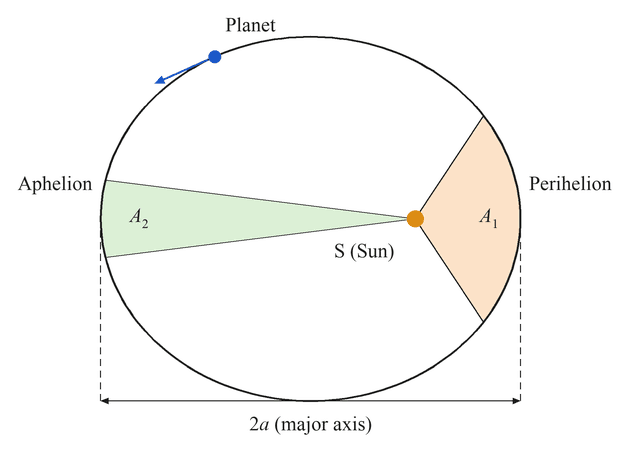
Step 2 — State the second law (law of areas). The line joining the Sun to a planet sweeps out equal areas in equal intervals of time; in the figure the shaded areas and are swept in equal times. So the areal velocity is constant.
Step 3 — Explain the second law. The Sun's pull on the planet passes through the Sun, so it has no torque about the Sun, and the planet's angular momentum is constant. The area swept per unit time is:
Since is constant, so is . A planet therefore moves fastest at perihelion and slowest at aphelion.
Step 4 — State the third law (law of periods). The square of the period of revolution of a planet is proportional to the cube of the semi-major axis of its orbit:
Step 5 — Explain the third law for a circular orbit. For a circular orbit of radius , the Sun's pull gives the centripetal force:
The factor is the same for all planets, so .
Therefore, Kepler's laws are: (1) planets move in ellipses with the Sun at one focus; (2) the line from the Sun to a planet sweeps equal areas in equal times; (3) .