
Opening your dashboard
Class 11 Physics Chapter 12 Gravitation - Gravitational Field: Competency-Based Questions (CBQ)
50 questions on Chapter 12, each worked through on its own page with the AI tutor. Class 11 Physics, ICSE 2026-27.
50 questions
1–4 marks · Mixed difficulty
- 14 marks
Question 1
Competency: Application
A school physics club builds a small torsion balance to detect the pull between ordinary masses. A light rod hangs from a thin vertical fibre fixed to its centre O. A small lead sphere of mass is fixed at each end of the rod, with its centre from the fibre. Two large lead spheres, each of mass , are placed beside the small ones on opposite sides of the rod, as shown, so that the line joining the centres of each pair is at right angles to the rod and long. (Hypothetical data.) Take and , and ignore the pull of each large sphere on the farther small sphere.
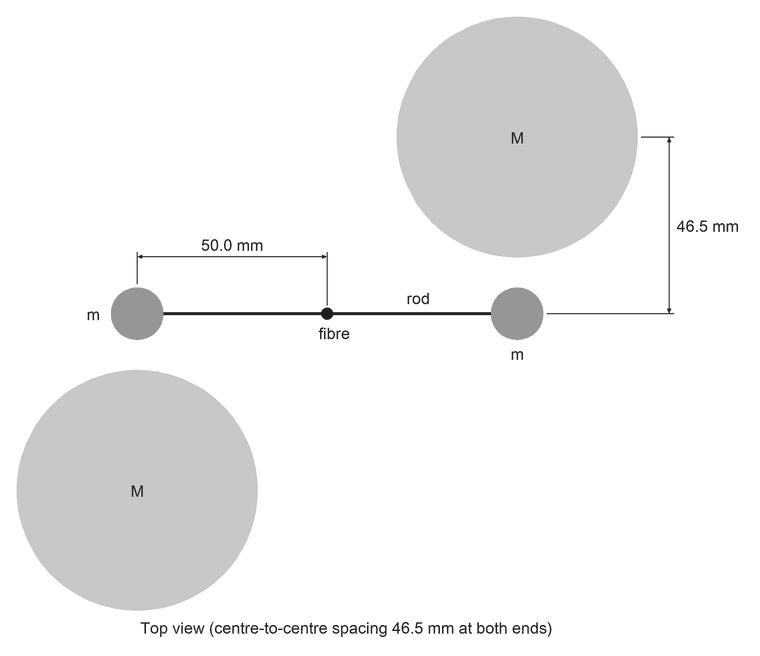
(a) Find the gravitational force between one large sphere and the small sphere next to it, and compare it with the weight of the small sphere.
(b) Find the total torque that the two forces in (a) exert on the rod about the fibre.
(c) The fibre twists until its restoring torque balances this torque, where . Find the angle of twist in radians and in degrees.
(d) A small mirror fixed to the rod reflects a laser beam onto a scale away. When a mirror turns through a small angle , the reflected beam turns through . How far does the light spot move along the scale?
- 21 mark
Question 2
Competency: Analysis & Evaluation
A stone of mass is falling freely towards the ground.
Assertion (A): While it falls, the stone pulls the Earth upward with a force equal in size to the force with which the Earth pulls the stone downward.
Reason (R): The Earth's acceleration towards the stone is far too small to notice, because the Earth's mass is enormous.
- 31 mark
Question 3
Competency: Application
A white dwarf is the hot, dense core left behind when a star like the Sun has used up its nuclear fuel. Astronomers estimate that one white dwarf has a mass of , about the mass of the Sun, packed into a sphere of radius , about the size of the Earth. (Hypothetical data.) Taking , the acceleration due to gravity at its surface is about
- 43 marks
Question 4
Competency: Analysis & Evaluation
In a school laboratory, a steel ball is released from rest by switching off an electromagnet, and an electronic timer measures the time it takes to fall through a height onto a trapdoor switch. Air resistance is negligible. The results are shown below. (Hypothetical data.)
(m) 0.200 0.400 0.600 0.800 1.000 (s) 0.202 0.286 0.350 0.404 0.452 (a) Show that a graph of against should be a straight line through the origin, and state what its slope gives.
(b) Use the results to find the acceleration due to gravity in the laboratory.
(c) The same apparatus is taken to a hill station higher, at the same latitude. Near the Earth, at a height is smaller than at the starting level by a fraction of about , where . The timer reads to . By about how much would the fall time for the drop change, and could this timer show the change?
- 54 marks
Question 5
Competency: Analysis & Evaluation
A science magazine describes a "gravity train": a perfectly straight tunnel AB dug through the Earth between two cities, in which a car could run with no engine at all. Treat the Earth as a uniform sphere of radius , with at its surface, and ignore friction, air resistance and the Earth's spin. (Hypothetical data.) The figure shows a section through the Earth's centre O and the tunnel. M is the mid-point of the tunnel, so OM is at right angles to AB, and OM . At one instant the car is at P, a distance from O and a distance from M.
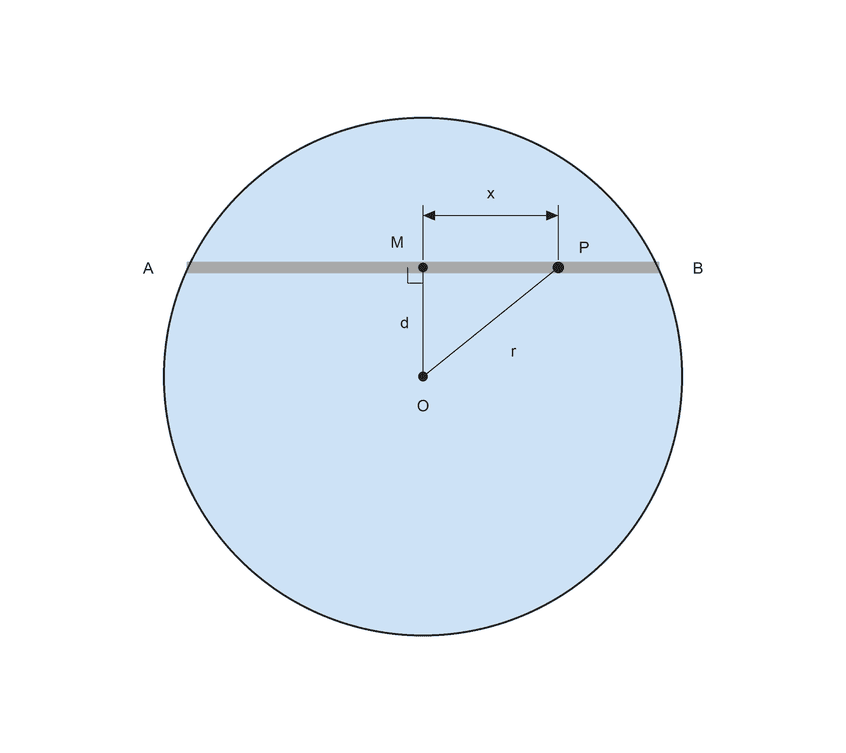
Use this fact: a uniform spherical shell exerts no net gravitational force on a body inside it.
(a) Show that the gravitational acceleration at P has magnitude and points towards O.
(b) Show that the component of this acceleration along the tunnel is , directed towards M.
(c) A body whose acceleration is towards a fixed point, where is its distance from that point, moves to and fro about the point with a period . Find the time the car takes to run from A to B, starting from rest at A.
(d) Explain why this time is the same for a short tunnel between two nearby towns as for a long tunnel between two distant cities.
- 61 mark
Question 6
Competency: Analysis & Evaluation
Two students discuss how the acceleration due to gravity changes inside and outside a model Earth of uniform density.
Assertion (A): In this model, is greatest at the Earth's surface and becomes smaller both above the surface and below it.
Reason (R): Below the surface, the layer of the Earth lying above a body pulls it upward and so partly cancels the pull of the inner part.
- 74 marks
Question 7
Competency: Application
A geophysics team searches for a buried metal ore body with a gravimeter, an instrument that measures tiny changes in the vertical component of the gravitational field. They model the ore body as a sphere of radius whose density is more than that of the surrounding rock, with its centre C below flat ground. Only this extra ("excess") mass changes the field from its usual value. Point P on the ground is directly above C, and point Q is on the ground from P, as shown. (Hypothetical data.) Take .
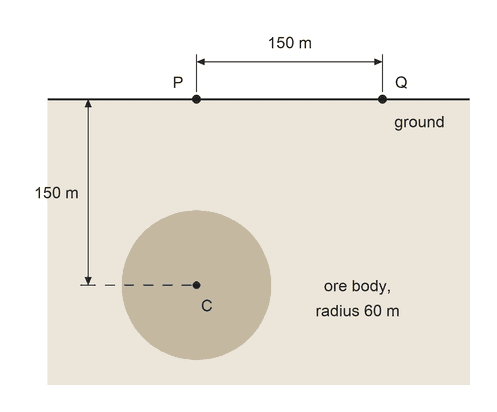
(a) Find the excess mass of the ore body.
(b) Find the extra gravitational field intensity at P, and give its direction.
(c) Find the vertical component of the extra field intensity at Q.
(d) Find the ratio of the extra readings at Q and at P, and explain why the team looks for the place where the extra reading is largest.
- 81 mark
Question 8
Competency: Analysis & Evaluation
A student places first a test body and then a test body at the same point P near the Earth's surface, and measures the gravitational force on each.
Assertion (A): The gravitational field intensity at P is larger when the body is placed there.
Reason (R): The gravitational force on a body placed at a point is proportional to the mass of the body.
- 91 mark
Question 9
Competency: Application
At one moment a geostationary satellite S lies on the straight line joining the centres of the Earth and the Moon, between them, as shown. Its distance from the Earth's centre is ; take the distance between the centres of the Earth and the Moon as . Take for the Earth and for the Moon.
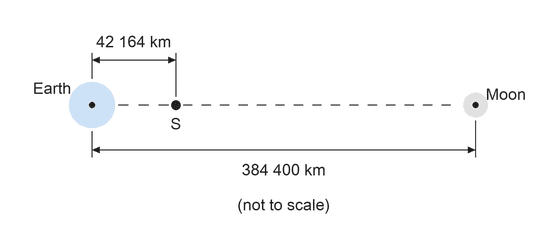
The ratio of the gravitational field intensity at S due to the Moon to that due to the Earth is about
- 103 marks
Question 10
Competency: Analysis & Evaluation
A mission planner's table gives the gravitational potential of a planet at several distances from its centre, all outside the planet. (Hypothetical data.)
( m) 6.00 6.50 7.00 7.50 ( J kg⁻¹) −43.333 −40.000 −37.143 −34.667 (a) Show that the values fit with one value of , and find for the planet.
(b) Use the two entries on either side of to estimate the gravitational field intensity there, and check your estimate with .
(c) A probe falls from rest at , with only the planet's gravity acting on it. Using the table, find its speed when it reaches .
- 111 mark
Question 11
Competency: Analysis & Evaluation
A satellite moves round the Earth in a circular orbit.
Assertion (A): The gravitational potential energy of the Earth–satellite system is negative.
Reason (R): Gravitational potential energy is negative because the satellite moves along a closed path round the Earth.
- 121 mark
Question 12
Competency: Application
A sample-return mission must launch rock samples from the surface of the Moon and send them away from the Moon for ever. Ignore the rotation of each body and any air. Take and radius for the Moon, and and radius for the Earth. The least energy needed by each kilogram to escape from the Moon's surface, as a fraction of the least energy needed by each kilogram to escape from the Earth's surface, is about
- 133 marks
Question 13
Competency: Application
Many of India's rockets are launched eastward from Sriharikota, at latitude N. A probe is to leave the Earth for ever. To keep the model simple, ignore air resistance and suppose the probe is given its full speed at ground level. Take , the Earth's radius , and the time for one turn of the Earth relative to the stars as . (Hypothetical data.)
(a) Find the escape speed from the Earth's surface, and the eastward speed of the launch site that is caused by the Earth's rotation.
(b) The escape speed is a speed relative to the Earth's centre, not relative to the ground. If the probe is launched horizontally due east, what speed relative to the ground must the launch give it?
(c) By what percentage does launching eastward reduce the kinetic energy per kilogram (relative to the ground) that must be supplied, compared with a non-rotating Earth? By what percentage would launching due west increase it?
- 141 mark
Question 14
Competency: Analysis & Evaluation
A spacecraft bound for the Moon first coasts in a low circular orbit above the Earth. Its engine then fires briefly to send it towards the Moon. Ignoring the Moon's own pull, a calculation shows that the speed needed just after the burn is about , while the escape speed at that height is about .
Assertion (A): To reach the Moon, the spacecraft does not need to be given the full escape speed at that height.
Reason (R): To reach the Moon's distance, the spacecraft only has to climb to about from the Earth's centre, not to infinity, so it needs a little less energy than it would need to escape.
- 153 marks
Question 15
Competency: Application
A lunar orbiter moves in a circular orbit above the Moon's surface. The plane of its orbit contains the line from the Moon to the Earth, as shown. Take for the Moon and the Moon's radius as . The Earth is so far away that all lines of sight from the Earth to the Moon may be taken as parallel. (Hypothetical data.)
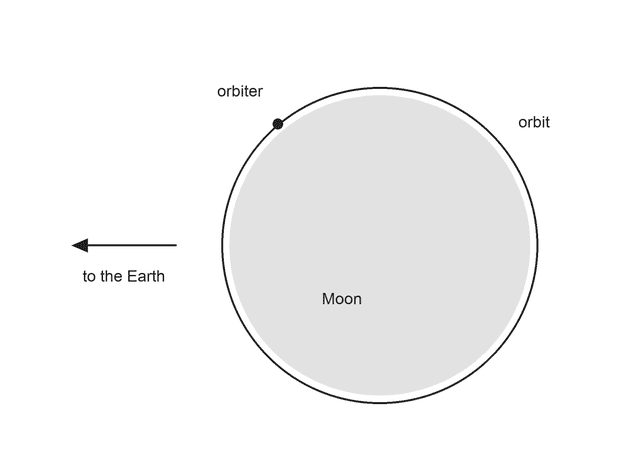
(a) Find the orbital speed of the orbiter.
(b) Find its period of revolution in minutes.
(c) Radio contact with the Earth is lost whenever the Moon blocks the line of sight. For how many minutes of each orbit is the orbiter hidden from the Earth?
- 163 marks
Question 16
Competency: Analysis & Evaluation
Two satellites move in circular orbits at the same height, above the Earth: one in an equatorial orbit and one in a polar orbit. Both orbits pass over the same point above the equator, where the satellites' velocities are at right angles to each other. Engineers check how dangerous a collision there would be. Take and the Earth's radius as . (Hypothetical data.)
(a) Find the orbital speed of each satellite.
(b) Find the speed of one satellite relative to the other at the crossing point.
(c) A fragment of mass broken off one satellite strikes the other at this relative speed. Find its kinetic energy relative to the satellite it hits, and compare it with the kinetic energy of a car moving at .
- 171 mark
Question 17
Competency: Analysis & Evaluation
An advertisement claims that a new satellite will circle the Earth once every 70 minutes in a circular orbit, "giving faster coverage than any satellite before it". Take and the Earth's radius as . Which statement correctly judges this claim?
- 184 marks
Question 18
Competency: Application
Planners of a future Mars communication network want "areostationary" satellites, which stay above one point on the Martian equator, just as geostationary satellites do round the Earth. Mars turns once on its axis, relative to the stars, in (about ). Take for Mars and its equatorial radius as . Mars's inner moon, Phobos, moves in a nearly circular orbit of radius above the Martian equator, in the same direction as Mars turns.
(a) Find the radius of an areostationary orbit and its height above the Martian surface.
(b) Find the orbital speed of an areostationary satellite.
(c) Find the period of Phobos in hours.
(d) Use (c) to explain why an observer on the Martian equator sees Phobos rise in the west and set in the east, and find roughly how often it rises.
- 191 mark
Question 19
Competency: Analysis & Evaluation
A communication satellite is placed in a geostationary orbit above the equator.
Assertion (A): The satellite must move round the Earth from west to east.
Reason (R): The period of a geostationary satellite is equal to the time the Earth takes to turn once on its axis.
- 201 mark
Question 20
Competency: Analysis & Evaluation
An engineer is finding the radius of a geostationary orbit from and must choose the period . The time from one noon to the next is , while the Earth turns once relative to the distant stars in about . Which period should be used, and why?
- 211 mark
Question 21
Competency: Analysis & Evaluation
A video from a space station orbiting about above the Earth shows astronauts and loose objects floating in the cabin.
Assertion (A): The astronauts float freely inside the cabin without pressing on its floor.
Reason (R): At a height of the Earth's gravitational pull on the astronauts is practically zero.
- 221 mark
Question 22
Competency: Analysis & Evaluation
In an experiment on board an orbiting space station, a small candle is lit inside a closed chamber full of still air at normal pressure. On the Earth a candle flame is tall and pointed, because the hot gases from the flame rise and fresh air flows in from below. In the station, the flame is most likely to be
- 233 marks
Question 23
Competency: Analysis & Evaluation
Astronomers find two planets, b and c, going round a star in nearly circular orbits. Their measurements are: planet b, orbit radius , period days; planet c, orbit radius , period days. One astronomical unit (1 AU), the radius of the Earth's orbit, is , and the Earth's period is days. For a planet in a circular orbit of radius round a star of mass , . (Hypothetical data.)
(a) Show that the two planets obey Kepler's third law.
(b) Find the mass of the star as a multiple of the Sun's mass.
(c) Find the orbital speed of planet b in .
- 241 mark
Question 24
Competency: Analysis & Evaluation
From the March equinox to the September equinox (spring and summer in the northern hemisphere) there are about 186 days, but from the September equinox back to the March equinox there are only about 179 days. The Earth is nearest the Sun in early January and farthest from it in early July. Which statement best explains why the two parts of the year are unequal?
- 251 mark
Question 25
Competency: Analysis & Evaluation
A history-of-science display makes two statements.
Assertion (A): Kepler found his three laws of planetary motion from careful observations of the planets, before Newton's law of gravitation was published.
Reason (R): Kepler's laws can be derived from Newton's law of gravitation together with Newton's laws of motion.
- 264 marks
Question 26
A simple model of the Earth has a core of radius and uniform density , surrounded by a mantle of uniform density that reaches the surface at radius , as shown in the figure. (Hypothetical data.) Use two facts: a uniform spherical shell exerts no net gravitational force on a body inside it, and a uniform sphere or shell attracts a body outside it as if all its mass were at its centre.
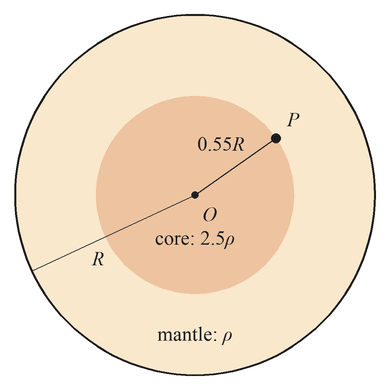
(a) Find the mass of the core as a fraction of the total mass of this model Earth.
(b) Find at the core–mantle boundary (point ) as a multiple of at the surface.
(c) For a uniform Earth, at a depth is . What would this formula give at , and why does the model disagree with it?
- 274 marks
Question 27
Two small spheres, each of mass , are fixed at points and , a distance apart. A point lies on the perpendicular bisector of , at a distance from the mid-point , as shown in the figure.
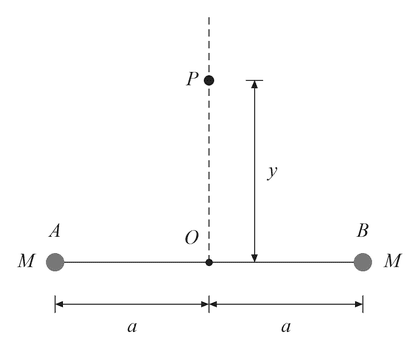
(a) Show that the gravitational field at points from towards and has magnitude .
(b) Find the distance at which this field is strongest, and an expression for the greatest field.
(c) Take kg, m and . (Hypothetical data.) Find this distance and the greatest field.
- 284 marks
Question 28
An object of mass kg is to be lifted from the Earth's surface to a height of m. (Hypothetical data.) Take , the Earth's mass kg and radius m, and use at the surface.
(a) Find the increase in its gravitational potential energy.
(b) Find the value that the formula would give, and compare the two.
(c) Show that , and find the height at which overestimates by 10%.
- 294 marks
Question 29
(Hypothetical data.) A satellite moves in a circular orbit above the Earth. Over one month, air drag in the very thin upper atmosphere removes from its total energy, and the satellite settles into a slightly lower circular orbit. Take for the Earth and the radius of the Earth as .
(a) Find the satellite's total energy in its first orbit.
(b) Find how far the satellite comes down, and the radius of its new orbit.
(c) Find the changes in its kinetic energy and its potential energy, and explain why air drag has made the satellite move faster.
- 304 marks
Question 30
A geostationary satellite S is above the equator on the same line of longitude as Delhi (P), whose latitude is N. The figure shows the section of the Earth through that line of longitude, with the Earth's centre O.
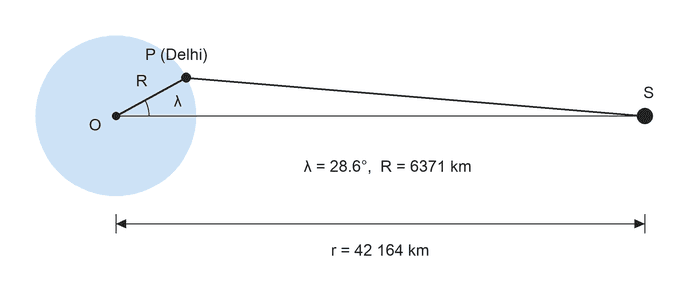
Take the radius of the Earth and the radius of the geostationary orbit .
(a) Find the distance PS from Delhi to the satellite.
(b) Find the angle of elevation of the satellite seen from Delhi: the angle between the line PS and the local horizontal at P.
(c) Show that a geostationary satellite cannot be seen at all from places at latitudes above about .
- 314 marks
Question 31
A spacecraft is sent from the Earth to Mars along the usual energy-saving path: half of an ellipse, with the Sun at a focus, that just touches the Earth's orbit at E and Mars's orbit at M, as shown. Take both planets' orbits as circles round the Sun, of radii (period 1 year) and .
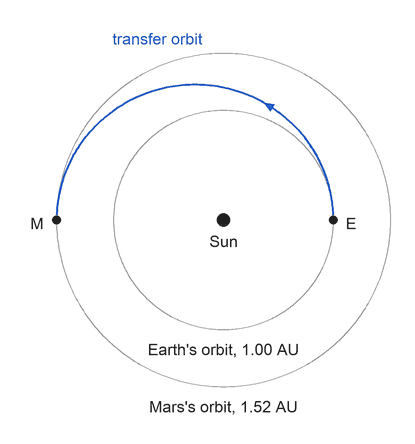
(a) Find the semi-major axis of the transfer orbit.
(b) Find the time the journey takes, in days.
(c) At launch, how many degrees ahead of the Earth (measured round the Sun) must Mars be, so that it reaches M at the same time as the spacecraft?
- 323 marks
Question 32
Calculate the mass of the Earth from the following data. Radius of the Earth = 6371 km, .
- 333 marks
Question 33
Density of the Earth is . Assume the Earth to be a homogeneous sphere, find the value of on the surface of the Earth. Use the known values of and .
- 343 marks
Question 34
If the Earth were a perfect sphere of radius m, rotating about its axis with a period of 1 day ( s), how much would the acceleration due to gravity differ from the poles to the equator?
- 354 marks
Question 35
(a) How much faster than its present rate should the Earth rotate about its axis so that the weight of a body at the equator becomes zero?
(b) Also calculate the new length of the day.
(c) What would happen if rotation becomes faster?
- 363 marks
Question 36
A geostationary satellite orbits the Earth at a height of nearly 36000 km from the surface of the Earth. What is the potential due to the Earth's gravity at the site of this satellite? (Take the potential energy at infinity to be zero.) Mass of the Earth kg, radius = 6400 km.
- 373 marks
Question 37
Two bodies of masses and are placed distant apart. Show that the position where the gravitational field due to them is zero, the potential is given by .
- 383 marks
Question 38
Calculate the distance from the Earth to the point where the gravitational field due to the Earth and the Moon cancel out. Given that the Earth–Moon distance is m and the mass of the Earth is 81 times that of the Moon.
- 393 marks
Question 39
Two masses 800 kg and 600 kg are at a distance 0.25 m apart. Calculate the magnitude of the gravitational intensity at a point distant 0.20 m from the 800 kg mass and 0.15 m from the 600 kg mass. .

- 403 marks
Question 40
What is the change in potential energy of a body of mass 10 kg when it is taken to a height of from the Earth's surface?
- 413 marks
Question 41
What is the escape velocity of a body from the solar system? Calculate using the following data. Mass of the Sun kg. The distance between the Earth and the Sun m.
- 423 marks
Question 42
The radius of a planet is double that of the Earth, but their average densities are the same. If the escape velocities at the planet and the Earth are and respectively, then prove that .
- 433 marks
Question 43
With what velocity a body of mass be projected vertically upwards so that it may be able to reach a height above the Earth's surface.
- 443 marks
Question 44
The escape velocity of a projectile on the Earth's surface is . A body is projected out with 4 times this speed. What is the speed of the body far away from the Earth?
- 453 marks
Question 45
Find the orbital velocity of an artificial satellite of the Earth in an orbit close to the Earth.
- 463 marks
Question 46
What should be the percentage increase in the orbital velocity to escape velocity?
- 473 marks
Question 47
An Earth satellite makes a complete revolution around the Earth in 120 minutes. If the orbit is circular, calculate the height of satellite above the Earth. Radius of the Earth = 6400 km and .
- 483 marks
Question 48
A satellite is in a circular orbit about a planet of radius . If the altitude of the satellite is and its period is , show that the density of the planet is .
- 493 marks
Question 49
Find the mass of the Sun from the following data. The mean orbital radius of the Earth around the Sun is km.
- 503 marks
Question 50
A satellite of mass 50 kg orbits the Earth at a height of 100 km. Calculate (i) K.E., (ii) P.E. and (iii) total energy. Given . Radius of the Earth is 6400 km and mass of the Earth is kg.