Gravitation - Gravitational Field · Question 53 of 56
(a) (i) Deduce an expression for the minimum velocity with which a rocket must be fired to escape the Earth's…
Question 535 marksMedium
(a)(i) Deduce an expression for the minimum velocity with which a rocket must be fired to escape the Earth's gravitational field.
(ii) Explain why hydrogen is found in abundance around the sun while it is absent from the Earth's atmosphere. Why there is no atmosphere on the moon?
(b) How is an artificial satellite positioned above the Earth to serve as a relay station for television or telecommunications?
(c) Derive an expression to explain the decrease in acceleration due to gravity inside the Earth as one approaches the centre.
Solution:
Concept: (a) A body escapes when its kinetic energy is enough to do the work against gravity all the way to infinity. (b) A geostationary satellite stays above one place. (c) Inside a uniform sphere, only the mass nearer the centre than the point pulls on it; the outer shell gives no net force.
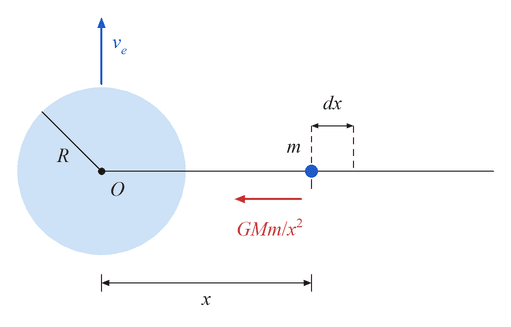
Step 1 — (a)(i) Work needed to escape. Let the Earth have mass M and radius R. When the rocket (mass m) is at distance x from the centre, the pull on it is x2GMm, as in the figure.
The work needed to move it from the surface to infinity is:
W=∫R∞x2GMmdxW=RGMm
Step 2 — (a)(i) Escape velocity. The kinetic energy at launch must supply this work:
21mve2=RGMmve=R2GM
Since GM=gR2, ve=2gR, about 11.2km s−1 for the Earth.
Step 3 — (a)(ii) Hydrogen round the Sun. The Sun's escape velocity is very large, about 618km s−1. Even at its surface temperature of about 5800 K, hydrogen atoms have an r.m.s. speed of only about 12km s−1, far less. So the Sun holds on to its hydrogen, and hydrogen is abundant round it.
Step 4 — (a)(ii) Hydrogen and the Earth. Hydrogen is the lightest gas, so its molecules and atoms move fastest. In the hot upper atmosphere (about 1000 K or more) hydrogen atoms have r.m.s. speeds of about 5km s−1, and a fraction of them exceed the Earth's escape velocity of 11.2km s−1. Over millions of years nearly all free hydrogen has escaped, so it is practically absent from the Earth's atmosphere.
Step 5 — (a)(ii) The Moon. The Moon's escape velocity is only about 2.4km s−1. This is only a few times the r.m.s. speeds of gas molecules on its sunlit surface (about 390 K): about 0.6km s−1 for nitrogen and 2.2km s−1 for hydrogen. The fastest molecules in the spread exceed the escape velocity and leave, so over its long history the Moon has lost practically all its gases and has practically no atmosphere (only an extremely thin exosphere).
Step 6 — (b) Relay satellite. A communication satellite is placed in a geostationary orbit: in the equatorial plane, moving west to east with a period of one sidereal day (about 23 h 56 min), at a height of about 36 000 km. It then stays above one point, so ground aerials can stay fixed on it. It receives signals from a ground station, amplifies them and sends them back to a wide region of the Earth. Three such satellites, 120∘ apart, can cover almost the whole Earth (except the polar regions), as the figure shows.
Step 7 — (c) Set up the depth problem. Take the Earth as a uniform sphere of density ρ and radius R. At the surface:
g=R2GMg=34πGρR
A point P at depth d is at distance R−d from the centre, as in the figure. The shell of thickness d outside P exerts no net force on it; only the inner sphere of radius R−d pulls it.
Step 8 — (c) Find g at depth d. The inner sphere has mass 34π(R−d)3ρ, so:
gd=(R−d)2G×34π(R−d)3ρgd=34πGρ(R−d)
Step 9 — (c) Compare with the surface. We divide by the value at the surface:
ggd=RR−dgd=g(1−Rd)
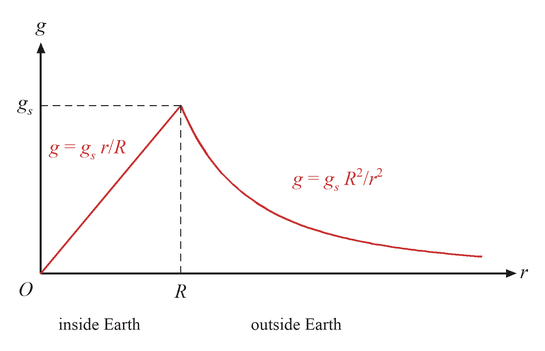
So g decreases steadily with depth and becomes zero at the centre (d=R). The graph shows how g varies inside and outside the Earth.
Therefore, (a)(i) the escape velocity is ve=R2GM (about 11.2 km/s); (ii) the Sun's huge escape velocity keeps hydrogen, while the Earth lost its fast-moving hydrogen and the Moon, with a very small escape velocity, lost practically all its gases; (b) a relay satellite is put in a geostationary orbit about 36 000 km above the equator; (c) gd=g(1−Rd), falling to zero at the centre.