
Opening your dashboard
Class 11 Chemistry Chapter 6: Chemical Thermodynamics Solutions
229 textbook questions with step-by-step answers, free to read, for ISC 2026-27.
Get talked through Ch 6, not just shown the answer
Reading a finished solution is not the same as being able to do it. The AI tutor takes one question at a time and works it with you, in your own words, until you can.
- Ask it out loud, in your own words
- It gives you the next step, not the answer
- Stuck on part (ii)? Start there
229 questions with solutions
1–3 marks · Mixed difficulty
The first 31 solutions are on this page. This chapter is a long one, so the rest open on their own page to keep this one quick to load.
- 11 mark
Question 1
The process of evaporation of a liquid is accompanied by:
(a) an increase of enthalpy
(b) a decrease of entropy
(c) no change in free energy
(d) an increase of entropy
Solve with AIWritten solution
Solution:
Key idea: Evaporation turns a liquid into its vapour. It needs heat (the enthalpy of vaporisation, which is positive), and it lets the molecules move freely through a much larger volume, so the disorder (entropy) rises.
Step 1 — Judge statement (a). The liquid must absorb heat from its surroundings to pull its molecules apart, so and the enthalpy of the system increases. Statement (a) is correct.
Step 2 — Judge statement (b). Molecules in a vapour are far apart and move randomly through the whole space, so they are much more disordered than in the liquid. Entropy increases, so statement (b) is wrong.
Step 3 — Judge statement (c). The free energy change is zero only when liquid and vapour are at equilibrium (for example water at 100°C under 1 atm). A liquid that is actually evaporating into unsaturated air does so spontaneously, so its free energy falls (). Statement (c) is therefore not a general feature of evaporation.
Step 4 — Judge statement (d). As shown in Step 2, the change from liquid to vapour raises the entropy, so . Statement (d) is correct.
Note: Two of the printed options are correct here, so this question is answered as a short-answer item.
Therefore, evaporation is accompanied by an increase of enthalpy (a) and an increase of entropy (d).
- 21 mark
Question 2
For a reversible reaction at equilibrium, the free energy change of the system is:
Solve with AIAnswer
- Correct
(A) zero
(B) negative
(C) positive
(D) large negative
Answer: (A) zero
Key idea: At constant temperature and pressure the Gibbs free energy change tells us the direction of change: means the forward change is spontaneous, means the reverse change is spontaneous, and means neither direction is favoured, which is equilibrium.
Step 1 — Recall what equilibrium means. At equilibrium the forward and backward reactions go on at equal rates, so there is no net tendency to move either way.
Step 2 — Translate this into free energy. No net driving force in either direction means the free energy of the system is at its lowest point and does not change for a small shift.
Why the other options are wrong:
- (B) A negative means the forward reaction can still proceed by itself, so the system has not yet reached equilibrium.
- (C) A positive means the reverse reaction is the spontaneous one, which again is a system away from equilibrium.
- (D) A large negative value describes a reaction with a strong forward drive, far from equilibrium.
Therefore, the free energy change at equilibrium is zero.
- 31 mark
Question 3
Which of the following is true for a substance present in different phases?
Solve with AIAnswer
(A)
- Correct
(B)
(C)
(D)
Answer: (B)
Key idea: Entropy measures the randomness of particles. In a solid the particles only vibrate about fixed positions; in a liquid they move about but stay close together; in a gas they move freely through the whole container. So for one substance the entropy rises from solid to liquid to gas.
Step 1 — Compare the solid and the liquid. Melting lets the particles leave their fixed positions, so the liquid is more disordered than the solid. This gives .
Step 2 — Compare the liquid and the gas. Vaporisation spreads the particles over a far larger volume, so the gas is the most disordered. This gives .
Step 3 — Join the two results. Putting the two comparisons together gives one order.
Why the other options are wrong:
- (A) This puts the solid above the liquid, but a solid has the most ordered particles and so the least entropy.
- (C) This makes the same mistake, placing the solid above the liquid.
- (D) This puts the liquid above the gas, but gas particles are far more spread out and random than liquid particles.
Note: Options (A) and (C) are printed identically; both are kept as printed.
Therefore, the correct order is .
- 41 mark
Question 4
What is the entropy change for the vaporization of water at 100°C, if its molar enthalpy of vaporization is 40.627 kJ mol⁻¹?
Solve with AIAnswer
(A) 406.27 J mol⁻¹
- Correct
(B) 108.87 J mol⁻¹
(C) 606.27 J mol⁻¹
(D) 808.27 J mol⁻¹
Answer: (B) 108.87 J mol⁻¹
Key idea: At the normal boiling point liquid and vapour are at equilibrium, so the change is reversible and the entropy change equals the heat absorbed divided by the temperature in kelvin: .
Step 1 — Write the data in the right units. The enthalpy must be in joules and the temperature in kelvin.
Step 2 — Divide the enthalpy by the temperature. This gives the entropy of vaporisation per mole.
Step 3 — Compare with the options. The printed value 108.87 is this result cut to two decimal places; rounded it is 108.88, and with K it is 108.92. Only option (B) is close.
Why the other options are wrong:
- (A) 406.27 comes from dividing by 100, the temperature in degrees Celsius; entropy needs the absolute temperature.
- (C) 606.27 would need a boiling temperature of about 67 K, far below 373 K.
- (D) 808.27 would need a boiling temperature of about 50 K, which is also impossible for water at 1 atm.
Note: The unit of entropy change here is J K⁻¹ mol⁻¹; the options print J mol⁻¹ without the K⁻¹.
Therefore, the entropy of vaporisation of water at 100°C is about 108.88 J K⁻¹ mol⁻¹, which is option (B) (printed as 108.87).
- 51 mark
Question 5
During an isothermal expansion of an ideal gas, which of the following is true?
Solve with AIAnswer
(A) Enthalpy decreases
(B) Entropy decreases
- Correct
(C) Enthalpy remains unaltered
(D) Entropy remains unaltered
Answer: (C) Enthalpy remains unaltered
Key idea: For an ideal gas there are no forces between the molecules, so its internal energy depends only on temperature. Its enthalpy also depends only on temperature, because equals for an ideal gas. In an isothermal change the temperature stays fixed.
Step 1 — Find the change in internal energy. The temperature does not change, so the internal energy does not change either.
Step 2 — Find the change in enthalpy. We use , and for an ideal gas , which is zero here.
Step 3 — Check the entropy. When the gas expands at constant temperature, its molecules spread into a larger volume, so the entropy rises by , which is positive because .
Why the other options are wrong:
- (A) The enthalpy of an ideal gas could fall only if its temperature fell, and here the temperature is constant.
- (B) Entropy increases on expansion, because the molecules have more room and more possible arrangements.
- (D) Entropy does change: it rises by .
Note: The printed answer, "enthalpy decreases", is a slip; for an ideal gas at constant temperature the enthalpy stays the same, which is option (C).
Therefore, during isothermal expansion of an ideal gas the enthalpy remains unaltered.
- 61 mark
Question 6
For a spontaneous process at all conditions of temperature, which of the following is true?
Solve with AIAnswer
(A)
- Correct
(B)
(C)
(D)
Answer: (B) entropy change positive and enthalpy change negative
Key idea: A process is spontaneous at constant temperature and pressure when is negative. We look for the sign pattern that makes negative whatever the temperature.
Step 1 — Put in a negative and a positive . The first term is negative, and is also negative because is always positive.
Step 2 — Decide the sign of . Both parts are negative, so their sum is negative at every temperature.
Why the other options are wrong:
- (A) With both positive, is negative only when is larger than , that is only above .
- (C) With positive and negative, both parts of are positive, so the process is never spontaneous.
- (D) With both negative, is negative only at low temperatures, below .
Therefore, a process is spontaneous at all temperatures when ΔS is positive and ΔH is negative.
- 71 mark
Question 7
A reaction will never be spontaneous at any temperature and pressure provided:
Solve with AIAnswer
(A)
(B)
- Correct
(C)
(D)
Answer: (C) entropy change negative and enthalpy change positive
Key idea: A reaction is spontaneous only when is negative. A reaction that is never spontaneous has a positive at every temperature.
Step 1 — Put in a positive and a negative . The first term is positive, and is also positive because is negative.
Step 2 — Decide the sign of . Both parts are positive, so their sum is positive whatever the temperature.
Why the other options are wrong:
- (A) With both positive, a high enough temperature (above ) makes negative.
- (B) This is the pattern that is spontaneous at every temperature.
- (D) With both negative, the reaction is spontaneous at low temperatures (below ).
Therefore, a reaction is never spontaneous when ΔS is negative and ΔH is positive.
- 81 mark
Question 8
Which of the following has the highest calorific value?
Solve with AIAnswer
(A) Carbohydrates
- Correct
(B) Fats
(C) Vitamins
(D) Proteins
Answer: (B) Fats
Key idea: The calorific value of a food is the heat released when one gram of it is completely oxidised. Fats are rich in C–H bonds and contain little oxygen, so they release the most energy per gram.
Step 1 — Recall the approximate calorific values. These are the usual round values for foods.
- Fats: about 37 kJ g⁻¹ (about 9 kcal g⁻¹).
- Carbohydrates: about 17 kJ g⁻¹ (about 4 kcal g⁻¹).
- Proteins: about 17 kJ g⁻¹ (about 4 kcal g⁻¹).
Step 2 — Pick the largest. Fats give roughly twice the energy per gram of carbohydrates or proteins.
Why the other options are wrong:
- (A) Carbohydrates are partly oxidised already (they contain much oxygen), so they release only about 17 kJ per gram.
- (C) Vitamins are needed in tiny amounts to help body processes; they are not a source of energy.
- (D) Proteins give about the same energy per gram as carbohydrates, far less than fats.
Therefore, fats have the highest calorific value.
- 91 mark
Question 9
In an isothermal expansion of an ideal gas against a vacuum the work involved is:
Solve with AIAnswer
- Correct
(A) zero
(B) maximum
(C) minimum
(D) not equal to the heat absorbed by the system
Answer: (A) zero
Key idea: The work of expansion against a constant external pressure is (work done on the system taken as positive). Expansion into a vacuum is called free expansion: nothing pushes back on the gas.
Step 1 — Put in the external pressure. A vacuum exerts no pressure, so the external pressure is zero.
Step 2 — Find the work. The volume change does not matter, because it is multiplied by zero.
Step 3 — Check with the first law. For an ideal gas at constant temperature , so , and here both heat and work are zero.
Why the other options are wrong:
- (B) Maximum work is obtained in a reversible expansion, where the external pressure is kept just below the gas pressure at every stage; against a vacuum no work at all is done.
- (C) Zero is indeed the least work an expansion can involve, but "minimum" does not state the value; the exact result is zero, which is what (A) says.
- (D) Here the heat absorbed is also zero (with no change in internal energy, the heat absorbed is just minus the work), so the work is equal in size to the heat absorbed.
Therefore, the work involved in expansion against a vacuum is zero.
- 101 mark
Question 10
For a spontaneous process, which of the following is true?
Solve with AIAnswer
(A) is positive
(B) is positive
- Correct
(C) is positive
(D) is negative
Answer: (C) is positive
Key idea: By the second law of thermodynamics, in every spontaneous (irreversible) process the total entropy of the system and its surroundings increases.
Step 1 — Write the total entropy change. It is the sum of the changes for the system and the surroundings.
Step 2 — Apply the second law. For a spontaneous process this sum must be greater than zero.
Why the other options are wrong:
- (A) The system's entropy can fall in a spontaneous process, as when water freezes below 0°C; the surroundings then gain more entropy from the released heat.
- (B) The surroundings can lose entropy in a spontaneous process, as when ice melts above 0°C and takes heat from them.
- (D) A negative total entropy change marks a process that cannot happen by itself.
Therefore, for a spontaneous process ΔS(total) is positive.
- 111 mark
Question 11
For a spontaneous process, the change in the value of G is equal to the:
Solve with AIAnswer
(A) heat content of the system
(B) entropy change of the system
(C) work of expansion
- Correct
(D) useful work
Answer: (D) useful work
Key idea: At constant temperature and pressure the decrease in Gibbs free energy, , equals the maximum useful work (work other than expansion work, such as electrical work in a cell) that the process can do. That is why is called "free" energy: it is the energy free to do useful work.
Step 1 — Write the relation. For a reversible change at constant and the useful work done by the system equals the fall in free energy.
Step 2 — Apply it to a spontaneous process. Here is negative, so the system can deliver useful work equal to the size of . For example, in a cell is the electrical work.
Why the other options are wrong:
- (A) The heat content of the system is its enthalpy; differs from by the term .
- (B) The entropy change enters only through , and it has different units (J K⁻¹, not J).
- (C) Expansion work () is exactly the part that is left out of ; counts only the non-expansion work.
Therefore, the change in G equals the (maximum) useful work.
- 121 mark
Question 12
For which type of reactions having following characteristics, the probability of its occurrence at higher temperature, will be enhanced?
Solve with AIAnswer
(A) small positive, negative
- Correct
(B) small positive, positive
(C) small negative, negative
(D) zero, negative
Answer: (B) small positive, positive
Key idea: The drive of a reaction is measured by ; the more negative , the more likely the reaction. Raising makes the term more negative only when is positive.
Step 1 — See how changes with temperature. Only the term depends on temperature, so the sign of decides the trend.
Step 2 — Apply this to option (B). With positive, grows as rises; once it exceeds the small positive , becomes negative and the reaction becomes spontaneous.
Why the other options are wrong:
- (A) With positive and negative, is positive at all temperatures and becomes even more positive as rises.
- (C) With negative, the term is positive and grows with , so a higher temperature makes this reaction less likely.
- (D) With , is positive and increases with temperature.
Therefore, a reaction with a small positive ΔH and a positive ΔS becomes more likely at higher temperature.
- 131 mark
Question 13
For which type of reactions having following characteristics the probability of its occurrence at lower temperature will be lowered?
Solve with AIAnswer
(A) small positive, negative
- Correct
(B) small positive, positive
(C) small negative, negative
(D) zero, negative
Answer: (B) small positive, positive
Key idea: The drive of a reaction is measured by . When is lowered, rises (becomes less favourable) only if is positive, because then the helpful term shrinks.
Step 1 — Write how changes when the temperature changes. For a change in temperature (with and nearly constant), the free energy changes by .
Step 2 — Lower the temperature. Lowering means is negative, so goes up when is positive and goes down when is negative.
Step 3 — Apply this to option (B). With positive and positive, the reaction relies on to beat ; at a lower temperature is smaller, rises, and the reaction becomes less likely.
Why the other options are wrong:
- (A) Here is negative, so lowering makes smaller; the reaction stays non-spontaneous, but the drive against it weakens rather than strengthens.
- (C) Here both are negative, so lowering makes more negative and the reaction more likely; this option answers the opposite question, where the probability at lower temperature is enhanced.
- (D) Here , which becomes smaller as falls, so the drive against the reaction weakens.
Note: The printed answer is the option with ΔH small negative and ΔS negative, but that reaction becomes more likely at lower temperature; for the question as printed ("lowered") the correct option is (B).
Therefore, the reaction with a small positive ΔH and a positive ΔS becomes less likely at lower temperature.
- 141 mark
Question 14
Which of the following is true when the reaction is at equilibrium?
Solve with AIAnswer
(A)
(B)
- Correct
(C)
(D)
Answer: (C)
Key idea: At equilibrium (constant and ) the Gibbs free energy change is zero, and .
Step 1 — Set to zero. This is the condition for equilibrium.
Step 2 — Rearrange. Moving to the right-hand side gives the relation.
Why the other options are wrong:
- (A) makes positive, so the forward reaction is non-spontaneous; it is not at equilibrium.
- (B) makes negative, so the forward reaction still proceeds by itself.
- (D) (in J mol⁻¹) and (in J K⁻¹ mol⁻¹) have different units, so they cannot be equated; the temperature factor is missing.
Therefore, at equilibrium ΔH = TΔS.
- 151 mark
Question 15
Which of the following reactions is attended by an increase of entropy?
Solve with AIAnswer
(A)
(B)
(C)
- Correct
(D)
Answer: (D) the reaction of graphite with steam
Key idea: Gases have far more entropy than liquids or solids, so the sign of a reaction's entropy change is decided mainly by the change in the number of moles of gas, = moles of gaseous products − moles of gaseous reactants.
Step 1 — Count the gas moles in each reaction. We count only the species marked (g).
- (A): 4 mol of gas give 2 mol, so .
- (B): 3 mol of gas give liquid water, so .
- (C): 2 mol of gas give 2 mol, so .
- (D): 1 mol of gas (steam) with solid carbon gives 2 mol of gas, so .
Step 2 — Pick the reaction with more gas formed. Only (D) increases the moles of gas, so its entropy clearly rises; tables give about +134 J K⁻¹ for it.
Why the other options are wrong:
- (A) Four molecules of gas combine into two, so the disorder falls and is negative.
- (B) Gases turn into a liquid, which greatly lowers the entropy.
- (C) The number of gas molecules does not change, so the entropy change is very small (about +22 J K⁻¹ from tables, against about +134 J K⁻¹ for (D)).
Note: On table values reaction (C) shows only a very small rise; the question looks for the reaction in which the gas count, and so the entropy, clearly increases, which is (D).
Therefore, the reaction C(graphite) + H₂O(g) → CO(g) + H₂(g) is attended by an increase of entropy.
- 161 mark
Question 16
Which of the following reactions is attended to by a decrease of entropy?
Solve with AIAnswer
- Correct
(A)
(B)
(C)
(D)
Answer: (A) the formation of liquid water from hydrogen and oxygen
Key idea: The entropy change of a reaction is decided mainly by the change in moles of gas, . Fewer gas molecules, or gases turning into a liquid, means less disorder.
Step 1 — Count the gas moles in each reaction. We count only the species marked (g).
- (A): 3 mol of gas give a liquid, so .
- (B): 1 mol of gas gives 2 mol, so .
- (C): 2 mol of gas give 2 mol, so .
- (D): 1 mol of oxygen gives 2 mol of carbon monoxide, so .
Step 2 — Pick the reaction that loses gas. Only (A) removes gas molecules, turning them into a liquid, so its entropy falls sharply.
Why the other options are wrong:
- (B) One molecule of steam becomes two gas molecules, so the entropy increases.
- (C) The number of gas molecules stays the same, so the entropy hardly changes (in fact it rises slightly).
- (D) One molecule of oxygen gives two molecules of carbon monoxide, so the entropy increases.
Therefore, the reaction 2H₂(g) + O₂(g) → 2H₂O(l) is attended by a decrease of entropy.
- 171 mark
Question 17
Which of the following results a decrease in entropy?
(a) Crystallisation of sucrose from solution
(b) Rusting of iron
(c) Conversion of ice into water
(d) Vaporisation of camphor
Solve with AIWritten solution
Solution:
Key idea: Entropy falls when particles become more ordered: when a dissolved substance forms a crystal, or when a gas is used up to make a solid.
Step 1 — Judge process (a). In solution the sucrose molecules move freely among the water molecules; in a crystal they are fixed in a regular pattern. The system becomes more ordered, so its entropy decreases.
Step 2 — Judge process (b). Rusting combines solid iron with oxygen gas (and water) to form a solid oxide. Gas molecules are used up, so the entropy of the system decreases. For the simple oxide reaction below, table values give about −550 J K⁻¹.
Step 3 — Judge process (c). Melting frees the water molecules from the rigid ice lattice, so the entropy increases.
Step 4 — Judge process (d). Camphor passing into vapour spreads its molecules through a large volume, so the entropy increases.
Note: Two of the printed options are correct here, so this question is answered as a short-answer item.
Therefore, crystallisation of sucrose from solution (a) and rusting of iron (b) both result in a decrease in entropy.
- 181 mark
Question 18
For a reversible isothermal expansion of an ideal gas:
Solve with AIAnswer
(A) positive
- Correct
(B)
(C) or
(D)
Answer: (B) the entropy change of the system is equal and opposite to that of the surroundings
Key idea: In a reversible process the total entropy of the universe stays constant: .
Step 1 — Find the entropy change of the gas. The gas absorbs heat at temperature while it expands, so its entropy rises.
Step 2 — Find the entropy change of the surroundings. The surroundings give up exactly the same heat at the same temperature, so their entropy falls by the same amount.
Step 3 — Compare the two. The two changes are equal in size and opposite in sign.
Why the other options are wrong:
- (A) If both rose, the total entropy would increase, which happens only in an irreversible process.
- (C) The two changes always have opposite signs here, so they cannot be equal (unless both were zero, which is not so for an expansion).
- (D) If both fell, the total entropy would decrease, which the second law forbids.
Therefore, for a reversible isothermal expansion ΔS(sys) = −ΔS(sur).
- 191 mark
Question 19
For an irreversible isothermal expansion of an ideal gas:
Solve with AIAnswer
(A)
(B)
- Correct
(C)
(D)
Answer: (C)
Key idea: Entropy is a state function, so the gas's entropy change is the same as in a reversible expansion between the same states, . In an irreversible process the total entropy of the universe must increase.
Step 1 — Find the entropy change of the gas. It depends only on the initial and final states, so it equals the reversible value, which is positive for an expansion.
Step 2 — Find the entropy change of the surroundings. In an irreversible expansion the gas does less work than in the reversible one; since for an ideal gas at constant temperature, it also takes less heat, , from the surroundings.
Step 3 — Compare their sizes. Because , the surroundings lose less entropy than the gas gains, so the total entropy change is positive, as the second law requires.
Why the other options are wrong:
- (A) The gas gains entropy while the surroundings lose (or keep) entropy, so the two cannot be equal for an expansion.
- (B) Equal and opposite changes give a total of zero, which is true only for a reversible expansion.
- (D) A larger loss by the surroundings than the gain by the gas would make the total entropy change negative, which the second law forbids.
Note: The printed answer, |ΔS(sys)| < |ΔS(sur)|, is a slip; it would make the total entropy change negative. The correct answer is (C).
Therefore, for an irreversible isothermal expansion |ΔS(sys)| > |ΔS(sur)|.
- 201 mark
Question 20
Gibb's free energy function is given as:
Solve with AIAnswer
- Correct
(A)
(B)
(C)
(D)
Answer: (A)
Key idea: The Gibbs free energy is defined from the enthalpy , the absolute temperature and the entropy of the system. It is the part of the enthalpy that is "free" to do useful work after the energy tied up as is removed.
Step 1 — Write the definition. The free energy is the enthalpy minus the product of temperature and entropy.
Step 2 — Write it in terms of internal energy. Since , the same definition can also be written with .
Why the other options are wrong:
- (B) The term must be subtracted, not added.
- (C) The term carries a plus sign, because .
- (D) Here the term has the wrong sign.
Therefore, the Gibbs free energy function is G = H − TS.
- 211 mark
Question 21
Heat of reaction at constant pressure is equal to thermodynamically:
Solve with AIAnswer
(A)
(B)
(C)
- Correct
(D)
Answer: (D)
Key idea: By the first law, . At constant pressure the only work is expansion work, , and enthalpy is defined as .
Step 1 — Write the heat at constant pressure. Rearranging the first law with gives the heat absorbed.
Step 2 — Recognise the enthalpy change. At constant pressure , so the two are the same.
Why the other options are wrong:
- (A) is the entropy change, measured in J K⁻¹, not a heat.
- (B) Heat is not a state function, so a system does not "contain" heat and there is no .
- (C) (that is, ) equals the heat of reaction at constant volume, .
Therefore, the heat of reaction at constant pressure equals ΔH.
- 221 mark
Question 22
Entropy decreases in:
Solve with AIAnswer
- Correct
(A) crystallisation of NaCl from solution
(B) dissolving iron in HCl
(C) melting of sulphur
(D) vaporisation of acetone
Answer: (A) crystallisation of NaCl from solution
Key idea: Entropy decreases when particles become more ordered, for example when freely moving ions settle into a regular crystal lattice.
Step 1 — Look at crystallisation. In solution the and ions move about among water molecules; in the crystal they are locked in fixed positions. The order increases, so the entropy of the system decreases.
Step 2 — Look at the other processes. Melting and vaporisation free the particles from their fixed or close-packed positions, so the entropy clearly rises in both. Iron dissolving in the acid gives off hydrogen gas, which at this level is taken as a rise in entropy as well.
Why the other options are wrong:
- (B) Iron reacts with the acid and gives off hydrogen gas, and at this level forming a gas is taken to raise the entropy. The case is not clear-cut, as the note below explains, so crystallisation (A) is the better answer.
- (C) Melting frees the sulphur molecules from the solid lattice, so the entropy increases.
- (D) Vaporisation spreads acetone molecules through a large volume, so the entropy increases.
Note: The Fe²⁺ ions formed hold water molecules tightly around them, so on standard table values ΔS° for Fe(s) + 2H⁺(aq) → Fe²⁺(aq) + H₂(g) is about −34 J K⁻¹ mol⁻¹; in a real dilute solution the sign depends on the concentrations. Crystallisation of NaCl from solution is the clear-cut decrease, which is why (A) is the answer.
Therefore, entropy decreases in the crystallisation of NaCl from solution.
- 231 mark
Question 23
When ice melts into water, entropy:
Solve with AIAnswer
(A) becomes zero
(B) decreases
- Correct
(C) increases
(D) remains the same
Answer: (C) increases
Key idea: On melting, molecules leave the ordered ice lattice and move about in the liquid. The change is reversible at 0°C, so , and the heat of fusion is absorbed, so it is positive.
Step 1 — Put in the values for ice. The enthalpy of fusion of ice is about 6.01 kJ mol⁻¹ and it melts at 273.15 K.
Step 2 — Read the sign. The entropy change is positive, so the entropy increases.
Why the other options are wrong:
- (A) Entropy becomes zero only for a perfect crystal at 0 K (third law); liquid water at 0°C has a large entropy.
- (B) Entropy decreases in the reverse change, when water freezes into ice.
- (D) Melting absorbs heat at a fixed temperature, so is not zero and the entropy changes.
Therefore, when ice melts into water its entropy increases.
- 241 mark
Question 24
Which one of the following statement is true? The entropy of universe:
Solve with AIAnswer
- Correct
(A) increases and tends towards maximum value
(B) decreases and tends to be zero
(C) remains constant
(D) decreases and increases with a periodic rate
Answer: (A) increases and tends towards maximum value
Key idea: Clausius (1865) summed up the first two laws of thermodynamics in one sentence: the energy of the universe is constant (first law), and the entropy of the universe tends towards a maximum (second law).
Step 1 — Recall that natural processes are irreversible. All real (spontaneous) processes are irreversible, and in every irreversible process the total entropy of the universe increases.
Step 2 — Draw the conclusion. Since such processes go on all the time, the entropy of the universe keeps increasing towards a maximum value.
Why the other options are wrong:
- (B) The entropy of a part (a system) can fall, but the entropy of the universe as a whole never falls.
- (C) The total entropy stays constant only in an ideal reversible process, and real processes are not reversible.
- (D) There is no periodic rise and fall: the second law allows the entropy of the universe only to increase.
Therefore, the entropy of the universe increases and tends towards a maximum value.
- 251 mark
Question 25
The total entropy change for a system and its surroundings increases, if the process is:
Solve with AIAnswer
(A) reversible
- Correct
(B) irreversible
(C) exothermic
(D) endothermic
Answer: (B) irreversible
Key idea: For any process . This total is zero for a reversible process and positive for an irreversible (spontaneous) one.
Step 1 — Write the two cases. The second law gives one condition for each kind of process.
Step 2 — Pick the case asked for. The total entropy increases only in the irreversible case.
Why the other options are wrong:
- (A) In a reversible process the system and surroundings change by equal and opposite amounts, so the total stays the same.
- (C) Being exothermic does not settle it: water freezing at +10°C is exothermic but would lower the total entropy, so it does not happen.
- (D) Being endothermic does not settle it either: ice melting at −10°C is endothermic but would lower the total entropy.
Therefore, the total entropy increases when the process is irreversible.
- 261 mark
Question 26
Which one is incorrect statement of the second law of thermodynamics?
Solve with AIAnswer
(A) It is impossible for a cyclic process to transfer heat from a system at a lower temperature to one at a higher temperature without external aid.
(B) It is impossible to convert heat completely into equivalent amount of work without producing changes elsewhere.
(C) Every perfect machine working reversibly between the same temperatures of the source and sink have the same efficiency whatever be the nature of the substance used.
- Correct
(D) Heat engines can be made 100% efficient.
Answer: (D) Heat engines can be made 100% efficient.
Key idea: The efficiency of the best possible (reversible, Carnot) engine working between a source at and a sink at is . This is always less than 1 for any real sink temperature above 0 K.
Step 1 — Use the efficiency formula. For 100% efficiency we would need .
Step 2 — See what this demands. It needs K, a sink at absolute zero, which cannot be reached. So some heat must always be given to the sink, and no engine can turn all its heat into work.
Why the other options are wrong:
- (A) This is the Clausius statement of the second law, so it is a correct statement.
- (B) This is the Kelvin–Planck statement of the second law, so it is a correct statement.
- (C) This is Carnot's theorem: all reversible engines between the same two temperatures have the same efficiency, whatever the working substance. It is correct.
Therefore, the incorrect statement is that heat engines can be made 100% efficient.
- 271 mark
Question 27
is the enthalpy change and is the entropy change accompanying a reaction. The reaction is most spontaneous, if:
Solve with AIAnswer
(A) and are both negative
- Correct
(B) is negative and is positive
(C) is positive and is negative
(D) and both are positive
Answer: (B) is negative and is positive
Key idea: The drive of a reaction is . It is most negative, and the reaction most spontaneous, when both terms work the same way.
Step 1 — Look at each term. A negative makes the first term negative, and a positive makes negative.
Step 2 — Conclude. Both parts lower , so is negative at every temperature: energy and entropy both favour the reaction.
Why the other options are wrong:
- (A) With both negative, the entropy term opposes the reaction, which is spontaneous only at low temperatures.
- (C) With positive and negative, both terms oppose the reaction, so it is never spontaneous.
- (D) With both positive, the enthalpy term opposes the reaction, which is spontaneous only at high temperatures.
Therefore, the reaction is most spontaneous when ΔH is negative and ΔS is positive.
- 281 mark
Question 28
For a system in equilibrium, under conditions of constant:
Solve with AIAnswer
- Correct
(A) temperature and pressure
(B) temperature and volume
(C) energy and volume
(D) pressure and volume
Answer: (A) temperature and pressure
Key idea: The Gibbs free energy is the criterion of spontaneity and equilibrium for changes at constant temperature and pressure: for a spontaneous change and at equilibrium.
Step 1 — Recall where the free energy criterion comes from. It is derived from the second law by taking the entropy change of the surroundings as ; the enthalpy change equals the heat exchanged only when the pressure is constant, and the temperature must also be fixed.
Step 2 — Apply it to equilibrium. At constant and the equilibrium state has the lowest free energy, so a small change there gives .
Why the other options are wrong:
- (B) At constant temperature and volume the matching criterion is the Helmholtz energy, , whose change is zero at equilibrium; is not the test there.
- (C) At constant energy and volume (an isolated system) the criterion is that the entropy is a maximum, .
- (D) If the temperature is not fixed, is not a criterion at all, because the term needs a constant .
Note: The printed answer, "temperature and volume", is a slip; ΔG = 0 is the equilibrium condition at constant temperature and pressure.
Therefore, ΔG = 0 at equilibrium under constant temperature and pressure.
- 291 mark
Question 29
For a reaction to be spontaneous at all temperatures:
Solve with AIAnswer
- Correct
(A) and should be negative
(B)
(C) and should be positive
(D)
Answer: (A) and should be negative
Key idea: A reaction is spontaneous when . For this to hold at every temperature we need together with , so that both terms are negative.
Step 1 — Find the condition for all temperatures. With negative and positive, is negative whatever the value of ; this is the only sign pattern of the kind.
Step 2 — Match it with the options. Option (A) is the only one that asks for a negative (spontaneous) together with a negative (exothermic), as this pattern needs.
Why the other options are wrong:
- (B) is the condition for equilibrium, not for a spontaneous change.
- (C) A positive means the reaction is non-spontaneous.
- (D) means is negative, so is negative and the reaction stops being spontaneous at high temperatures.
Note: Strictly, a negative ΔH is not enough by itself; ΔS must also be positive for the reaction to be spontaneous at every temperature.
Therefore, for a reaction to be spontaneous at all temperatures ΔG and ΔH should be negative (with ΔS positive).
- 301 mark
Question 30
For the spontaneity of a reaction which statement is true?
(a)
(b)
(c)
(d)
Solve with AIWritten solution
Solution:
Key idea: At constant temperature and pressure a reaction is spontaneous exactly when is negative.
Step 1 — Judge statement (a). A positive means the reaction is not spontaneous, whatever is. Statement (a) is wrong.
Step 2 — Judge statement (b). With positive and negative, both and are positive, so is positive at every temperature. Statement (b) is wrong.
Step 3 — Judge statement (c). A negative is itself the condition for spontaneity, so this reaction is spontaneous at the stated conditions. Its negative simply means it is spontaneous only at temperatures low enough, as for water freezing below 0°C. Statement (c) is correct.
Step 4 — Judge statement (d). With negative and positive, both terms of are negative, so the reaction is spontaneous at every temperature. Statement (d) is correct.
Note: Two of the printed options are correct here, so this question is answered as a short-answer item; (d) is the case that is spontaneous at all temperatures.
Therefore, statements (c) and (d) are true for a spontaneous reaction.
- 311 mark
Question 31
At constant T and P, which one of the following statements is correct for the reaction
Solve with AIAnswer
(A)
- Correct
(B)
(C)
(D) H is independent of physical state of the compound.
Answer: (B) , that is, the enthalpy change is smaller than the internal energy change
Key idea: At constant temperature the enthalpy and internal energy changes of a gas reaction are related by , where = moles of gaseous products − moles of gaseous reactants. (Here and in the options stand for and .)
Step 1 — Count the change in gas moles. One mole of is formed from mol of gas.
Step 2 — Put this into the relation. A negative makes the correction term negative.
Step 3 — Compare. Since is positive, is less than . (Both are negative for this combustion, so the heat given out at constant pressure is larger, because the surroundings do work on the shrinking gas.)
Why the other options are wrong:
- (A) Equal values of and need no change in the moles of gas, but here the gas moles fall by one half.
- (C) would need more gas moles in the products than in the reactants.
- (D) Enthalpy does depend on physical state: for example, and differ by about 44 kJ mol⁻¹.
Therefore, for this reaction ΔH is less than ΔE (H < E).
- 321 mark
Question 32
Which among the following is (are) endothermic reaction(s)?
(a) Combustion of methane
(b) Decomposition of
(c) Hydration of ethanol
(d) Conversion of graphite to diamond.
- 331 mark
Question 33
Entropy is expressed in:
(a) Calories
(b) Calories degree⁻¹
(c) Calories degree⁻¹ mol⁻¹
(d) Calories mol⁻¹
- 341 mark
Question 34
for , and are −393.5, −110.5 and −241.8 kJ mol⁻¹ respectively. The standard enthalpy change (in kJ) for the reaction is:
- 351 mark
Question 35
Standard state Gibb's free energy change for isomerisation reaction cis-2-pentene trans-2-pentene is −3.67 kJ/mol at 400 K. If more trans-2-pentene is added to the reaction vessel, then:
- 361 mark
Question 36
For a reaction to occur spontaneously:
- 371 mark
Question 37
If enthalpies of formation for , and at 25°C and 1 atm. pressure are 52 kJ/mol, −394 kJ/mol and −286 kJ/mol respectively then enthalpy of combustion of will be:
- 381 mark
Question 38
Which of the following is correct equation?
- 391 mark
Question 39
Given that
The enthalpy of formation of carbon monoxide will be:
- 401 mark
Question 40
Identify the correct statement regarding entropy:
- 411 mark
Question 41
In an endothermic reaction, the value of is:
- 421 mark
Question 42
If is the heat of reaction for
at constant volume, the (heat of reaction at constant pressure) at constant temperature is:
- 431 mark
Question 43
The entropy change in the fusion of one mole of a solid melting at 27°C (Latent heat of fusion, 2930 J mol⁻¹) is:
- 441 mark
Question 44
The factor of values is important in metallurgy. The values for the following reactions at 800°C are given as:
The for the reaction:
will be:
- 451 mark
Question 45
Change in enthalpy for reaction
If heat of formation of and are −188 and −286 kJ/mol respectively:
- 461 mark
Question 46
When 1 mol gas is heated at constant volume, temperature is raised from 298 to 308 K. Heat supplied to the gas is 500 J. Then which statement is correct?
- 471 mark
Question 47
Enthalpy of is negative. If enthalpy of combustion of and are and respectively, then which relation is correct?
- 481 mark
Question 48
Unit of entropy is:
- 491 mark
Question 49
In a closed insulated container a liquid is stirred with a paddle to increase the temperature. Which of the following is true?
- 501 mark
Question 50
2 moles of ideal gas at 27°C temperature are expanded reversibly from 2 litres to 20 litres. Find entropy change (R = 2 cal/mol K):
- 511 mark
Question 51
Heat of combustion ΔH° for C(s), H₂(g) and CH₄(g) are −94, −68 and −213 kcal/mol.
Then ΔH° for is:
- 521 mark
Question 52
For which one of the following equations is equal to for the product?
- 531 mark
Question 53
For the reaction
at constant temperature, ΔH − ΔE is:
- 541 mark
Question 54
The for CO₂(g), CO(g) and H₂O (g) are − 393.5, − 110.5 and − 241.8 kJ mol⁻¹ respectively. The standard enthalpy change (in kJ mol⁻¹) for the reaction
is:
- 551 mark
Question 55
In thermodynamics, a process called reversible when:
- 561 mark
Question 56
Which of the reaction defines :
- 571 mark
Question 57
Adiabatic process involves
- 581 mark
Question 58
If 0.75 mole of an ideal gas expands isothermally at 27°C from 15 L to 25 L then the maximum work done is
- 591 mark
Question 59
For the reaction, which one of the following is correct regarding ΔH?
- 601 mark
Question 60
Hess's law states
- 611 mark
Question 61
The heat of formation of C₁₂H₂₂O₁₁(s), CO₂(g) and H₂O(l) are −5.30, −94.3 and −68.3 kcal/mol, respectively. The amount of C₁₂H₂₂O₁₁ to supply 2700 kcal of energy is
- 621 mark
Question 62
At equilibrium, the Gibb's free energy is
- 631 mark
Question 63
At 298 K, the heat of combustion of methane is ΔH = 890.2 kJ
At the same temperature the magnitude of ΔE of reaction is
- 641 mark
Question 64
Second law of thermodynamics states that
- 651 mark
Question 65
In an exothermic reaction the enthalpy of reaction is always
- 661 mark
Question 66
The enthalpy of formation of C₂H₆(g) is − 2826 kJ mol⁻¹. The bond energy of C–H bond is 416 kJ mol⁻¹. The bond energy of C–C is
- 671 mark
Question 67
The enthalpies of formation of C₂H₂(g) and C₆H₆(g) at 298 K are 230 and 85 kJ/mol respectively. The enthalpy change for the reaction is
- 681 mark
Question 68
Which law states entropy of all pure crystalline solids is zero at absolute zero?
- 691 mark
Question 69
The relation of ΔH and ΔE is represented as
(a) ΔH = ΔE − PΔV
(b) ΔE = ΔH − PΔV
(c) ΔH = ΔE + ΔnRT
(d) ΔE = ΔV + ΔH
- 701 mark
Question 70
Which is correct for an endothermic reaction?
- 711 mark
Question 71
The heat of neutralization of strong base and strong acid is 57.0 kJ. The heat released when 0.5 mole of HNO₃ is added to 0.20 mole of NaOH solution is:
- 721 mark
Question 72
Given the reaction at 975°C and 1 atm.
ΔH = 176 kJ. Then ΔE is equal to
- 731 mark
Question 73
Given the value of ΔH = 177.9 kJ and ΔS = 160.4 kJ mol⁻¹. For the reaction
at 298 K, the free energy change per mole would be
- 741 mark
Question 74
For a process to be spontaneous, the most favourable condition is:
- 751 mark
Question 75
Following reaction occurring in an automobile
The sign of ΔH, ΔS and ΔG would be
- 761 mark
Question 76
Entropy is an example of:
- 771 mark
Question 77
Which of the following reactions defines ?
- 781 mark
Question 78
How much energy is released when 6 moles of octane is burnt in air? Given for CO₂(g), H₂O(g) and C₈H₁₈(g) respectively are −490, −240 and + 160 kJ/mol.
- 791 mark
Question 79
For the equilibrium at 1 atm and 298 K,
- 801 mark
Question 80
If the bond energies of H–H, Br–Br and H–Br are 433, 192 and 364 kJ mol⁻¹ respectively, ΔH° for the reaction
is
- 811 mark
Question 81
The work done during the expansion of a gas from 4 dm³ to 6 dm³ against a constant external pressure of 3 atm is (1 L atm = 101.32 J)
- 821 mark
Question 82
Two moles of an ideal gas expand isothermally and reversibly from 1 litre to 10 litre at 300 K. The enthalpy change (in kJ) for the process is
- 831 mark
Question 83
The enthalpy of vaporisation of a liquid is 30 kJ mol⁻¹ and entropy of vaporisation is 755 JK⁻¹ mol⁻¹. The boiling point of the liquid at one atmosphere is
- 841 mark
Question 84
An ideal gas expands in volume from 1 × 10⁻³ m³ to 1 × 10⁻² m³ at 300 K against a constant pressure of 1 × 10⁵ Nm⁻². The work done is
- 851 mark
Question 85
Internal energy is
- 861 mark
Question 86
A process is taking place at constant temperature and pressure. Then
- 871 mark
Question 87
For the reaction, , ΔH and ΔU are related as
- 881 mark
Question 88
One mole of a perfect gas expands isothermally to ten times its original volume. The change in entropy is
- 891 mark
Question 89
For A → B
ΔH = 4 kcal mol⁻¹, ΔS = 10 cal mol⁻¹ K⁻¹.
Reaction is spontaneous when temperature is
- 901 mark
Question 90
When one mole of a monoatomic ideal gas at initial temperature T K expands adiabatically from 1 litre to 2 litre, the final temperature in Kelvin would be
- 911 mark
Question 91
For the reaction of one mole of zinc dust with one mole of sulphuric acid in a bomb calorimeter, ΔU and correspond to
- 921 mark
Question 92
Consider the reaction : carried out at constant temperature and pressure. If ΔH and ΔU are the enthalpy and internal energy changes for the reaction, which of the following expression is true?
- 931 mark
Question 93
If the bond dissociation energies of XY, X₂ and Y₂ (all diatomic molecules) are in the ratio 1 : 1 : 0.5 and for the formation of XY is −200 kJ mol⁻¹, the bond dissociation energy of X₂ will be
- 941 mark
Question 94
A reaction occurs spontaneously if
- 951 mark
Question 95
The sublimation energy of I₂ (s) is 57.3 kJ/mol and the enthalpy of fusion is 15.5 kJ/mol. The enthalpy of vaporisation of I₂ is
- 961 mark
Question 96
For the reaction , ΔH = −571. Bond energy of H–H = 435 and O = O = 498. Then the average bond energy of O–H bond will be
- 971 mark
Question 97
The standard molar heat of formation of ethane, and water () are, respectively, −21.0, −94.1 and −68.3 kcal. The standard molar heat of combustion of ethane will be
- 981 mark
Question 98
In exothermic reaction heat is
- 991 mark
Question 99
In a closed insulated container, a liquid is stirred with a paddle to increase the temperature. Which of the following is true?
- 1001 mark
Question 100
The enthalpy of combustion at 25°C of , cyclohexane () and cyclohexene () are −241, −3920 and −3800 kJ/mol, respectively. The heat of hydrogenation of cyclohexene is:
- 1011 mark
Question 101
The entropy values (in J K⁻¹ mol⁻¹) of (g) = 130.6, (g) = 223.0 and HCl (g) = 186.7 at 298 K and 1 atm pressure. Then entropy change for the reaction
is
- 1021 mark
Question 102
Which of the following pairs of a chemical reaction is certain to result in a spontaneous reaction?
- 1031 mark
Question 103
A reaction occurs spontaneously if:
- 1041 mark
Question 104
The absolute enthalpy of neutralisation of the reaction:
will be:
- 1051 mark
Question 105
Identify the correct statement for change of Gibbs energy for a system () at constant temperature and pressure.
- 1061 mark
Question 106
The enthalpy and entropy change for the reaction:
are 30 kJ mol⁻¹ and 105 J K⁻¹ mol⁻¹ respectively. The temperature at which the reaction will be in equilibrium is:
- 1071 mark
Question 107
The enthalpy of combustion of , cyclohexene () and cyclohexane () are −241, −3800 and −3920 kJ per mol, respectively. Heat of hydrogenation of cyclohexene is:
- 1081 mark
Question 108
Internal energy is sum of
- 1091 mark
Question 109
Which of the following is combustion reaction?
- 1101 mark
Question 110
The heat of formation of CO(g) and (g) are and kJ mol⁻¹ respectively. What is the heat of reaction () (in kJ mol⁻¹) for the following reaction?
- 1111 mark
Question 111
Consider following reactions
I : ;
II : ;
III : ;
Select correct statement
- 1121 mark
Question 112
The heats of combustion of carbon monoxide at constant pressure and at constant volume at 27°C will differ from one another by:
- 1131 mark
Question 113
For the reaction
the change of enthalpy at 27°C is 19 kcal. The value of is:
- 1141 mark
Question 114
In an isochoric process, for a system is equal to:
- 1151 mark
Question 115
If at 298 K the bond energies of C–H, C–C, C=C and H–H bonds are, respectively, 414, 347, 615 and 435 kJ mol⁻¹, the value of enthalpy change for the reaction
at 298 K will be
- 1161 mark
Question 116
Consider the reaction
carried out at constant temperature and pressure. If and are the enthalpy and internal energy changes for the reaction, which of the following expressions is true?
- 1171 mark
Question 117
The enthalpies of combustion of carbon and carbon monoxide are −393.5 and −283 kJ mol⁻¹ respectively. The enthalpy of formation of carbon monoxide per mole is
- 1181 mark
Question 118
Formation of a solution from two components can be considered as
(1) pure solvent → separated solvent molecules,
(2) pure solute → separated solute molecules,
(3) separated solvent and solute molecules → solution,
Solution so formed will be ideal if
- 1191 mark
Question 119
The work done during the expansion of a gas from a volume of 4 dm³ to 6 dm³ against a constant external pressure of 3 atm, is
- 1201 mark
Question 120
The heat of formation for (g), () and (g) are −400 kJ mol⁻¹, −280 kJ mol⁻¹ and −70 kJ mol⁻¹ respectively. The heat of combustion of in kJ mol⁻¹ is
- 1211 mark
Question 121
; kcal
; kcal.
The heat of formation of CO(g) is
- 1221 mark
Question 122
The entropy of a perfectly crystalline material is zero at 0°C. This is statement of
- 1231 mark
Question 123
How many joules of heat are absorbed when 70.0 g of water is completely vaporised at its boiling point?
- 1241 mark
Question 124
In any chemical reaction, a quantity that decrease to a minimum is
- 1251 mark
Question 125
Consider the following reactions:
(i) ; kJ mol⁻¹
(ii) ; kJ mol⁻¹
(iii) kJ mol⁻¹
(iv) kJ mol⁻¹
Enthalpy of formation of is:
- 1261 mark
Question 126
Given that bond energies of H – H and Cl – Cl are 430 kJ mol⁻¹ and 240 kJ mol⁻¹ respectively and for HCl is −90 kJ mol⁻¹. Bond enthalpy of HCl is :
- 1271 mark
Question 127
Which of the following are not state functions?
(I)
(II)
(III)
(IV)
- 1281 mark
Question 128
If a gas expands at constant temperature, it indicates that
- 1291 mark
Question 129
For the gas phase reaction,
Which of the following conditions are correct?
- 1301 mark
Question 130
Bond dissociation enthalpy of , and HCl are 434, 242 and 431 kJ mol⁻¹ respectively. Enthalpy of formation of HCl is
- 1311 mark
Question 131
From the following bond energies:
H–H bond energy : 431.37 kJ mol⁻¹
C=C bond energy : 606.10 kJ mol⁻¹
C–C bond energy : 336.49 kJ mol⁻¹
Enthalpy for the reaction,
will be
- 1321 mark
Question 132
The values of and for the reaction,
are 170 kJ and 170 J K⁻¹, respectively. This reaction will be spontaneous at
- 1331 mark
Question 133
The value of for (g) at 298 K is −74.8 kJ mol⁻¹. The additional information required to determine the average energy of C–H bond is:
- 1341 mark
Question 134
() for the formation of carbon monoxide from its constituent elements at 298 K is
- 1351 mark
Question 135
Enthalpy changes for the following processes are listed below.
; 242.3 kJ/mol
; 151.0 kJ/mol
; 242.3 kJ/mol
Given that standard states of iodine and chlorine as and . The standard enthalpy of formation of ICl(g) is
- 1361 mark
Question 136
Assuming that water vapour is an ideal gas, the internal energy change () when 1 mole of water is vapourised at 1 bar pressure and 100°C. (Given : molar enthalpy of vaporization of water 41 kJ mol⁻¹ at 1 bar and 373 K and R = 8.3 J mol⁻¹ K⁻¹) will be:
- 1371 mark
Question 137
Identify the correct statement regarding a spontaneous process
- 1381 mark
Question 138
In conversion of lime-stone to lime,
the value of and are +179.1 kJ mol⁻¹ and 160.2 J/K respectively at 298 K and 1 bar. Assuming that and do not change with temperature, temperature above which conversion of lime-stone to lime will spontaneous is
- 1391 mark
Question 139
Standard entropy of , and are 60, 40 and 50 J K⁻¹ mol⁻¹, respectively. For the reaction,
to be at equilibrium, the temperature will be
- 1401 mark
Question 140
Oxidising power of chlorine in aqueous solution can be determined by the parameters indicated below
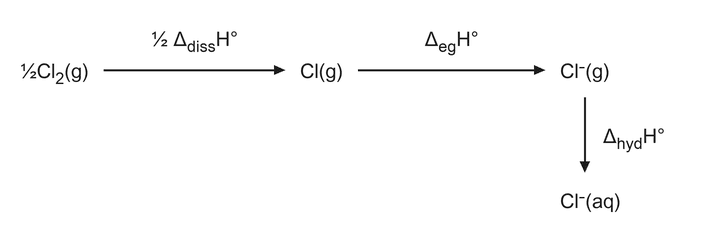
The energy involve in the conversion of to (using the data,
kJ mol⁻¹
kJ mol⁻¹
kJ mol⁻¹) will be
- 1411 mark
Question 141
In a fuel cell methanol is used as fuel and oxygen gas is used as an oxidizer. The reaction is
At 298 K standard Gibb's energies of formation for , and are −1.662, −237.2, − 394.4 kJ mol⁻¹ respectively if standard enthalpy of combustion of methanol is −726 kJ mol⁻¹ efficiency of the fuel cell will be :
- 1421 mark
Question 142
For the process (1 bar, 273 K) → (1 bar, 373 K), the correct set of thermodynamics parameters is:
- 1431 mark
Question 143
Among the following, the state function (s) is (are)
(a) internal energy
(b) irreversible expansion work
(c) reversible expansion work
(d) molar enthalpy
- 1441 mark
Question 144
The value of for a reaction A ⇌ B is (Given: kJ mol⁻¹, J K⁻¹ mol⁻¹ and R = 8.314 J K⁻¹ mol⁻¹; 2.303 × 8.314 × 298 = 5705)
- 1451 mark
Question 145
The condition for the ______ of a process can be deduced from the ______ law of thermodynamics.
- 1461 mark
Question 146
For a ______ reaction free energy change is ______.
- 1471 mark
Question 147
When a spontaneous process takes place, it is accompanied by an increase in the total ______ of the ______.
- 1482 marks
Question 148
Five moles of an ideal gas at 300 K and 10 atm pressure undergo isothermal reversible expansion to double its volume. Subsequently it is isothermally compressed to its original volume. What is the net heat absorbed by the gas and what is the net work done by the gas?
- 1492 marks
Question 149
(i) Calculate the work done in Joules when 3 moles of an ideal gas at 27°C expands isothermally and reversibly from 10 to 1 atm (1 atm = 1.013 × 10⁵ N m⁻²). What will be the work done if the expansion is against a constant pressure of 1 atm?
(ii) Will the internal energy and entropy of an ideal gas whose heat capacity does not change with temperature increase or decrease during an adiabatic expansion?
- 1502 marks
Question 150
(i) Correct the following statement: When any system undergoes a transformation the entropy of the system increases.
(ii) Distinguish between change in internal energy and change in enthalpy of a gas with reference to heat absorbed during its transformation.
(iii) 5 moles of nitrogen at 5 atm. pressure contained in 100 litre cylinder absorbed 30.26 kilo Joules of heat when it expands to 200 litres at 2 atm. pressure. What is the change in internal energy of the gas?
(iv) Under what conditions can the entropy change of a system be used to determine the spontaneity of a transformation of a system?
(v) State the second law of thermodynamics in terms of entropy of the universe.
- 1512 marks
Question 151
(i) 5 moles of an ideal gas expand reversibly from a volume of 8 dm³ to 80 dm³ at a temperature of 27°C. Calculate the change in entropy and change in internal energy.
(ii) Give the mathematical expression for the first law of thermodynamics.
- 1522 marks
Question 152
One mole of a gas is allowed to expand isothermally and reversibly from a volume of 1 dm³ to 50 dm³ at 273 K. Calculate W, ΔE and q assuming ideal behavior of the gas.
- 1532 marks
Question 153
(i) Ethanol boils at 78.4°C. The enthalpy of vaporisation of ethanol is 42.4 kJ mol⁻¹. Calculate the entropy of vaporisation of ethanol.
(ii) Calculate the standard free energy change for the reaction,
at 298 K. The standard enthalpy change and standard entropy change for the reaction are 52.0 kJ and 165.2 J K⁻¹ respectively. Is this reaction spontaneous at 298 K? Why?
- 1542 marks
Question 154
A sample of gas is compressed at a pressure of 0.5 atm. from a volume of 400 cm³ to 200 cm³. During the process 8.0 J of heat flows to the surroundings. Calculate the change in the internal energy of the system.
- 1552 marks
Question 155
(i) Write Gibbs–Helmholtz equation.
(ii) What is the criteria for spontaneity of a reaction in terms of free energy and entropy?
(iii) What are isobaric and isochoric reactions?
- 1562 marks
Question 156
A gas cylinder of 5 litres capacity containing 4 kg of helium gas at 27°C developed a leak leading to the escape of gas into the atmosphere. If the atmospheric pressure was 1.0 atmosphere, calculate the work done by the gas, assuming ideal behaviour.
- 1572 marks
Question 157
(a) (i) What is the physical significance of entropy?
(ii) How is the entropy of the universe changing?
(b) Calculate the maximum work for the expansion of 1 mole of an ideal gas from 1 L to 10 L at a temperature of 0°C.
- 1582 marks
Question 158
Correct the following statement.
A system which can exchange neither matter nor energy with the surroundings is called a closed system.
- 1592 marks
Question 159
(i) ΔH and ΔS for vaporization of water at 1 atm pressure are 40.63 kJ mol⁻¹ and 108.8 J K⁻¹ mol⁻¹ respectively. Calculate the temperature at which the free energy change for the transformation will be zero. Predict the sign of free energy change below this temperature.
(ii) The heat supplied to a Carnot engine is 1958.22 kJ. How much useful work can be done by the engine which works between 0°C and 100°C?
- 1602 marks
Question 160
Calculate the enthalpy of formation of methane from the following data:
ΔH = −394 kJ mol⁻¹
ΔH = −286 kJ mol⁻¹
ΔH = −890 kJ mol⁻¹
- 1612 marks
Question 161
(i) Correct the following statement.
The enthalpy of a system is an intensive property, i.e., its value depends on the amount of matter in the system.
(ii) Enthalpy change and entropy change of a chemical reaction at 25°C are 177.0 kJ and 160.4 J K⁻¹ respectively. Calculate free energy change of the reaction and predict whether the reaction is spontaneous or non-spontaneous.
- 1622 marks
Question 162
(i) 2 moles of an ideal gas at 27°C expand reversibly from 2 litres to 20 litres. Find the entropy change for the reaction.
(ii) State the second law of thermodynamics in terms of entropy of the universe.
If enthalpies of formation for , and at 25°C and 1 atm pressure are 52 kJ/mol, −394 kJ/mol and −286 kJ/mole respectively, calculate the enthalpy of combustion of .
- 1632 marks
Question 163
(i) Calculate the maximum work done when 64 g of gas occupying a volume of 7 litres is expanded isothermally at 27°C (R = 1.987 Cal deg⁻¹ mol⁻¹).
(ii) Diethyl ether boils at 35°C at 1 atmosphere pressure. If its heat of vaporisation is 6.5 kcal, calculate its entropy at boiling point.
- 1642 marks
Question 164
(i) Correct the following statement by changing the underlined part of the sentence. For all spontaneous processes the change in entropy is zero.
(ii) Write the mathematical expression for the first law of thermodynamics. One mole of an ideal gas is expanded isothermally against a constant pressure of 3 atmospheres from 10 litres to 35 L. Calculate work done, change in internal energy and heat absorbed during the process.
(iii) Calculate the free energy change of the reaction :
ΔH = 300 kJ mol⁻¹
and ΔS = 37 K⁻¹ mol⁻¹ at 300 K.
Predict whether the reaction is spontaneous or not at 300 K.
- 1653 marks
Question 165
Calculate the enthalpy of the following reaction
The bond energies of C–H, C–C, C = C and H–H are 414, 347, 615 and 435 kJ mol⁻¹ respectively.
- 1663 marks
Question 166
The molar heat of formation of (s) is −367.54 kJ and those of (g) and (l) are + 81.46 kJ and −285.78 kJ respectively at 25°C and 1.0 atmospheric pressure. Calculate ΔH and ΔE for the reaction
- 1673 marks
Question 167
Using the data (all values are in kilocalories per mole at 25°C) given below, calculate the bond energy of C–C and C–H bonds
(ethane) = −372.0
(propane) = −530.0
for = 172.0
Bond energy of H—H = 104.0
of (l) = −68.0
for (g) = −94.0
- 1683 marks
Question 168
The standard heats of formation of (g), (g) and (g) are −76.2, −394.8 and −241.6 kJ mol⁻¹ respectively. Calculate the amount of heat evolved by burning 1 m³ of methane measured under normal conditions.
- 1693 marks
Question 169
Calculate the resonance energy of from the following data: of = 82 kJ mol⁻¹ Bond energies of N ≡ N, N = N, O = O and N = O bonds are 946, 418, 498 and 607 kJ mol⁻¹ respectively.
- 1703 marks
Question 170
Calculate for chloride ion from the following data:
- 1713 marks
Question 171
The polymerisation of ethylene to linear polyethylene is represented by the reaction
where n has a large integral value. Given that the average enthalpies of bond dissociation for C = C and C–C at 298 K are + 590 and + 331 kJ mol⁻¹ respectively, calculate the enthalpy of polymerisation per mole of ethylene at 298 K.
- 1723 marks
Question 172
0.16 g of methane was subjected to combustion at 27°C in a bomb calorimeter system. The temperature of the calorimeter system (including water) was found to rise by 0.5°C. Calculate the heat of combustion of methane at
(i) constant volume, and
(ii) constant pressure.
The thermal capacity of the calorimeter system is 17.7 kJ K⁻¹ ( = 8.314 kJ K⁻¹ mol⁻¹)
- 1733 marks
Question 173
At 300 K, the standard enthalpies of formation of (s), (g) and (l) are −408, −393 and −286 kJ mol⁻¹. Calculate the heat of combustion of benzoic acid at
(i) constant pressure and
(ii) constant volume
( = 8.314 J mol⁻¹ K⁻¹).
- 1743 marks
Question 174
The standard molar enthalpies of formation of cyclohexane (l) and benzene (l) at 25°C are −156 and +49 kJ mol⁻¹ respectively. The standard enthalpy of hydrogenation of cyclohexene (l) at 25° C is −119 kJ mol⁻¹. Use these data to estimate the magnitude of the resonance energy of benzene.
- 1753 marks
Question 175
The heat liberated on complete combustion of 7.8 g benzene is 327 kJ. This heat has been measured at constant volume and at 27°C. Calculate the heat of combustion of benzene at constant pressure ( = 8.3 J mol⁻¹ K⁻¹)
- 1763 marks
Question 176
Compute the heat of formation of liquid methyl alcohol in kilojoules per mol, using the following data. Heat of vaporisation of liquid methyl alcohol = 38 kJ/mol. Heat of formation of gaseous atoms from the elements in their standard states:
H, 218 kJ/mol; C, 715; O, 249 kJ/mol.
Average bond energies: C–H, 415 kJ/mol; C–O, 356 kJ/mol; O–H, 463 kJ/mol
- 1773 marks
Question 177
10 g of argon is compressed isothermally and reversibly at a temperature of 27°C from 10 L to 5 L. Calculate , , ΔE and ΔH for this process.
= 2.0 cal K⁻¹ mol⁻¹, log 2 = 0.30.
Atomic wt. of Ar = 40.
- 1783 marks
Question 178
From the following data, calculate the enthalpy change for the combustion of cyclopropane at 298 K. The enthalpy of formation of (g), (l) and propene (g) are − 393.5, − 285.8 and 20.42 kJ mol⁻¹ respectively. The enthalpy of isomerisation of cyclopropane to propene is − 33.9 kJ mol⁻¹.
- 1793 marks
Question 179
Determine the value of ΔH and ΔE for the reversible isothermal evaporation of 90.0 g of water at 100°C. Assume that water vapour behave as an ideal gas and heat of evaporation of water is 540 cal g⁻¹ ( = 2.0 cal mol⁻¹K⁻¹).
- 1803 marks
Question 180
Estimate the average S–F bond energy in . The standard heat of formation values of (g), S (g) and F (g) are: — 1100, 275 and 80 kJ mol⁻¹ respectively.
- 1813 marks
Question 181
Calculate the value of log for the reaction
at 25°C. The standard enthalpy of formation of (g) is −46 kJ and standard entropies of (g), (g) and (g) are 191, 130, 192 J K⁻¹ mol⁻¹ respectively. (R = 8.3 J K⁻¹ mol⁻¹)
- 1823 marks
Question 182
A sample of argon gas at 1 atm pressure and 27°C expands reversibly and adiabatically from 1.25 dm³ to 2.50 dm³. Calculate the enthalpy change in this process. for argon is 12.48 J K⁻¹ mol⁻¹.
- 1833 marks
Question 183
Show that the reaction at 300 K is spontaneous and exothermic when the standard entropy change is −0.094 kJ mol⁻¹ K⁻¹. The standard Gibbs free energies of formation for and CO are −394.4 and −137.2 kJ mol⁻¹ respectively.
- 1843 marks
Question 184
Diborane is a potential rocket fuel which undergoes combustion according to the reaction
From the following data, calculate the enthalpy change for the combustion of diborane.
- 1853 marks
Question 185
Calculate Q, W, ΔE and ΔH for the isothermal reversible expansion of one mole of an ideal gas from an initial pressure of 1.0 bar to a final pressure of 0.1 bar at a constant temperature of 273 K.
- 1863 marks
Question 186
One mol of an ideal gas undergoes reversible isothermal expansion from an initial volume of to a final volume of 10 and does 10 kJ of work. The initial pressure was 1 × 10⁷ Pa.
(a) Calculate .
(b) If there were 2 mol of gas, what must its temperature have been?
- 1873 marks
Question 187
Two moles of a perfect gas undergo the following processes:
(a) a reversible isobaric expansion from (1.0 atm, 20.0 L) to (1.0 atm, 40.0 L)
(b) a reversible isochoric of state from (1.0 atm, 40.0 L) to (0.5 atm, 40.0 L)
(c) a reversible isothermal compression from (0.5 atm, 40.0 L) to (1.0 atm, 20.0 L)
(i) Sketch with labels each of the processes on the same P-V diagram.
(ii) Calculate the total work () and the total heat change () involved in the above processes.
(iii) What will be the value of ΔU, ΔH and ΔS for the overall process?
- 1883 marks
Question 188
One mole of a liquid (1 bar, 100 mL) is taken in an adiabatic container and the pressure increases steeply to 100 bar. Then at constant pressure of 100 bar, volume decreases by 1 mL. Find ΔU.
- 1893 marks
Question 189
(i)
This reaction is carried out at 298 K and 20 bar. 5 mol each of and are taken initially. Given
Find ΔG for the reaction at 298 K under given condition.
(ii) The reaction proceeds at an initial pressure of 20 bar. Find the direction in which the reaction proceeds to achieve equilibrium.
- 1903 marks
Question 190
ΔH = − 10,000 J mol⁻¹, ΔS = − 33.3 J mol⁻¹ K⁻¹
(i) At what temperature the reaction will occur spontaneously from left to right?
(ii) At what temperature, the reaction will reverse?
- 1913 marks
Question 191
ΔH = − 270.6 kJ mol⁻¹, ΔS = − 139.0 J K⁻¹ mol⁻¹
(i) Is the reaction favoured by entropy, enthalpy, both or none?
(ii) Find ΔG if T = 300 K
- 1923 marks
Question 192
From the following data, calculate the enthalpy change for the combustion of cyclopropane at 298 K. The enthalpy of formation of (g), () and propene (g) are − 393.5, − 285.8 and 20.42 kJ mol⁻¹ respectively. The enthalpy of isomerisation of cyclopropane to propene is − 33.0 kJ mol⁻¹
- 1933 marks
Question 193
Estimate the average S–F bond energy in . The values of standard enthalpy of formation of (g), S(g) and F(g) are: 1100, 275 and 80 kJ mol⁻¹ respectively.
- 1943 marks
Question 194
Show that the reaction at 300 K, is spontaneous and exothermic, when the standard entropy change is − 0.094 kJ mol⁻¹ K⁻¹. The standard Gibb's free energies of formation for and CO are − 394.4 and − 137.2 kJ mol⁻¹, respectively.
- 1953 marks
Question 195
Diborane is a potential rocket fuel which undergoes combustion according to the reaction
From the following data, calculate the enthalpy change for the combustion of diborane
- 1963 marks
Question 196
What is the entropy change (ΔS) for the evaporation of a mole of -hexane at 341.7 K? Given of -hexane = 29 kJ mol⁻¹.
- 1973 marks
Question 197
Calculate the entropy change for the conversion of 18 gm of ice to water at 273 K under 1 atm. pressure ( of ice = 6.025 kJ mol⁻¹).
- 1983 marks
Question 198
The enthalpy change for the transition of liquid water to steam, is 41.03 kJ mole⁻¹ at 373 K. Calculate the entropy change for the process.
- 1993 marks
Question 199
Calculate the enthalpy of vaporization involved in the conversion of 1 mole of water at 1 atm. pressure to water vapours, without change in temperature or pressure. The entropy of vaporization of water is 109.5 J K⁻¹ mol⁻¹.
- 2003 marks
Question 200
The latent heat of vaporization of benzene is 30.76 kJ mol⁻¹. Calculate the boiling point of benzene if the change in molar entropy is 87.14 J mol⁻¹ K⁻¹.
- 2013 marks
Question 201
The following data is given about melting of KCl = 7.25 kJ mol⁻¹ and = 0.007 kJ mol⁻¹ K⁻¹. Calculate the melting point.
- 2023 marks
Question 202
Calculate the entropy change when 15.0 g of ice has changed to liquid at 0°C, the heat of fusion is 80.0 cal g⁻¹.
- 2033 marks
Question 203
and for vaporization of water at 1 atm. pressure are 40.63 kJ mole⁻¹ and 108.8 J K⁻¹mol⁻¹ respectively. Calculate the temperature at which the free energy change for the transformation will be zero. Predict the sign of free energy change below this temperature.
- 2043 marks
Question 204
The and for are + 61.4 kJ mol⁻¹ and + 132 J K⁻¹ mol⁻¹ respectively. Above what temperature will the reaction be spontaneous?
- 2053 marks
Question 205
Predict whether at 27°C, the following reaction is spontaneous or not
Given = + 9080 J mol⁻¹ and = + 35.7 J K⁻¹ mol⁻¹. At what temperature the reaction will be at equilibrium?
- 2063 marks
Question 206
Enthalpy and entropy changes of a reaction are 40.63 kJ mol⁻¹ and 108.8 J K⁻¹ mol⁻¹ respectively. Predict the feasibility of the reaction at 27°C.
- 2073 marks
Question 207
Zinc reacts with dil. HCl to give hydrogen at 17°C. The enthalpy for the reaction is − 12.55 kJ per mole of zinc and the entropy change equals 5.0 J K⁻¹ mol⁻¹ for the reaction. Calculate the free energy change and predict whether the reaction is spontaneous or not.
- 2083 marks
Question 208
At 0°C, ice and water are in equilibrium and is 6.0 kJ mol⁻¹ for the process .
Calculate for the conversion of ice to liquid water.
- 2093 marks
Question 209
The standard free energy of formation for some compounds at 298 K is given below:
(l): −93.8 kcal
(l): −56.7 kcal
(l): −41.8 kcal
Calculate for the reaction
- 2103 marks
Question 210
Calculate the standard free energy change for the reaction
Given for ammonia is − 16.3 kJ mol⁻¹.
- 2113 marks
Question 211
Calculate the standard free energy change for the reaction ( and are − 741.0 and − 237.2 kJ mol⁻¹ respectively).
- 2123 marks
Question 212
Calculate the standard free energy change taking place in / fuel cell in which the following reactions occur.
(i)
= 1.229 V
(ii)
= 0.00 V
- 2133 marks
Question 213
The standard potential for the reaction
is + 0.028 V. Calculate standard free energy change for the reaction?
- 2143 marks
Question 214
Calculate the work done when 11.2 g of iron dissolves in hydrochloric acid in (i) a closed vessel (ii) an open beaker at 25°C (Atomic mass of Fe = 56 u).
- 2153 marks
Question 215
Calculate and in calories if one mole of a monoatomic ideal gas is heated at constant pressure of 1 atm from 25°C to 50°C.
- 2163 marks
Question 216
10 moles of an ideal gas expand isothermally and reversibly from a pressure of 5 atm to 1 atm at 300 K. What is the largest mass that can be lifted through a height of 1 metre by this expansion?
- 2173 marks
Question 217
The enthalpy change for the reaction
is − 154.40 kJ mol⁻¹. The formation of 2 g of hydrogen expands the system by 22.4 litres at 1 atm pressure. What is the internal energy change of the reaction?
- 2183 marks
Question 218
Calculate the energy of C–Cl bond from the following data:
= − 100.3 kJ
The bond energy of C–H, Cl–Cl and H–Cl bonds are 413, 243 and 431 kJ mol⁻¹ respectively.
- 2193 marks
Question 219
Calculate the heat of combustion of glucose (), given that the heats of formation of , and glucose are − 393.5, − 286.0 kJ and − 1169.3 kJ mol⁻¹ respectively.
- 2203 marks
Question 220
was carried out at 27°C by taking one mole of each of the reactants. The reaction reached equilibrium when 2/3rds of the reactants were consumed. Calculate the free energy change for the reaction ( = 8.314 J K⁻¹ mol⁻¹)
- 2213 marks
Question 221
Which is a good fuel or ? The standard enthalpy of formation of , , and are − 74.8, − 84.6, − 393.5 and − 296 kJ mol⁻¹ respectively.
- 2223 marks
Question 222
Calculate the enthalpy of hydrogenation of (g) given that the enthalpy of formation of ethane () (g) and that of formation of ethylene are − 20.2 kcal and + 12.5 kcal respectively.
- 2233 marks
Question 223
Calculate of the reaction
The average bond energies of C–H bond and C–Cl bond are 416 kJ and 325 kJ mol⁻¹ respectively.
- 2243 marks
Question 224
Calculate for the reaction :
Given that the standard enthalpies of formation of (aq), (aq) and (l) are −278.5, − 228.9 and −285 kJ mol⁻¹ respectively (all at 298 K).
- 2253 marks
Question 225
Given that the enthalpy of formation of is − 68 kcal/mole. Calculate the enthalpy of formation of ions.
- 2263 marks
Question 226
Calculate the work of expansion when 100 g of water is electrolysed at a constant pressure of 1 atm and temperature of 25°C.
- 2273 marks
Question 227
Work done in the expansion of an ideal gas from 4 dm³ to 6 dm³ against a constant external pressure of 2.5 atm was used to heat up 1 mole of water at 20°C. What will be the final temperature of water. Given that the specific heat of water 4.184 J g K⁻¹.
- 2283 marks
Question 228
The enthalpy change involved in the oxidation of glucose is − 2880 kJ mol⁻¹. Twenty five per cent of this energy is available for muscular work. If 200 kJ of muscular work is needed to walk one kilometer, what is the maximum distance that a person will be able to walk after eating 120 g of glucose?
- 2293 marks
Question 229
For the reaction, ; = − 560 kJ. Two moles of CO and one mole of are taken in a container of volume 1 L. They completely form two moles of , the gases deviate appreciably from ideal behaviour. If the pressure in the vessel changes from 70 to 40 atm, find the magnitude (absolute value) of at 500 K. (1 L atm = 0.1 kJ)
What Class 11 Chemistry Ch 6 covers
The sections of the chapter, in the order the book takes them. Every question above comes from one of these.
- 01System, Surroundings and Thermodynamic Processes
- 02Internal Energy, Work and Heat
- 03First Law of Thermodynamics
- 04Enthalpy and Heat Capacity
- 05Spontaneity and Heat Engines
- 06Thermochemistry and Enthalpies of Reaction
More ways to study this chapter
The same chapter asked three other ways. Practise it, revise it, and see what the board has set on Ch 6 before.
Class 11 Chemistry Ch 6 questions students ask
How many questions are there in Class 11 Chemistry Ch 6?
229 questions. Every one is solved step by step on this page.
Are these Class 11 Chemistry solutions free?
Yes. Every question and its full working is free to read, with no account needed.
Can I download the Class 11 Chemistry Ch 6 solutions as a PDF?
There is no PDF to download. Every solution is on this page instead, which means it is searchable, always the current syllabus, and readable on a phone. Use your browser's print option if you want it on paper.