
Question 1191 markMCQEasy
The work done during the expansion of a gas from a volume of 4 dm³ to 6 dm³ against a constant external pressure of 3 atm, is
Confirming your payment
Sign up now and get 250 free tokens.
Chemical Thermodynamics · Question 119 of 229
The work done during the expansion of a gas from a volume of 4 dm³ to 6 dm³ against a constant external pressure of 3 atm, is
(A) −6 J
(B) −608 J
(C) +304 J
(D) −304 J
Answer: (B) −608 J
Key idea: Work done on a gas against a constant external pressure is . It is negative for an expansion, because the gas does work on the surroundings. On a P–V diagram its size is the area under the horizontal line at .
Step 1 — Find the change in volume.
The gas expands from 4 dm³ to 6 dm³.
Step 2 — Work out the work in dm³ atm.
We multiply the external pressure by the change in volume and put in the minus sign.
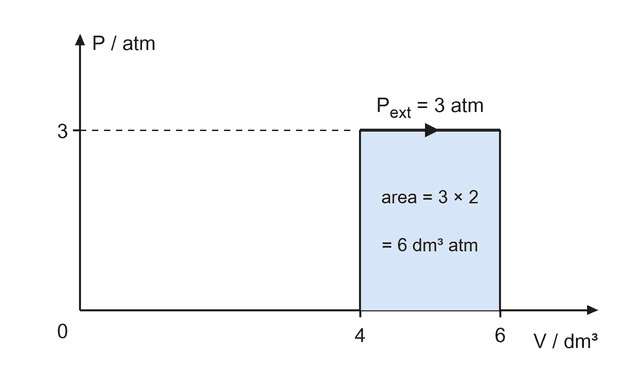
Step 3 — Convert to joules.
One litre-atmosphere (1 dm³ atm) equals 101.3 J.
Why the other options are wrong:
(A) −6 J forgets to convert dm³ atm into joules.
(C) +304 J is half the size and has the wrong sign; an expanding gas loses energy as work.
(D) −304 J is half the correct value (as if the volume changed by only 1 dm³).
Therefore, the work done is about −608 J.