
Question 1401 markMCQMedium
Oxidising power of chlorine in aqueous solution can be determined by the parameters indicated below
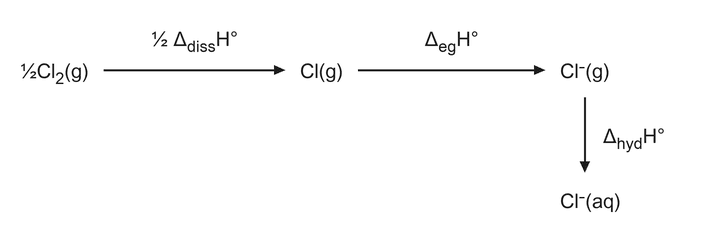
The energy involve in the conversion of to (using the data,
kJ mol⁻¹
kJ mol⁻¹
kJ mol⁻¹) will be
Confirming your payment
Sign up now and get 250 free tokens.
Chemical Thermodynamics · Question 140 of 229
Oxidising power of chlorine in aqueous solution can be determined by the parameters indicated below
The energy involve in the conversion of to (using the data,
kJ mol⁻¹
kJ mol⁻¹
kJ mol⁻¹) will be
(A) −850 kJ mol⁻¹
(B) + 120 kJ mol⁻¹
(C) +152 kJ mol⁻¹
(D) − 610 kJ mol⁻¹
Answer: (D) − 610 kJ mol⁻¹
Key idea: By Hess's law, the enthalpy change for the overall conversion is the sum of the enthalpy changes of the steps along the path: half the dissociation enthalpy of , then electron gain, then hydration of the gaseous chloride ion.
Step 1 — Take half the dissociation enthalpy.
Only half a mole of is dissociated to make one mole of Cl atoms.
Step 2 — Add the electron gain enthalpy.
Each Cl atom gains an electron and becomes , releasing 349 kJ per mole.
Step 3 — Add the hydration enthalpy.
The gaseous chloride ions are surrounded by water molecules, releasing 381 kJ per mole.
Step 4 — Add the three steps.
The enthalpy-level diagram below shows the three steps to scale.
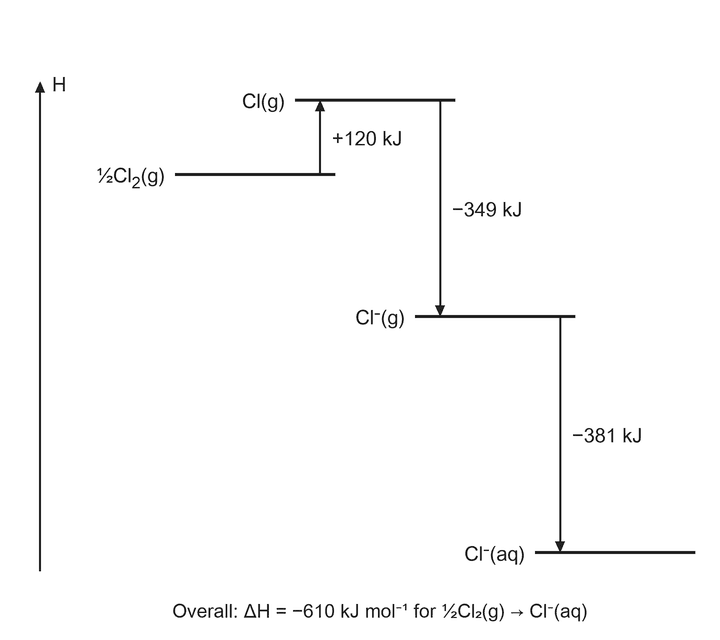
Note: The printed path and the stem write the last species as Cl(aq); the hydrated chloride ion, Cl⁻(aq), is meant. Option C is printed with the unit kJ mol⁻²; kJ mol⁻¹ is meant.
Why the other options are wrong:
(A) −850 kJ mol⁻¹ takes the dissociation step as −120 kJ; breaking a bond needs energy, so it is +120 kJ.
(B) +120 kJ mol⁻¹ is only the first step, the dissociation of half a mole of chlorine.
(C) +152 kJ mol⁻¹ takes the hydration step as +381 kJ (120 − 349 + 381); hydration of an ion releases energy.
Therefore, the energy involved in the conversion is −610 kJ mol⁻¹.