Solution:
Key idea: Work done ON the gas is w=−PextΔV at constant pressure, zero at constant volume, and −2.303nRTlogV1V2 for a reversible isothermal change. U, H and S are state functions: their changes depend only on the initial and final states. We use 1 L atm = 101.3 J and log 2 = 0.3010.
Step 1 — Sketch the three processes, part (i).
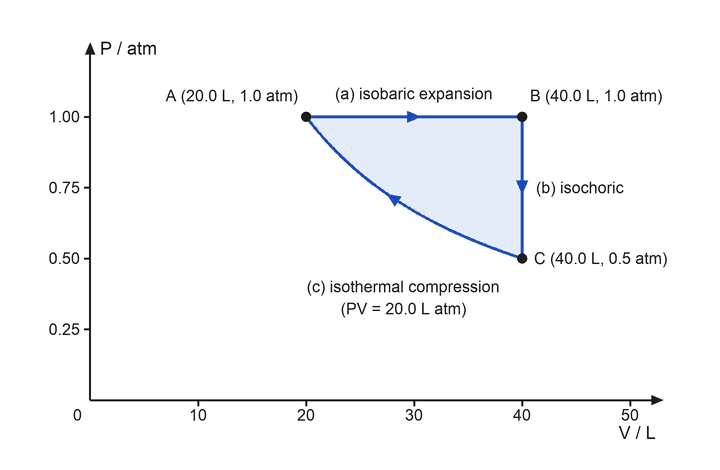
Call the states A (1.0 atm, 20.0 L), B (1.0 atm, 40.0 L) and C (0.5 atm, 40.0 L). Process (a) is a horizontal line A → B at 1.0 atm, process (b) is a vertical line B → C at 40.0 L, and process (c) is the curve C → A. Since PV at C is 0.5 × 40.0 and at A is 1.0 × 20.0, both 20.0 L atm, A and C lie on one isotherm (a rectangular hyperbola), so the gas returns to its starting state and the three processes form a cycle.
Step 2 — Find the work for process (a).
The gas expands by 20.0 L against a constant 1.0 atm, so the work done on it is negative.
wa=−PΔV
wa=−1.0×(40.0−20.0)
wa=−20.0 L atm
Step 3 — Find the work for process (b).
The volume does not change, so no work is done.
wb=0
Step 4 — Find the work for process (c).
The compression follows the isotherm from 40.0 L to 20.0 L. On it nRT equals PV, and PV is 20.0 L atm at both A and C, so we can use nRT in L atm and get the work in L atm.
wc=−2.303×20.0×log40.020.0
wc=2.303×20.0×0.3010
wc≈13.864 L atm
Step 5 — Find the total work, part (ii).
We add the three works and convert litre-atmospheres to joules.
w=−20.0+0+13.864
w=−6.136 L atm
w=−6.136×101.3 J
w≈−621.6 J
The net work is negative: over the cycle the gas does more work in expanding along A → B than is done on it along C → A. This net work is the area enclosed by the cycle in the figure.
Step 6 — Find the total heat, part (ii).
The gas ends in its initial state, so ΔU for the whole cycle is zero. The first law is ΔU = q + w, so the total heat is the negative of the total work.
q=−w
q≈+621.6 J
Step 7 — Find ΔU, ΔH and ΔS, part (iii).
The final state (1.0 atm, 20.0 L, same temperature) is the same as the initial state, and U, H and S are state functions, so their overall changes are zero.
ΔU=0
ΔH=0
ΔS=0
Note: The printed −621.0 J comes from rounding the total work to −6.13 L atm before converting to joules (6.13 × 101.3 = 621.0); the unrounded value is −621.6 J.
Therefore, (i) the processes form the cycle A → B → C → A shown in the figure; (ii) w ≈ −621.6 J (printed as −621.0 J) and q ≈ +621.6 J; (iii) ΔU = 0, ΔH = 0 and ΔS = 0 for the overall process.
