
Opening your dashboard
Class 11 Chemistry Chapter 6 Chemical Thermodynamics: Practice Questions
137 questions on Chapter 6, each worked through on its own page with the AI tutor. Class 11 Chemistry, ICSE 2026-27.
137 questions
1–4 marks · Mixed difficulty
- 11 mark
Question 1
Rice is being cooked in a pressure cooker on a gas stove. The lid is locked and the whistle has not yet lifted, so no steam is escaping. Taking the cooker and its contents as the system, the system at this stage is best described as
- 22 marks
Question 2
Mass and volume are extensive properties, but density, which is mass divided by volume, is an intensive property.
(a) Explain why the ratio of two extensive properties is always intensive.
(b) Classify each of the following as extensive or intensive: heat capacity, molar heat capacity, internal energy, molar volume.
- 31 mark
Question 3
A sample of an ideal gas is warmed slowly by an electric heater. Its pressure rises steadily in proportion to its temperature, from 2.0 bar at 300 K (volume 12.0 L) to 2.4 bar at 360 K. (Hypothetical data.) The process undergone by the gas is
- 43 marks
Question 4
A system is in thermodynamic equilibrium only when it is in thermal, mechanical and chemical equilibrium at the same time. For each system below, name the kind of equilibrium that is NOT yet reached and give a reason.
(a) A gas in a cylinder whose piston is still moving outwards.
(b) A sealed flask of hydrogen and iodine vapour kept at 700 K, in which the amount of hydrogen iodide is still increasing.
(c) A copper rod with one end dipped in boiling water and the other end in melting ice.
- 51 mark
Question 5
A gas initially occupying 3.0 L expands against a constant external pressure of 1.5 bar. It does 750 J of work on the surroundings. (Hypothetical data.) Taking 1 L bar = 100 J, the final volume of the gas is
- 61 mark
Question 6
For a fixed amount of an ideal gas, which of the following changes increases its internal energy?
- 73 marks
Question 7
A 1.5 V torch cell supplies a steady current of 0.20 A to a bulb for 30 minutes. During this time the internal energy of the cell falls by 600 J. (Hypothetical data.) Taking the cell as the system:
(a) find the charge that flows through the circuit;
(b) find the electrical work done on the cell, , with its sign;
(c) find the heat exchanged by the cell and say whether the cell gives out or takes in heat.
- 81 mark
Question 8
Hot tea is poured into a thermos flask, a few ice cubes are dropped in, and the flask is quickly stoppered. Treat the stoppered flask and its contents as an isolated system. After the ice has melted and the temperature inside has become steady,
- 94 marks
Question 9
A sample of gas is taken once round the cycle A → B → C → A shown in the figure: A → B at constant pressure, B → C along the straight line, and C → A at constant volume. (Hypothetical data.) Take 1 L bar = 100 J.
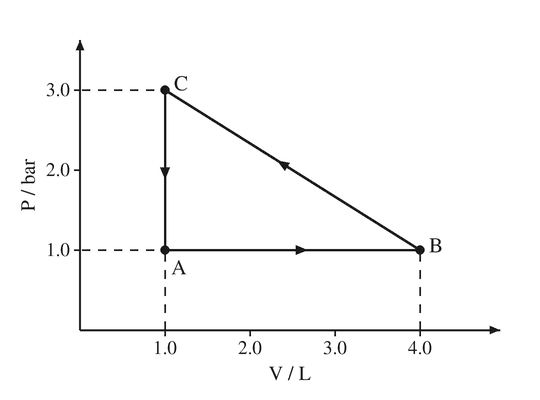
(a) Calculate the work done on the gas, , in each of the three steps.
(b) Find , and for one complete cycle.
(c) State, with a reason, whether this cycle could act as a heat engine.
- 103 marks
Question 10
Use the first law of thermodynamics to explain each observation.
(a) When a bicycle tyre is pumped up quickly, the barrel of the pump becomes warm near its outlet.
(b) When the valve of a fully inflated tyre is opened, the air rushing out feels cool.
(c) State the signs of , and for the air in each case.
- 111 mark
Question 11
An inventor claims that a sealed device, working in a cycle and returning to the same state after every cycle, takes in 30 J of heat and delivers 50 J of work in each cycle. Which statement about the claim is correct?
- 123 marks
Question 12
Solid ammonium carbamate decomposes on heating:
When 1 mol of ammonium carbamate decomposes in a sealed rigid vessel at 298 K, 152.3 kJ of heat is absorbed. (Hypothetical data.) Assuming the gases behave ideally and taking J K⁻¹ mol⁻¹:
(a) find for the reaction at 298 K;
(b) explain why is larger than for this reaction.
- 131 mark
Question 13
600 J of heat is supplied to 1.00 mol of helium gas kept at constant pressure. (Hypothetical data.) Treating helium as an ideal monatomic gas and taking J K⁻¹ mol⁻¹, the rise in temperature of the gas is
- 143 marks
Question 14
The specific heat capacity of methane gas at constant pressure is 2.23 J g⁻¹ K⁻¹ at 25 °C. Taking J K⁻¹ mol⁻¹ and treating methane as an ideal gas, calculate:
(a) its molar heat capacity at constant pressure, ;
(b) its molar heat capacity at constant volume, ;
(c) the ratio , and explain why it is smaller than the value 1.67 found for helium.
- 152 marks
Question 15
(a) Explain why the molar heat capacity of a gas at constant pressure, , is greater than its molar heat capacity at constant volume, .
(b) Explain why, for solids and liquids, and are almost equal.
- 161 mark
Question 16
A Carnot engine rejects heat to a sink at 27 °C and has an efficiency of 25%. (Hypothetical data.) Keeping the sink temperature unchanged, the efficiency is to be raised to 40%. The temperature of the source must be raised by
- 173 marks
Question 17
A power-plant engineer claims that an engine taking in steam at 527 °C and rejecting heat to cooling water at 27 °C delivers 700 kJ of work for every 1000 kJ of heat taken from the steam. (Hypothetical data.)
(a) Calculate the maximum (Carnot) efficiency possible between these two temperatures.
(b) Is the claim possible? Say which law of thermodynamics decides this, and whether the first law is broken.
(c) Find the least heat that must be rejected to the cooling water for every 1000 kJ taken in.
- 181 mark
Question 18
Which of the following spontaneous changes shows most clearly that a decrease in enthalpy is not, by itself, the condition that decides whether a process is spontaneous?
- 192 marks
Question 19
An ice cube is dropped into a glass of warm water. The ice melts and the water cools until both are at the same temperature.
(a) Show that the reverse change (the water becoming warmer while the ice cube grows larger) would also obey the first law of thermodynamics.
(b) What does this tell us about a limitation of the first law, and what is needed to decide the direction of change?
- 201 mark
Question 20
Sulphur dioxide is oxidised to sulphur trioxide in the contact process:
kJ. The heat evolved when 32.0 g of sulphur trioxide is formed by this reaction is (S = 32, O = 16)
- 213 marks
Question 21
The enthalpy level diagram below is for the slaking of 1 mol of quicklime (calcium oxide) with water.
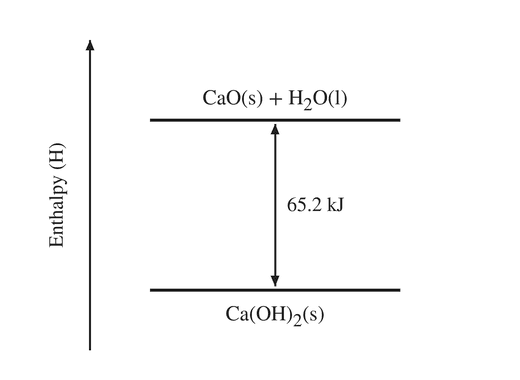
(a) Is the reaction exothermic or endothermic? Give the value of with its sign, and a reason from the diagram.
(b) How much heat is involved when 14.0 g of quicklime is slaked? (Ca = 40, O = 16)
(c) Write for the change of 1 mol of solid calcium hydroxide back into calcium oxide and liquid water.
- 223 marks
Question 22
A student dissolves 5.35 g of ammonium chloride in 100.0 g of water in an insulated cup. The temperature of the solution falls from 25.0 °C to 21.6 °C. (Hypothetical data.) Take the mass of the solution as the total mass of water and salt, its specific heat capacity as 4.18 J g⁻¹ K⁻¹, and neglect the heat capacity of the cup (N = 14, H = 1, Cl = 35.5).
(a) Calculate the heat absorbed when the salt dissolves.
(b) Calculate the enthalpy of solution of ammonium chloride in kJ mol⁻¹, with its sign.
(c) Explain why the temperature of the water falls.
- 234 marks
Question 23
A bomb calorimeter is first calibrated by burning 0.500 g of benzoic acid, whose internal energy of combustion is −26.43 kJ g⁻¹; the temperature of the calorimeter rises by 1.358 K. Then 0.320 g of naphthalene, , is burnt in the same calorimeter and the temperature rises by 1.323 K. (Hypothetical data.) (C = 12, H = 1)
(a) Calculate the heat capacity of the calorimeter.
(b) Calculate the molar internal energy of combustion, , of naphthalene.
(c) Explain why the heat measured in a bomb calorimeter gives and not .
- 243 marks
Question 24
When 1 mol of pure sulphuric acid is dissolved in 10 mol of water, 67.0 kJ of heat is evolved; when 1 mol of the acid is dissolved in 100 mol of water, 74.0 kJ is evolved. (Hypothetical data.)
(a) What is meant by the enthalpy of dilution?
(b) Find the enthalpy of dilution when a solution containing 1 mol of the acid in 10 mol of water is diluted with 90 mol more water, and the heat given out when 0.50 mol of the acid in such a solution is diluted in the same way.
(c) Use these results to explain why concentrated sulphuric acid is always added slowly to water, and never water to the acid.
- 251 mark
Question 25
Use the two thermochemical equations below to find the standard enthalpy of formation of nitrogen dioxide, (g).
kJ
kJ
- 263 marks
Question 26
Sulphur exists as rhombic sulphur and monoclinic sulphur. The standard enthalpies of combustion of the two forms to (g) are −296.83 kJ mol⁻¹ for rhombic sulphur and −297.16 kJ mol⁻¹ for monoclinic sulphur.
(a) Write the two combustion equations and combine them, using Hess's law, to give the equation for the change of rhombic sulphur into monoclinic sulphur.
(b) Calculate the enthalpy change for this transition.
(c) Why is Hess's law the practical way to find this enthalpy change, rather than measuring it directly?
- 274 marks
Question 27
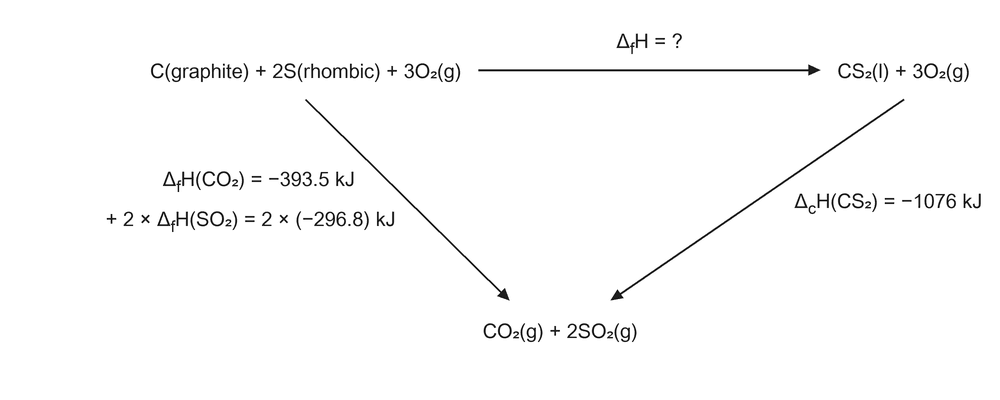
Carbon disulphide, (l), cannot be made directly from carbon and sulphur in a calorimeter, but it burns readily in oxygen. The enthalpy cycle below links its formation to its combustion. All values are standard enthalpy changes at 298 K.
(a) State Hess's law of constant heat summation.
(b) Use the cycle to calculate the standard enthalpy of formation of (l).
(c) What does the sign of your answer tell you about (l) compared with its elements?
- 281 mark
Question 28
Butane, (g), and its isomer 2-methylpropane, (g), both burn completely to (g) and (l):
The standard enthalpies of combustion are −2877.4 kJ mol⁻¹ for butane and −2868.8 kJ mol⁻¹ for 2-methylpropane. What is ΔH° for the isomerisation of butane into 2-methylpropane?
- 294 marks
Question 29
The Born–Haber cycle below, an application of Hess's law, shows the formation of potassium chloride from its elements in their standard states. All values are in kJ mol⁻¹. Take the lattice enthalpy to mean the enthalpy change when one mole of solid KCl forms from its gaseous ions.
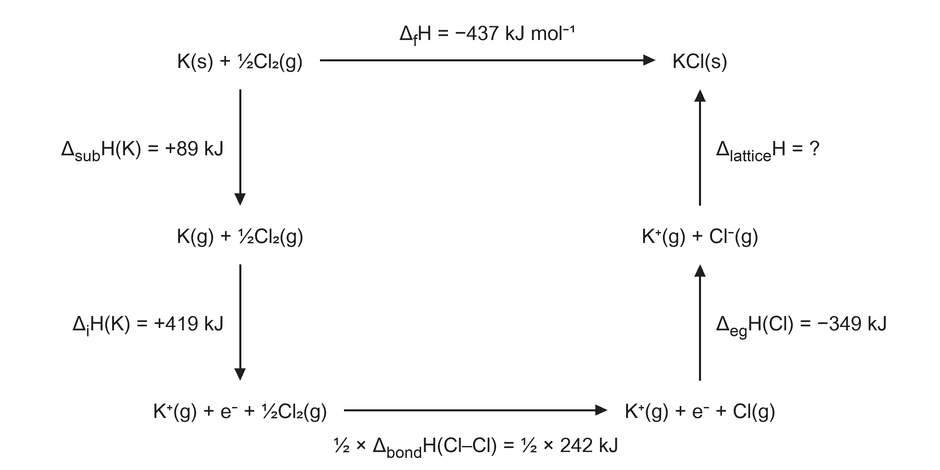
(a) Calculate the lattice enthalpy of KCl.
(b) Some tables quote lattice enthalpy for the reverse change, KCl(s) → K⁺(g) + Cl⁻(g). What value would such a table give?
(c) Which single step in the cycle releases enough energy to make the formation of KCl exothermic overall?
- 301 mark
Question 30
The enthalpy change of which process is the bond dissociation enthalpy of the H–Cl bond?
- 313 marks
Question 31
The four C–H bonds of methane are broken one after another. The bond dissociation enthalpies of the four steps are:
kJ mol⁻¹
kJ mol⁻¹
kJ mol⁻¹
kJ mol⁻¹
(a) Find the enthalpy of atomisation of methane.
(b) Find the average C–H bond enthalpy in methane.
(c) Why are the four values different, and why do data tables list a single average C–H bond enthalpy?
- 321 mark
Question 32
The average bond enthalpies of the C–C single bond and the C=C double bond are 348 kJ mol⁻¹ and 614 kJ mol⁻¹. A C=C bond is one σ bond plus one π bond. Treating its σ bond as being as strong as a C–C single bond, what is the best estimate of the energy needed to break just the π bonds in one mole of C=C bonds?
- 333 marks
Question 33
Hydrazine vapour, (g), has the structure and can decompose as shown:
Average bond enthalpies (kJ mol⁻¹): N–N 163, N–H 391, N≡N 946, H–H 436. The standard enthalpy of formation of (g) is +95.4 kJ mol⁻¹.
(a) Estimate ΔH for the decomposition from the bond enthalpies.
(b) Calculate ΔH for the decomposition from the enthalpy of formation.
(c) Explain why the two answers are not the same.
- 343 marks
Question 34
Ethanol can be made by adding steam to ethene:
Average bond enthalpies (kJ mol⁻¹): C=C 614, C–C 348, C–H 414, C–O 360, O–H 463.
(a) Name the bonds that are broken and the bonds that are formed. (Bonds that appear unchanged on both sides need not be counted.)
(b) Estimate ΔH for the reaction.
(c) The enthalpy of vaporisation of ethanol is 42 kJ mol⁻¹. Estimate ΔH when the product is liquid ethanol, and say why bond enthalpies alone cannot give this value.
- 351 mark
Question 35
A large hot metal block at 600 K is placed in contact with a large cold metal block at 300 K, and 1200 J of heat passes from the hot block to the cold block. (Hypothetical data.) Both blocks are so large that their temperatures do not change noticeably. What is the total entropy change of the two blocks?
- 363 marks
Question 36
2.00 mol of liquid water is heated at constant pressure from 25 °C to 75 °C. The molar heat capacity of liquid water is 75.3 J K⁻¹ mol⁻¹ and may be taken as constant. For heating at constant pressure the entropy change is
(a) Calculate the entropy change of the water.
(b) Explain in terms of the motion of the molecules why the entropy of the water increases.
- 371 mark
Question 37
Which order of standard molar entropy, S°, at 298 K is correct for the gases methane, ethane and propane?
- 383 marks
Question 38
When open bottles of concentrated ammonia solution and concentrated hydrochloric acid stand side by side, a white smoke of ammonium chloride forms where the two gases meet:
At 298 K, ΔH° = −176.0 kJ and the entropy change of the reacting system is ΔS°(system) = −284.8 J K⁻¹.
(a) Calculate the entropy change of the surroundings.
(b) Calculate the total entropy change and say whether the reaction is spontaneous at 298 K.
(c) Explain how a reaction whose own entropy decreases can still obey the second law.
- 393 marks
Question 39
Mercury melts at −38.8 °C and boils at 356.7 °C. Its enthalpy of fusion is 2.29 kJ mol⁻¹ and its enthalpy of vaporisation at the boiling point is 59.1 kJ mol⁻¹.
(a) Calculate the molar entropy of fusion and the molar entropy of vaporisation of mercury. (Use T/K = t/°C + 273.15.)
(b) Explain why the entropy of vaporisation is so much larger than the entropy of fusion.
- 401 mark
Question 40
At 298 K, ΔG° = −237.1 kJ mol⁻¹ for the reaction below, yet a mixture of hydrogen and oxygen can be kept at room temperature for years without noticeable change.
Which statement best explains this?
- 414 marks
Question 41
For a certain gas-phase reaction, the standard Gibbs energy change was measured at several temperatures and the results lay on a straight line. (Hypothetical data.) The graph shows this line, with point P at (300 K, +40.0 kJ mol⁻¹) and point Q at (500 K, +10.0 kJ mol⁻¹). Assume that ΔH° and ΔS° do not change with temperature, and take R = 8.314 J K⁻¹ mol⁻¹.
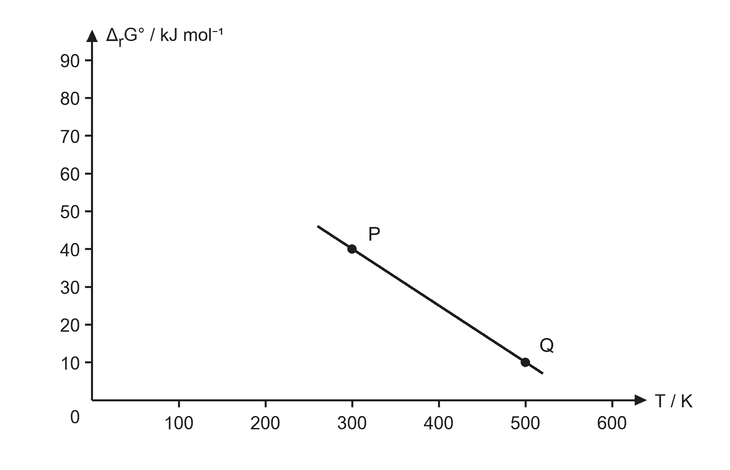
(a) Use and the slope of the line to find ΔS°.
(b) Find ΔH°.
(c) Above what temperature is the reaction spontaneous under standard conditions?
(d) Calculate the equilibrium constant K at 500 K.
- 422 marks
Question 42
In living cells, glucose is turned into glucose-6-phosphate. On its own this step is not spontaneous, but the cell couples it with the hydrolysis of ATP. Standard Gibbs energy changes (biochemical standard conditions) are:
ΔG° = +13.8 kJ mol⁻¹
ΔG° = −30.5 kJ mol⁻¹
(a) Find ΔG° for the coupled reaction, glucose + ATP → glucose-6-phosphate + ADP.
(b) Explain why coupling the two reactions makes the formation of glucose-6-phosphate possible.
- 431 mark
Question 43
A process takes place in a system kept at a constant temperature of 300 K and constant pressure, and the total entropy change of the system and its surroundings is +2.40 J K⁻¹. (Hypothetical data.) What is the Gibbs energy change, ΔG, of the system?
- 442 marks
Question 44
Tin has two solid forms: metallic white tin and powdery grey tin. For the change
ΔH° = −2.09 kJ mol⁻¹ and ΔS° = −7.04 J K⁻¹ mol⁻¹. Assume that both stay constant with temperature.
(a) Calculate ΔG° for the change at −20 °C (253 K) and at 25 °C (298 K).
(b) Use your answers to explain why tin objects left for a long time in a very cold place can slowly crumble to powder, while they keep well at room temperature.
- 451 mark
Question 45
According to the third law of thermodynamics, which of the following would have zero entropy at absolute zero (0 K)?
- 463 marks
Question 46
The standard Gibbs energy change and the equilibrium constant are related by (R = 8.314 J K⁻¹ mol⁻¹).
(a) Show that at 298 K, making ΔG° more negative by about 5.71 kJ mol⁻¹ makes K ten times larger.
(b) Two reactions X and Y are studied at 298 K. ΔG° for Y is 17.1 kJ mol⁻¹ more positive than ΔG° for X. (Hypothetical data.) Without finding either equilibrium constant separately, find the ratio .
- 474 marks
Question 47
Methanol vapour can be made from carbon monoxide and hydrogen:
At 298 K the standard Gibbs energies of formation are: (g) −137.2 kJ mol⁻¹, (g) −162.0 kJ mol⁻¹. Use R = 8.314 J K⁻¹ mol⁻¹, and, for a mixture that is not at equilibrium, , where Q is the reaction quotient written with partial pressures in bar.
(a) Calculate ΔG° for the reaction at 298 K.
(b) Calculate the equilibrium constant K at 298 K.
(c) A mixture at 298 K contains at 1.0 bar, at 2.0 bar and at 0.50 bar. Calculate Q and ΔG for this mixture.
(d) In which direction will this mixture react? Give a reason.
- 481 mark
Question 48
Which statement about standard molar entropies, S°, at 298 K is correct?
- 493 marks
Question 49
Hydrogen is made industrially by steam reforming of methane:
For this reaction ΔH° = +206.1 kJ mol⁻¹ and ΔS° = +214.7 J K⁻¹ mol⁻¹. Assume that both stay constant with temperature, and use R = 8.314 J K⁻¹ mol⁻¹ and .
(a) Calculate the equilibrium constant K at 298 K.
(b) Calculate K at 1100 K.
(c) Explain why the reaction is carried out at a high temperature.
- 501 mark
Question 50
For a particular reversible reaction at temperature , and were found to be both +ve. If is the temperature at equilibrium, the reaction would be spontaneous when
- 511 mark
Question 51
Molar heat capacity of aluminium is 25 J K⁻¹ mol⁻¹. The heat necessary to raise the temperature of 54 g of aluminium (Atomic mass 27 g mol⁻¹) from 30°C to 50°C is
- 521 mark
Question 52
The entropy change involved in the isothermal reversible expansion of 2 moles of an ideal gas from a volume of 10 dm³ to a volume of 100 dm³ at 27°C is
- 531 mark
Question 53
Four grams of graphite is burnt in a bomb calorimeter of heat capacity of 30 kJ K⁻¹ in excess of oxygen at 1 atmospheric pressure. The temperature rises from 300 to 304 K. What is the enthalpy of combustion of graphite (in kJ mol⁻¹)?
- 541 mark
Question 54
The incorrect expression among the following is
- 551 mark
Question 55
Using the data provided, calculate the multiple bond energy (kJ mol⁻¹) of a bond in . The energy is (take the bond energy of a C–H bond as 350 kJ mol⁻¹):
kJ mol⁻¹
kJ mol⁻¹
kJ mol⁻¹
- 561 mark
Question 56
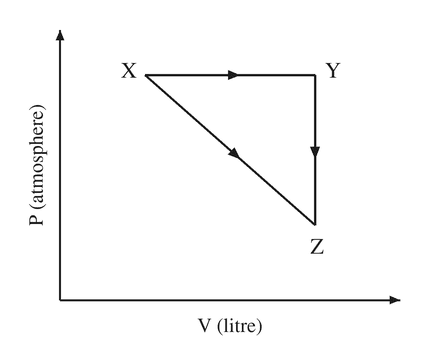
For an ideal gas, consider only P-V work in going from an initial state X to the final state Z. The final state Z can be reached by either of the two paths shown in the figure. Which of the following choice(s) is (are) correct? [Take ΔS as change in entropy and W as work done]
(a)
(b)
(c)
(d)
- 571 mark
Question 57
The reversible expansion of an ideal gas under adiabatic and isothermal conditions is shown in the figure. Which of the following statement(s) is(are) correct?

(a)
(b)
(c)
(d)
- 581 mark
Question 58
A piston filled with 0.04 mol of an ideal gas expands reversibly from 50.0 mL to 375 mL at a constant temperature of 37.0°C. As it does so, it absorbs 208 J of heat. The values of and for the process will be
( J mol⁻¹ K⁻¹) ()
- 591 mark
Question 59
The standard enthalpies of formation of , and glucose(s) at 25°C are –400 kJ/mol, –300 kJ/mol and –1300 kJ/mol, respectively. The standard enthalpy of combustion per gram of glucose at 25°C is
- 601 mark
Question 60
Benzene and naphthalene form an ideal solution at room temperature. For this process, the true statement(s) is (are)
(a) is positive
(b) is positive
(c)
(d)
- 611 mark
Question 61
The enthalpy of vaporization of a certain liquid at its boiling point of 35°C is 24.64 kJ mol⁻¹. The value of change in entropy for the process is
- 621 mark
Question 62
The ratio of heat liberated at 298 K from the combustion of one kg of coke and by burning, water gas obtained from 1 kg of coke is (assume coke to be 100% carbon, enthalpies of combustion of C, CO and as 393.5 kJ, 285 kJ, 285 kJ, respectively, all at 298 K).
- 631 mark
Question 63
For complete combustion of ethanol,
the amount of heat produced as measured in bomb calorimeter, is 1364.47 kJ mol⁻¹ at 25°C. Assuming ideality the enthalpy of combustion, , for the reaction will be ( J mol⁻¹)
- 641 mark
Question 64
For the process at °C and 1 atmosphere pressure, the correct choice is
- 651 mark
Question 65
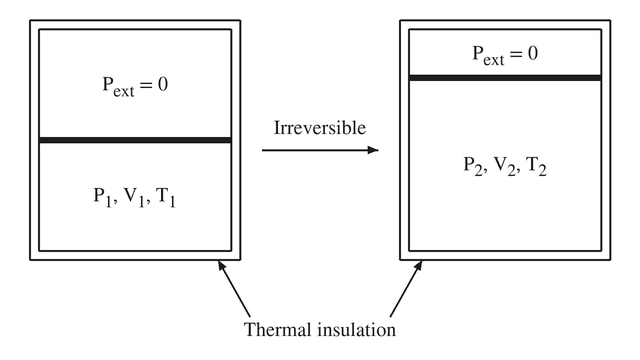
An ideal gas in a thermally insulated vessel at internal pressure , volume and absolute temperature expands irreversibly against zero external pressure, as shown in the diagram. The final internal pressure, volume and absolute temperature of gas are , and , respectively. For this expansion,
(a)
(b)
(c)
(d)
- 661 mark
Question 66
The correct descending order of the heat liberated (in kJ) during the neutralisation of the acids (W), HF (X), HCOOH (Y) and HCN (Z) under identical conditions
( of , , and ) is
- 671 mark
Question 67
The correct statement regarding entropy is
- 681 mark
Question 68
The heats of combustion of carbon and carbon monoxide are –393.5 and –283.5 kJ mol⁻¹ respectively. The heat of formation (in kJ) of carbon monoxide per mole is
- 691 mark
Question 69
One mole of an ideal gas at 300 K in thermal contact with surroundings expands isothermally from 1.0 L to 2.0 L against a constant pressure of 3.0 atm. In this process, the change in entropy of surroundings () in J K⁻¹ is
(1 L atm = 101.3 J)
- 701 mark
Question 70
Given
kJ mol⁻¹
kJ mol⁻¹
kJ mol⁻¹
Based on the above thermochemical equations, the value of at 298 K for the reaction
will be:
- 711 mark
Question 71
An ideal gas is expanded from (, , ) to (, , ) under different conditions. The correct statement(s) among the following is(are)
(a) if the expansion is carried out freely, it is simultaneously both isothermal as well as adiabatic.
(b) the work done by the gas is less when it is expanded reversibly from to under adiabatic conditions as compared to that when expanded reversibly from to under isothermal conditions.
(c) the work done on the gas is maximum when it is compressed irreversibly from (, ) to (, ) against constant pressure .
(d) the change in internal energy of the gas is (i) zero, if it is expanded reversibly with , and (ii) positive, if it is expanded reversibly under adiabatic conditions with .
- 721 mark
Question 72
The standard state Gibbs free energies of formation of C(graphite) and C(diamond) at T = 298 K are
[C(graphite)] = 0 kJ mol⁻¹
[C(diamond)] = 2.9 kJ mol⁻¹
The standard state means that the pressure should be 1 bar, and substance should be pure at a given temperature. The conversion of graphite [C(graphite)] to diamond [C(diamond)] reduces its volume by m³ mol⁻¹. If C(graphite) is converted to C(diamond) isothermally at T = 298 K, the pressure at which C(graphite) is in equilibrium with C(diamond), is
[Useful information: 1 J = 1 kg m² s⁻²; 1 Pa = 1 kg m⁻¹ s⁻²; 1 bar = 10⁵ Pa]
- 731 mark
Question 73
The heat of neutralisation of a strong base and a strong acid is 13.7 kcal. The heat released when 0.6 mol HCl solution is added to 0.25 mol of NaOH is
- 741 mark
Question 74
During a reversible adiabatic process, the pressure of a gas is found to be proportional to the cube of its absolute temperature. The ratio for the gas is
- 751 mark
Question 75
The combustion of benzene(l) gives and . Given that heat of combustion of benzene at constant volume is –3263.9 kJ mol⁻¹ at 25°C; heat of combustion (in kJ mol⁻¹) of benzene at constant pressure will be:
( J K⁻¹ mol⁻¹)
- 761 mark
Question 76
The process with negative entropy change is
- 771 mark
Question 77
A reversible cyclic process for an ideal gas is shown below. Here, P, V and T are pressure, volume and temperature, respectively. The thermodynamic parameters , , and are heat, work, enthalpy and internal energy, respectively.
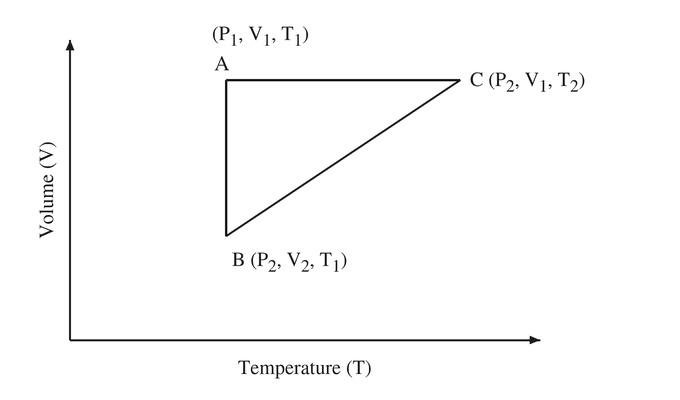
The correct option(s) is (are)
(a) and
(b) and
(c) and
(d) and
- 781 mark
Question 78
Given
(i) C(graphite) + ; kJ mol⁻¹
(ii) C(graphite) + ; kJ mol⁻¹
(iii) ; kJ mol⁻¹
Based on the above thermochemical equations, find out which one of the following algebraic relationship is correct?
- 791 mark
Question 79
The combination of plots which does not represent isothermal expansion of an ideal gas is:
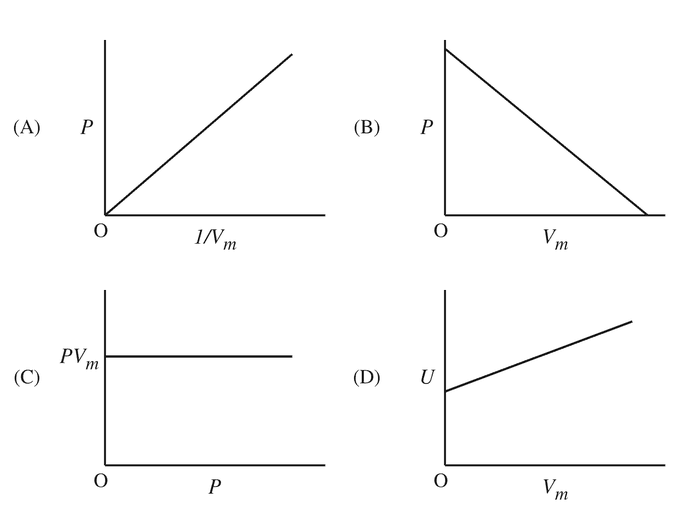
- 801 mark
Question 80
Which one of the following equations does not correctly represent the first law of thermodynamics for the given processes involving an ideal gas?
(Assume non-expansion work is zero)
- 811 mark
Question 81
For a diatomic ideal gas in a closed system, which of the following plots does not correctly describe the relation between various thermodynamic quantities?

- 821 mark
Question 82
The entropy change associated with the conversion of 1 kg of ice at 237 K to water vapours at 383 K is:
(specific heat of liquid water and water vapour are 4.2 kJ K⁻¹ kg⁻¹ and 2.0 kJ K⁻¹ kg⁻¹; heat of liquid fusion and vaporisation of water are 334 kJ kg⁻¹ and 2491 kJ kg⁻¹ respectively).
(log 273 = 2.436, log 373 = 2.572, log 383 = 2.583)
- 831 mark
Question 83
5 moles of an ideal gas at 100 K are allowed to undergo reversible compression till its temperature becomes 200 K. If J K⁻¹ mol⁻¹, calculate and for this process. ( J K⁻¹ mol⁻¹)
- 841 mark
Question 84
The difference between and , when the combustion of one mole of heptane is carried out at a temperature , is equal to:
- 851 mark
Question 85
An ideal gas undergoes isothermal compression from 5 m³ against a constant external pressure of 4 N m⁻². Heat released in this process is used to increase the temperature of 1 mole of Al. If molar heat capacity of Al is 24 J mol⁻¹ K⁻¹, the temperature of Al increases by:
- 861 mark
Question 86
A process has J mol⁻¹ and J K⁻¹ mol⁻¹. Out of the values given below, choose the minimum temperature above which the process will be spontaneous:
- 871 mark
Question 87
Among the following, the set of parameters that represents path function, is:
P.
Q.
R.
S.
- 881 mark
Question 88
An ideal gas is allowed to expand from 1 L to 10 L against a constant external pressure of 1 bar. The work done in kJ is:
- 891 mark
Question 89
Choose the reaction(s) from the following options, for which the standard enthalpy of reaction is equal to the standard enthalpy of formation.
(a)
(b)
(c)
(d)
- 901 mark
Question 90
The correct thermodynamic conditions for the spontaneous reaction at all temperature is
(a) and
(b) and
(c) and
(d) and
- 911 mark
Question 91
For a sample of perfect gas when its pressure is changed isothermally from to the entropy change is given by
- 921 mark
Question 92
If enthalpy of atomisation for is kJ/mol and bond enthalpy for is kJ/mol, the relation between them:
- 931 mark
Question 93
The true statement amongst the following is:
- 941 mark
Question 94
Lattice enthalpy and enthalpy of solution of NaCl are 788 kJ mol⁻¹ and 4 kJ mol⁻¹, respectively. The hydration enthalpy of NaCl is:
- 951 mark
Question 95
Five moles of an ideal gas at 1 bar and 298 K is expanded into vacuum to double the volume. The work done is:
- 961 mark
Question 96
The internal energy change (in J) when 90 g of water undergoes complete evaporation at 100°C is ________.
(Given: for water at 373 K = 41 kJ/mol, J K⁻¹ mol⁻¹)
- 971 mark
Question 97
The heat of combustion of ethanol into carbon dioxide and water is −327 kcal at constant pressure. The heat evolved (in cal) at constant volume at 27°C (if all gases behave ideally) is ( cal mol⁻¹ K⁻¹) ________.
- 981 mark
Question 98
For a dimerization reaction,
at 298 K, kJ mol⁻¹, J K⁻¹ mol⁻¹, then the will be ________ J.
- 991 mark
Question 99
The standard heat of formation of ethane (in kJ/mol), if the heat of combustion of ethane, hydrogen and graphite are −1560, −393.5 and −286 kJ/mol, respectively is ________.
- 1001 mark
Question 100
At constant volume, 4 mol of an ideal gas when heated from 300 K to 500 K changes its internal energy by 5000 J. The molar heat capacity at constant volume is ________.
- 1011 mark
Question 101
For the reaction;
kcal, cal K⁻¹ at 300 K. Hence in kcal is ________.
- 1021 mark
Question 102
In thermodynamics, the – work done is given by
For a system undergoing a particular process, the work done is,
This equation is applicable to a
(a) system that satisfies the van der Waals equation of state.
(b) process that is reversible and isothermal.
(c) process that is reversible and adiabatic.
(d) process that is irreversible and at constant pressure.
- 1031 mark
Question 103
During which of the following processes, does entropy decrease?
P. Freezing of water to ice at 0°C
Q. Freezing of water to ice at −10°C
R.
S. Adsorption of CO(g) on lead surface
T. Dissolution of NaCl in water
- 1041 mark
Question 104
An average person needs about 10000 kJ energy per day. The amount of glucose (molar mass = 180.0 g mol⁻¹) needed to meet this energy requirement is ________ g. (Nearest integer)
(Use: (glucose) = −2700 kJ mol⁻¹)
- 1051 mark
Question 105
For a given chemical reaction at 300 K, the free energy change is −49.4 kJ mol⁻¹ and the enthalpy of reaction is 51.4 kJ mol⁻¹. The entropy change of the reaction is ________ J K⁻¹ mol⁻¹. (Nearest integer)
- 1061 mark
Question 106
At 298 K, the enthalpy of a solid (X) is 2.8 kJ mol⁻¹ and the enthalpy of vaporisation of the liquid (X) is 98.2 kJ mol⁻¹. The enthalpy of sublimation of the substance (X) in kJ mol⁻¹ is ________ (in nearest integer)
- 1071 mark
Question 107
When 400 mL of 0.2 M solution is mixed with 600 mL of 0.1 M NaOH solution, the increase in temperature of the final solution is ________ K. (Round off to the nearest integer)
[Use: ; kJ mol⁻¹
Specific heat of = 4.18 J K⁻¹ g⁻¹
Density of = 1.0 g cm⁻³]
- 1081 mark
Question 108
For the reaction: , the value of the equilibrium constant at 300 K and 1 atm is equal to 100.0. The value of for the reaction at 300 K and 1 atm in J mol⁻¹ is , where is ________. (Rounded off to the nearest integer) ( J mol⁻¹ K⁻¹ and ln 10 = 2.3)
- 1091 mark
Question 109
Assuming ideal behaviour, the magnitude of log K for the following reaction at 25°C is . The value of is ________. (Integer answer)
[Given: J mol⁻¹;
J mol⁻¹; J K⁻¹ mol⁻¹]
- 1101 mark
Question 110
The ionization enthalpy of formation from Na(g) is 495.8 kJ mol⁻¹, while the electron gain enthalpy of Br is −325.0 kJ mol⁻¹. Given the lattice enthalpy of NaBr is −728.4 kJ mol⁻¹. The energy for the formation of NaBr ionic solid is (−) ________ kJ mol⁻¹.
- 1111 mark
Question 111
The reaction of cyanamide, with oxygen was run in a bomb calorimeter and was found to be −742.24 kJ mol⁻¹. The magnitude of for the reaction:
is ________ kJ. (Rounded off to the nearest integer) [Assume ideal gases and J mol⁻¹ K⁻¹]
- 1121 mark
Question 112
The average S–F bond energy in kJ mol⁻¹ of is ________. (Rounded off to the nearest integer)
[Given: The values of standard enthalpy of formation of , S(g) and F(g) are −1100, 275 and 80 kJ mol⁻¹ respectively.]
- 1131 mark
Question 113
The standard enthalpies of formation of and CaO are −1675 kJ mol⁻¹ and −635 kJ mol⁻¹ respectively.
For the reaction:
the standard reaction enthalpy = ________ kJ. (Rounded off to the nearest integer)
- 1141 mark
Question 114
Five moles of an ideal gas at 293 K is expanded isothermally from an initial pressure of 2.1 MPa to 1.3 MPa against a constant external pressure 4.3 MPa. The heat transferred in this process is ________ kJ mol⁻¹ (Rounded off to the nearest integer) Use J mol⁻¹ K⁻¹
- 1151 mark
Question 115
Which of the following is correct option for free expansion of an ideal gas under adiabatic condition?
- 1161 mark
Question 116
In which of the following reactions, standard reaction entropy change is positive and standard Gibbs's energy change decreases sharply with increasing temperature?
- 1171 mark
Question 117
The enthalpy of fusion of water is 1.435 kcal/mol. The molar entropy change for the melting of ice at 0°C is
- 1181 mark
Question 118
In the following reaction:
if is formed instead of in the reaction, the enthalpy change (in kJ) would be (enthalpy of sublimation of is +53 kJ mol⁻¹).
- 1191 mark
Question 119
For the reaction, ,
kcal, cal K⁻¹ at 300 K
Hence, is
- 1201 mark
Question 120
The entropy of vaporization of a liquid is 58 J K⁻¹ mol⁻¹. If 100 g of its vapour condenses at its boiling point of 123°C, the value of entropy change for the process is (molar mass of the liquid = 58 g mol⁻¹).
- 1211 mark
Question 121
The enthalpies of solution for copper sulphate pentahydrate and anhydrous copper sulphate are respectively 11.7 and −65.5 kJ mol⁻¹. The hydration enthalpy of anhydrous copper sulphate is
- 1221 mark
Question 122
Calculate the work done by 16 g of oxygen gas (assume ideal behaviour) of molar mass 32 g mol⁻¹ undergoing isothermal reversible expansion at 300 K from an initial volume of 2.5 L to the final volume of 25 L in litre atm.
( L atm K⁻¹ mol⁻¹)
- 1231 mark
Question 123
The heat of combustion of carbon to is −393.5 kJ/mol. The heat released for the formation of 35.2 g of from carbon and oxygen gas is:
- 1241 mark
Question 124
For a given reaction, kJ mol⁻¹ and J K⁻¹ mol⁻¹. The reaction is spontaneous at (assume that and do not vary with temperature).
- 1251 mark
Question 125
A gas is allowed to expand in a well insulated container against a constant external pressure of 2.5 atm from an initial volume of 2.50 L to a final volume of 4.50 L. The change in internal energy of the gas in joules will be
- 1261 mark
Question 126
A reaction has both and −ve. The rate of reaction
- 1271 mark
Question 127
Mixing of and form an ideal gas mixture at room temperature in a container. For this process, which of the following statements is true?
- 1281 mark
Question 128
The bond dissociation energies of , and XY are in the ratio of 1 : 0.5 : 1. for the formation of XY is −200 kJ mol⁻¹. The bond dissociation energy of will be
- 1291 mark
Question 129
Under isothermal conditions, a gas at 300 K expands from 0.1 L to 0.25 L against a constant external pressure of 2 bar. The work done by the gas is
[Given that 1 L bar = 100 J]
- 1301 mark
Question 130
In which case change in entropy is negative?
- 1311 mark
Question 131
The standard heat of formation of , and are −76.2, −394.8 and −285.82 kJ mol⁻¹ respectively. Heat of vaporization of water is 44 kJ mol⁻¹. Calculate the amount of heat evolved when 22.4 L of kept under normal conditions is oxidized into its gaseous products.
- 1321 mark
Question 132
The reaction in which is.
- 1331 mark
Question 133
A gas performs 0.320 kJ work on surroundings and absorbs 120 J of heat from the surroundings. Hence change in internal energy is
- 1341 mark
Question 134
The correct option for free expansion of an ideal gas under adiabatic condition is
- 1351 mark
Question 135
For the reaction, , the correct option is:
- 1361 mark
Question 136
Which one among the following is the correct option for right relationship between and for one mole of ideal gas?
- 1371 mark
Question 137
For irreversible expansion of an ideal gas under isothermal condition, the correct option is: