
Question 294 marksMedium
The Born–Haber cycle below, an application of Hess's law, shows the formation of potassium chloride from its elements in their standard states. All values are in kJ mol⁻¹. Take the lattice enthalpy to mean the enthalpy change when one mole of solid KCl forms from its gaseous ions.
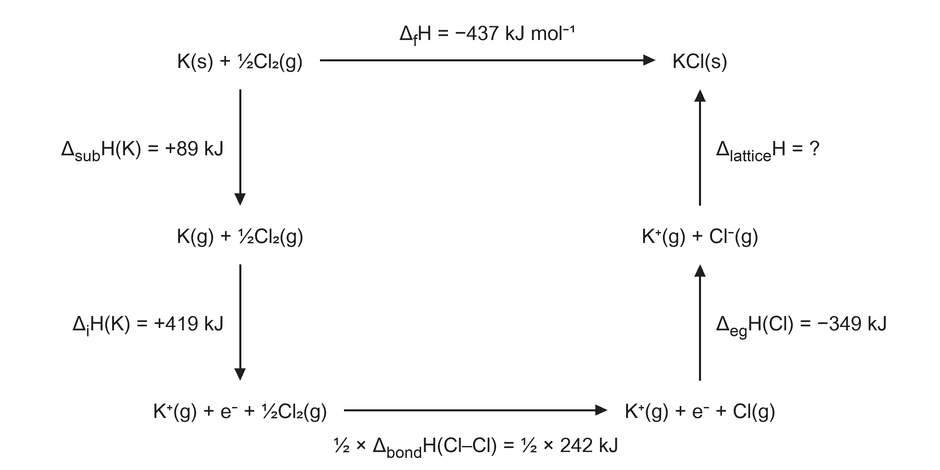
(a) Calculate the lattice enthalpy of KCl.
(b) Some tables quote lattice enthalpy for the reverse change, KCl(s) → K⁺(g) + Cl⁻(g). What value would such a table give?
(c) Which single step in the cycle releases enough energy to make the formation of KCl exothermic overall?